Open Book Online Assessments Predict 90 Day Results for Hiring Teams

Open book online assessments are timed, role-specific tests delivered remotely, where candidates may consult resources they’d realistically use on the job, like documentation, spreadsheets, or search tools. They work best when the role itself requires research, judgment, or tool use, and they fail badly for compliance, safety, or credentialing roles where the point is testing unaided recall. Some platforms offer tools that build these tests directly from a job description in minutes.
TL;DR:
- Open book assessments are most appropriate for roles that require use of research, documentation, or tools, and are less suitable for safety or compliance positions where recall matters.
- Delivery mode should depend on the job demands, with unproctored assessments favoring high-volume screening and proctored tests necessary for roles requiring strict validation.
- Designing valid assessments involves job analysis, using short role-specific tasks, writing rubrics before candidate submissions, and calibrating reviewer scores to ensure fairness and predictive accuracy.
- Anti-cheat measures like webcam monitoring and session replays should be transparent, consented to, and balanced with accessibility accommodations to prevent bias.
- Assessment scores should complement structured interviews and performance data, with regular follow-up to validate and improve the predictive power of the evaluation process.
Table of Contents
- What Open Book Online Assessments Mean for Hiring Teams
- Open Book vs. Proctored: How to Choose
- Building a Valid Open Book Assessment: Design Rules That Hold Up
- Anti-Cheat, Privacy, and Fairness in Remote Assessments
- Turning Assessment Scores Into Hiring Decisions
- Why Rubrics Matter More Than the Test Itself
- Get Started With Talent Approved’s Skill Assessments
- Sources
- FAQ
What Open Book Online Assessments Mean for Hiring Teams
Forget the classroom version of this term. In hiring, an open book online assessment is a scored, role-specific task where candidates use whatever resources they’d have on the actual job. There’s no test of memorized trivia here. The goal is capability, not recall.
Delivery comes in three flavors, each with real trade-offs:
- Open book, unproctored: Candidates work independently with full resource access. Fastest to deploy, lowest friction, best candidate experience.
- Remote proctored: Webcam and screen monitoring track the session. Better for roles where unaided performance matters.
- Hybrid: Open resources for research tasks, locked browser for specific segments. Common in technical screens where part of the task tests raw skill and part tests problem-solving.
Most well-designed assessments run 30 to 90 minutes, according to structuring guidance for remote-hire skills tests. Time-boxing matters for fairness as much as for logistics. A task with no clear time limit rewards candidates who spend excessive time on a task that should take considerably less time, which measures free time, not skill.
Open Book vs. Proctored: How to Choose
Delivery mode should follow directly from what the job actually demands, not from whatever setting your assessment tool defaults to.
- Pick open book when the task mirrors real work. If the job involves debugging with documentation open, writing with a style guide handy, or analyzing data with a calculator, testing candidates without those tools measures the wrong thing.
- Pick proctored or closed book for compliance and safety roles. Positions where a wrong unaided answer signals a real gap, clinical judgment, financial controls, safety-critical operations, need tighter controls. Large public-sector hiring systems reserve proctored assessments specifically for roles requiring strict validation and reliability.
- Factor in volume and candidate experience. Open book assessments scale more easily across high applicant volume because they need less setup, no proctoring infrastructure, and less candidate friction, which matters when you’re screening hundreds of applicants for a single opening.
The wrong call in either direction costs you. Proctoring a role that never needed it drives away strong candidates who see it as invasive. Skipping proctoring on a role where unaided skill matters gives you noisy, inflated scores.
Building a Valid Open Book Assessment: Design Rules That Hold Up
Every reliable assessment starts before you write a single question. Job analysis, mapping the actual tasks and outcomes the role demands, is the foundation, according to evidence-based hiring process guidance. Skip this step and you’re testing candidates on skills that don’t predict performance.
From there, four design rules separate assessments that actually work from ones that just look good:
- Use short, job-real work samples. A task that mirrors the candidate’s likely first 90 days beats a generic puzzle every time. Practical design guidance points to standardized samples scored on prewritten rubrics as the most predictive format.
- Time-box every task. Keep candidate time humane, generally 30 to 90 minutes, and never assign unpaid production work disguised as a “test.”
- Write your rubric before you see a single submission. Scoring criteria decided after reviewing candidates invites bias, even unintentional bias, toward whoever wrote the most impressive-sounding answer.
- Calibrate reviewers against each other. Two hiring managers scoring the same submission should land within a point or two, not three tiers apart.
Rubric language matters just as much as rubric structure. Guidance on observed behaviors recommends specific, observable criteria over vague labels. “Strong communicator” tells a reviewer nothing actionable. “Explains technical tradeoffs in plain language within two sentences” gives every reviewer the same yardstick. Tools like Talent Approved’s assessment templates help standardize this across role families so a rubric written for one opening doesn’t have to be rebuilt from scratch for the next.
Pro Tip: Pilot your rubric on two or three sample submissions before opening the assessment to real candidates. If your reviewers disagree on scores, the rubric needs work, not the candidates.
For a deeper look at choosing which skills to test, start from the outcomes the role needs to produce, then work backward to the task that reveals them.
Anti-Cheat, Privacy, and Fairness in Remote Assessments
Open book delivery still needs guardrails. The resources are allowed, but the identity of the person taking the test and the integrity of their work aren’t optional.
Common anti-cheat tools carry real privacy trade-offs candidates deserve to know about upfront:
- Browser lockdowns restrict tab switching during timed segments; disclose this before the session starts, not after.
- Webcam monitoring confirms the person taking the test matches the applicant; always requires clear consent language, not a buried checkbox.
- Session replay lets reviewers see how a candidate worked through a problem, valuable for catching outside help, but it should be limited to hiring-relevant review, not indefinite storage.
Accessibility can’t be an afterthought bolted onto anti-cheat design. Offer alternative formats, extended time as a standard accommodation option, and a request process that doesn’t require a candidate to explain a diagnosis in a form field. Skip the jargon. “Request an accommodation” beats a dropdown full of clinical terminology.
Every automated decision needs an exportable record: who took the test, when, what inputs the system flagged, and what a human reviewed before any high-stakes rejection. SHRM’s guidance on skills-based hiring is direct on this point: pairing skills assessments with blind evaluation expands the talent pool and reduces bias, but assessments alone don’t eliminate it. Human review remains the backstop.
The predictive payoff is real. Fast Company reports that 90% of employers using skills-based assessments saw a reduction in mis-hires, and 91% reported improved retention. That’s the return on doing the design work right.
Turning Assessment Scores Into Hiring Decisions
A score is one data point, not a verdict. Treat it that way and your hiring process gets both faster and more accurate.
- Combine assessment scores with structured interviews and reference checks. No single evidence stream should carry a hiring decision alone, according to guidance on using assessment results. Build a documented decision matrix that weights each input before anyone starts comparing candidates.
- Have reviewers score independently before group discussion. Anchoring bias creeps in fast once one reviewer states an opinion out loud.
- Run 30 and 90 day follow-ups. Compare assessment scores against actual on-the-job performance to validate your rubric, then revise it. This is where most hiring teams stop, and it’s the step that actually proves the assessment works.
- Automate triage, not judgment. AI-generated summaries and fast candidate evaluation workflows speed up review at volume, but the final call on borderline candidates should stay with a person.
Assessments run right after an initial resume and structured screen, not before, focus reviewer time on candidates who’ve already cleared a first bar, respecting everyone’s time in the process.
Why Rubrics Matter More Than the Test Itself
Most hiring teams obsess over the assessment question and barely glance at the rubric that scores it. That’s backwards. The question is just the delivery mechanism. The rubric is what makes the result defensible, comparable across candidates, and useful three months later when someone asks why a candidate got rejected.
I’d argue the biggest mistake in open book assessment design isn’t picking the wrong delivery mode, it’s skipping job analysis and writing a generic task because it’s faster. A generic coding puzzle or a canned writing prompt tells you almost nothing about how someone will perform in your specific role. Some solutions use AI to generate assessments tied to what the role actually requires rather than a stock template. Pairing that with AI-generated summaries and anti-cheat monitoring helps reviewers spend their time on judgment calls, not administrative cleanup.
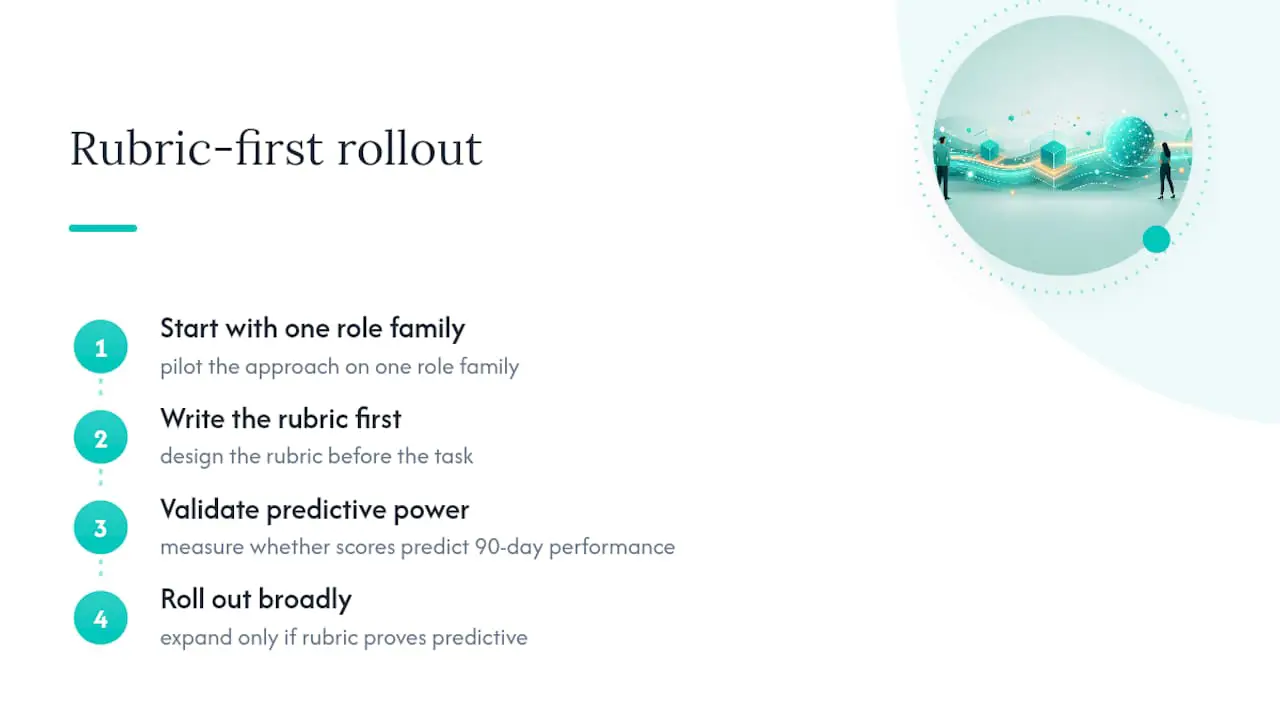
Start with one role family. Write the rubric first. Measure whether scores predict 90-day performance before you roll the approach out everywhere else.
— Jimmie
Get Started With Talent Approved’s Skill Assessments
There are platforms built for the workflow this article walks through: role-specific assessments, generated fast, scored consistently. Some tools can turn a job description into a tailored, time-boxed work sample in minutes, avoiding the need to reuse generic templates for every open role.
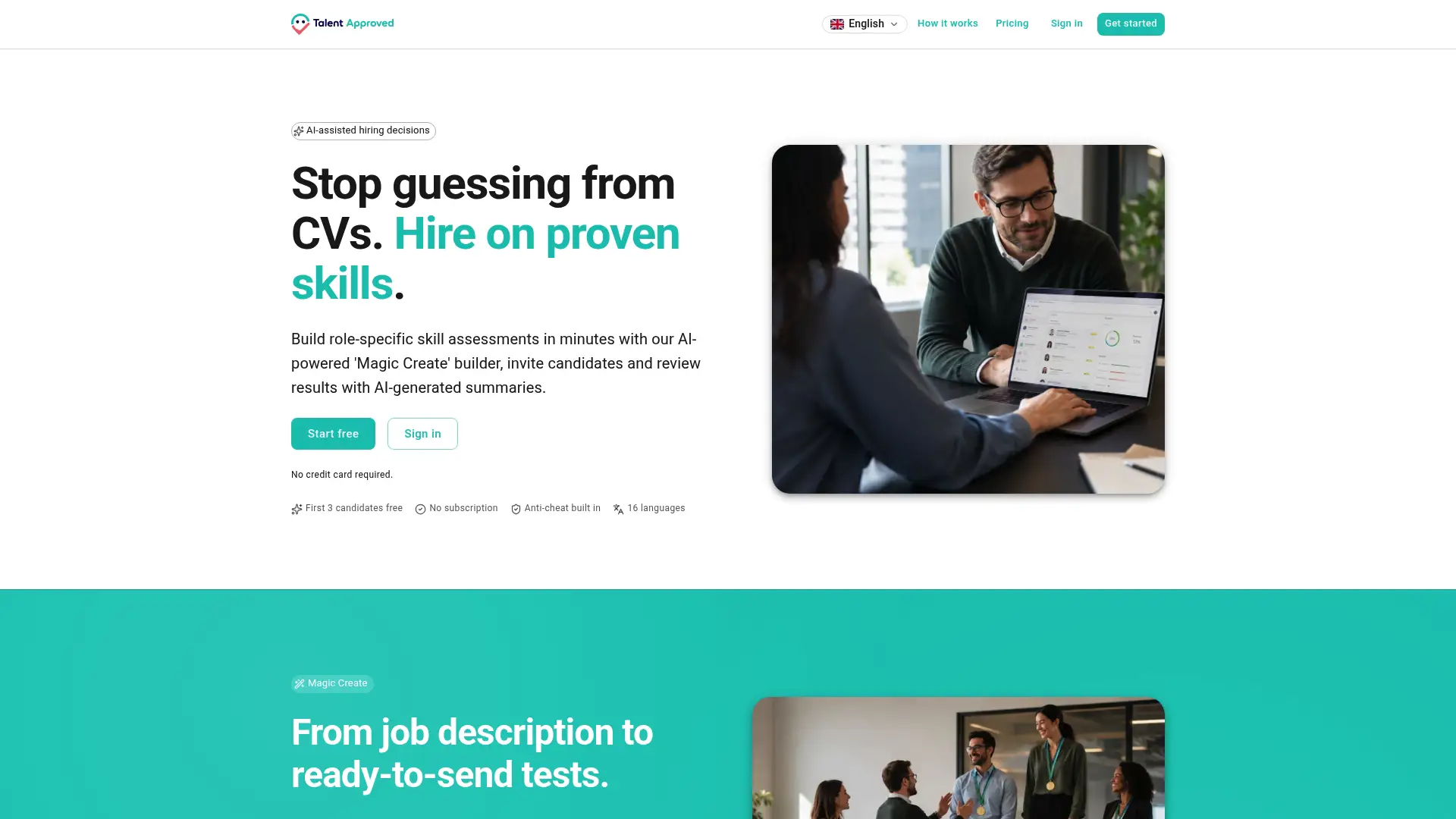
Anti-cheat monitoring and AI-generated candidate summaries handle the heavy lifting on review, letting your team focus on the judgment calls that actually need a human. Because pricing runs pay-as-you-go at $5 per completed candidate, there’s no subscription commitment sitting on your books between hiring cycles. If you want audit-ready validity records tied to every assessment your team runs, that’s built into the same $5 fee. Check the pricing page and run your first assessment on an open role today.
Sources
- Skills over degrees: the future of hiring and organizational growth — Fast Company
- Skills-based hiring: building stronger teams with blind evaluations — SHRM
- Hiring process: an evidence-based guide — ScientificHiring
- How to structure a skills assessment for remote hires — Claude Library
FAQ
What Is an Open Book Online Assessment in Hiring?
It’s a timed, role-specific test delivered remotely where candidates may use resources like documentation or research tools, mirroring how they’d actually perform the job. It measures applied skill rather than memorized knowledge.
How Long Should a Candidate Assessment Take?
Most well-designed assessments run 30 to 90 minutes. Longer tasks risk unpaid labor concerns and lower completion rates without improving predictive accuracy.
When Should I Use Proctored Instead of Open Book Testing?
Choose proctored delivery for compliance, safety, or credentialing roles where unaided performance is the actual skill being measured. Open book works better when the job itself involves research, documentation, or tool use.
Does Open Book Testing Increase Cheating Risk?
It shifts the risk rather than eliminating it, which is why webcam monitoring, session replay, and browser lockdowns exist as optional layers. Clear consent and disclosure before the session matter as much as the tools themselves.
How Much Does Talent Approved Cost per Assessment?
Talent Approved charges $5 per completed candidate assessment with no subscription required. You only pay when a candidate finishes the test.