
HR Teams: Make Skills Test Validity Audit-Ready, $5 per Assessment

Skills test validity means a test measures what it claims to measure, and its scores actually predict how someone performs on the job. The immediate first step is a job analysis, either your own or one documented in a vendor’s technical manual, showing the test content matches real job tasks. That evidence is also the legal baseline recruiters need under the EEOC Uniform Guidelines.
TL;DR:
- Validity claims must be supported by a detailed job analysis, sample size data, and evidence linking scores to actual job performance to be trustworthy.
- Consistent test administration with standardized conditions and documentation of accommodations are crucial to avoid bias claims and ensure fairness.
- Reliability alone does not ensure validity, but without reliability, validity cannot be established; a test must produce stable results to predict performance accurately.
- CPsychometric details like internal consistency and predictive validity coefficients should be available in full, transparent testing manuals for the assessment to pass legal and operational scrutiny.
- Automated, role-specific assessments with built-in monitoring and documentation, such as Talent Approved’s platform, streamline validity enforcement and reduce legal risks at scale.
Table of Contents
- Skills Test Validity: Key Terms Every Recruiter Should Know
- How to Establish Skills Test Validity Step by Step
- Keeping Test Administration Fair and Bias-Free
- What the Numbers Actually Mean
- How Talent Approved Supports Skills Test Validity
- The Part of Skills Test Validity Everyone Skips
- Put Skills Test Validity to Work
- Where to Go for Deeper Validation Guidance
- Sources
- FAQ
Skills Test Validity: Key Terms Every Recruiter Should Know
Validity isn’t one thing. It splits into four categories, and knowing which one a vendor is claiming (and which one you actually need) changes how you evaluate a test.
- Face validity is how the test looks to a candidate or hiring manager. A typing test that looks like typing has face validity, but looks can be deceiving on their own.
- Content validity checks whether test items actually sample the tasks the job requires. A coding assessment built from real tickets pulled from your engineering backlog has strong content validity.
- Construct validity asks whether the test measures the underlying trait it claims to, like problem-solving or attention to detail, rather than something else entirely.
- Predictive validity measures whether test scores correlate with future job performance, which is the strongest and most defensible form of evidence for hiring decisions.
None of that matters without reliability, meaning a candidate would score similarly if retested, and different raters would score the same response the same way. A test can be reliable without being valid, like a scale that consistently reads five pounds heavy. It’s precise, just wrong for the purpose. But a test cannot be valid without being reliable. Inconsistent scoring makes any claim about predicting job performance impossible to trust.
When a vendor hands you a validity claim, check it against this short list: Does it name the job analysis method used? Does it report a sample size? Does it show a correlation between scores and actual performance, not just a description of the test’s design?
How to Establish Skills Test Validity Step by Step
Building defensible evidence follows a sequence, and skipping steps is the most common reason validity claims fall apart under scrutiny.
- Run a job analysis with subject matter experts. Interview people currently doing the job, or reviewing their work, and build a table of specs that links each test item to a specific task or competency. This becomes your evidence that content validity exists before a single question is written.
- Design items and scoring rubrics together. Write scoring rules before you pilot the test, not after, and use blind grading where a rater doesn’t know which candidate produced which response. This step protects construct validity and reduces rater bias at the same time.
- Pilot the test on a representative sample. Run it with current employees or a realistic candidate pool, then compute item-level statistics and an internal consistency measure such as Cronbach’s alpha. Drop or rewrite items that perform poorly.
- Collect criterion-related evidence. Compare pilot scores against an actual performance measure, supervisor ratings, output quality, tenure, whatever reflects success in the role, and report the correlation. This is what turns a well-designed test into one with predictive validity.
- Package it into a technical manual. Document the job analysis, item statistics, reliability coefficients, and criterion correlations in one place so it can survive an audit or a legal challenge.
Pro Tip: Ask any vendor for the technical manual before you sign a contract, not after. If they can’t produce sample sizes, SME methodology, and statistical tables on request, treat that as a red flag rather than an oversight.
Peer-reviewed work on cognitive skills testing shows the kind of statistical detail a serious validation study includes: coefficient alpha, test-retest correlations, and concurrent validity figures reported against named criteria, not vague claims of accuracy. That’s the level of documentation worth expecting from any assessment you’re paying for.
Keeping Test Administration Fair and Bias-Free
Psychometric soundness on paper means little if the test is administered inconsistently. Operational controls are what keep scores comparable across candidates, and comparable scores are what keep you out of legal trouble.
- Standardize test conditions: same time limits, same instructions, same environment expectations for every candidate, logged automatically where possible.
- Document accommodation procedures in advance, consistent with EEOC guidance on assistive technology and reasonable adjustments, so requests are handled the same way every time.
- Use secure session monitoring to confirm candidates are working under comparable conditions, which also protects the integrity of your pilot data down the road.
- Run an adverse-impact check across demographic groups after each hiring cycle and have a remediation plan ready if a gap shows up.
- Set a revalidation trigger, not just a calendar reminder, tied to major changes in the role, the tools used, or the labor market you’re hiring from.
Inconsistent proctoring and uneven accommodations are among the most common sources of bias claims HR teams face, more common than flawed test content itself. A platform that enforces standardization and logs deviations automatically removes a large share of that risk before it ever becomes a complaint.
What the Numbers Actually Mean
A validity claim without numbers is a marketing claim. Here’s what the numbers should look like and how to read them without a statistics degree.
Cronbach’s alpha measures internal consistency, and for selection tests you generally want to see something in the 0.70 to 0.90 range. Lower than that and the test is likely measuring more than one thing, or measuring nothing consistently. Item difficulty and discrimination statistics tell you whether a question is too easy, too hard, or fails to separate strong candidates from weak ones. Items with poor discrimination should get rewritten or cut during the pilot stage rather than left in a live test.
Predictive validity coefficients are typically the softest numbers to interpret, since even a modest correlation between test scores and job performance can be practically useful at hiring scale. A correlation in the 0.20 to 0.35 range is often considered a solid signal in employment testing, while anything past 0.35 is unusually strong for most job-skill assessments.
| Metric | What it tells you | Rough interpretation |
|---|---|---|
| Cronbach’s alpha | Internal consistency of test items | 0.70 to 0.90 is typical for selection tests |
| Item discrimination | Whether an item separates strong from weak performers | Low or negative values signal a item to revise |
| Predictive validity coefficient | Correlation between scores and job performance | 0.20 to 0.35 is a solid signal in most hiring contexts |
A technical manual worth trusting includes sample size, the SME process used to build content, and full statistical tables, not summary language. When you build a hiring-score report internally, present the raw score alongside the benchmark it’s compared against, so a hiring manager understands what “72 out of 100” actually means for that role.
How Talent Approved Supports Skills Test Validity
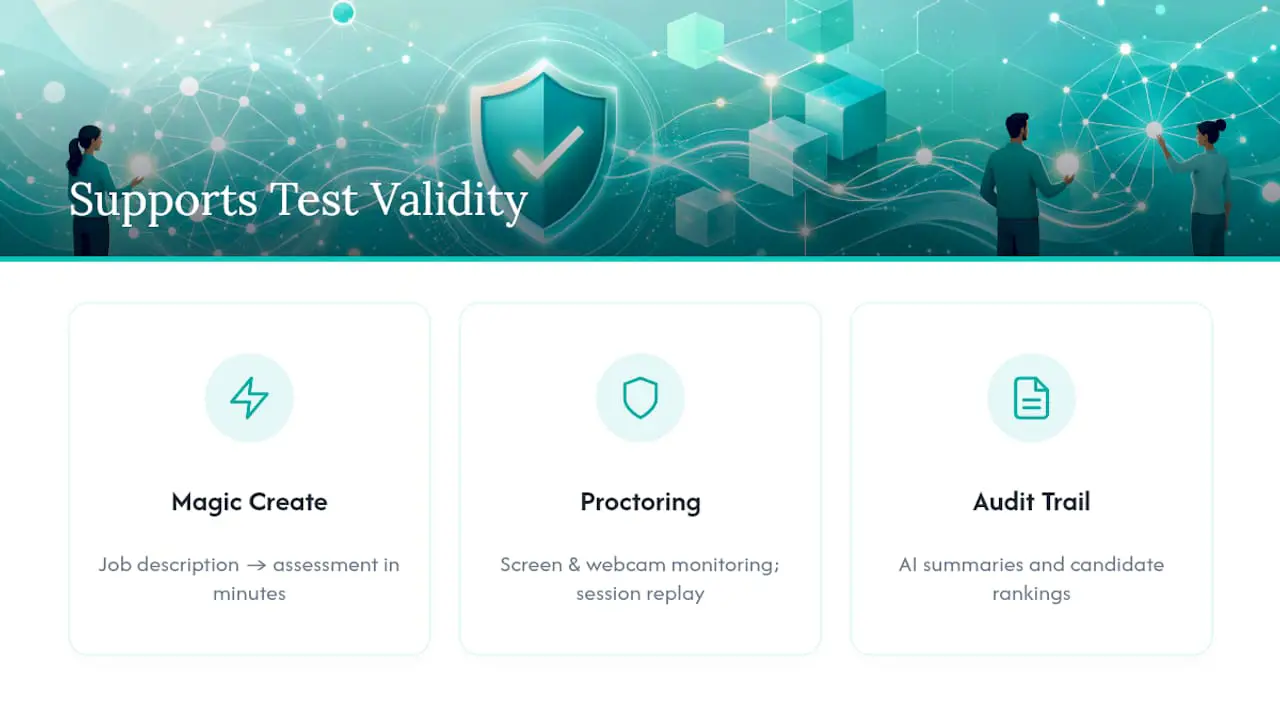
Building this evidence by hand takes weeks. Talent Approved’s Magic Create feature turns a job description or a skills list into a structured, role-specific assessment in minutes, mapping test content directly to the tasks that matter, which is the content validity groundwork explained in our AI Skill Assessment guide most teams skip. Built-in anti-cheat tools, screen and webcam monitoring, and session replay standardize administration automatically, addressing the exact implementation gaps that generate adverse-impact complaints. AI-generated summaries and candidate rankings give you the documentation trail auditors and legal teams ask for. For more on structuring role-specific content, see how role-specific tests get built.
The Part of Skills Test Validity Everyone Skips
Most advice on skills test validity stops at definitions. Recruiters learn the difference between content and predictive validity, nod along, and then go back to using whatever assessment their applicant tracking system bundled in. That’s the gap: validity theory is treated as academic, while the operational side, how a test gets administered, monitored, and revalidated, gets almost no attention despite being where most legal exposure actually lives.
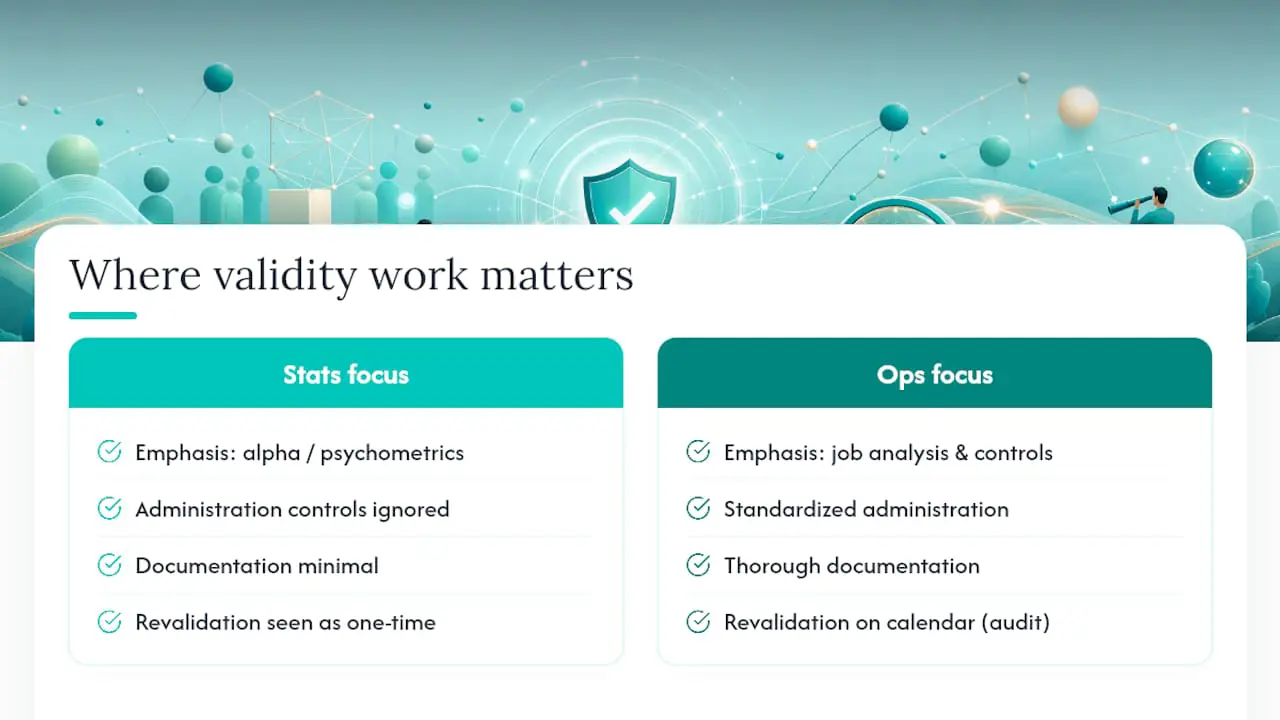
Here’s what the research actually supports: a psychometrically perfect test administered inconsistently is not a defensible test. Standardization and documentation matter as much as the statistics behind the questions. If a hiring team has to choose where to spend limited time, spend it first on job analysis and administration controls, not on chasing a marginally higher alpha coefficient.
The other overrated idea is that validity is a one-time achievement. Roles change, labor markets shift, and a test validated three years ago on a different candidate pool can quietly stop measuring what it once did. Build revalidation into your calendar the same way you’d schedule a compliance audit, because that’s effectively what it is.
— Jimmie
Put Skills Test Validity to Work
Talent Approved is built for the exact workflow this article walks through: job analysis, piloting, standardized administration, and evidence capture, without the weeks of manual setup most validation work demands.
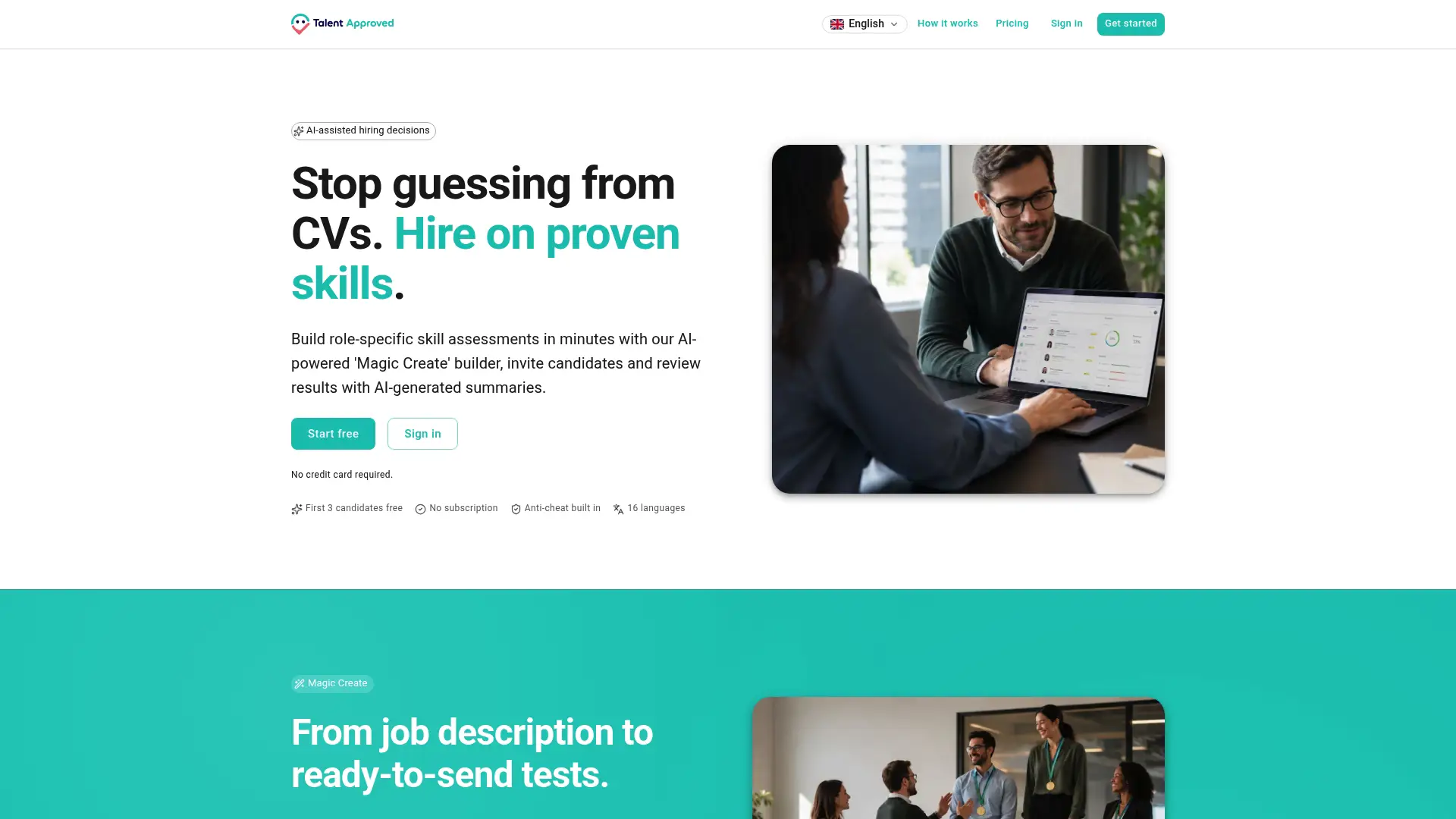
Instead of stitching together spreadsheets, SME interviews, and a separate proctoring tool, Talent Approved’s Magic Create generates a role-specific test from a job description in minutes, then locks in standardized, monitored administration for every candidate who takes it. There’s no subscription commitment. You pay $5 per completed candidate assessment, which means the cost scales with your actual hiring volume instead of sitting on your books as a fixed line item. Visit the Talent Approved platform to see a live demo and check the documentation your legal or compliance team will want on file before your next hiring round.
Where to Go for Deeper Validation Guidance
- The American Psychological Association’s testing resources explain why validity is tied to a specific use, not a general property of a test.
- ACT’s WorkKeys technical documentation shows what a complete vendor manual looks like in practice.
Ask any vendor for sample sizes, SME methodology, and statistical tables before trusting a validity claim at face value.
Sources
- ACT Research: Validity evidence for WorkKeys (2026)
- Peer-reviewed validation study: Gibson Test of Cognitive Skills
FAQ
What is skills test validity in simple terms?
It’s evidence that a test’s scores actually predict or reflect the job skills it claims to measure, typically shown through content, construct, or predictive validity studies under EEOC guidelines.
How is test reliability different from validity?
Reliability means a test produces consistent scores across administrations and raters, while validity means those scores actually measure the right thing for the intended hiring decision.
What should I ask a testing vendor for?
Request their technical manual, including job analysis methodology, sample sizes, item statistics, and predictive validity correlations, before signing a contract.
How often should a skills test be revalidated?
Revalidate whenever the role, required skills, or labor market shifts significantly, and set a recurring review even without a major change to catch validity drift early.
Can an AI-generated assessment be legally defensible?
Yes, provided the platform documents job analysis, standardizes administration, and monitors for cheating; Talent Approved’s Magic Create and session replay features are built to capture that evidence automatically.