How Workforce Skills Audits Work: An HR Leader's Guide

A workforce skills audit maps the capabilities your organization needs against the capabilities your people actually have, producing three immediate outputs you can act on:
- A skills inventory listing every assessed employee, skill, and proficiency level
- A gap heat map showing where confirmed shortfalls cluster by role, team, or function
- A prioritized action plan assigning development, hiring, or redeployment decisions to specific owners
According to AIHR, 87% of organizations report that they have or expect to have a skills gap in the coming years. The guide below walks through the full operational process, from scoping your first pilot to turning results into measurable business outcomes.
Table of Contents
- Why organizations run skills audits
- How to perform a skills audit, step by step
- The core components every audit must produce
- Organizational audits versus individual audits
- Turning audit results into development, hiring, and succession plans
- How assessment platforms support the audit process
- Key Takeaways
- The audit mistake most HR teams make twice
- Talent Approved makes skills audits faster and more credible
- Useful sources
- FAQ
Why organizations run skills audits
The business case is direct. A skills audit tells you where to spend your learning and development budget, which open roles you can fill internally, and which external hires are genuinely necessary. Without it, training programs get designed around assumptions rather than evidence, and hiring managers write job descriptions that duplicate skills already sitting in another department.
Primary benefits include:
- Targeted L&D spend: Training dollars go to confirmed gaps, not guessed ones. A skills inventory aligned to strategic objectives can reduce training costs by focusing interventions where gaps are real.
- Internal mobility: — Knowing who has adjacent skills makes it possible to redeploy people before posting an external job.
The World Economic Forum’s Future of Jobs Report 2025 frames the macro urgency: skill demand is changing faster than most organizations can track informally, making regular skills mapping a prerequisite for workforce resilience.
A skills audit is the right tool when you need evidence-based decisions about development, staffing, or hiring. It is not the right tool when the real problem is a process failure, a management issue, or a compensation gap. Auditing skills when the root cause is something else produces data that does not solve the actual problem.
How to perform a skills audit, step by step
The process runs in eight stages. Each stage has a clear deliverable so you know when to move forward.
-
Scope the audit. Define which roles, departments, or functions you are auditing and why. Identify the business decision the audit will inform. Set a clear boundary: auditing everything at once is the most common failure mode, and Training Industry’s practitioner guidance consistently recommends starting with a focused pilot in a high-impact area before scaling.
-
Define required skills and standards. For each role in scope, list the skills required and the proficiency level needed. Use your competency framework as the standard. If no framework exists, build a short one from your top performers’ profiles rather than relying solely on industry medians.
-
Design the assessment template. Create the skills matrix structure, choose your evidence sources (see Section 5), and write the survey or test instruments. Decide how you will weight each source.
-
Run a pilot. Select one team or department. Run the full process, collect feedback from assessors and employees, and fix calibration problems before the full rollout.
-
Collect assessments at scale. Distribute self-assessments, manager ratings, and objective tests. Set a clear deadline and a communication plan explaining why the audit is happening and how results will be used.
-
Compile the skills inventory. Aggregate all evidence into a single record per employee per skill. Flag unassessed items explicitly rather than leaving them blank.
-
Analyze gaps and produce the heat map. Compare assessed levels to required levels. Identify confirmed gaps, confirmed strengths, and unassessed areas. Cluster findings by role, team, and function.
-
Build the action plan and set reassessment dates. Assign each gap a development action, an owner, and a deadline. Schedule the next reassessment cycle before you close the current one.
Sample timeline
| Stage | Suggested duration | Notes |
|---|---|---|
| Scoping and design | 2–3 weeks | Longer if no competency framework exists |
| Pilot (one department) | 3–4 weeks | Includes feedback and calibration fixes |
| Full rollout (collection) | 3–4 weeks | Allow time for follow-up on non-responses |
| Compilation and analysis | 1–2 weeks | Faster with platform automation |
| Action plan and sign-off | 1–2 weeks | Requires leadership review |
| Total (first run) | 10–15 weeks | Repeat cycles run faster |
Roles and responsibilities
| Role | Responsibilities |
|---|---|
| Project owner (HR lead or CHRO) | Scope, budget, stakeholder alignment, final sign-off |
| HR business partners | Communication, manager briefings, data quality checks |
| Line managers | Complete manager ratings, validate self-assessments, own development actions |
| Employees | Complete self-assessments honestly and on time |
| L&D team | Map gaps to existing programs, identify new program needs |
| Data analyst / HRIS team | Aggregate data, build heat maps, maintain the inventory |
| Assessors (if using structured tests) | Administer and score objective assessments |
Validating self-assessed data
Self-assessments are fast to collect but prone to inflation or deflation. Validate them by triangulating with manager ratings, spot-testing a sample of employees with objective tests, reviewing performance records for behavioral evidence, and requiring employees to link a specific piece of evidence to any rating above “developing.” Michael Page’s skills audit guidance recommends using multiple evidence sources and weighting them appropriately to reduce bias. Where ratings diverge significantly between self and manager, treat the skill as unassessed until a third source resolves the discrepancy.
The core components every audit must produce
Skills matrix structure
Every row in your skills matrix should carry these fields:
| Field | Purpose |
|---|---|
| Employee name / ID | Identifies the individual |
| Role | Anchors the required-level standard |
| Skill | Specific, defined capability |
| Required proficiency level | The standard for this role |
| Assessed proficiency level | The evidence-backed rating |
| Evidence source(s) | What supports the rating |
| Evidence status | Confirmed, self-reported, or unassessed |
| Development action | What happens next |
| Assessor | Who rated it |
| Assessment date | When it was rated |
| Reassessment date | When it will be reviewed |
SkillProof’s audit guide notes that a competency model and a skills matrix are complementary records: the competency model defines the standard; the matrix maps current staff against it. Collapsing both into a single unexplained score loses the traceability that makes audits defensible.
Comparing assessment methods
| Method | Strengths | Limitations | Best used for |
|---|---|---|---|
| Self-assessment | Fast, scalable, surfaces employee perspective | Inflation/deflation bias; no external validation | Baseline data; development conversations |
| Manager rating | Contextual, behavioral evidence | Halo/horn effect; inconsistent standards across managers | Behavioral and soft skills |
| Objective test | Verifiable, bias-resistant | Takes time to build; not suitable for all skill types | Technical and knowledge-based skills |
| 360 feedback | Multi-perspective; good for leadership skills | Resource-intensive; requires psychological safety | Senior roles; leadership competencies |
| Observation / work sample | Direct evidence of performance | Hard to scale; observer effect | Hands-on technical roles; compliance-critical skills |
For soft skills assessment, a combination of structured behavioral questions, manager ratings, and 360 feedback produces more reliable evidence than any single method alone.
Organizational audits versus individual audits
The choice of scope shapes everything: the data you collect, the time you spend, and the decisions the audit can support.
| Dimension | Organizational audit | Individual audit |
|---|---|---|
| Primary goal | Identify collective gaps and strengths across roles or functions | Understand one person’s development needs and readiness |
| Scope | Department, function, or enterprise-wide | Single employee |
| Data depth | Breadth over depth; standardized fields | Deep evidence; narrative and behavioral detail |
| Primary output | Heat map, aggregate gap analysis, workforce plan | Personal development plan, promotion readiness assessment |
| Typical trigger | Reorganization, digital transformation, succession cycle | Performance review, promotion decision, role change |
| Time investment | Weeks to months depending on scale | Hours to days |
| Decision it feeds | Hiring plans, L&D budget, workforce strategy | Individual development, coaching, career pathing |
Choosing the right scope
For a reorganization or digital transformation, an organizational audit across the affected functions gives you the data to redeploy people, identify retraining needs, and write precise hiring briefs for genuine gaps. For succession planning, a targeted individual audit on your identified successors tells you exactly what each person needs to be ready. For rapid growth, a sampled organizational audit covering your highest-volume roles lets you build a scalable hiring and onboarding profile without auditing every employee.
Sampling strategy matters. A 20–30% random sample within a role family, combined with a full audit of critical or scarce roles, usually gives enough statistical confidence to make workforce-level decisions without the cost of a full census. Run the pilot in the department where a skills mismatch creates the most measurable cost or risk, prove ROI, and then scale.
Data governance checklist
- Assign a named data owner for the skills inventory
- Define role-based access: who can view, edit, and export
- Set a data retention period and a deletion schedule
- Establish a refresh cadence (annual minimum; semi-annual for fast-changing roles)
- Document employee consent and the communication given at collection
- Log every change to a record with a timestamp and the editor’s name
Turning audit results into development, hiring, and succession plans
The inventory is only as valuable as the decisions it drives. Here is how each output connects to a business action.
Targeted L&D: Map confirmed gaps to existing programs first. Where no program covers a gap, that is a build-or-buy decision for L&D. Track training completion against demonstrated proficiency, not just attendance, to measure whether the intervention actually closed the gap.
Internal mobility: A searchable skills inventory lets you match open roles to employees with adjacent or transferable skills before posting externally. This shortens time-to-fill and improves retention. For guidance on building a skills-based hiring process that uses audit outputs as the foundation for selection criteria, the methodology translates directly from internal mobility to external hiring.
Project staffing: Pull the skills inventory when assembling a project team. Assign roles based on confirmed proficiency, not seniority or availability, and flag any skill gaps the project needs that the current team cannot cover.
Hiring specifications: Confirmed gaps that cannot be closed through training or redeployment become external hiring requirements. Audit data produces tighter job briefs because you know the exact proficiency level needed and can write assessment criteria against it.
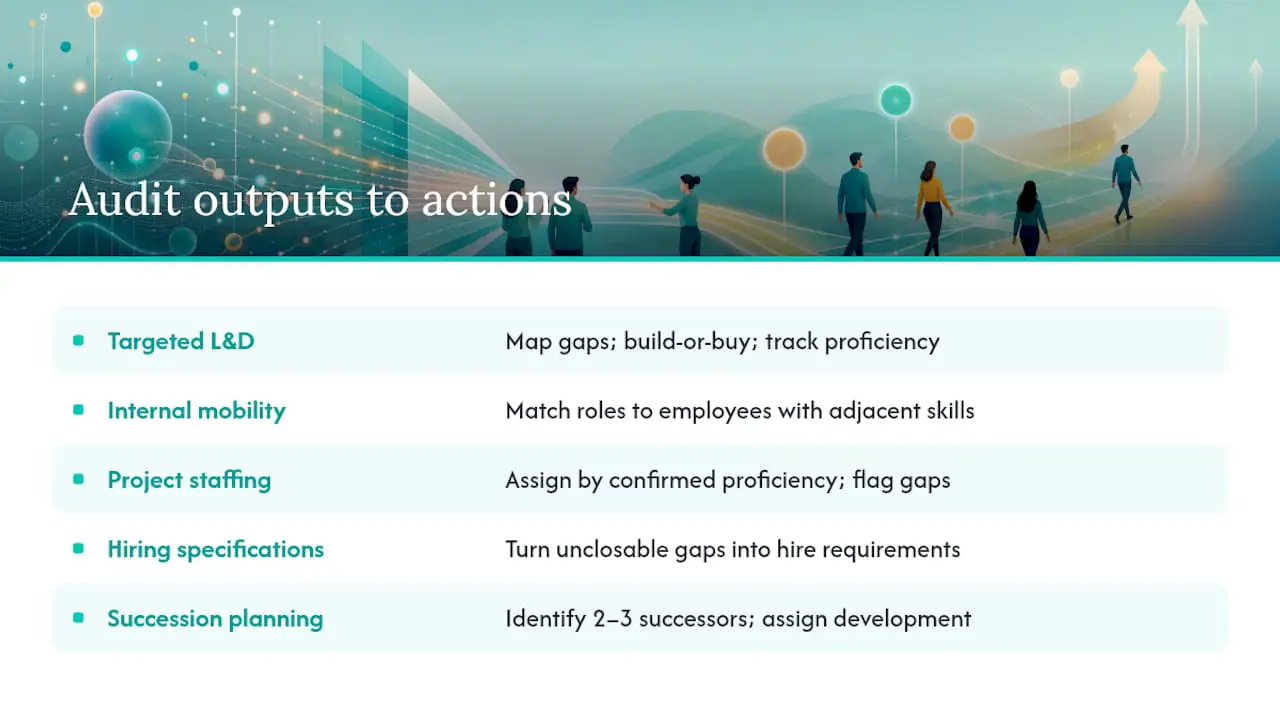
Succession planning: For each critical role, identify the two or three employees closest to readiness, document the specific gaps between their current profile and the role’s requirements, and assign targeted development actions with a timeline.
Post-audit KPIs to track
- Time-to-fill for critical roles (before and after audit-informed hiring)
- Percentage of promotions filled internally
- Training completion rate versus demonstrated proficiency improvement
- Gap closure rate per skill per quarter
- Percentage of the workforce with a current, evidence-backed skills record
Use an impact-versus-effort matrix to prioritize which gaps to close first. High-impact, low-effort gaps (a short online course closes a widespread technical gap) go first. High-impact, high-effort gaps (a leadership competency that requires 12 months of coaching) need a longer timeline and dedicated budget. Review the action plan quarterly and update the inventory as evidence accumulates.
How assessment platforms support the audit process
A purpose-built assessment platform does not replace the audit process, but it removes the manual bottlenecks that make audits slow and inconsistent. When evaluating platforms, look for these capabilities:
- Test generation from job descriptions or skill lists: Cuts template creation from days to minutes
- Reusable question libraries: Lets you standardize assessments across roles and reuse validated items
- Proctoring and anti-cheat tools: Screen recording, webcam monitoring, and session replays protect the integrity of objective test scores
- Automated scoring and candidate ranking: Removes manual grading and produces consistent, comparable results
- Evidence storage: Links test scores, certifications, and other evidence directly to the skills record
- Reporting and dashboards: Aggregates results into gap heat maps without manual spreadsheet work
- HRIS and LMS integrations: Keeps the skills inventory current without duplicate data entry
- Role-based access controls: Limits who can view sensitive assessment data
Vendor due-diligence checklist:
- Data privacy and security certifications (SOC 2, ISO 27001, or equivalent)
- Role-based access with audit trails
- Data retention and export options
- Compliance with applicable U.S. state privacy laws (California Consumer Privacy Act and similar)
Pro Tip: Pilot the platform with one team before enterprise rollout. Train managers on how to interpret scores before they see results, not after. Platforms that produce data managers cannot interpret create confusion rather than clarity.
Talent Approved maps directly to the audit workflow. Its AI test generator builds role-specific assessments from a job description in minutes, so you can create standardized tests for each role in your pilot without a dedicated test-design team. Anti-cheat screen recording and proctoring protects the integrity of objective scores, which is the evidence layer that validates self-assessments. Automated scoring and AI-generated performance summaries let HR teams review results at scale without reading every response individually. The pay-as-you-go model ($5 per completed assessment) means you can run a department-level pilot without a long-term platform commitment, then scale to the full organization once the process is proven.
For guidance on choosing the right skills to test for each role in your audit, Talent Approved’s resource library covers the selection methodology in detail.
Key Takeaways
A workforce skills audit produces a defensible, evidence-backed inventory only when it combines multiple assessment methods, starts with a scoped pilot, and connects every gap to a named action with an owner and a deadline.
| Point | Details |
|---|---|
| Start with a pilot | Audit one high-impact area first; scale only after the pilot proves ROI and fixes calibration issues. |
| Use mixed evidence sources | Combine self-assessments, manager ratings, and objective tests to reduce bias and validate ratings. |
| Record evidence status | Distinguish confirmed, self-reported, and unassessed skills so decisions rest on verified data. |
| Connect gaps to actions | Every confirmed gap needs a development action, an owner, and a reassessment date before the audit closes. |
| Talent Approved for objective testing | Talent Approved’s AI test generator and anti-cheat proctoring add verifiable evidence to the audit at a per-assessment cost, with no subscription required. |
The audit mistake most HR teams make twice
The most predictable failure in workforce skills audits is not a methodology problem. It is a scope problem dressed up as an ambition problem. HR teams launch with the goal of auditing every skill across every role in the organization, spend three months collecting incomplete data, and end up with a spreadsheet no one trusts and an action plan no one owns.
The fix is not a better template. It is a smaller starting question. Pick the one area where a skills mismatch is costing the business something measurable: a team that keeps missing project deadlines because of a specific technical gap, a function where every promotion goes external because no one knows who is ready internally, a compliance-critical role where certification currency is genuinely unknown. Audit that. Prove that the data changes a decision. Then scale.
The second mistake is treating the audit as a project with an end date rather than a process with a cadence. Skills data has a shelf life. A proficiency rating from 18 months ago in a role affected by new technology is not evidence; it is a guess. The organizations that get lasting value from skills audits build the reassessment cycle into their HR calendar before the first audit closes, not as an afterthought when the data goes stale.
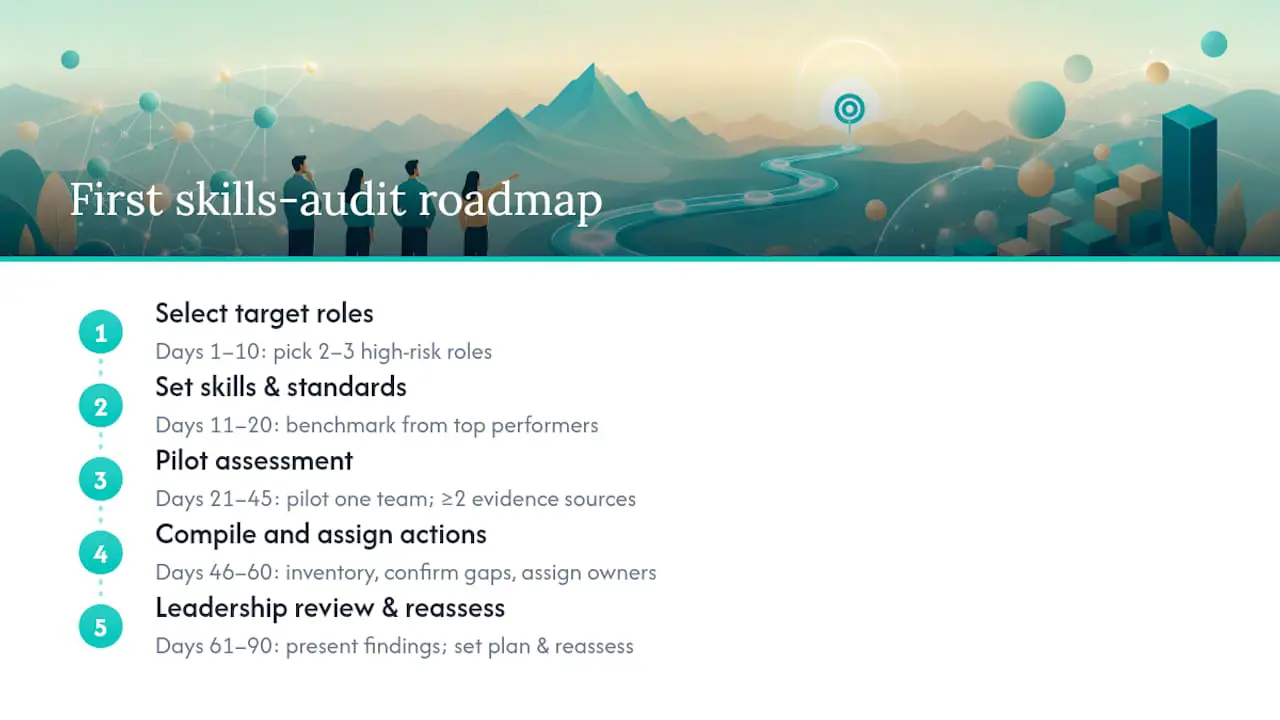
One practical implementation checklist for your first 30–90 days: identify the two or three roles where a skills gap creates the most measurable risk or cost (days 1–10); define required skills and proficiency standards for those roles using your top performers as the benchmark (days 11–20); design and pilot the assessment with one team, using at least two evidence sources (days 21–45); compile the inventory, identify confirmed gaps, and assign actions with owners (days 46–60); present findings to leadership with a proposed action plan and a reassessment date (days 61–90).
Talent Approved makes skills audits faster and more credible
Running a skills audit manually means weeks of spreadsheet work, inconsistent scoring, and self-assessment data you cannot fully trust. Talent Approved gives HR teams a faster path to verifiable evidence.
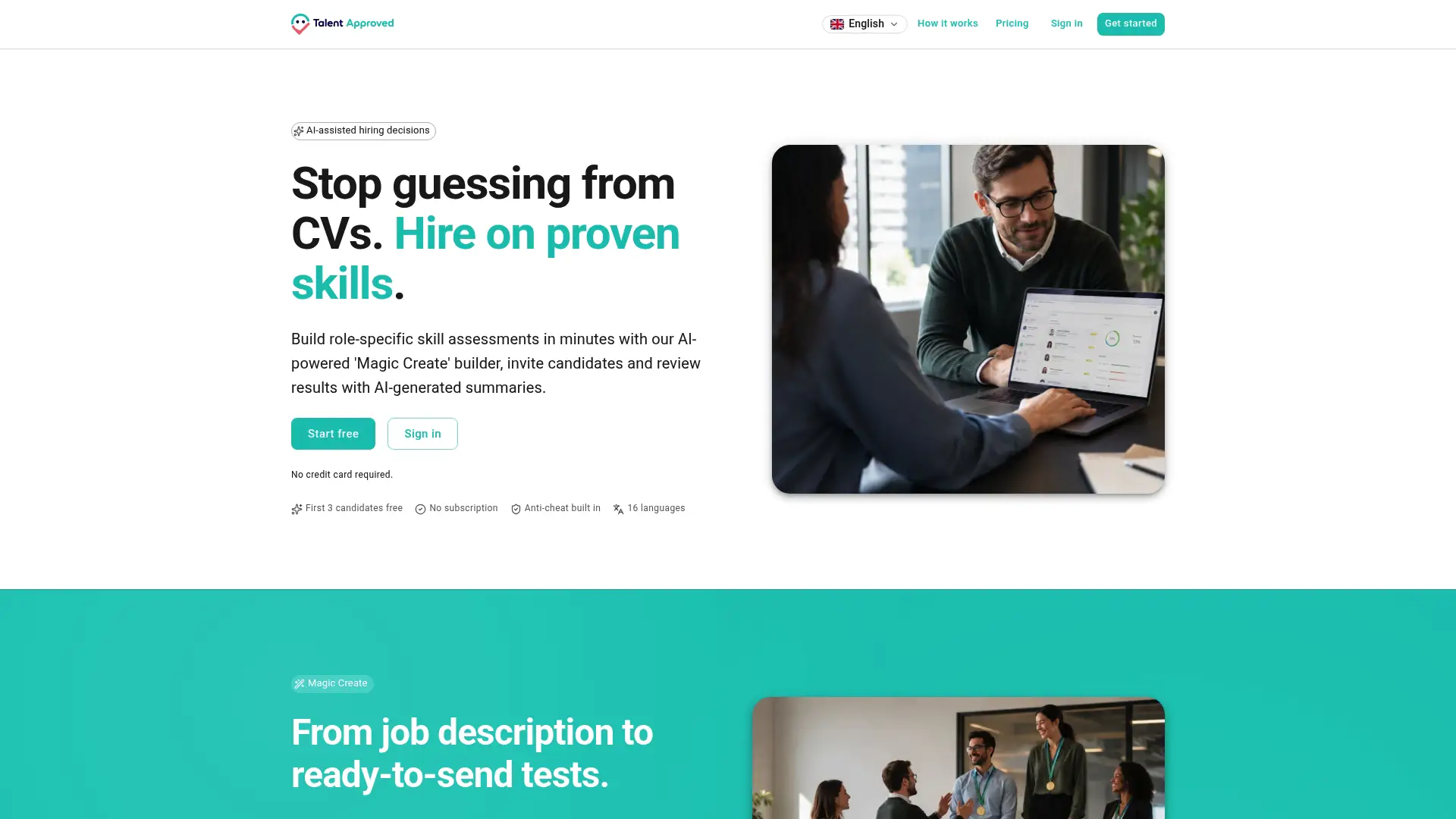
The platform’s AI-powered assessment workflow turns a job description into a role-specific test in minutes, so you can cover every role in your pilot without a test-design specialist. Built-in proctoring with screen and webcam recording protects the integrity of every score. Automated ranking and AI-generated summaries let you review results across a full department in the time it would normally take to read a handful of responses. There is no subscription: you pay $5 per completed assessment, which means a 50-person pilot costs $250 in platform fees.
Ready to add objective evidence to your next audit? See how Talent Approved works and run your first assessment today.
Useful sources
The following references provide templates, frameworks, and deeper reading for HR teams building or refining their audit process:
- How To Conduct a Skills Audit at Your Organization — AIHR
- Skills Audits & Inventories: Properly Manage and Utilize Resources
- Skills Audits: The best way to get them right from the start
- Organisational Skills Audit Guide | SkillProof
- How to carry out an efficient skills audit | Michael Page
FAQ
What is a skills audit in the workplace?
A workforce skills audit is a structured process that compares the skills your organization needs against the skills your employees currently have. The output is a skills inventory showing confirmed strengths, confirmed gaps, and unassessed areas, which HR teams use to direct training, hiring, and succession decisions.
What is the difference between a skills audit and a workforce assessment?
A workforce skills assessment and a skills audit describe the same core process. “Skills audit” tends to emphasize the gap-analysis output and the evidence-based record-keeping; “workforce assessment” is sometimes used more broadly to include performance reviews and engagement surveys. In practice, the terms are often interchangeable in HR contexts.
What are the main steps in a skills audit process?
The core steps are: define required skills and standards, design assessment templates, run a pilot, collect multi-source evidence (self-assessments, manager ratings, objective tests), compile the skills inventory, analyze gaps, and build an action plan with owners and reassessment dates.
How long does a workforce skills audit take?
A first-run audit covering one department typically takes 10–15 weeks from scoping to a signed-off action plan. Repeat cycles run faster once templates, calibration standards, and communication processes are in place.
What is a workforce audit?
A workforce audit is a broader review of an organization’s human capital, which can include headcount, skills, compensation, and compliance. When focused specifically on capabilities, it is equivalent to a workforce skills audit: a systematic comparison of required versus current skills to inform staffing and development decisions.