
The Role of Soft Skills Testing Explained for HR Teams

Soft skills testing is the objective evaluation of a candidate’s interpersonal abilities, behavioral tendencies, and cognitive traits using structured, validated instruments. The role of soft skills testing explained simply: it captures what resumes and interviews routinely miss. A polished CV tells you where someone worked. It does not tell you how they handle conflict, adapt under pressure, or communicate with a difficult stakeholder. According to Robert Half, 14% of managers attribute hiring mistakes directly to overemphasizing technical skills at the expense of soft skills. That figure represents real teams that underperformed because the hiring process measured the wrong things. In an AI-augmented workplace, where routine tasks are increasingly automated, the ability to assess human skills accurately has never mattered more.
What are the key soft skills and why do they matter for hiring success?
Soft skills are the interpersonal and behavioral competencies that determine how a person works, not just what they can do. Communication, adaptability, teamwork, critical thinking, and emotional intelligence consistently appear at the top of employer priority lists. These traits predict how a new hire will integrate into a team, respond to feedback, and perform under ambiguity.
The importance of soft skills grows sharper as AI handles more routine work. Critical thinking, communication, and adaptability are the competencies that AI cannot replicate. That shift means the human skills that once seemed secondary are now the primary differentiators between average and high-performing employees.
“The future of work is human. As AI takes over repetitive tasks, the skills that make us distinctly human — empathy, creativity, and judgment — become the most valuable assets an organization can hire for.”
The specific soft skills that most directly affect team dynamics include:
- Communication: Clarity in written and verbal exchanges reduces errors and speeds up decisions.
- Adaptability: Employees who adjust quickly to change reduce disruption during transitions.
- Teamwork: Collaborative workers improve group output beyond what individual performance predicts.
- Problem-solving: Structured thinkers resolve issues without escalating them unnecessarily.
- Emotional intelligence: High EQ employees manage conflict constructively and build trust faster.
Each of these traits has a measurable impact on business outcomes. A candidate who scores high on adaptability is more likely to stay productive during organizational change. A candidate with strong emotional intelligence is more likely to retain client relationships. The importance of soft skills is not abstract. It shows up in retention rates, client satisfaction scores, and team output.
How does the soft skills assessment process work and what makes it reliable?

The soft skills assessment process becomes defensible only when it meets psychometric standards. Two criteria matter most: reliability and validity. Reliability measures whether a test produces consistent results across different administrations. Validity measures whether the test actually captures what it claims to measure.
A Cronbach’s alpha of at least 0.80 is the minimum reliability threshold mandated by the British Psychological Society and the International Test Commission. Any test scoring below that threshold produces results too inconsistent to base hiring decisions on. Construct validity requires that test items be calibrated against normative samples, a process formalized by bodies like the European Soft Skills Certification (EASEC).
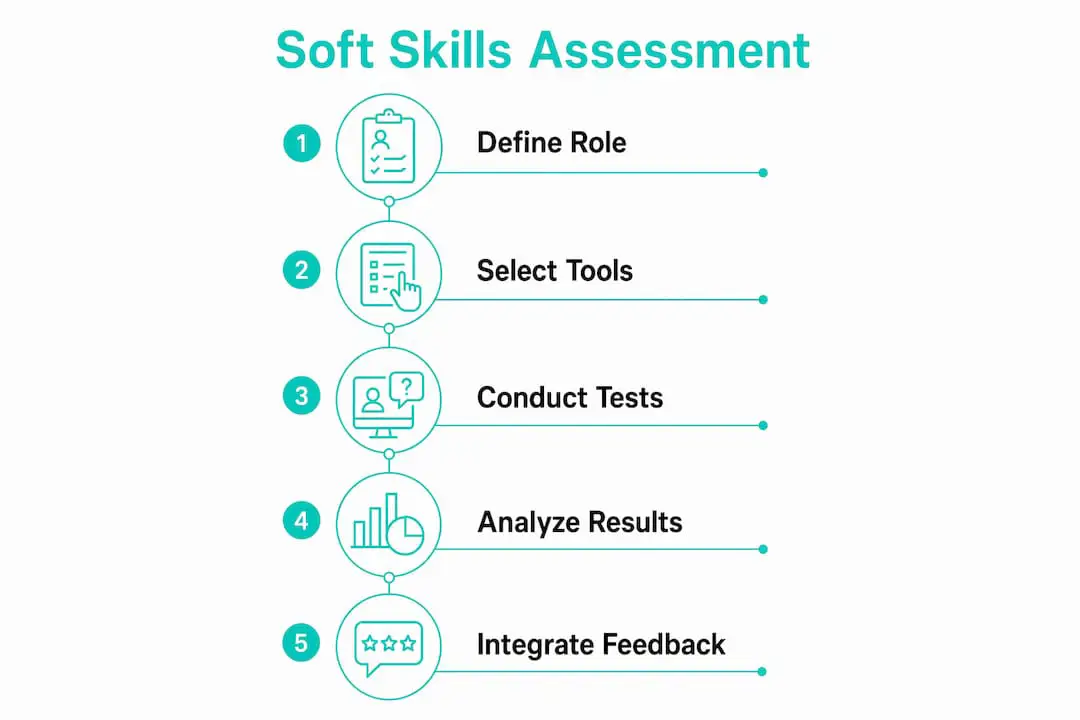
Most commercial soft skills tools measure perceived abilities rather than actual competence. That distinction matters enormously. A self-report questionnaire asking “Are you a good communicator?” captures self-image, not skill. A psychometrically validated instrument uses calibrated behavioral scenarios to infer actual competency levels, controlling for response bias in the process.
The three main soft skills evaluation methods each serve a different purpose:
| Method | What it measures | Reliability level |
|---|---|---|
| Self-report questionnaire | Candidate’s self-perception of skills | Low to moderate without bias controls |
| Behavioral interview | Past behavior as a predictor of future performance | Moderate, improves with structured rubrics |
| Situational judgment test (SJT) | Decision-making in realistic work scenarios | High when psychometrically validated |
| Psychometric instrument | Underlying traits via calibrated items and normative scoring | High when Cronbach’s alpha ≥ 0.80 |
Understanding psychometric testing in HR helps you select tools that meet these standards rather than tools that simply look credible on a vendor’s website.
Pro Tip: Before purchasing any soft skills assessment tool, ask the vendor for its reliability coefficient and the normative sample used for calibration. If they cannot provide both, the test is not psychometrically defensible.
What challenges exist in assessing soft skills, and how can HR professionals address them?
Soft skills are harder to measure than technical skills because they are context-dependent and socially influenced. Two specific biases undermine most standard approaches.
The first is social desirability bias. Candidates in interviews and self-report tests naturally present the version of themselves they believe the interviewer wants to see. Validated tests must control for this to capture true competencies. Tests that do not include bias-detection items will consistently overestimate candidate soft skills.
The second is the observer effect in panel interviews. When multiple interviewers discuss a candidate together before scoring independently, the most vocal opinion in the room shapes everyone else’s rating. This is groupthink applied to hiring, and it inflates false confidence in subjective assessments.
Practical strategies to address these challenges include:
- Use multi-method assessment. Observer-based assessments and self-reports reveal different but complementary signals. No single method gives you the full picture.
- Score independently before discussing. Require each interviewer to complete their rating before any group debrief. This preserves independent judgment.
- Apply structured behavioral anchors. Using structured behavioral anchors with scoring protocols improves rating accuracy by giving each rater a concrete reference point rather than a vague impression.
- Rotate scenario types. Use both retrospective questions (“Tell me about a time when…”) and prospective ones (“What would you do if…”) to triangulate behavioral patterns.
Pro Tip: When training interviewers, run a calibration exercise where all raters score the same recorded response independently. Compare results before discussing. The variance between raters tells you exactly where your rubric needs tightening.
Context dependency is the third challenge most HR professionals underestimate. A candidate who demonstrates strong communication in a one-on-one interview may struggle in cross-functional team settings. Testing across multiple formats, including written tasks and group exercises, reduces this blind spot significantly.
How can organizations effectively implement soft skills testing in their hiring process?
Effective implementation starts with role-specific skill mapping. Generic soft skills tests applied uniformly across all roles produce noisy data. A customer success manager needs high emotional intelligence and communication clarity. A data analyst needs structured problem-solving and attention to detail. Identifying the two or three soft skills most predictive of success in each specific role focuses your assessment and improves its predictive validity.
A layered assessment approach produces the most accurate candidate profiles. Combining psychometric tests, behavioral interviews, and situational judgment tests can reduce your finalist pool by 50% while doubling your identification of high-potential candidates. That is not a marginal improvement. It is a structural change in hiring quality.
A practical implementation sequence looks like this:
- Define role-specific soft skills. Map two to three competencies directly to business outcomes for the role.
- Screen with a validated psychometric instrument. Apply it early to filter candidates before investing interview time.
- Run structured behavioral interviews. Use the STAR method (Situation, Task, Action, Result) with pre-defined behavioral anchors for each competency.
- Add a situational judgment test. Present realistic work scenarios and score responses against a validated rubric.
- Include a work sample task. For roles requiring written communication or project management, a real task reveals more than any interview question.
- Score independently, then calibrate. Require all raters to score before any group discussion to protect against groupthink.
Remote hiring adds a specific layer of complexity. Asynchronous tasks such as responding to incomplete briefs assess communication clarity more accurately than live video interviews for distributed roles. A candidate who writes a clear, structured response to an ambiguous brief demonstrates exactly the communication skill that remote collaboration requires. Live interviews, by contrast, reward verbal fluency, which is a different and often less relevant competency for async work environments.
You can learn more about integrating assessments into hiring to build a consistent process your hiring managers can apply without reinventing the approach for every role.
Key Takeaways
Soft skills testing produces reliable hiring decisions only when it combines psychometrically validated instruments, structured behavioral interviews, and role-specific competency mapping.
| Point | Details |
|---|---|
| Reliability threshold matters | Any soft skills test must reach a Cronbach’s alpha of at least 0.80 to produce defensible results. |
| Multi-method beats single-method | Combining psychometrics, behavioral interviews, and SJTs doubles identification of high-potential candidates. |
| Role-specific mapping improves accuracy | Mapping two to three soft skills directly to business outcomes reduces assessment noise. |
| Bias controls are non-negotiable | Social desirability bias and groupthink distort results without independent scoring and validated instruments. |
| Remote roles need async tasks | Asynchronous written tasks reveal communication clarity better than live interviews for distributed positions. |
Why I think most hiring teams are using soft skills data the wrong way
The most common mistake I see is treating soft skills test results as a pass/fail gate rather than a signal to interpret. A candidate who scores lower on assertiveness is not automatically a poor fit for a leadership role. That score is a prompt to probe further in the behavioral interview, not a reason to reject the application.
Soft skills test results are dynamic signals that inform role fit and development planning. The best hiring teams I have observed use assessment data to build a richer candidate profile, then validate that profile through structured conversation. They ask: “What does this score tell us about how this person will perform in this specific context?” That question produces far better hiring decisions than a simple ranking by total score.
The AI era makes this discipline more urgent, not less. As AI tools take over more analytical and administrative tasks, the human judgment required to evaluate soft skills accurately becomes the most valuable thing a recruiter brings to the process. Investing in validated assessment methods and training your hiring managers to interpret results correctly is the highest-return activity most HR teams are currently underinvesting in.
— Jimmie
How Talent Approved supports your soft skills assessment process
Talent Approved’s AI-powered platform gives HR teams a practical way to build and manage soft skills assessments without needing a psychometrics background.
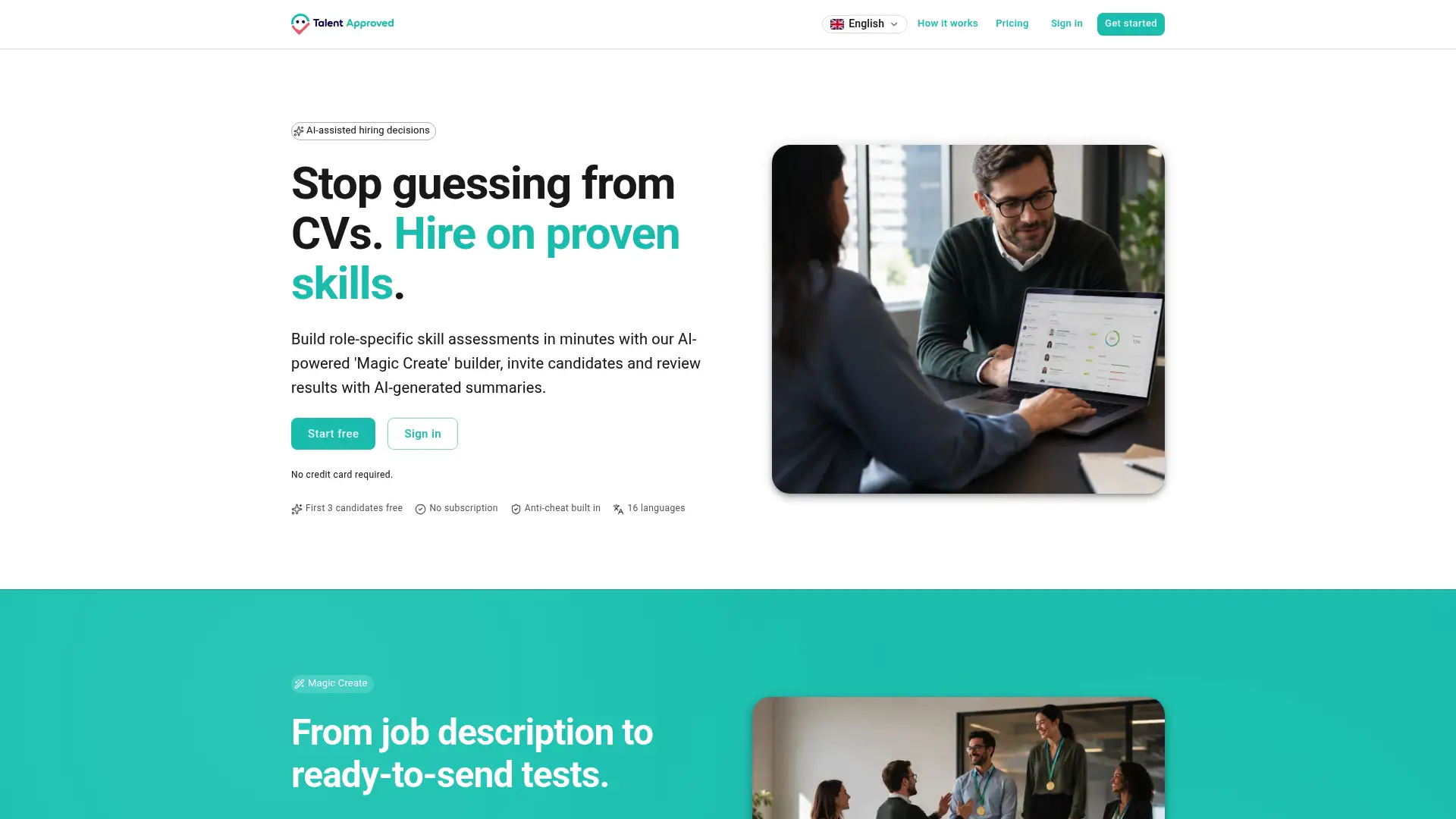
The platform’s Magic Create feature generates role-specific assessments in minutes from a job description or a list of target competencies. Built-in anti-cheat mechanisms and AI-generated candidate summaries mean you spend less time reviewing raw responses and more time making informed decisions. AI-powered candidate ranking combines soft skills and technical scores into a single, comparable profile for each applicant. You can also review assessment results with AI to surface the most relevant signals quickly. For teams ready to move from CV-based screening to capability-based hiring, Talent Approved’s assessment platform is built for exactly that shift.
FAQ
What is soft skills testing in hiring?
Soft skills testing is the structured evaluation of a candidate’s interpersonal, behavioral, and cognitive traits using validated instruments. It captures competencies like communication, adaptability, and emotional intelligence that resumes and unstructured interviews consistently miss.
Why do soft skills matter more in the age of AI?
As AI automates routine tasks, critical thinking, communication, and adaptability become the primary differentiators between average and high-performing employees. Robert Half identifies these as the competencies AI cannot replicate.
How do you assess soft skills reliably?
Reliable soft skills assessment combines psychometrically validated instruments with a Cronbach’s alpha of at least 0.80, structured behavioral interviews using the STAR method, and situational judgment tests scored against pre-defined rubrics.
What is the biggest risk in soft skills evaluation?
Social desirability bias is the most common risk. Candidates present idealized versions of themselves in interviews and self-report tests. Validated psychometric instruments with built-in bias controls are the most effective way to counteract this.
How does remote hiring change soft skills assessment?
Remote roles benefit most from asynchronous written tasks, such as responding to an incomplete brief, which assess communication clarity and structured thinking more accurately than live video interviews.