
How to Train Hiring Managers to Use Assessments

Training hiring managers to use assessments is the single most effective way to shift hiring from gut-feel decisions to evidence-based outcomes. Structured interviews carry a predictive validity of 0.51 versus 0.20 for unstructured conversations. That gap represents a 155% improvement in your ability to predict job performance. The industry term for this approach is structured assessment-based hiring, and it requires more than handing managers a test link. It requires deliberate training, calibration, and accountability. Research from Cadient shows that proper assessment implementation can cut turnover by up to 65%. Talent Approved, SHRM, and the Schmidt and Hunter meta-analysis all point to the same conclusion: structure and training, not instinct, produce better hires.
How to train hiring managers to use assessments: prerequisites and tools
Before any training session begins, your team needs the right infrastructure in place. Without it, even the best workshop produces no lasting change.
The three non-negotiable prerequisites are:
- Standardized interview scorecards. Every interviewer on a panel must use the same rubric with defined rating anchors. Vague labels like “good communicator” produce inconsistent scores. Specific behavioral anchors like “gave a clear example with measurable outcome” do not.
- Role-specific assessments. Cognitive ability tests, work sample tests, and personality assessments each serve a different purpose. Cognitive and work sample tests carry the strongest predictive power. Personality assessments work best as a secondary tool to inform interview questions, not as a primary filter.
- Leadership buy-in. Training adoption fails when participation is optional. Making assessment training mandatory for all interview panel members signals that the organization treats hiring as a skill, not a formality.
The table below maps each tool category to its function in a training program.
| Tool category | Primary function in training |
|---|---|
| Structured interview scorecard | Standardizes scoring and reduces interviewer bias |
| Cognitive ability test | Predicts learning speed and problem-solving capacity |
| Work sample test | Measures job-relevant skills directly |
| Personality assessment | Informs interview questions, not hiring decisions |
| Calibration session | Aligns interviewers on scoring definitions |
Delivery infrastructure matters too. Effective training programs for recruiters combine live workshops, e-learning modules for asynchronous review, and recurring calibration sessions. Each format serves a different learning need.

How to run effective workshops and calibration sessions
The workshop is where hiring managers build the skills they need to evaluate candidates effectively. A well-designed session runs 60–120 minutes and covers four core areas: structured interview technique, behavioral question design, assessment interpretation, and legal compliance basics.
Start with the scoring rubric. Give every participant the same anonymized candidate response and ask them to score it independently before any discussion. This exercise almost always reveals wide scoring variance. That variance is the problem you are solving.
- Distribute anonymized candidate examples. Use real responses from past hiring rounds with all identifying details removed. Ask each manager to score independently using the rubric.
- Reveal scores and discuss gaps. When one manager gives a 4 and another gives a 2 for the same response, that gap requires explanation. Walk through the scoring anchors together until the group converges.
- Introduce behavioral question frameworks. Teach the STAR method (Situation, Task, Action, Result) as the standard format for both asking and evaluating responses.
- Cover assessment interpretation basics. Explain what each test type measures, what a score means in context, and what it does not tell you.
- Address legal compliance. Hiring managers must understand which questions are off-limits and why standardized processes protect both the candidate and the organization.
After the initial workshop, shadow interviews reinforce skills in real hiring situations. A senior recruiter or HR professional observes the hiring manager during a live interview and provides structured feedback afterward.
Pro Tip: Require all interviewers to submit their scorecard scores before the debrief meeting. Once one person shares their opinion aloud, anchoring bias pulls everyone else toward that view. Pre-submission removes that distortion.
Calibration sessions should run quarterly, even during slow hiring periods. A 30-minute calibration session can cut scoring variance by half. Without regular calibration, interviewers revert to gut judgment within a few months.
What are best practices for interpreting and using assessment results?
Assessment scores are data points, not verdicts. Training hiring managers to treat them as one input in a larger decision process is the most important mindset shift in any assessment training program.
The triangulation principle is the foundation of good interpretation. Managers should combine three sources before making a decision:
- Assessment scores from cognitive, work sample, or skills tests
- Structured interview ratings from the scorecard
- Reference check findings that confirm or challenge the picture
Treat assessment scores as one element in a multi-input hiring decision. Scores must be triangulated with interviews and references to avoid over-reliance on any single measure.
Personality assessments deserve special attention in training. They have weaker individual predictive power compared to cognitive or work sample tests. Train managers to use personality results as conversation starters. A high score on a conscientiousness scale, for example, should prompt a follow-up behavioral question, not a hiring decision.
Assessment results also connect directly to onboarding. Organizations that tie assessment outputs to onboarding plans see better new hire success and retention. A candidate who scores lower on written communication can be paired with a writing-focused onboarding buddy in their first week. That connection between assessment data and onboarding action is what makes the whole system worth running.
You can also use a candidate evaluation checklist to standardize how managers document their triangulated decisions across all three input sources.
What challenges arise when training hiring managers, and how do you fix them?
Resistance is the most common obstacle. Hiring managers who have hired successfully for years often see structured assessments as bureaucratic overhead. The fix is not persuasion. It is accountability. When leadership makes training mandatory and ties scorecard completion to hiring approval, adoption follows.
The second challenge is scoring variance. Even after a strong initial workshop, interviewers drift back to inconsistent scoring without reinforcement. Scoring variance within panels signals calibration failure. A one-point spread among interviewers for the same candidate response is acceptable. Anything wider indicates a problem that requires a calibration session to correct.
The third challenge is ignoring assessment data after collecting it. This happens when managers feel the process is a checkbox rather than a genuine input. Two solutions work here:
- Integrate score review into the debrief agenda. Make it a required agenda item, not an optional add-on.
- Build role-based learning pathways. One-off training events without ongoing coaching produce short-term compliance, not lasting behavior change. Programs structured as ongoing academies with role-based pathways show higher adoption and sustained impact.
Track scorecard completion rates as your primary adoption metric. A rate below 95% signals that training has not taken hold. Use that number to identify which managers or teams need additional coaching.
How do you measure whether assessment training is actually working?
Measurement turns training from a one-time event into a continuous improvement process. Three KPIs give you the clearest picture of training effectiveness.
Pro Tip: Set your measurement cadence before training begins. Collecting baseline data on scorecard completion rates and scoring variance before the first workshop gives you a genuine before-and-after comparison.
| KPI | What it measures | Target |
|---|---|---|
| Scorecard completion rate | Training adoption across the interview panel | 95% or higher |
| Scoring variance within panels | Calibration quality among interviewers | One-point spread maximum |
| Quality-of-hire rating at 90 days | Downstream hiring outcome improvement | Upward trend quarter over quarter |
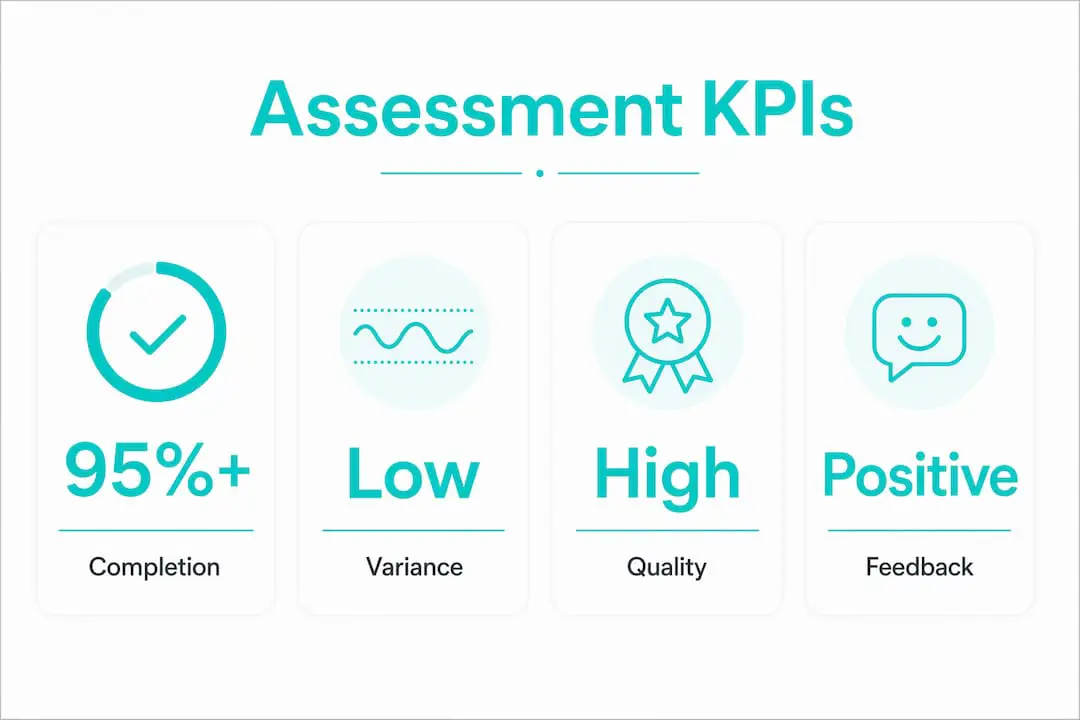
Scorecard completion rates at 95% or higher are the primary indicator that training has been adopted. Scoring variance within panels tells you whether calibration is holding. Quality-of-hire ratings at 30, 60, and 90 days post-hire tell you whether better process is producing better people.
Hiring manager Net Promoter Scores add a fourth dimension. They measure whether managers find the training useful, not just whether they completed it. Low NPS scores on training content signal that the material needs to be revised, not just repeated.
Connect your quality of hire metrics to your training calendar. When quality-of-hire ratings drop, that is your trigger for a calibration session, not a full retraining program.
Key Takeaways
Training hiring managers to use assessments requires structured workshops, regular calibration, and consistent measurement to produce lasting improvements in hiring quality.
| Point | Details |
|---|---|
| Structure beats instinct | Structured interviews predict job performance 155% better than unstructured conversations. |
| Calibration prevents drift | Quarterly 30-minute sessions cut scoring variance by half and stop gut-feel habits from returning. |
| Triangulate every decision | Combine assessment scores, structured interview ratings, and reference checks before deciding. |
| Measure adoption first | A 95% scorecard completion rate is the baseline indicator that training has taken hold. |
| Connect scores to onboarding | Sharing assessment outputs with onboarding plans improves new hire retention and performance. |
Why most assessment training fails before it starts
I have watched organizations invest in well-designed assessment tools and then watch adoption collapse within 90 days. The pattern is almost always the same. Training happens once, managers complete it, and then nothing reinforces the behavior. Six months later, the scorecards are half-filled and the calibration sessions have been canceled to make room for other priorities.
The uncomfortable truth is that assessment training is not primarily a content problem. It is a culture problem. When leadership does not model structured hiring behavior, managers read that as permission to revert to what they know. The fastest way to fix this is to make scorecard completion a visible metric in hiring reviews, not a private HR concern.
Another thing I have seen consistently: organizations treat personality assessments as the centerpiece of their hiring process and then wonder why the data feels unreliable. Personality tools are genuinely useful when they inform interview questions. They are actively harmful when they become filters. Training managers to understand that distinction is more valuable than any specific assessment platform.
The organizations that get this right share one trait. They treat hiring manager training as an ongoing program, not a one-time event. They run calibration sessions even when hiring is slow. They track scoring variance and act on it. They connect assessment data to onboarding outcomes and close the loop. That discipline is what separates teams that hire well from teams that hire hopefully.
For candidate motivation specifically, assessment techniques for recruiters offer a practical framework that complements structured interview training.
— Jimmie
Talent Approved makes assessment training easier to apply
Talent Approved gives hiring managers the tools to put structured assessment training into practice immediately.
With the AI skill test creator, you can build role-specific assessments directly from a job description in minutes. No test design experience required. Once candidates complete their assessments, the AI-powered results review generates clear summaries that help hiring managers interpret scores accurately and consistently. The candidate ranking feature then organizes results so your team can compare candidates based on actual performance data, not resume impressions. Talent Approved is built for HR teams that want evidence-based hiring without the administrative overhead.
FAQ
How long should hiring manager assessment training take?
An effective initial workshop runs 60–120 minutes and covers structured interviews, assessment interpretation, and scoring practice. Follow-up calibration sessions of 30 minutes should run quarterly to maintain skills.
What is the best indicator that assessment training is working?
A scorecard completion rate of 95% or higher is the primary sign that training has been adopted across the interview panel. Quality-of-hire ratings at 90 days confirm whether better process is producing better outcomes.
Should personality assessments be used to filter candidates?
Personality assessments should not serve as a primary filter. They carry weaker predictive power than cognitive or work sample tests and work best as a tool to inform behavioral interview questions.
How do you reduce scoring variance among interviewers?
Run calibration sessions where interviewers score the same anonymized candidate response independently, then discuss gaps. A 30-minute session can cut scoring variance by half and realign the panel on scoring definitions.
How do assessment results connect to onboarding?
Assessment outputs shared with onboarding managers allow targeted support in the new hire’s first week. A candidate with a lower score in a specific skill area can receive focused coaching from day one, improving retention and performance.