
Candidate Evaluation Criteria Checklist for Hiring Teams

A candidate evaluation criteria checklist is a structured tool that lists the specific skills, behaviors, and attributes hiring teams use to objectively score and compare job applicants. Without one, interviewers rely on gut feeling, which reduces hiring accuracy by up to 40% compared to structured methods. The industry term for this tool is a hiring scorecard, and both terms describe the same practice: defining what “good” looks like before the first interview begins. This guide covers the essential categories, scoring design, legal compliance, and implementation steps that make a checklist work in practice.
1. What belongs on a candidate evaluation criteria checklist
The most effective checklists organize criteria into four core categories: critical hard skills, essential soft skills, culture add attributes, and measurable performance indicators. Each category predicts job success in a different way. Hard skills confirm technical competence. Soft skills predict how a candidate will work with others. Culture add attributes assess whether a candidate will strengthen the team’s existing dynamics. Performance indicators connect evaluation scores to real job outcomes.

Hard skills are role-specific and non-negotiable. For a data analyst role, SQL proficiency and data visualization belong here. For a sales manager, pipeline management and forecasting accuracy are the right anchors. Soft skills require more care. Communication, adaptability, and problem-solving are common choices, but they only work when defined with behavioral examples. “Good communicator” means nothing. “Explains complex data clearly to non-technical stakeholders” is a criterion you can actually score.
Culture add is the category most teams get wrong. Hiring for “culture fit” often becomes a proxy for personal similarity, which introduces bias. Culture add, by contrast, asks what perspective or working style this candidate brings that the team currently lacks. Define it in behavioral terms before the interview begins.
- Hard skills: Role-specific technical competencies tied directly to job tasks
- Soft skills: Interpersonal and cognitive behaviors defined with concrete examples
- Culture add: Behavioral attributes that expand team capability, not replicate it
- Performance KPIs: Measurable outcomes the candidate must achieve in the first 90 days
Pro Tip: Limit your checklist to 5–8 criteria. Exceeding 10–12 items causes decision fatigue and reduces scoring consistency across interviewers.
2. How to design a scoring rubric for your hiring evaluation form
A scoring rubric turns vague impressions into comparable numbers. The standard format uses a 1–5 scale, where 1 represents a clearly inadequate response and 5 represents an outstanding one. The critical step most teams skip is writing behavioral anchors for each score level. An anchor describes exactly what a candidate said or did to earn that score.
| Score | Label | Behavioral anchor example |
|---|---|---|
| 1 | Inadequate | Candidate could not describe a relevant example or gave a generic, unrelated answer |
| 2 | Below expectations | Candidate described a situation but could not explain their specific actions or results |
| 3 | Meets expectations | Candidate described a clear situation, their role, and a measurable outcome |
| 4 | Exceeds expectations | Candidate described a complex situation, led the resolution, and quantified the impact |
| 5 | Outstanding | Candidate demonstrated exceptional judgment, influenced others, and drove lasting change |
Behaviorally anchored rubrics reduce subjective bias and increase fairness across different interviewers. This matters because two interviewers watching the same response will score it differently without a shared reference point. Anchors create that reference point.
Score each criterion immediately after the candidate answers, not at the end of the interview. Memory degrades fast. Waiting until after a 60-minute interview means your scores reflect your final impression, not each individual response.
Structured interviews achieve a predictive validity of r = 0.42, compared to r = 0.20 for unstructured interviews. Combining structured interviews with skills assessments pushes predictive validity to r = 0.60–0.65. That gap represents a significant difference in hiring accuracy.
Pro Tip: Have each interviewer submit their scores independently before any group discussion. Independent scoring before discussion prevents anchoring bias, where the first opinion shared in a room shapes everyone else’s view.
3. How to minimize bias and meet legal standards in candidate evaluation
Bias in hiring is not always intentional. Affinity bias, halo effects, and anchoring bias all operate below conscious awareness. A well-designed selection criteria checklist reduces their impact by forcing evaluators to score specific behaviors rather than overall impressions.
The legal dimension is equally important. Under EEOC 29 CFR Part 1607, scored evaluation methods are legally classified as tests. Any employer with 15 or more employees must conduct adverse impact analyses on their scoring methods. This applies to structured interview scorecards, skills assessments, and any other scored selection tool. Ignoring this requirement creates legal exposure.
Assigning each interviewer to evaluate only specific criteria, rather than scoring every dimension, produces deeper assessment and reduces the “all-around nice guy” bias. When one interviewer owns technical skills and another owns communication, each goes deeper on their assigned area instead of forming a general likability impression.
Practical steps to reduce bias in your process:
- Use blind scoring where possible. Remove candidate names from scorecards during initial review to reduce name-based bias.
- Specialize interviewers by criteria. Assigning separate criteria to different panel members reduces general likability scoring and encourages deeper investigation.
- Run calibration sessions. Before the hiring decision, bring the panel together to compare scores and discuss evidence. This surfaces inconsistencies before they affect the outcome.
- Document specific examples. Every score should reference a concrete candidate statement or behavior. “Strong communicator” is not documentation. “Candidate explained the API integration process clearly using a whiteboard diagram” is.
Calibration sessions also serve a secondary purpose. They train interviewers over time. Teams that run regular calibration sessions develop more consistent scoring standards across hiring cycles.
4. How to implement a candidate assessment guide in your hiring workflow
Effective implementation starts before you post the job. Defining required skills and a success blueprint before sourcing prevents the common mistake of chasing a wishlist and improves recruitment focus. The success blueprint answers one question: what does this person need to accomplish in their first 90 days to be considered successful?
Follow this sequence to build implementation into your process:
- Define the success blueprint. List 5–7 critical hard and soft skills the role requires. Tie each skill to a specific job outcome, not a job description bullet point.
- Build the scorecard. Create behavioral anchors for each criterion at each score level. Assign criteria to specific interviewers based on their expertise.
- Train your interviewers. Walk every panel member through the rubric before the first interview. Practice scoring sample responses together to calibrate expectations.
- Divide criteria across the panel. Each interviewer owns 2–3 criteria. They prepare questions, listen for behavioral evidence, and score independently.
- Score immediately after each response. Do not wait until the interview ends. Record specific quotes or behaviors that support each score.
- Collect scores before the debrief. All panel members submit their scorecards before the group discussion begins.
- Run the calibration debrief. Compare scores, discuss evidence, and resolve significant discrepancies. The goal is not consensus but clarity.
- Combine with work samples or assessments. For roles where technical skill is critical, pair your interview scorecard with a skills-based assessment to validate what candidates claim in interviews.
Pro Tip: Use the identical checklist for every candidate in the same role. Changing criteria mid-process creates legal risk and makes candidate comparison unreliable.
Candidate motivation is a dimension many checklists overlook. A candidate may score well on every technical criterion but lack the drive to apply those skills in your specific context. Assessing candidate motivation alongside skill criteria gives you a more complete picture of likely job performance.
The quality of hire metrics you track after hiring will tell you whether your checklist is working. If new hires consistently underperform on specific criteria, those criteria need sharper behavioral anchors or better interview questions.
Key takeaways
A structured candidate evaluation criteria checklist, limited to 5–8 behaviorally anchored criteria, is the single most reliable way to reduce mis-hires and improve hiring consistency.
| Point | Details |
|---|---|
| Limit criteria to 5–8 items | More than 10–12 criteria causes decision fatigue and reduces scoring accuracy. |
| Use behavioral anchors | Define what a 1, 3, and 5 look like in concrete terms for every criterion. |
| Score independently first | All interviewers submit scores before group discussion to prevent anchoring bias. |
| Comply with EEOC 29 CFR Part 1607 | Scored hiring tools are legally classified as tests requiring adverse impact analysis. |
| Define success before sourcing | Build your checklist from a 90-day success blueprint, not a job description wishlist. |
Why most evaluation checklists fail before the first interview
The most common failure I see is not a bad checklist. It is a checklist built too late. Teams write their criteria after they have already started interviewing, which means the first few candidates get evaluated on different standards than the last few. That inconsistency is both a legal risk and a practical one.
The second failure is criteria that sound good but cannot be scored. “Strong leadership presence” is not a criterion. It is a feeling. The moment you try to write a behavioral anchor for it, you realize you do not actually know what you mean. That discomfort is useful. It forces you to get specific, and specificity is what makes a checklist work.
I have also seen teams add criteria to their checklists because a senior stakeholder insisted on them, not because they predict job success. A VP who “just knows” that candidates need to be “strategic thinkers” will push for that criterion even when no one can define it. The right response is to ask: what would a strategic thinker do in their first 30 days that a non-strategic thinker would not? If no one can answer that, the criterion does not belong on the checklist.
AI tools are starting to change how teams analyze scoring data across hiring cycles. Platforms that flag scoring inconsistencies or identify criteria with low predictive validity will make checklist refinement faster and more evidence-based. That is a real improvement over the current practice of waiting for a bad hire to realize something in the process was broken.
— Jimmie
Talent Approved brings structure to your candidate evaluation
Building a checklist is the first step. Validating what candidates claim in interviews is the next one.
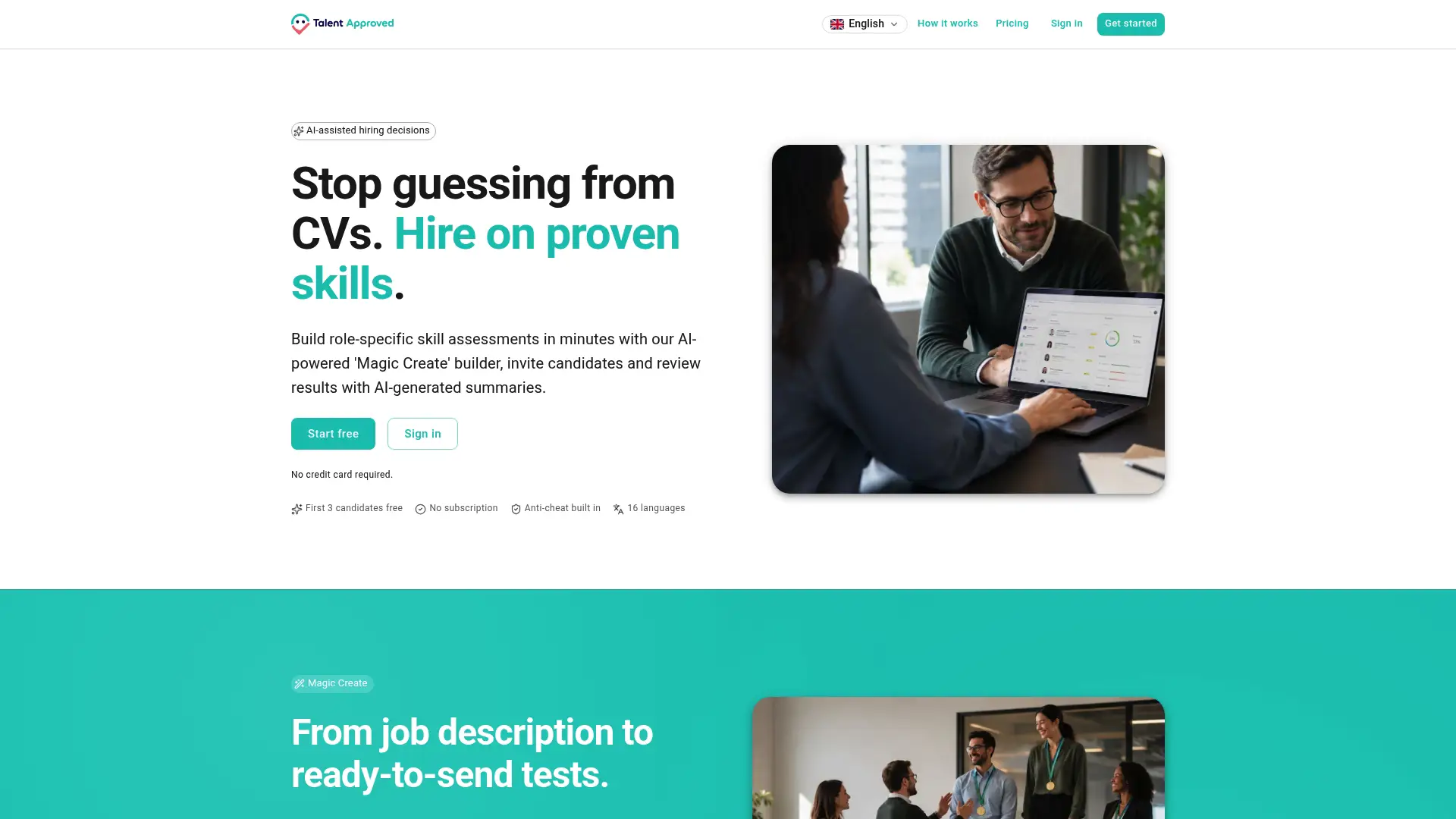
Talent Approved’s AI-powered platform lets you create role-specific skill assessments in minutes using the Magic Create feature. You input a job description or a list of required skills, and the platform generates a tailored assessment aligned to your success blueprint. The built-in anti-cheat mechanisms and AI-generated candidate summaries give your panel objective data to bring into the debrief. See how it works and learn how structured assessments pair with your hiring scorecard to improve the accuracy of every hiring decision.
FAQ
What is a candidate evaluation criteria checklist?
A candidate evaluation criteria checklist is a structured hiring scorecard that lists the specific skills, behaviors, and attributes interviewers use to score job applicants consistently. It replaces subjective impressions with defined, comparable criteria.
How many criteria should a hiring scorecard include?
Limit your scorecard to 5–8 criteria. Exceeding 10–12 items causes decision fatigue and reduces scoring consistency across interviewers.
Are structured interview scorecards legally regulated?
Yes. Under EEOC 29 CFR Part 1607, scored evaluation tools are classified as employment tests. Employers with 15 or more employees must conduct adverse impact analyses on any scored selection method.
How do behavioral anchors improve scoring accuracy?
Behavioral anchors define what a poor, average, and outstanding response looks like for each criterion. They give all interviewers a shared reference point, which reduces subjective scoring variation.
When should skills assessments be used alongside interview scorecards?
Use skills assessments for roles where technical competence is critical and difficult to verify through interview questions alone. Combining structured interviews with assessments pushes predictive validity to r = 0.60–0.65, compared to r = 0.42 for structured interviews alone.