
Candidate Motivation Assessment Techniques for Recruiters

Candidate motivation assessment techniques are structured methods that reveal a candidate’s true drive and fit for a role by evaluating past behavior, motivational alignment, and task preferences. The industry term for this practice is motivation-based interviewing, and it sits at the intersection of behavioral psychology and structured recruitment. Recruiters who rely on resumes alone miss the most predictive signal available: whether a candidate is genuinely energized by the work itself. Frameworks like Self-Determination Theory (SDT), push-pull behavioral questioning, and rubric-based scoring give you a repeatable system for measuring that signal. Talentapproved builds AI-powered assessments that complement these methods by adding objective skill data to your motivation conversations.

1. What are the top candidate motivation assessment techniques?
Motivation-based interviewing covers a set of proven methods that go well beyond asking “What motivates you?” That question produces rehearsed answers. The techniques below produce evidence.
- Structured behavioral interviews with scoring rubrics. Ask candidates to describe specific past situations, then score their responses on a 1–5 rubric before discussing as a panel. This removes gut-feel decisions and creates a documented record.
- Self-Determination Theory (SDT) questioning. SDT identifies three core psychological needs: autonomy, competence, and relatedness. A 2026 meta-analysis of 192 studies confirms that supporting these needs measurably increases job satisfaction and engagement across industries. Questions mapped to each need reveal whether the role can actually sustain a candidate’s motivation.
- Push-pull behavioral questioning. Instead of asking what a candidate wants, ask what drove them away from a previous role and what pulled them toward this one. Push-pull questions avoid rehearsed answers and expose actual drivers.
- Work activity mapping. Map the role’s eight core work actions (evaluating, coordinating, pioneering, and others) to what the candidate finds energizing. Misalignment on daily tasks signals resignation risk even when the resume looks strong.
- Role deconstruction before interviewing. Break the role into its dominant daily tasks before you write a single interview question. Candidates who are motivated by the actual work, not the job title, show up clearly when your questions reflect real task demands.
- Simulation exercises. Give candidates a short, realistic task that mirrors the job. Observe how they approach it, what questions they ask, and how they handle ambiguity. Motivation shows up in behavior, not just words.
Pro Tip: Write your scoring rubric before the first interview, not after. Defining what a “5” looks like for each question prevents you from reverse-engineering scores to match your gut feeling about a candidate.
2. How to implement structured interviews to objectively assess motivation
Structured interviews are the single most reliable way to reduce bias in motivation evaluation. The process is straightforward and costs nothing to start.
- Define 3–5 motivational questions mapped to competencies. Each question should target one specific motivational signal, such as ownership, quality focus, or resilience. Vague questions produce vague answers.
- Build a 1–5 scoring rubric for each question. Describe what each score level looks like in concrete behavioral terms. A “1” might be “candidate describes a situation where someone else solved the problem.” A “5” might be “candidate describes taking initiative before being asked and explains the reasoning.”
- Score independently before panel discussion. Each interviewer documents their scores privately. Implementing this process takes about 10 minutes and improves interview consistency significantly. Discussing scores before independent recording creates anchoring bias.
- Run a calibration brief before each interview cycle. A calibration brief is a 15-minute meeting where the hiring team agrees on what success looks like in the first 90 days. Pre-defined success criteria prevent role standards from shifting candidate to candidate.
- Use a spreadsheet to track scores across candidates. No software investment is required. A simple grid with candidate names, question scores, and total scores gives you a defensible, comparable record.
Pro Tip: Limit your motivational question set to five questions maximum. More questions dilute focus and fatigue both the interviewer and the candidate. Depth beats breadth every time.
The consistency gains from this system are real. Recruiters who use structured rubrics report fewer post-hire surprises because the scoring process forces them to articulate what they actually need, not just what feels right.
3. Applying motivation frameworks like SDT and work activity mapping
Self-Determination Theory gives you a psychological map for understanding what sustains a person’s effort over time. The three needs are autonomy (control over how work gets done), competence (the feeling of growing and mastering skills), and relatedness (meaningful connection with colleagues and purpose). Each need maps directly to interview questions.
- Autonomy questions: “Describe a project where you had full ownership. What did you do differently than you would have if you had a manager directing each step?”
- Competence questions: “Tell me about a skill you built specifically because the role demanded it. How did you approach the learning process?”
- Relatedness questions: “Describe a team dynamic where you did your best work. What made that environment different?”
Work activity mapping adds a practical layer on top of SDT. Motivation is task-specific, not a static personality trait. A candidate energized by pioneering new ideas will disengage quickly in a role dominated by coordinating and maintaining existing systems, regardless of how well they interview.
| Work activity | Candidate energized by this | Role fit signal |
|---|---|---|
| Pioneering | Creating new approaches, taking risks | Strong fit for startup or product roles |
| Evaluating | Analyzing data, identifying problems | Strong fit for QA, finance, or strategy roles |
| Coordinating | Managing logistics, aligning people | Strong fit for operations or project management |
| Developing | Teaching, mentoring, growing others | Strong fit for team lead or L&D roles |
Use this grid during debrief sessions to visualize where a candidate’s energy aligns with the role’s actual demands. A motivational mapping grid makes misalignment visible before a hire is made, not six months after.
4. Best behavioral questions and simulation exercises for assessing motivation
The most effective questions in motivation-based interviewing are behavioral probes that force candidates to recall specific past events. Hypothetical questions (“What would you do if…”) allow candidates to describe their ideal self. Behavioral questions reveal their actual self.
- Setback probes: “Tell me about a project that failed. What was your role in that outcome?” Listen for ownership versus blame-shifting. Candidates with genuine intrinsic motivation tend to analyze their own contribution first.
- Quality focus probes: “Describe a time you delivered something you weren’t fully satisfied with. What happened, and what did you do about it?” This question separates candidates who care about the work from those who care about appearing to care.
- Emotional response probes: “Tell me about a decision at work that genuinely excited you. What made it feel significant?” The emotional texture of the answer, not just the content, signals intrinsic motivation.
“Look beyond the answers themselves. Assess communication style and emotional engagement. Candidates articulating challenges, successes, and growth with enthusiasm signal strong intrinsic motivation.” — Robert Half
Storytelling ability is a direct proxy for motivation. Candidates who tell rich, specific stories with clear personal stakes are showing you that the work mattered to them. Candidates who give thin, generic answers are showing you the opposite.
Simulation exercises add another layer of evidence. Give a sales candidate a cold outreach scenario. Give a data analyst a messy dataset and a 20-minute window. Give a project manager a scope-change scenario and ask them to walk you through their response. Past concrete behavior is the strongest predictor of future motivation. Simulations create new behavioral evidence in real time.
Pro Tip: Record the exact words candidates use to describe what they loved or hated about past roles. Their phrasing tells you more than your summary of it. “I loved untangling the mess” signals something very different from “I managed the project successfully.”
5. Common pitfalls and how to avoid bias in motivation assessment
The most common error in motivation evaluation is confusing culture fit with cultural alignment. Culture fit is a feeling. Cultural alignment is a measurable match between a candidate’s working style and the team’s actual operating norms. Confusing the two introduces subconscious bias and produces homogeneous teams.
- Replace “culture fit” with observable behaviors. Instead of asking whether a candidate “fits,” ask whether they demonstrate the specific behaviors your team needs. Define those behaviors in writing before the interview.
- Score behaviors, not impressions. A rubric forces you to evaluate what the candidate actually said and did, not how much you liked them. Liking a candidate is not a motivation signal.
- Use calibration briefs to anchor standards. Calibration briefs that include 3–5 observable behaviors and expected outcomes in the first 90 days prevent the goalposts from moving between candidates.
- Watch for halo and anchoring effects. A strong first answer can inflate scores on subsequent questions. Score each question independently and reset your frame between questions.
- Separate motivation assessment from skills assessment. Conflating the two creates noise. A candidate can be highly skilled and completely unmotivated by the role’s actual tasks. Assess each dimension separately, then combine the picture.
Key takeaways
The most effective candidate motivation assessment combines structured behavioral interviews, SDT-based questioning, and rubric scoring to reveal genuine drive and predict long-term fit.
| Point | Details |
|---|---|
| Use behavioral questions | Ask about past actions, not hypothetical intentions, to surface real motivation. |
| Apply SDT as a framework | Map questions to autonomy, competence, and relatedness to assess sustained drive. |
| Score before discussing | Independent rubric scoring prevents anchoring bias in panel interviews. |
| Map tasks, not traits | Align candidate energy to the role’s dominant daily activities, not just job title. |
| Calibrate before each cycle | A pre-interview brief locks in success criteria and keeps evaluation consistent. |
Why motivation assessment is the hiring skill most recruiters underinvest in
I have reviewed hundreds of hiring processes, and the pattern is consistent. Teams spend weeks refining job descriptions and minutes designing interview questions. The result is a process that filters for presentation skills, not actual motivation.
The discipline that changes outcomes is simple: write your rubric before you meet the first candidate. Define what a motivated response looks like in writing. Then score what you hear, not what you hoped to hear. This single habit eliminates more post-hire regret than any other change I have seen.
AI-assisted screening has made this easier. Reducing manual screening effort frees up time for the structured conversations that actually predict performance. The technology handles volume. Your structured questions handle depth.
The other thing I would tell any recruiter is this: pay attention to what candidates do not say. A candidate who never mentions the work itself, only the title, the salary, or the team culture, is telling you something important. Intrinsically motivated candidates talk about the problems they want to solve. That signal is available in every interview. You just have to be listening for it.
— Jimmie
How Talentapproved supports your motivation assessment process
Structured interviews and behavioral frameworks give you the qualitative picture. Talentapproved adds the objective skills layer that makes your hiring decisions defensible.
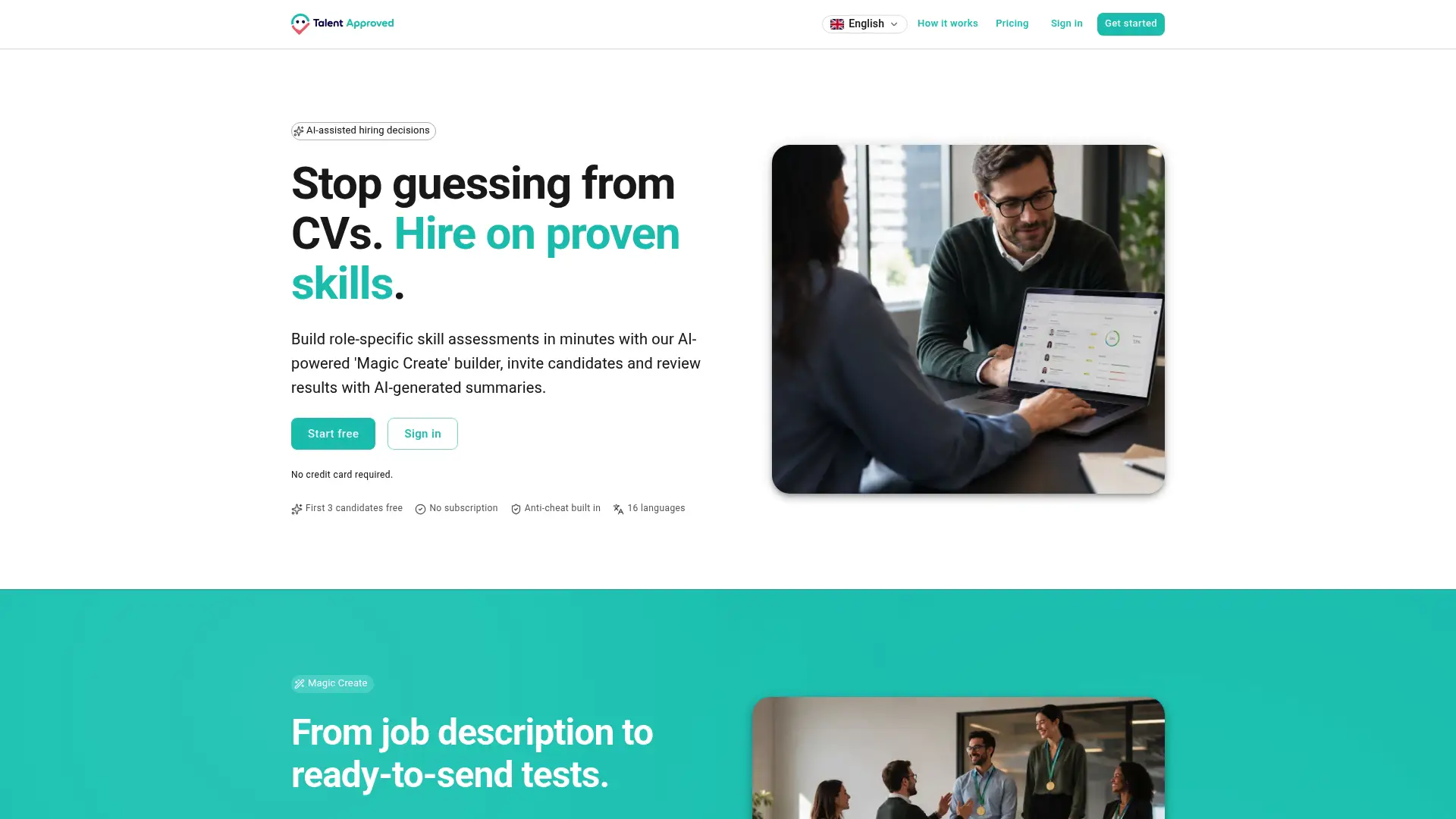
Talentapproved’s Magic Create feature builds role-specific assessments in minutes from a job description or a list of required skills. The platform’s AI-generated summaries and built-in anti-cheat mechanisms mean you spend your time on high-quality motivation conversations, not manual test review. For HR teams and recruiters who want to hire on proven capability rather than CV claims, Talentapproved’s AI assessments pair directly with the motivation techniques in this article to give you a complete picture of every candidate.
FAQ
What is candidate motivation assessment?
Candidate motivation assessment is the process of using structured questions, behavioral frameworks, and scoring rubrics to evaluate whether a candidate is genuinely driven by the work a role requires. It goes beyond skills to measure intrinsic fit.
What are the best questions to assess candidate motivation?
Push-pull behavioral questions are the most effective. Ask what drove a candidate away from a previous role and what specifically attracted them to this one. Their exact phrasing reveals real values more reliably than direct motivation questions.
How do you assess motivation without a dedicated HR team?
Small teams can use 3–5 structured interview questions with a simple 1–5 scoring rubric tracked in a spreadsheet. This approach costs nothing and eliminates gut-feel decisions by creating a documented, comparable record for each candidate.
What is Self-Determination Theory and why does it matter in hiring?
Self-Determination Theory identifies autonomy, competence, and relatedness as the three core drivers of sustained motivation. Mapping interview questions to these three needs helps recruiters predict whether a role will keep a candidate engaged over time.
How do simulation exercises help assess motivation?
Simulations create new behavioral evidence by placing candidates in realistic job scenarios. Observing how a candidate approaches a real task, what questions they ask, and how they handle ambiguity reveals motivation more accurately than any self-reported answer.