
How to Improve Quality of Hire Metrics in 2026

Quality of hire is defined as the value an employee provides to an organization after joining. It is the single most important metric in modern recruitment, yet it remains one of the least consistently tracked. 91% of talent leaders call it their most important recruiting metric, but 66% of organizations fail to track it due to a lack of clear definition. That gap represents a direct cost to hiring accuracy, retention, and business performance. To improve quality of hire metrics, HR professionals need structured processes, leading indicators, and a measurement framework built before the first interview, not after the first 90-day review.
What are the most effective metrics to measure quality of hire?
Quality of hire (QoH) is the industry standard term for measuring the post-hire value a new employee delivers. The phrase “improve quality of hire metrics” refers to the practical work of making that measurement more accurate, timely, and actionable. Most HR teams default to lagging indicators, such as 90-day performance reviews, turnover rates, and manager satisfaction scores collected months after hire. These metrics confirm problems but rarely prevent them.
The shift to leading indicators changes that. Leading indicators like competency capture coverage, measured within 24 hours of an interview, give hiring teams data they can act on before a bad hire is finalized. That speed is the difference between course-correcting a search and onboarding the wrong person.

The core metrics that reliably reflect hire quality fall into five categories:
| Metric | Definition | When to Measure |
|---|---|---|
| Job performance | Manager-rated output against role expectations | 30, 60, and 90 days post-hire |
| Retention rate | Percentage of hires still employed at 12 months | 12 months post-hire |
| Employee engagement | Survey scores reflecting motivation and fit | 60 days post-hire |
| Ramp-up time | Days until new hire reaches full productivity | Tracked from day one |
| Competency capture coverage | Percentage of required competencies assessed in interview | Within 24 hours post-interview |
Competency capture coverage is the most underused metric on this list. It tells you whether your interview actually tested what the role requires. If a sales role demands negotiation, objection handling, and pipeline management, but your interview only covered general communication, your QoH data will be incomplete from the start.
How do structured interviews improve quality of hire?
Structured interviews are the single most reliable tool for improving hiring quality. Structured interviews are 57% more predictive of job success than unstructured interviews. That predictive advantage translates directly into higher QoH scores and fewer costly mis-hires.
The difference between structured and unstructured interviews comes down to consistency. In a structured interview, every candidate answers the same questions, evaluated against the same competency rubric. In an unstructured interview, the conversation follows the interviewer’s instincts. The result is a comparison of impressions rather than evidence.
Competency rubrics are the backbone of structured interviewing. A rubric defines what “excellent,” “adequate,” and “impressive but unfit” look like for each competency before sourcing begins. Success criteria defined in intake sessions as rubric definitions give interviewers a shared language and reduce the subjectivity that distorts hiring decisions.
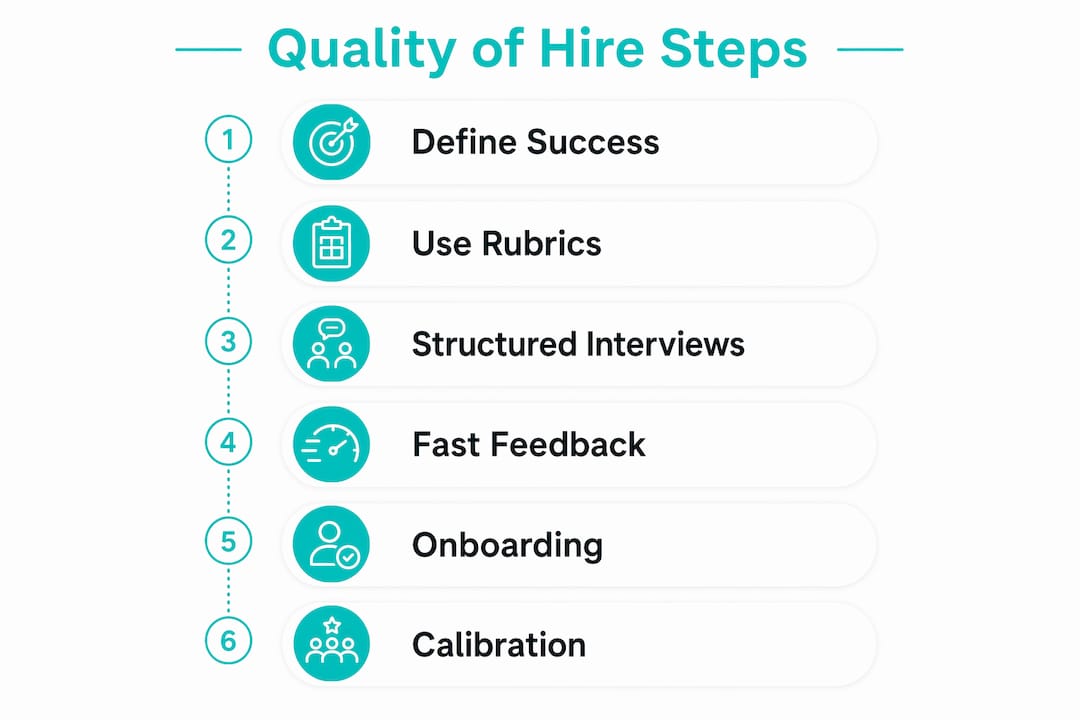
Pro Tip: Run your intake session as a rubric-definition workshop. Ask the hiring manager to describe the last person who excelled in this role and the last person who failed. Those two descriptions become your scoring anchors.
Best practices for structured interview design include:
- Write behavioral questions tied directly to each competency in the rubric.
- Assign each question to a specific interviewer to avoid redundancy across panel rounds.
- Calibrate rubric anchors with the hiring team before the first interview, not after.
- Train interviewers to score candidates independently before any debrief discussion.
- Co-define job specifications with hiring managers to improve QoH by 18–25% and reduce sourcing costs by 20%.
Structured interviews also protect employer brand. Rejected candidates report 35% higher satisfaction when interviewed through a structured process. That matters because rejected candidates talk, and their experience shapes how future applicants perceive your organization.
What processes enable fast feedback loops in hiring?
Fast feedback loops are the operational engine behind accurate QoH measurement. The core problem is memory decay. Scoring candidates during interviews prevents the loss of 80% of conversational context that occurs after a call ends. Waiting until a debrief meeting the next day means interviewers reconstruct impressions rather than report evidence.
Real-time scoring solves this. When interviewers score each competency during the interview itself, the data is captured at peak accuracy. AI-assisted note-taking tools that auto-populate scorecards from structured interviews take this further by reducing the manual effort that causes interviewers to skip scoring altogether.
The steps in a fast feedback loop from interview to hire calibration are:
- Score each competency in real time during the interview using the agreed rubric.
- Submit scores within one hour of the interview ending to prevent memory contamination.
- Flag rubric variance, where two interviewers score the same competency more than two levels apart, for immediate discussion.
- Review competency capture coverage before advancing any candidate to the next round.
- Run a weekly calibration session to cross-reference recent hires against their pre-hire scores and adjust rubric anchors where patterns emerge.
Pro Tip: Track rubric variance as a standalone metric. High variance between interviewers on the same competency signals a poorly defined rubric anchor, not a difficult candidate. Fix the rubric, not the process.
Calibration sessions reduce rating variance by up to 25%, which directly increases consistency in QoH measurements across hiring managers and roles. Weekly calibration is more effective than monthly calibration because it catches drift before it compounds across multiple hires.
How does structured onboarding affect quality of hire outcomes?
Onboarding is where quality of hire either gets confirmed or quietly unravels. Organizations with structured 90-day onboarding programs achieve 25% higher retention and 30% faster time-to-productivity than those using ad hoc onboarding. Those numbers represent a direct return on the investment made during hiring.
The connection between onboarding and QoH is straightforward. A new hire who reaches full productivity faster generates value sooner. A new hire who stays past 12 months validates the hiring decision. Both outcomes feed directly into QoH calculations.
| Onboarding feature | Impact on QoH metrics |
|---|---|
| 30/60/90-day milestone plan | Accelerates ramp-up time measurement |
| Buddy system | Improves 60-day engagement scores |
| Manager feedback loops | Increases 90-day performance rating accuracy |
| Role-specific training tracks | Reduces time to full productivity |
| Cultural integration activities | Improves retention at 12 months |
Recommended onboarding practices that directly support QoH measurement include:
- Set written milestones for days 30, 60, and 90 before the hire’s first day.
- Assign a peer buddy from the same team to accelerate cultural integration.
- Schedule weekly manager check-ins during the first 90 days with a structured agenda.
- Collect engagement survey data at 60 days to catch early disengagement before it becomes turnover.
- Feed onboarding performance data back into the hiring rubric to refine future assessments.
The feedback loop from onboarding back to hiring is where most organizations leave value on the table. If your 90-day data consistently shows a gap between interview scores and actual performance, your rubric anchors need recalibration.
What are the most common mistakes when measuring hire quality?
The most common mistake in QoH measurement is waiting too long to measure anything. Only 23% of organizations that consistently deliver high-quality hires measure QoH in detail. The other 77% rely on intuition, manager feedback, or turnover rates that arrive months after the damage is done.
Undefined success criteria are the root cause of most measurement failures. When hiring managers and recruiters have different mental models of what a successful hire looks like, every metric they collect measures something slightly different. The result is data that cannot be compared, aggregated, or acted on.
Candidate-versus-candidate scoring is another common trap. When interviewers score candidates relative to each other rather than against a fixed rubric, the best candidate in a weak pool still looks good on paper. Rubric anchoring prevents this by holding every candidate to the same absolute standard.
“Quality of hire must be defined prior to the search as the value an employee provides after joining, not retroactively reconstructed.” — Crosschq
Pro Tip: Involve hiring managers in rubric definition at the start of every search, not just for senior roles. The earlier they co-own the success criteria, the more accurately they will rate candidates against them.
Delaying interventions until 90-day reviews is the third major mistake. By that point, a poor hire has already cost the organization in onboarding time, team disruption, and lost productivity. Leading indicators measured within 24 hours of each interview give you the data to course-correct during the search, not after it ends.
Key Takeaways
Improving quality of hire metrics requires defining success criteria before sourcing begins, measuring leading indicators within 24 hours of each interview, and running regular calibration sessions to keep scoring consistent.
| Point | Details |
|---|---|
| Define QoH before sourcing | Set explicit success criteria in intake sessions so every interviewer measures the same thing. |
| Use leading indicators | Measure competency capture coverage within 24 hours to avoid waiting for 90-day reviews. |
| Structured interviews predict success | Structured formats are 57% more predictive of job success than unstructured conversations. |
| Calibrate regularly | Weekly calibration sessions reduce rating variance by up to 25% across interviewers. |
| Connect onboarding to hiring data | Feed 90-day performance data back into rubrics to refine future assessments. |
Why I think most QoH programs fail before they start
After years of working with HR teams on hiring measurement, the pattern I keep seeing is the same. Organizations invest in metrics frameworks, buy new tools, and train interviewers, then wonder why their QoH scores do not improve. The problem is almost never the tools. It is the sequence.
Most teams define quality of hire after a search is already underway. They build rubrics during the debrief, not the intake. They collect data after the hire, not during the interview. Every intervention arrives one step too late to change the outcome it is supposed to measure.
The teams I have seen get this right treat the intake session as the most important meeting in the hiring process. Not the final interview. Not the offer call. The intake. That is where success gets defined, rubrics get anchored, and the measurement framework gets built. Everything after that is execution.
The other thing most articles will not tell you is that calibration is a cultural practice, not a process step. You can mandate weekly calibration sessions and still get no value from them if hiring managers treat them as a checkbox. The sessions only work when recruiters and managers genuinely use them to question their own scoring. That requires psychological safety and a shared belief that the data matters. Building that belief is the real work of improving hiring quality, and no tool does it for you.
— Jimmie
How Talentapproved supports better hiring decisions
HR teams that want to move from intuition-based hiring to evidence-based hiring need assessment infrastructure that works at the speed of a real search.
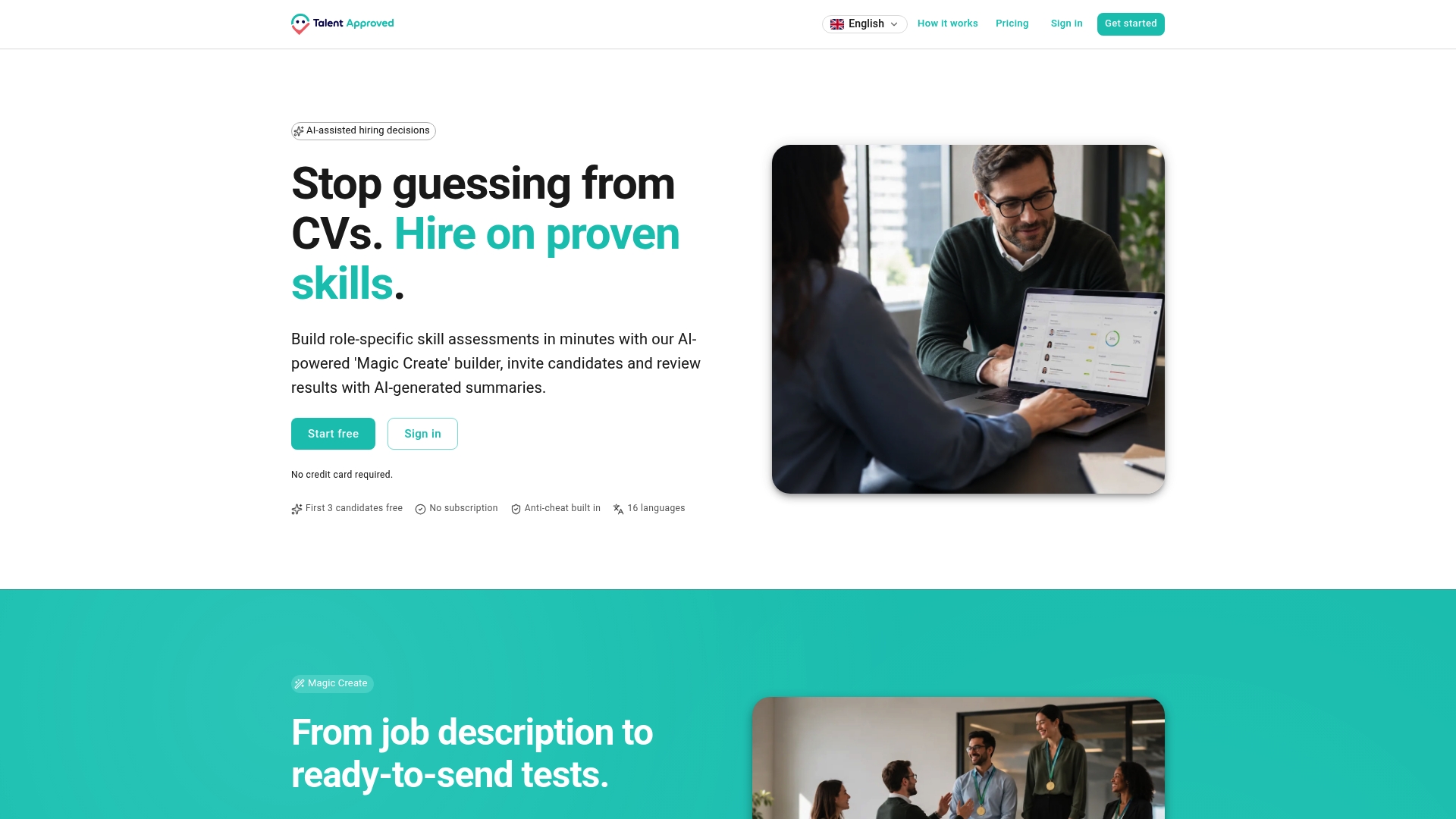
Talentapproved provides an AI-powered platform for building and managing skill assessments tied directly to role-specific competencies. Its Magic Create feature generates tailored assessments in minutes from a job description or skills list, giving hiring teams structured data before the first interview debrief. Built-in anti-cheat mechanisms and AI-generated candidate summaries reduce the manual review burden and keep scoring consistent across interviewers. For HR teams focused on measuring recruitment effectiveness and improving the ROI of their recruitment processes, Talentapproved connects candidate evaluation directly to the competency rubrics that drive QoH measurement.
FAQ
What is quality of hire and why is it measured?
Quality of hire measures the value a new employee delivers after joining an organization. It is measured to connect recruiting decisions to business outcomes like retention, productivity, and performance.
How do structured interviews improve quality of hire scores?
Structured interviews are 57% more predictive of job success than unstructured interviews because every candidate is evaluated against the same competency rubric, reducing bias and improving scoring consistency.
What are leading indicators in quality of hire measurement?
Leading indicators are metrics like competency capture coverage that are measurable within 24 hours of an interview. They allow hiring teams to assess and adjust candidate quality during a search rather than waiting for 90-day performance reviews.
How often should hiring teams run calibration sessions?
Weekly calibration sessions are more effective than monthly ones. Regular calibration reduces rating variance by up to 25% and catches scoring drift before it affects multiple hires.
How does onboarding connect to quality of hire metrics?
Structured 90-day onboarding programs produce 25% higher retention and 30% faster time-to-productivity. Feeding onboarding performance data back into hiring rubrics improves the accuracy of future candidate assessments.