
The Role of Psychometric Testing in HR Hiring

Psychometric testing is the standardized, scientific measurement of a candidate’s cognitive abilities, personality traits, and behavioral tendencies to support objective HR decision-making. The role of psychometric testing in HR goes far beyond a simple screening filter. These assessments give hiring managers objective data that resumes and interviews alone cannot provide. Around 80% of Fortune 500 companies use psychometric testing to improve hiring accuracy and reduce bias, with over two-thirds of European firms adopting similar practices. That level of adoption reflects a clear industry consensus: structured psychological measurement makes hiring more defensible, more fair, and more accurate.
Why psychometric testing matters in recruitment today
Psychometric assessments in recruitment solve a problem that every hiring manager knows well. Unstructured interviews favor candidates who are likable, well-spoken, or simply familiar. They do not reliably predict who will actually perform on the job.
General cognitive ability is one of the strongest validated predictors of job performance, outperforming unstructured interviews across decades of meta-analysis by Schmidt & Hunter. That finding holds across industries and role levels. Cognitive tests measure reasoning, working memory, and problem-solving speed. These are skills that directly affect how quickly someone learns a new role and handles complexity.

Personality measures add a second layer. Conscientiousness, in particular, consistently predicts performance in roles requiring reliability, attention to detail, and follow-through. Psychometric instruments reduce interviewer bias by measuring ability and traits that are independent of first impressions or likeability. That objectivity is what makes them valuable.
The key benefits of psychometric testing in HR recruitment include:
- Bias reduction: Structured test scores replace gut-feel judgments with measurable data.
- Predictive validity: Cognitive and personality scores correlate with on-the-job performance more reliably than most interview formats.
- Consistency: Every candidate faces the same questions under the same conditions, making comparisons fair.
- Efficiency: Screening large applicant pools with assessments before interviews saves significant recruiter time.
“Even scientifically validated tools must not replace the human element but rather provide objective data that makes hiring fairer, more transparent, and defensible.” This principle defines how responsible HR teams use psychometric data: as evidence to inform decisions, not as a verdict to replace them.
What are the main types of psychometric assessments?
HR professionals use three broad categories of psychometric tests, each measuring something distinct and serving a different purpose in the hiring process.
| Assessment type | What it measures | Best used for |
|---|---|---|
| Cognitive ability tests | Reasoning, memory, numerical and verbal skills | Roles with high learning demands or analytical complexity |
| Personality questionnaires | Traits like conscientiousness, openness, and emotional stability | Culture fit, team dynamics, and leadership potential |
| Behavioral/motivational assessments | Work style, motivation drivers, and interpersonal tendencies | Senior roles, client-facing positions, and team composition |
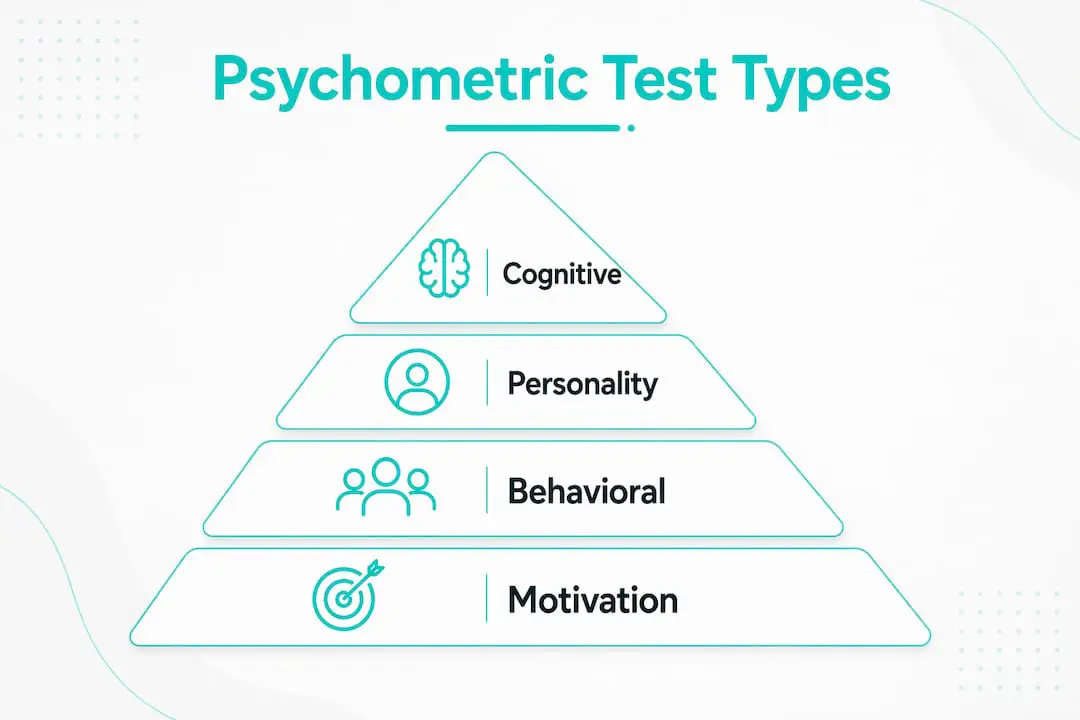
Cognitive ability tests are the most predictively powerful of the three. They work across a wide range of roles because most jobs require some level of reasoning and learning. Personality questionnaires like Aon’s ADEPT-15 extend beyond cognitive measures to evaluate culture fit and motivational drivers, which cognitive tests alone cannot capture.
Behavioral assessments add nuance for senior or specialized roles. A candidate may score well on reasoning but have a work style that conflicts with a team’s existing dynamics. Behavioral data surfaces those mismatches before the hire, not after.
Professionally recognized psychometric tests are conducted under identical conditions and statistically normed against reference populations. Many commercial tools lack these features entirely. HR professionals should verify that any tool they use has published validity data and a documented normative sample before deploying it.
Pro Tip: Ask any test vendor for their technical manual. A credible tool will have published reliability coefficients and normative data. If a vendor cannot provide this, the test is not professionally standardized.
How does psychometric testing strengthen organizational culture?
The impact of psychometric testing extends well beyond the initial hire. Organizations that embed assessments into their talent lifecycle gain a clearer picture of workforce strengths, development gaps, and internal mobility potential.
Psychometric assessment works best as a strategic organizational capability integrated within long-term HR and workforce planning frameworks. Human Capital Theory frames this directly: employees are assets, and understanding their cognitive and behavioral profiles helps organizations allocate talent more effectively. The Resource-Based View adds that a workforce with well-mapped capabilities becomes a competitive advantage that competitors cannot easily replicate.
Practical applications beyond hiring include:
- Internal mobility: Assessment data helps identify employees ready for promotion or lateral moves before a vacancy forces a rushed decision.
- Team composition: Behavioral profiles reveal complementary strengths and potential friction points when building project teams.
- Development planning: Cognitive and personality data informs which training investments will have the highest return for each employee.
- Succession planning: Organizations can identify high-potential employees early and build structured development paths around their profiles.
Psychometric assessments transition organizations from reactive hiring to proactive talent management. That shift supports sustainable workforce strategies rather than constant firefighting. When HR teams use T-shaped skills assessments alongside psychometric data, they build a far more complete picture of each employee’s current value and future potential.
Best practices for integrating psychometric tests into hiring
Getting the most from psychometric evaluation for employees and candidates requires more than simply purchasing a test and sending it to applicants. The process matters as much as the tool.
-
Select validated, standardized tools. Only use tests with published reliability and validity data. Standardization and scaling against normative populations are non-negotiable for results you can trust and defend.
-
Match the test to the role. A complex cognitive battery designed for senior analysts is not appropriate for an entry-level logistics role. Map test complexity and type to the actual demands of the position.
-
Integrate results into structured interviews. Administering tests without integrating results into interview questions wastes the objective data you collected. Use test findings to probe specific areas during the interview.
-
Apply the 60/40 approach. Combining psychometric results with structured interviews and work samples doubles selection quality compared to using only one method. Weight test data at roughly 60% and structured interview evidence at 40%, adjusting for role complexity.
-
Monitor local outcomes. Validity estimates are averages across populations. Your specific organization and role context may produce different results. Track hiring outcomes and adjust your selection system based on what the data shows locally.
-
Use AI-assisted review for efficiency. AI-powered assessment platforms generate structured candidate reports in under 5 minutes, addressing bottlenecks in high-volume recruitment. That speed allows HR teams to review more candidates without sacrificing depth.
Pro Tip: Build a simple scoring rubric that maps test results to role-specific competencies. This keeps interpretation consistent across different hiring managers and prevents individual bias from creeping back into the process.
For a practical look at how candidate motivation assessment fits into this workflow, the behavioral dimension is often the most overlooked and the most revealing.
Key Takeaways
Psychometric testing improves hiring accuracy by combining standardized cognitive, personality, and behavioral data with structured interviews, reducing bias and predicting job performance more reliably than any single method alone.
| Point | Details |
|---|---|
| Industry adoption is high | Around 80% of Fortune 500 companies use psychometric testing to improve selection accuracy. |
| Cognitive ability predicts performance | Schmidt & Hunter meta-analysis confirms cognitive tests outperform unstructured interviews for job success prediction. |
| Standardization is non-negotiable | Only use tools with published validity data and normative samples; skip any tool that cannot provide a technical manual. |
| Combine tests with interviews | A 60/40 blend of psychometric data and structured interviews doubles selection quality over single-method approaches. |
| Value extends beyond hiring | Psychometric data supports internal mobility, team planning, and succession decisions across the talent lifecycle. |
Why I think HR teams underuse psychometric data after the hire
Most HR professionals I have worked with treat psychometric testing as a recruitment gate. The candidate passes or fails, gets hired or rejected, and the test data gets filed away. That is a significant missed opportunity.
The same cognitive and behavioral profile that helped you hire someone tells you how to develop them, where to place them on a team, and when they are ready for more responsibility. Organizations that revisit assessment data during performance reviews and succession planning conversations get substantially more value from the investment they already made.
The other issue I see regularly is overconfidence in the tool itself. A well-validated test is a strong signal, not a guarantee. A single test does not capture full performance potential. Combining cognitive tests, conscientiousness measures, structured interviews, and work samples produces far better predictions than any one instrument alone. HR teams that treat a personality questionnaire as a definitive verdict are misusing the science.
The most responsible and effective approach is to treat psychometric data as one well-calibrated input in a larger, human-led decision process. Train your assessors, monitor your outcomes, and update your tools when the evidence says they are not working locally. The science supports psychometric testing strongly. The implementation still requires human judgment.
— Jimmie
How Talent Approved supports psychometric and skills testing in HR
HR teams that want to act on the evidence behind psychometric testing need tools that match the pace of modern recruitment.
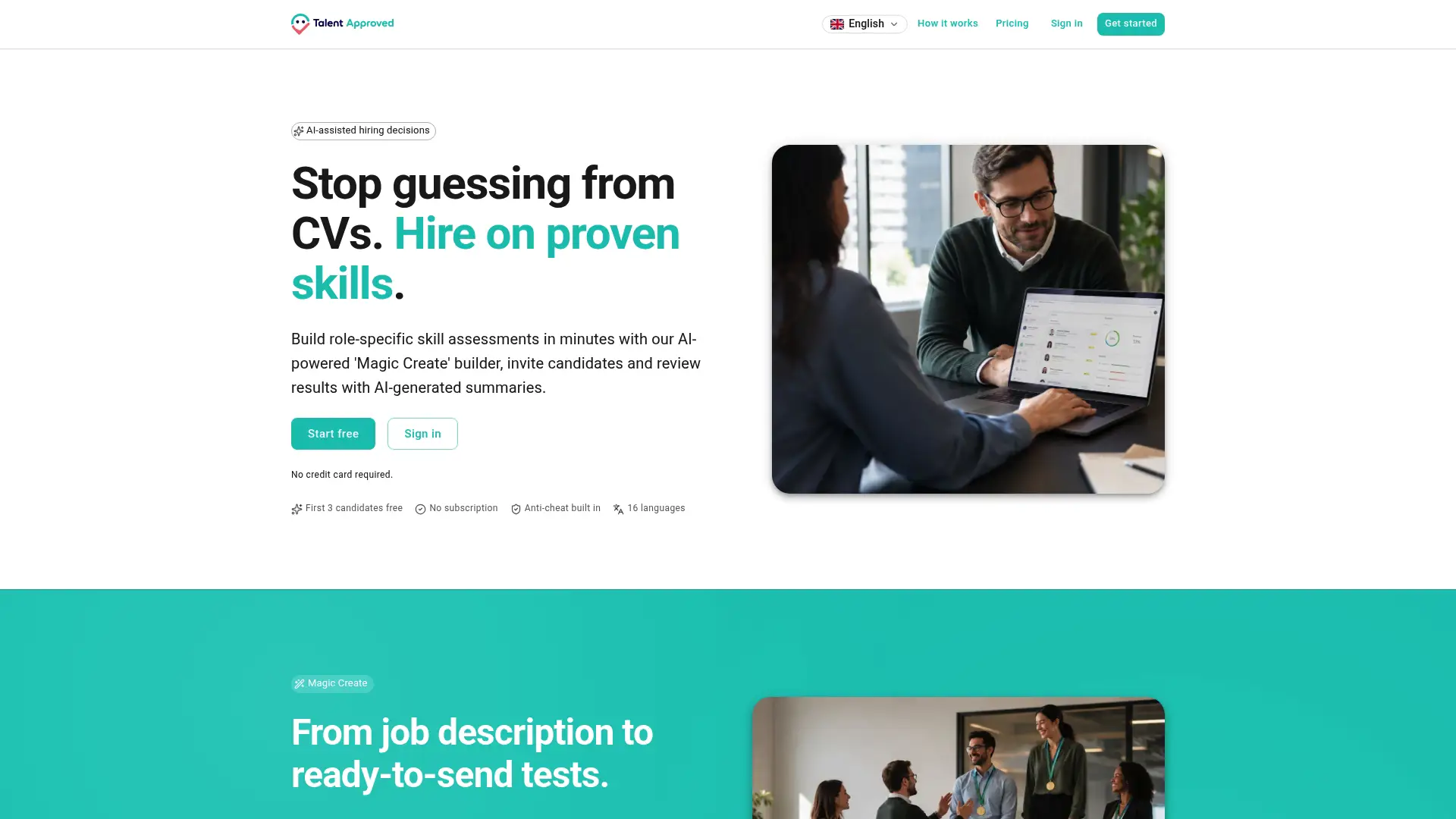
Talent Approved is an AI-powered platform that lets HR professionals create role-specific skill assessments from a job description in minutes using its Magic Create feature. The platform generates structured candidate reports quickly, reducing the bottleneck that slows high-volume hiring. Built-in anti-cheat mechanisms protect the integrity of every assessment. AI-driven candidate ranking surfaces the strongest candidates without requiring manual score comparison. For HR teams ready to move from CV-based screening to capability-based hiring, Talent Approved’s full platform shows exactly how the process works end to end.
FAQ
What is the role of psychometric testing in HR?
Psychometric testing in HR provides standardized, objective data on candidates’ cognitive abilities, personality traits, and behavioral tendencies. This data reduces hiring bias and improves the accuracy of job performance predictions.
How do psychometric tests reduce bias in hiring?
Psychometric instruments measure ability and traits independently of a candidate’s appearance, likeability, or communication style. This removes the subjective factors that typically skew unstructured interviews.
What types of psychometric tests are used in recruitment?
HR professionals use three main types: cognitive ability tests, personality questionnaires, and behavioral or motivational assessments. Each type measures different attributes and maps to different role requirements.
Should psychometric test results be the only factor in a hiring decision?
No. Combining psychometric results with structured interviews and work samples doubles selection quality compared to using any single method alone. Test scores are one strong input, not a final verdict.
How often should organizations validate their psychometric tools?
Organizations should monitor local hiring outcomes continuously and adjust their selection systems when results diverge from expected validity. Published validity estimates are population averages and may not hold in every organizational context.