
How T-Shaped Skills Are Assessed: A 2026 HR Guide

T-shaped skills are defined as a combination of deep expertise in one discipline and working knowledge across multiple adjacent areas. Knowing how t-shaped skills are assessed is the difference between hiring a specialist who collaborates well and one who creates silos. The AIHR T-Shaped HR Competency Model and McKinsey’s cross-functional team research both confirm that structured evaluation, not gut feel, produces reliable results. This guide gives HR professionals and recruiters a practical framework for measuring both dimensions accurately in 2026.
How t-shaped skills are assessed: depth, breadth, and the methods that work
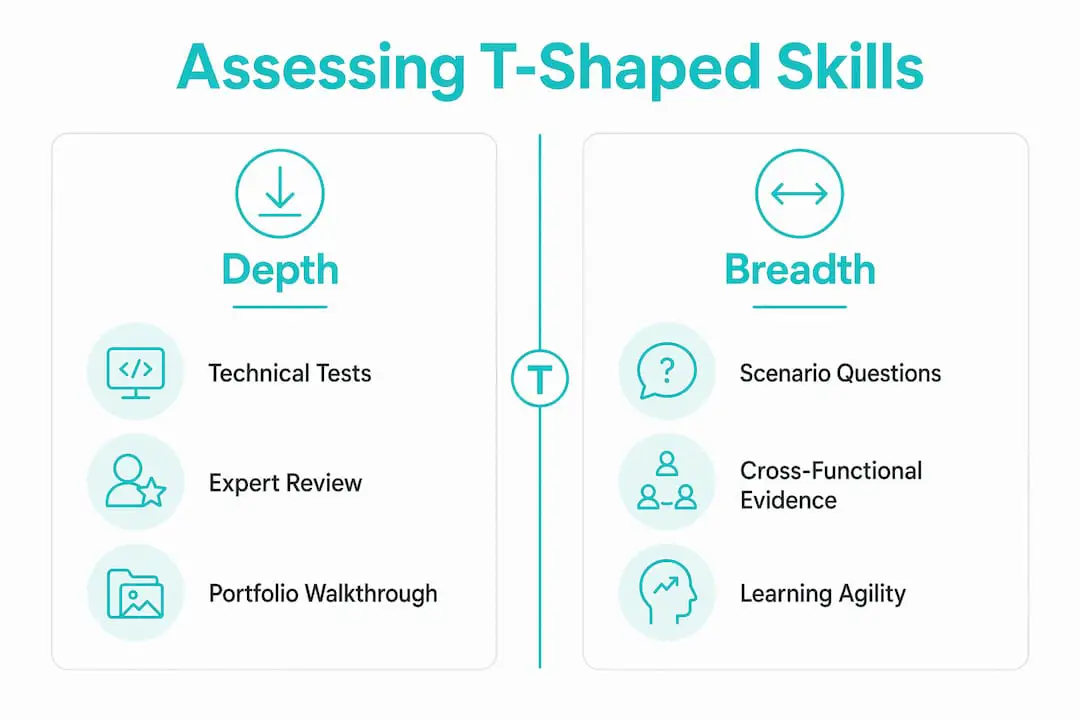
T-shaped skills evaluation requires two separate diagnostic tracks, not one blended score. Recruiters who collapse depth and breadth into a single rating miss the distinction that makes T-shaped hiring valuable. Treating assessment as binary rather than diagnosing each dimension through targeted methods is the most common error in T-shaped hiring.
Assessing depth: technical tests and expert validation
Depth assessment measures whether a candidate can perform core work without supervision. The most reliable methods are technical tests, portfolio review, and structured expert interviews. A Level 3 proficiency standard is defined as the ability to ship quality work unsupervised, while Level 4 means setting quality bars and mentoring others. Using these anchored definitions removes ambiguity and makes candidate comparison objective.

Portfolio review works best when reviewers ask candidates to walk through a specific deliverable, explain the decisions made, and describe the tradeoffs accepted. That process surfaces genuine expertise faster than any multiple-choice test.
Assessing breadth: scenario-based questions and cross-functional evidence
Breadth assessment tests whether a candidate has applied skills outside their core domain. Scenario-based interviews, cross-functional case studies, and behavioral questions are the primary tools. The strongest signal comes from specific cross-boundary stories with tangible outcomes, not vague claims about being a team player.
Ask candidates to describe a project where they had to work in a domain outside their specialty. Listen for real stakes, named collaborators, and measurable results. Candidates who cannot produce a concrete example often signal a narrow career pattern that limits T-shaped potential.
- Depth methods: technical skills tests, portfolio walkthroughs, expert panel interviews, work sample tasks
- Breadth methods: behavioral interviews, cross-functional case studies, scenario-based problem solving, reference checks focused on collaboration
- Learning agility signals: how candidates describe adapting to new domains, what they read, what they built outside their core role
Pro Tip: Ask every candidate one question about a time they had to learn a new domain quickly under pressure. Learning agility is a major predictor of success in T-shaped roles, and failure to test for it is a red flag in 2026 hiring.
What tools and frameworks work for measuring T-shaped skills?
Skills matrices are the standard tool for visualizing T-shaped profiles across both individual candidates and existing teams. A well-built matrix maps each person’s skills on two axes: the skill name and the proficiency level. The AIHR T-Shaped HR Competency Model uses annual reassessment to reveal team strengths and growth areas, directly supporting career pathing and internal mobility decisions.
Building a skills matrix that actually gets used
The most common mistake in matrix design is including too many skills. Skills matrices should cover only 8–12 key capabilities to stay actionable. Matrices with 30 or more rows become bureaucratic documents that managers ignore. Limiting the matrix to the skills that genuinely determine performance keeps it relevant and used.
A practical proficiency scale for T-shaped assessment looks like this:
| Proficiency level | Definition |
|---|---|
| 0 | No exposure to this skill |
| 1 | Aware of concepts; needs guidance for any task |
| 2 | Can complete tasks with supervision |
| 3 | Works independently; ships quality output |
| 4 | Sets standards; mentors others |
| 5 | Recognized authority; drives organizational practice |
Levels 3 and 4 are the critical thresholds for T-shaped assessment. A candidate with Level 4 in their core domain and Level 2 or 3 across three adjacent areas fits the T-shaped profile clearly.
Team metrics vs. individual output measures
Individual skills matrices capture personal profiles. Team-level T-shaped evaluation requires a different lens. Integration measures, such as cross-team unblockings, early escalation identification, and boundary-spanning contributions, capture what traditional performance reviews miss. Tracking these metrics at the team level creates a culture that rewards crossing domain boundaries, not just deepening a single specialty.
Pro Tip: When building a skills matrix for a hiring panel, include one column for “evidence source” next to each proficiency rating. Requiring evaluators to name the specific test, portfolio item, or interview question that justified the score eliminates uncalibrated guesswork.
Common challenges when assessing T-shaped skills
The biggest pitfall in T-shaped skills testing is relying on self-assessments without calibration anchors. Candidates consistently overrate their breadth because the criteria are vague. Without behaviorally anchored rating scales, a candidate’s “7 out of 10” in data analysis means nothing compared to another candidate’s “7 out of 10.”
A second common error is treating rotation assignments as a shortcut to breadth. Rotation periods shorter than six months rarely produce meaningful T-shaped development. Short rotations create surface familiarity, not genuine cross-domain capability. Recruiters who ask about past rotations should probe for duration, goals, and specific contributions made during the assignment.
“Candidates lacking specific examples of work crossing domain boundaries often signal a narrow career management style, limiting T-shaped potential. Interviewers should seek concrete stories with real stakes rather than vague claims.” — Roberto Hortal
Watch for these specific warning signs during T-shaped evaluation:
- Candidates who describe breadth only in terms of attending cross-functional meetings, not contributing to outcomes
- Self-rated proficiency scores that are not supported by any named deliverable or project
- Skills matrices that have not been updated in over a year, creating a bus factor risk where critical skills rest on a single person
- Rotation histories that lasted fewer than six months with no stated learning objective
Overcomplexity in assessment design is also a real risk. When a T-shaped evaluation process requires 12 separate tests and three panel interviews, hiring managers stop using it. Keep the process structured but proportionate to the role’s actual requirements.
Best practices for integrating T-shaped evaluation into hiring and development
Embedding T-shaped skills evaluation into your hiring process requires deliberate design at each stage, from job posting to final decision.
-
Write job descriptions that name both dimensions. Specify the core specialty required at Level 3 or above and list two or three adjacent areas where Level 2 competency is expected. This sets candidate expectations before the first interview.
-
Use structured behavioral interviews with cross-functional case studies. Design at least one case study that requires the candidate to apply their core expertise in an unfamiliar domain context. Score responses against a rubric tied to your skills matrix levels.
-
Evaluate learning agility explicitly. Ask candidates to describe a time they had to build competency in a new area within a defined deadline. Score the response on speed of acquisition, methods used, and quality of output achieved.
-
Apply skills matrices to guide internal mobility decisions. Annual reassessment of team skills matrices reveals gaps and informs which employees are ready for cross-functional assignments. This prevents reactive, unplanned rotations that fail to build genuine breadth.
-
Plan rotations with clear boundary goals and a minimum six-month timeline. Rotation assignments need a defined learning objective, a named sponsor in the receiving team, and a minimum viable duration to produce real cross-domain growth.
-
Measure boundary-spanning contributions in performance reviews. Track metrics like cross-team problems resolved, knowledge transfer sessions delivered, and escalations identified early. These numbers make T-shaped contribution visible and reward it.
Pro Tip: To avoid measurement bias, have two independent evaluators score each candidate’s depth and breadth separately before comparing notes. Calibration conversations after independent scoring produce more accurate final ratings than group scoring in real time.
Key takeaways
Assessing T-shaped skills requires separate, structured methods for depth and breadth, anchored to defined proficiency levels and supported by real candidate evidence.
| Point | Details |
|---|---|
| Assess depth and breadth separately | Use technical tests for depth and behavioral interviews for breadth; never collapse both into one score. |
| Anchor ratings to defined levels | Proficiency levels 0–5 with behavioral anchors remove ambiguity and enable objective candidate comparison. |
| Limit skills matrices to 8–12 skills | Matrices with more rows become unused; focus on the capabilities that determine actual job performance. |
| Require concrete cross-domain stories | Candidates without specific examples of boundary-spanning work signal limited T-shaped potential. |
| Plan rotations for six months minimum | Shorter rotations build surface familiarity, not genuine cross-domain capability. |
Why careful T-shaped assessment changes everything
Recruiters often ask me whether T-shaped hiring is worth the extra effort. My answer is always yes, but only when the assessment is built correctly from the start.
The mistake I see most often is that hiring teams spend 90% of their evaluation time on depth and treat breadth as a bonus question at the end of the interview. That approach produces deep specialists who struggle to collaborate across functions. The T-shaped value comes precisely from the combination, and you cannot measure a combination by testing only one half.
What I have found genuinely useful is treating the skills matrix as a living document rather than a compliance artifact. When a team updates its matrix quarterly and ties it to hiring decisions, succession planning, and rotation assignments, it becomes a real management tool. When it sits in a shared drive and gets reviewed once a year for a performance cycle, it tells you nothing useful.
The other shift that matters is moving from individual output metrics to integration metrics. A candidate who unblocks three other teams, identifies a cross-functional risk early, and transfers knowledge to two junior colleagues is delivering T-shaped value. Traditional performance reviews rarely capture any of that. Building those measures into your evaluation process, both for candidates and for existing employees, is what separates organizations that talk about T-shaped talent from those that actually develop it.
Assessment is not a one-time event. The best T-shaped hiring processes treat evaluation as ongoing, revisiting candidate profiles during onboarding and again at the six-month mark to confirm that the breadth signals from the interview hold up in practice.
— Jimmie
Talent Approved and T-shaped skill assessments
HR teams that want to move beyond CV screening and gut-feel interviews need a structured way to test both depth and breadth at scale. Talent Approved builds that structure directly into the hiring process.
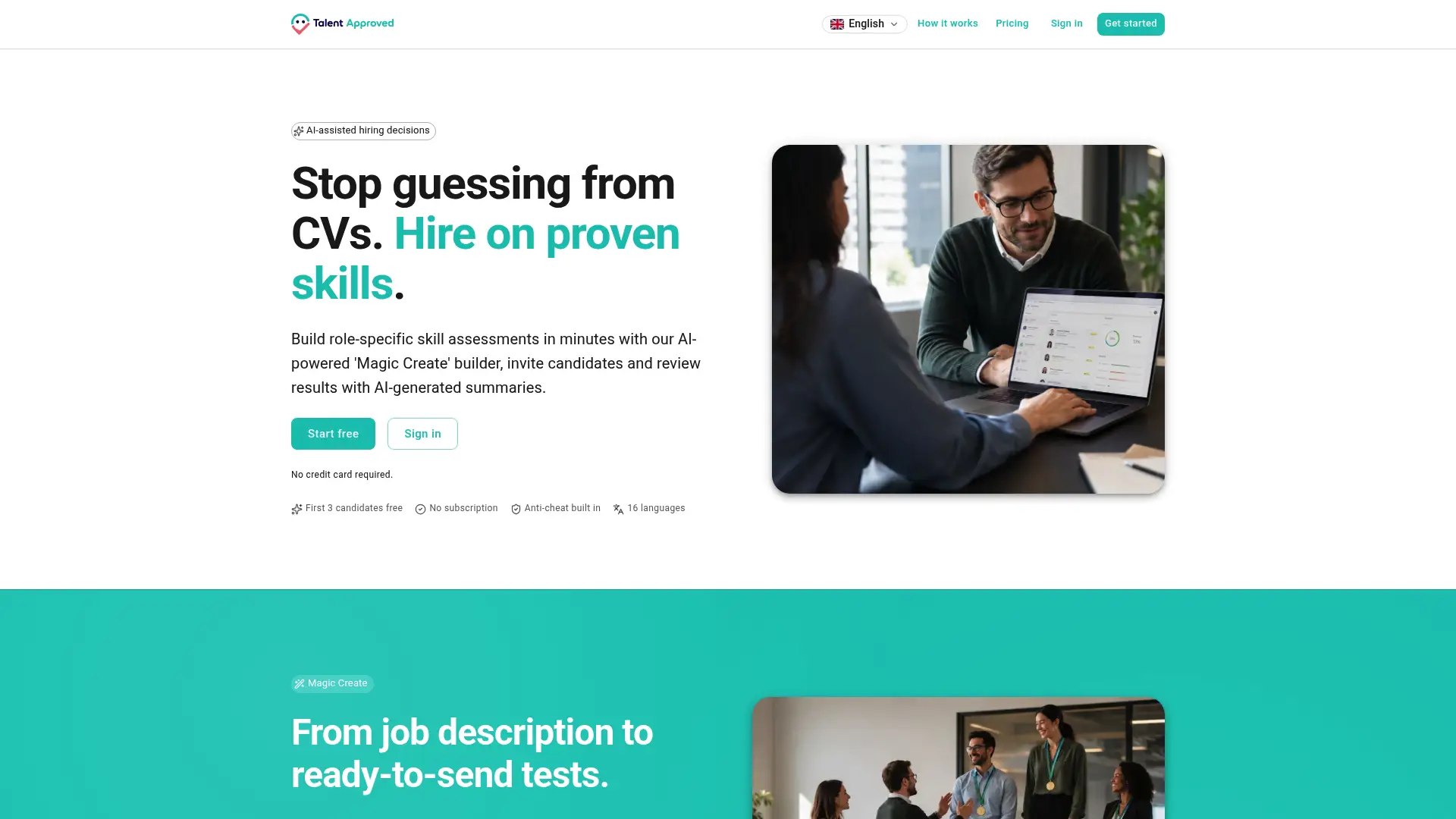
The platform’s Magic Create feature generates role-specific skills assessments in minutes from a job description or a list of target competencies. Each assessment can be configured to test core specialty depth alongside cross-functional breadth, matching the T-shaped evaluation framework described in this guide. Built-in anti-cheat mechanisms and AI-generated candidate summaries give hiring teams reliable, evidence-backed scores without hours of manual review. For HR professionals who need to hire T-shaped talent accurately and efficiently, Talent Approved removes the guesswork from the process.
FAQ
What are T-shaped skills?
T-shaped skills describe a professional profile combining deep expertise in one discipline with working knowledge across multiple adjacent areas. The vertical bar of the T represents depth; the horizontal bar represents breadth.
How do you evaluate T-shaped skills in an interview?
Use behavioral questions that require candidates to describe specific projects where they applied their core expertise in a different domain. Concrete stories with named outcomes are the strongest indicator of genuine T-shaped capability.
What proficiency levels are used in T-shaped skills assessment?
Most structured assessments use a 0–5 scale. Level 3 means working independently without supervision; Level 4 means setting quality standards and mentoring others. These anchors make candidate comparison objective.
How many skills should a T-shaped skills matrix include?
A skills matrix should cover 8–12 key capabilities to remain practical. Matrices with more skills become difficult to maintain and are rarely used by managers for actual decisions.
How long should a rotation assignment last to build T-shaped breadth?
Rotation assignments need at least six months to produce meaningful cross-domain development. Shorter periods create surface familiarity but rarely build the genuine competency that defines T-shaped breadth.