
Practical Skills Evaluation for HR: A Hiring Guide

Practical skills evaluation is defined as the direct observation and measurement of a candidate’s ability to perform specific job tasks under realistic conditions. Unlike resume screening or knowledge-based tests, this method produces evidence of actual competence. Industry standards emphasize four core qualities for any valid assessment: validity, reliability, fairness, and flexibility. HR professionals who apply these standards make hiring decisions grounded in demonstrated performance, not self-reported credentials. Performance-based testing effectively bridges the “knowing-doing” gap that resumes and interviews consistently fail to close.
What is practical skills evaluation and how does it work?
Practical skills evaluation is the industry term for what practitioners also call performance-based assessment or competency-based testing. The core mechanism is straightforward: a candidate performs a defined task, an assessor observes or a system records the output, and a scoring rubric converts that performance into a measurable result. Direct observation under realistic conditions is the industry best practice for generating valid competence evidence. The closer the test environment is to the actual job, the more accurately the result predicts on-the-job performance.
Assessment tools in this category typically include task checklists, stage-by-stage verifier guides, and automated scoring systems. Each component serves a distinct purpose. Checklists keep assessors focused on observable behaviors. Verifier guides ensure consistency across multiple evaluators. Automated scoring, increasingly powered by AI, removes subjective judgment from high-volume hiring workflows.

What are the core methods used in practical skills evaluation?
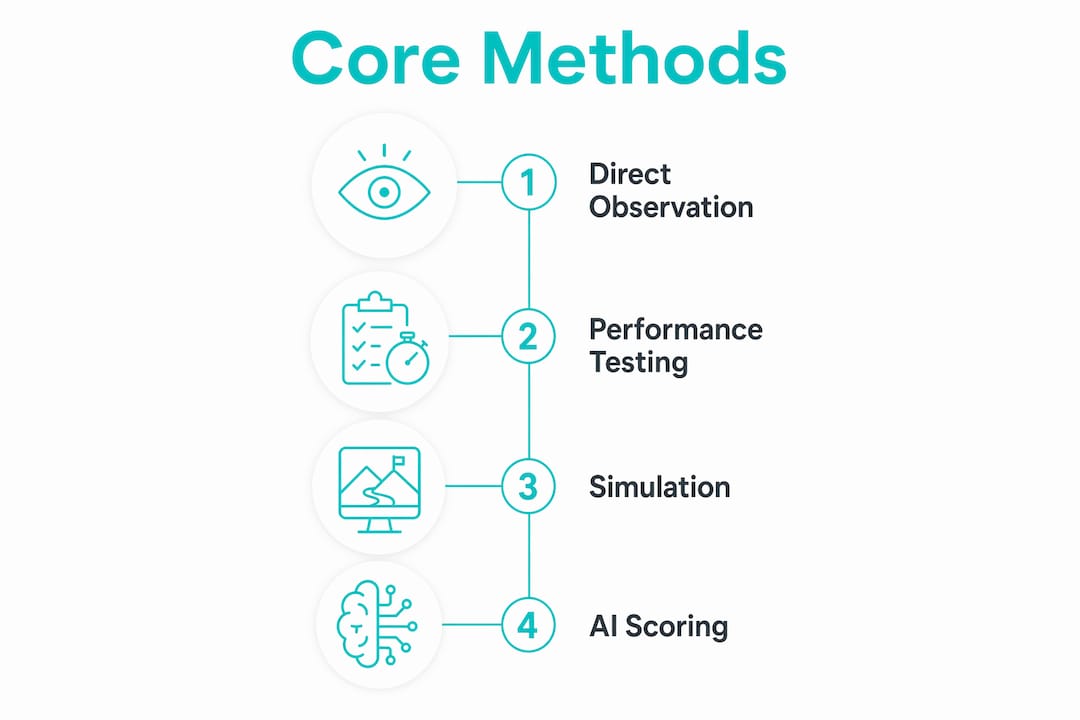
Four primary methods cover the full range of practical assessment needs in hiring.
Direct observation places a candidate in an actual or closely simulated job environment and records their actions in real time. A customer service role might use a live call simulation. A data analyst role might require building a report from a raw dataset.
Performance-based testing gives candidates real tools, software interfaces, or equipment and asks them to complete a defined task. Scenario-based assessments that mimic iterative workflows reveal more about problem-solving ability than isolated tasks do. A candidate who adapts when conditions change mid-scenario demonstrates a deeper skill level than one who only completes a static exercise.
Simulation environments replicate complex workflows without the risk or cost of using live systems. These are common in technical hiring, healthcare, and financial services.
Automated and AI-scored assessments capture granular performance data at scale. They score speed, accuracy, and decision sequencing in ways a human observer cannot track simultaneously.
| Method | Best use case | Key advantage | Limitation |
|---|---|---|---|
| Direct observation | Trade, clinical, or customer-facing roles | High ecological validity | Time-intensive for assessors |
| Performance-based testing | Technical and software roles | Real tool proficiency verified | Requires test environment setup |
| Scenario-based simulation | Complex, multi-step workflows | Reveals problem-solving depth | Higher design cost |
| AI-automated scoring | High-volume hiring | Objective, consistent, scalable | Requires validated scoring rubrics |
Pro Tip: Build your scenario around the three or four tasks that consume the most time in the actual role. If a task does not appear in a typical work week, it does not belong in the assessment.
How does practical evaluation differ from other assessment types?
The clearest distinction is between applied performance and knowledge recall. A multiple-choice test tells you whether a candidate knows the correct answer. A practical assessment tells you whether they can execute the correct action under realistic pressure. Those two things are not the same, and hiring decisions that treat them as equivalent produce poor role fit.
Psychometric tests measure personality traits, cognitive style, or behavioral tendencies. They are useful for predicting cultural fit or leadership potential, but they cannot verify whether a candidate can write SQL queries, manage a payroll cycle, or close a sales call. Forced-choice behavioral assessments carry an additional risk: candidates can game them by selecting socially desirable answers. Algorithms that flag inconsistent response patterns improve reliability, but the fundamental limitation remains.
The practical approach also differs from unstructured interviews. Interviews measure how well a candidate describes past behavior. Practical assessments measure current, observable performance. The gap between what candidates say they can do and what they actually do is where most bad hires originate.
The most effective hiring processes combine methods. A practical skills assessment verifies task competence. A structured interview explores judgment and communication. A brief cognitive test adds a measure of learning speed. No single method captures the full picture, but practical evaluation provides the evidence that other methods cannot.
Why is practical skills evaluation critical for effective hiring?
Practical assessment directly increases hiring accuracy by replacing subjective impressions with scored performance data. When a hiring manager reviews a candidate’s itemized results, they see exactly which tasks the candidate completed correctly, which steps they skipped, and how long each stage took. That level of detail is not available from a resume or a reference check.
The business case for skills-based hiring extends beyond the initial placement decision:
- Reduced mis-hire costs. A candidate who passes a role-specific practical test is far less likely to underperform in the first 90 days than one selected on credentials alone.
- Targeted training investment. Assessment results identify specific skill gaps. Training budgets go to the areas that actually need development, not to generic onboarding programs.
- Fairer, more defensible decisions. Structured scoring rubrics reduce the influence of unconscious bias. Every candidate is measured against the same criteria.
- Workforce benchmarking. Repeating assessments over time creates performance baselines. HR teams can track skill development across departments and identify high-potential employees before a vacancy opens.
Defining what success looks like on competency scales is critical for consistent, data-driven hiring. Organizations that skip this step end up with inconsistent ratings across assessors, which undermines the objectivity that practical evaluation is supposed to provide.
What are the best practices when implementing practical skills evaluation?
The most common failure point is vague criteria. An assessment that asks evaluators to rate a candidate as “good,” “average,” or “poor” without defining what each level means produces unreliable data. Training managers to interpret rating scales consistently is not optional. It is the foundation of objective hiring.
Five practices separate effective programs from ineffective ones:
- Define competency criteria before building the test. Write out exactly what a passing performance looks like at each proficiency level. Share those criteria with assessors before scoring begins.
- Use role-realistic scenarios. A scenario that mirrors an actual work task produces more valid results than an abstract exercise. Pull directly from job descriptions and day-one responsibilities.
- Share practice materials with candidates. Transparent preparation reduces test anxiety and produces performance that reflects true ability rather than format familiarity. Candidates who are surprised by the format underperform relative to their actual skill level.
- Run a no-skill baseline comparison. Testing with and without skill injections confirms that measured performance reflects genuine competence rather than luck or prior exposure to the test format. If a candidate with no relevant training scores similarly to a trained candidate, the assessment lacks discriminant validity.
- Avoid overfitting to the test format. Rotate scenarios periodically so that coaching to the specific test does not replace actual skill development.
Pro Tip: Pilot every new assessment with two or three current employees in the target role before using it with candidates. Their scores set a realistic performance benchmark and expose any design flaws before they affect hiring decisions.
How to interpret and use practical skills evaluation results
Assessment results are most useful when read at the item level, not just as a total score. A candidate who scores 72% overall might have scored 95% on technical execution and 40% on documentation. Those two profiles require completely different hiring or onboarding responses.
Four principles guide effective result interpretation:
- Read proficiency levels, not just pass/fail. A candidate who completes a task correctly but slowly may be suitable for a role with lower volume demands. A candidate who is fast but skips verification steps may need structured supervision.
- Cross-reference with other hiring data. Practical results gain meaning when compared with structured interview scores and reference feedback. A strong practical score combined with weak communication ratings points to a specific development need, not a disqualifying flaw.
- Use itemized reports to plan onboarding. The gaps identified in a pre-hire assessment become the agenda for the first 30 days of onboarding. This shortens time to full productivity.
- Document and store results consistently. Comparative data across candidates and cohorts builds the evidence base for refining both the assessment and the role requirements over time.
Key takeaways
Practical skills evaluation produces the most accurate hiring decisions when it combines realistic scenarios, defined competency criteria, and consistent assessor training.
| Point | Details |
|---|---|
| Definition and purpose | Practical skills evaluation measures task performance directly, not knowledge recall or self-reported experience. |
| Core methods | Direct observation, performance-based testing, simulation, and AI-scored assessments each serve different role types. |
| Key differentiator | Practical evaluation closes the knowing-doing gap that interviews and multiple-choice tests leave open. |
| Critical best practice | Define what success looks like at each proficiency level before scoring begins to keep ratings consistent. |
| Result application | Read results at the item level to identify specific strengths and gaps, then use that data to guide onboarding. |
Why I think most hiring teams underuse practical assessment
The organizations I have seen get the most value from practical skills evaluation share one habit: they treat the assessment as a conversation starter, not a gatekeeper. A candidate who scores 65% on a scenario-based test is not automatically disqualified. The itemized report tells you exactly where the 35% gap lives. That information is more useful in a hiring conversation than any interview question about “your greatest weakness.”
The technology side has also shifted the calculus significantly. AI-driven scoring removes the bottleneck that used to make practical assessment impractical at scale. When a platform can evaluate 200 candidates in the time it used to take to assess 20, the argument for skipping practical evaluation because it is “too time-consuming” no longer holds.
The one area where I still see consistent underinvestment is candidate communication. Teams spend weeks designing the assessment and almost no time explaining it to candidates. Telling a candidate what the test covers, how long it takes, and what format to expect does not give anything away. It produces a more accurate result because the candidate performs to their actual ability rather than spending the first 10 minutes figuring out the interface. Transparency is not a courtesy. It is a data quality decision.
— Jimmie
Talentapproved: AI-powered skills assessment built for hiring teams
HR teams that want to move from CV-based screening to performance-based hiring need a platform that makes assessment creation fast and scoring objective.
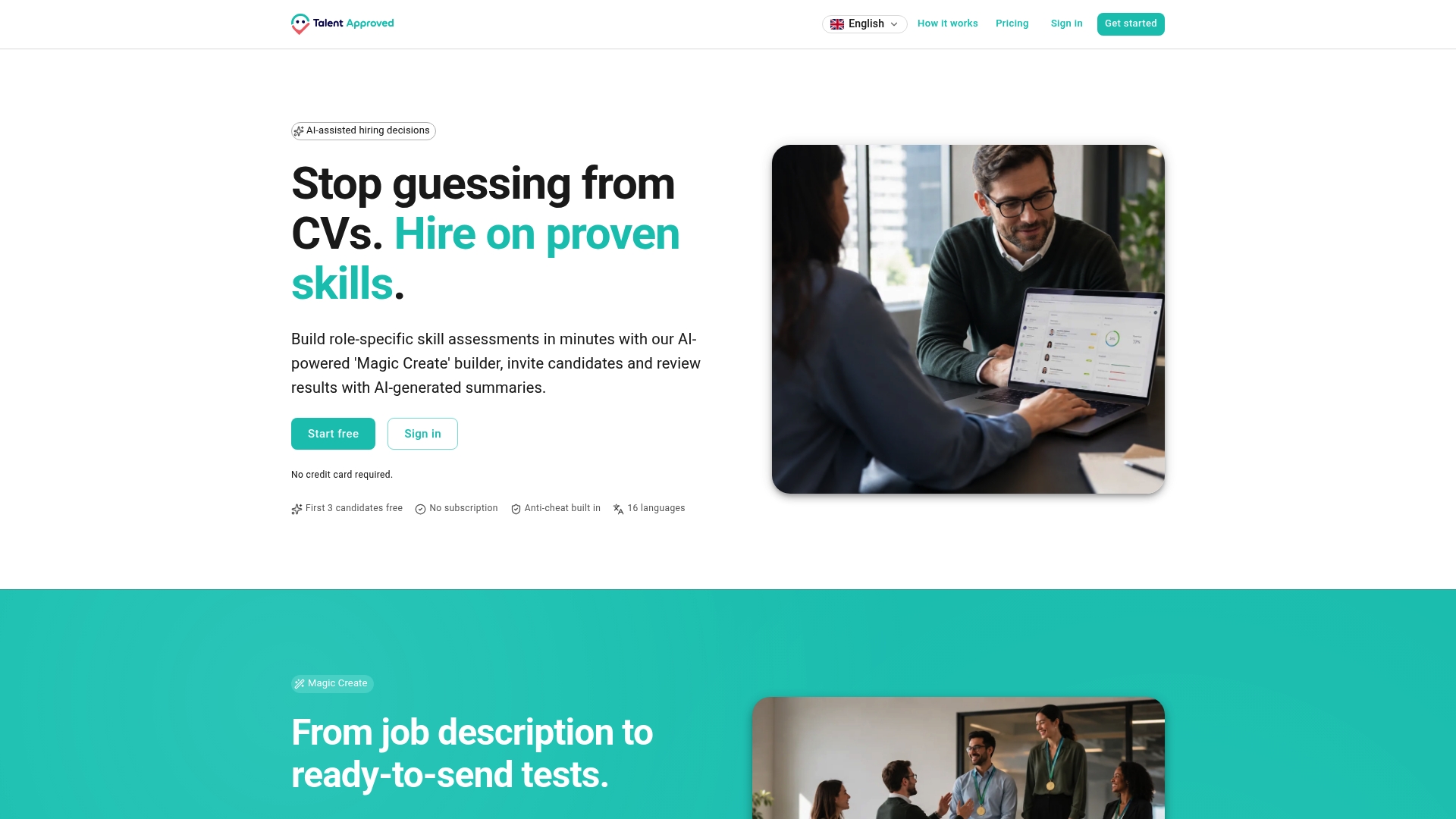
Talentapproved builds role-specific skill tests in minutes using its Magic Create feature. You paste in a job description, and the platform generates a tailored assessment with built-in anti-cheat mechanisms and AI-generated candidate summaries. Every result comes with itemized performance data so your team can make confident, evidence-based decisions without spending hours reviewing individual responses. For HR teams and recruiters who need reliable, fair, and fast skills assessment tools, Talentapproved is built for exactly that workflow.
FAQ
What is practical skills evaluation in hiring?
Practical skills evaluation is the direct observation and scoring of a candidate performing job-related tasks under realistic conditions. It measures actual task competence rather than knowledge recall or self-reported experience.
How does practical assessment differ from a written test?
A written test measures what a candidate knows. A practical assessment measures what they can do. The two methods address different parts of job readiness and work best when combined.
What are the most common methods for skills evaluation?
The four main methods are direct observation, performance-based testing with real tools, scenario-based simulation, and AI-automated scoring. Each suits different role types and hiring volumes.
Why do organizations fail at practical skills evaluation?
The most common failure is not defining what a passing performance looks like before scoring begins. Without clear competency criteria, assessor ratings become inconsistent and the data loses its value for hiring decisions.
How should HR teams use practical assessment results?
Read results at the item level to identify specific skill gaps, cross-reference with structured interview data, and use the findings to shape onboarding priorities for the first 30 days in role.