
How to Build a Skills-Based Hiring Process That Works

Skills-based hiring is defined as a recruitment method that evaluates candidates on demonstrated capabilities rather than degrees or years of experience. 85% of companies reported implementing some form of this approach by the end of 2025. That adoption rate signals a fundamental shift in how organizations think about talent. If you want to build a skills-based hiring process that actually holds up under pressure, the work starts well before you post a job description. It requires a shared skills taxonomy, structured assessments, and calibrated evaluation methods that every stakeholder uses consistently.
What does it take to build a skills-based hiring process?
Skills-based hiring, also called competency-based or assessment-driven hiring, succeeds only when the foundation is solid. 65% of global executives report moving toward this model but face adoption challenges due to inconsistent process infrastructure like scorecards. That gap between intent and execution is where most programs fail. The fix is not a better job posting. It is a shared skills taxonomy built before any candidate sees your application.
Building your skills taxonomy
A skills taxonomy is a structured list of capabilities organized by role family, function, and proficiency level. Without one, scoring rubrics become inconsistent and prone to subjective bias across interviewers. Your taxonomy should define each skill at three to four proficiency levels: foundational, developing, proficient, and expert. That specificity gives every evaluator the same reference point.

Start by mapping skills to role families rather than individual job titles. A “data analyst” and a “business intelligence specialist” may share 70% of their required skills. Grouping them reduces redundant work and creates a reusable evaluation framework across your organization.
| Prerequisite | Purpose | Tool category |
|---|---|---|
| Skills taxonomy | Consistent evaluation across roles | Spreadsheet or skills library software |
| Role family map | Reduces redundant assessment design | HR information system |
| Proficiency level definitions | Anchors scoring rubrics | Internal documentation |
| Stakeholder training | Aligns evaluators on rubric use | LMS or workshop |
| ATS integration | Enforces assessment as a mandatory step | Applicant tracking system |
Pro Tip: Involve hiring managers in taxonomy design from day one. Their input on what “proficient” looks like in practice prevents rubric drift later.
A phased rollout typically takes 10–16 weeks, covering job description audits, taxonomy definition, assessment selection, and interviewer training. Plan for that timeline rather than rushing to launch.
How do you redesign job descriptions for skills-based shortlisting?
The job description is where most credential bias enters the hiring funnel. Phrases like “bachelor’s degree required” or “5+ years of experience” filter out capable candidates before any evaluation occurs. Removing degree and experience filters increases applicant diversity and volume by more than 16%. That is a meaningful change in who reaches your assessment stage.
Redesigning job descriptions for skills-based shortlisting follows a clear sequence:
- Audit the current description. Identify every credential or experience filter. Ask whether each one predicts job performance or simply reflects historical hiring habits.
- Define the core skills the role requires. Pull directly from your taxonomy. List no more than eight to ten skills to keep the assessment focused.
- Write capability statements. Replace “5 years of project management experience” with “Ability to manage cross-functional projects with competing deadlines.”
- Remove degree requirements unless legally mandated. Most knowledge roles do not require a degree to perform well.
- Add a skills assessment gate. State clearly in the posting that candidates will complete a short skills check before the interview stage.
- Test the description with a diverse review panel. Check for language that signals cultural fit over capability, which reintroduces bias through the back door.
Resume keyword filtering penalizes skilled candidates who have not mastered resume optimization. Moving skills evaluation before resume review reduces that bias at the source. Your ATS can support this by routing candidates to an assessment immediately after application, before any human reviews a resume.
Pro Tip: Run your revised job description through a readability tool. If it reads above a 12th-grade level, simplify it. Accessible language attracts a wider and more diverse applicant pool.
A well-structured candidate evaluation checklist keeps your team aligned on what to look for at each stage, from application through final interview.
What assessment and interview strategies work best for skills evaluation?
Assessment design is where skills-based hiring either proves its value or collapses into another form of subjective judgment. The goal is objective evidence of capability, not proxy signals like a prestigious employer on a resume.
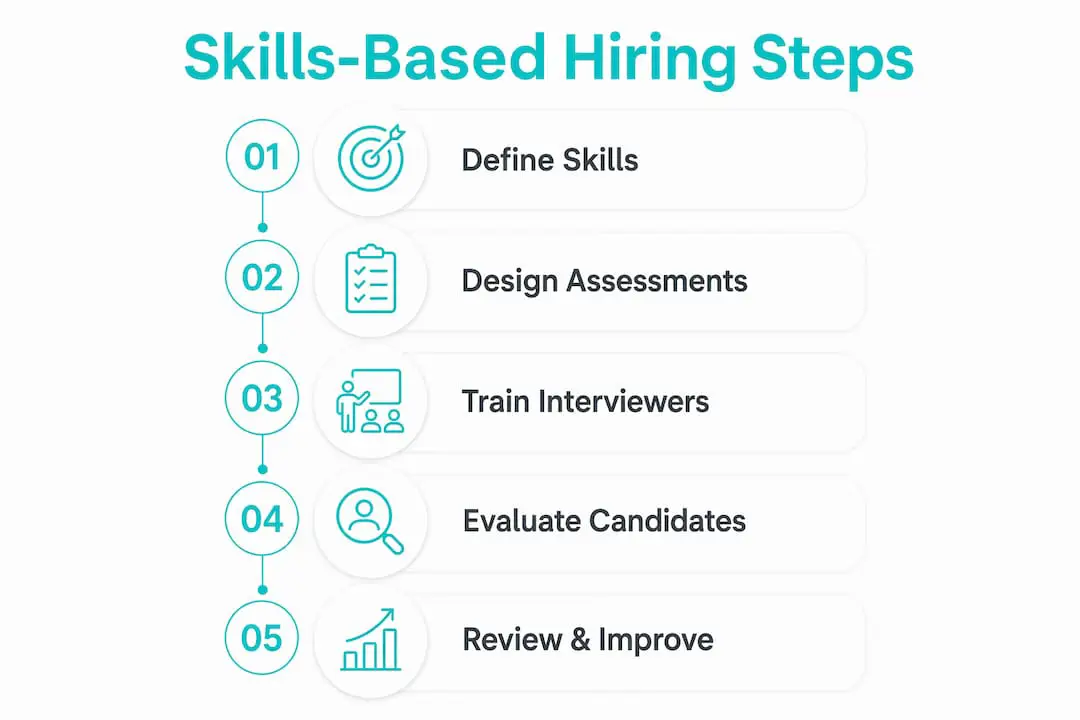
Choosing the right assessment format
Three assessment formats consistently produce reliable evidence:
- Work samples: Candidates complete a task that mirrors actual job duties. A content writer drafts a short article. A data analyst interprets a sample dataset. Work samples have high face validity because the task is the job.
- Technical tests: Structured questions that test specific knowledge or skill application. These work well for roles with clear right-or-wrong answers, such as coding, accounting, or compliance.
- Behavioral interviews: Structured questions using the STAR format (Situation, Task, Action, Result) that ask candidates to describe past behavior as evidence of a skill.
Structured interviews using standardized rubrics carry a predictive validity of 0.51, nearly triple that of unstructured interviews at 0.18. That difference translates directly into better hiring decisions and lower turnover.
Building scoring rubrics with behavioral anchors
A scoring rubric assigns a numeric value to each proficiency level for every skill being evaluated. Behavioral anchors describe what a “3 out of 5” response actually looks and sounds like. Without anchors, two interviewers scoring the same candidate will reach different conclusions.
AI-powered skills screening tools combine taxonomy alignment, role-level rubrics, structured interviewing, per-skill scoring with evidence, and ATS integration into a single workflow. That architecture removes the manual coordination burden from your HR team.
Interviewer calibration training is non-negotiable. Run practice scoring sessions before the hiring cycle opens. Have two evaluators independently score the same recorded response, then compare results. Disagreements reveal rubric gaps that need tightening.
Pro Tip: Require evaluators to attach evidence, such as a direct quote or a specific work sample result, to every skill score. Skills scores supported by evidence maintain evaluator confidence and create an auditable record.
A practical guide to evaluating candidate skills covers how to structure rubrics and calibrate your team across different role types.
How do you manage and improve the process over time?
A skills-based hiring process is not a one-time setup. It requires active monitoring, regular calibration, and willingness to adjust when data shows a problem.
Embedding the process into your workflow
Hiring managers revert to resume-based shortlisting under deadline pressure. The only reliable prevention is making the skills assessment a mandatory ATS stage that cannot be skipped. When the system requires a completed assessment score before a candidate advances, the process holds even when time is short.
Follow this sequence to monitor and improve your process:
- Track time-to-fill and retention rates from the first cohort hired through the new process. Time-to-fill and retention are the two primary indicators of skills-based hiring effectiveness.
- Review assessment completion rates. A high drop-off rate signals the assessment is too long or poorly scoped.
- Audit scoring consistency monthly. Compare scores across evaluators for the same role. High variance indicates a rubric or calibration problem.
- Gather hiring manager feedback at 90 days. Ask whether new hires are performing at the expected proficiency level for each assessed skill.
- Update assessments when roles change. Skills requirements shift as products, markets, and teams evolve. A static assessment becomes invalid within 12–18 months.
Common pitfalls to watch for:
- Evaluators adding informal credential checks after the assessment stage
- Assessment questions that test trivia rather than applied skill
- Rubrics that lack behavioral anchors, leading to score inflation
- Failing to source candidates from non-traditional channels, which limits the diversity gains the process is designed to produce
True skills-based hiring requires consistent evaluation by all stakeholders using the same rubric, not just rewriting job descriptions. Culture and process must reinforce each other.
Key Takeaways
A skills-based hiring process works when it combines a shared taxonomy, structured assessments, mandatory ATS integration, and consistent rubric calibration across every evaluator.
| Point | Details |
|---|---|
| Start with a skills taxonomy | Define proficiency levels before writing assessments or redesigning job descriptions. |
| Rewrite job descriptions around capabilities | Remove degree filters to increase applicant diversity and widen the talent pool. |
| Use structured assessments and rubrics | Structured interviews with behavioral anchors predict hiring success far better than unstructured ones. |
| Make assessments mandatory in your ATS | Embedding assessments as a required step prevents managers from bypassing the process under pressure. |
| Measure retention and time-to-fill | These two metrics reveal whether your skills-based process is producing better hires over time. |
Why most skills-based hiring programs stall in year one
The programs that fail are not failing because of bad assessments. They fail because the organization never agreed on what “good” looks like. I have seen HR teams spend months building technically sound rubrics, only to watch hiring managers override scores with gut instinct the moment a candidate has an impressive company name on their resume. That is not a process problem. It is a culture problem.
The fix is not more training decks. It is starting small and letting results do the persuading. Run your first skills-based cohort in one department. Measure 90-day performance against skill scores. When the data shows that your top-scoring candidates are outperforming your gut-hire candidates, you have a story that changes minds faster than any policy memo.
One thing most guides skip: standardized assessments do not work well for executive-level hires, where judgment, context, and track record carry more weight than a structured test can capture. Know where the model applies and where it does not. Applying it indiscriminately creates resistance from senior leaders who feel the process undervalues their experience.
Soft skills are also harder to assess than technical skills, but they are not impossible. Behavioral interviews with well-anchored rubrics capture communication, collaboration, and problem-solving with reasonable reliability. The mistake is skipping soft skill assessment entirely because it feels subjective. Subjectivity without structure is the problem. Structure reduces it.
Let data lead your expansion. Pilot, measure, share results, then scale to the next department. That sequence builds internal credibility faster than a company-wide rollout that hits friction everywhere at once.
— Jimmie
How Talent Approved supports your skills-based hiring workflow
Building a skills-based hiring process requires the right tools at every stage, from assessment creation to candidate ranking.
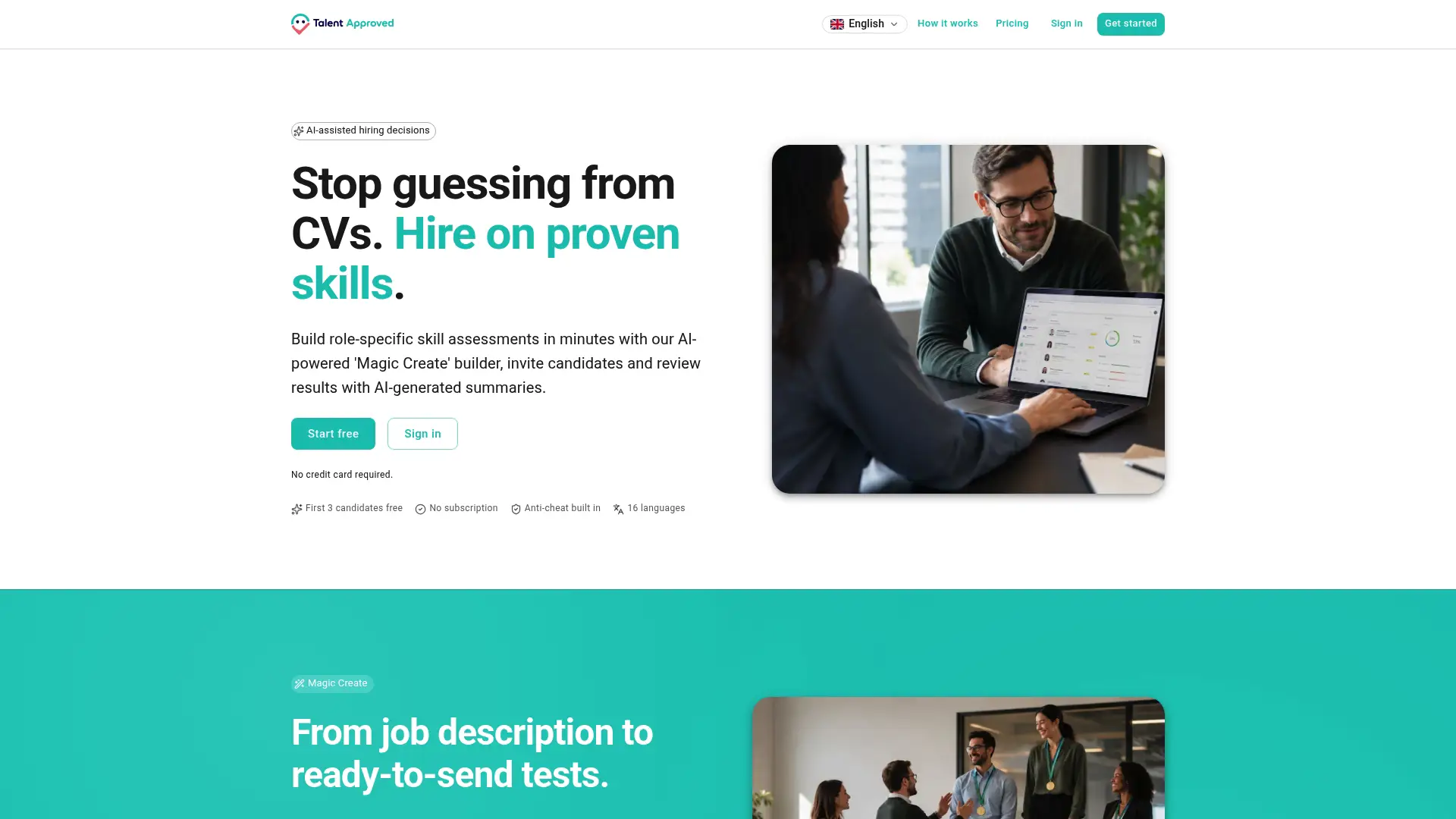
Talent Approved gives HR teams and hiring managers a direct path from job description to scored, ranked candidates. The Magic Create feature generates tailored skill tests from a job description in minutes, removing the manual work of assessment design. Built-in candidate ranking and AI scoring surfaces your strongest candidates without resume bias. Anti-cheat screen recording keeps results trustworthy. And AI-generated summaries give your team clear, evidence-backed candidate profiles that support faster, fairer decisions. See how Talent Approved works and put your next hire on a skills-first footing.
FAQ
What is skills-based hiring?
Skills-based hiring is a recruitment method that evaluates candidates on demonstrated capabilities rather than degrees or years of experience. It uses structured assessments and standardized rubrics to produce objective, comparable evidence of candidate ability.
How long does it take to implement a skills-based hiring process?
A phased implementation typically takes 10–16 weeks, covering job description audits, skills taxonomy definition, assessment selection, and interviewer training.
How does skills-based shortlisting reduce bias?
Skills-based shortlisting moves candidate evaluation before resume review, which prevents credential bias and resume keyword filtering from eliminating qualified candidates early in the funnel.
What metrics measure skills-based hiring success?
Time-to-fill and 90-day retention rates are the two primary metrics. Tracking score-to-performance correlation at 90 days also reveals whether your assessments are predicting real job success.
Do skills-based assessments work for every role?
Structured skills assessments work well for most individual contributor and management roles. They are less effective for executive-level hires, where judgment and contextual track record carry more predictive weight than a standardized test can capture.