
Lean Recruitment Strategy: A Practical HR Playbook

Lean recruitment is a hiring methodology that eliminates non-value-adding steps, reduces waste across the hiring cycle, and delivers faster, higher-quality hires by applying lean principles such as value stream mapping, kaizen, and just-in-time sourcing. Borrowed from Toyota’s manufacturing system, it treats every delay, redundant step, and miscommunication in your process as waste to be removed.
The short version:
- Goal: Remove waste, speed up hiring, and improve hire quality without adding headcount.
- Core methods: Process audit, value stream mapping, automation of repetitive tasks, and continuous improvement cycles.
- Key metrics: Time-to-fill, candidate drop-off rate, cost-per-hire, and quality-of-hire.
- Mindset: Kaizen — treat hiring as a process you improve continuously, not a problem you solve once.
Table of Contents
- Why lean recruitment matters for your hiring outcomes
- How the seven wastes show up in your hiring process
- How to implement lean recruitment: audit, pilot, scale
- Which metrics should you track in a lean hiring process?
- What should you automate first in a lean recruitment process?
- How Talent Approved supports lean recruitment outcomes
- Common pitfalls when implementing lean recruitment
- Your 30/60/90-day lean recruitment checklist
- Key Takeaways
- A practitioner’s perspective on lean recruitment
- Talent Approved fits directly into your lean pilot
- Useful sources and further reading
- FAQ
Why lean recruitment matters for your hiring outcomes
Lean hiring practices can reduce time-to-fill and produce cost savings while improving candidate experience and selection quality when paired with continuous measurement. That combination is what makes the methodology worth the investment.
The business case for HR leaders is straightforward:
- Faster hiring reduces the revenue cost of open roles and lowers the risk of losing top candidates to competing offers.
- Better hire quality comes from structured, standardized evaluation rather than gut-feel resume reviews.
- Lower cost-per-hire follows naturally when you cut redundant sourcing channels, unnecessary interview rounds, and manual scheduling.
- Improved candidate experience results from shorter timelines and clearer communication at every stage.
The biggest shift, though, is cultural. The move from a transactional, order-processing model toward strategic talent pipelining changes how your team spends its time and where it creates value.
How the seven wastes show up in your hiring process
Lean recruitment focuses on minimizing seven categories of waste across the hiring cycle. Here is what each one looks like in practice and the fastest fix for each:
- Waiting: Candidates sit in limbo between resume review and the first interview. Fix: set a maximum 48-hour SLA for stage-to-stage movement and assign a single owner per stage.
- Delays: Hiring manager feedback takes days because there is no structured scorecard. Fix: standardize a five-field interview scorecard and require submission within 24 hours of each interview.
- Unnecessary movement: Resumes travel through email chains, shared drives, and three Slack channels before anyone acts. Fix: centralize all candidate data in your ATS and eliminate parallel communication threads.
- Overprocessing: Candidates complete four interview rounds for a role that needs two. Fix: map the minimum decision points required and cut any round that duplicates information already gathered.
- Overproduction: Your team sources 300 resumes for a role that historically converts one in twenty. Fix: use a pull-system approach where sourcing volume matches actual demand, not recruiter habit.
- Defects: A hire fails probation because the job description did not reflect the real role requirements. Fix: align the JD with the hiring manager before posting, and use a structured skills assessment to validate fit. Well-prepared candidates also help here — resources like resume tailoring guides reduce mismatched applications at the top of the funnel.
- Underutilized talent: Recruiters spend a significant portion of their week on scheduling and data entry instead of candidate engagement. Fix: automate repetitive screening and scheduling tasks so recruiters focus on high-value conversations.
How to implement lean recruitment: audit, pilot, scale
The roadmap is simple: audit your current process, run a focused pilot on one or two roles, iterate on what you learn, then scale what works.
-
Audit the end-to-end process. Gather your TA lead, a recruiter, and a hiring manager. Map every step from job requisition approval to offer acceptance. Record the time each step takes and who owns it. Focus your audit on time-to-move through stages, pipeline quality, and communication gaps — these are where most waste hides.
-
Build a value stream map. VSM makes invisible wait times visible: feedback loops, approval queues, and handoff gaps that no one notices until you draw them. Many teams discover that approval waits and feedback loops account for the majority of elapsed time-to-fill.
-
Identify and prioritize waste. Score each step by effort to fix versus impact on time-to-fill. Quick wins — standardizing the JD template, adding a scheduling tool, creating a scorecard — should come first.
-
Design and run a 30–60 day pilot. Pick one or two roles. Set clear success criteria (target time-to-fill, drop-off rate, offer acceptance). Run daily or weekly huddles with the hiring team. Combining VSM with daily improvement huddles and rapid improvement events is the approach that consistently embeds continuous improvement into TA teams.
-
Measure, iterate, and document. At the end of the pilot, compare results against your baseline. Fix the one bottleneck that had the biggest impact. Document the improved process so it is repeatable.
-
Scale across role families. Roll the standardized process to similar roles. Assign a TA ops owner to maintain the kaizen cadence and update the VSM quarterly.
Which metrics should you track in a lean hiring process?
Track time-to-fill, candidate drop-off, cost-per-hire, quality-of-hire, and flow efficiency. These five give you a complete picture of where waste is entering your process and whether your improvements are working.
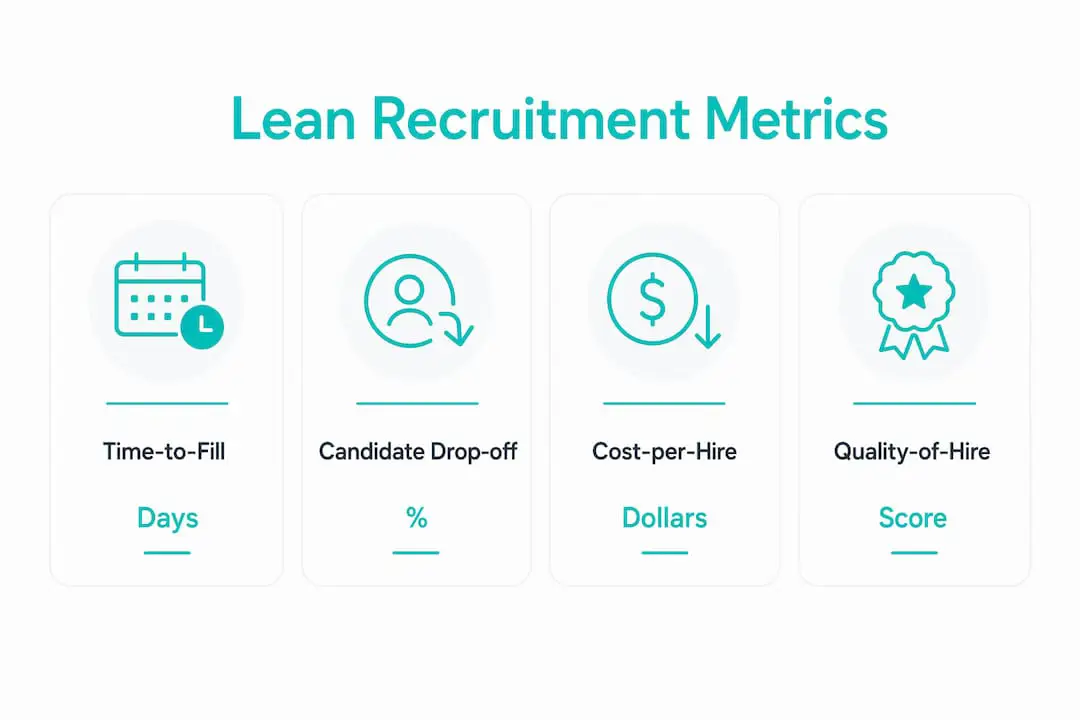
| Metric | What it measures | How to calculate | Improvement signal |
|---|---|---|---|
| Time-to-fill | Speed from requisition open to offer accepted | Days from req open to offer acceptance | Decreasing trend per role family |
| Candidate drop-off rate | Where candidates exit the funnel | % leaving at each stage vs. total entering | Drop in exit rate at key stages |
| Cost-per-hire | Total spend per successful hire | Total recruiting spend ÷ hires in period | Declining without quality loss |
| Quality-of-hire | Performance and retention of new hires | 90-day manager rating + retention | Rising scores, lower early attrition |
| Flow efficiency | Ratio of active work time to total elapsed time | Active processing time ÷ total time-to-fill | Ratio moving closer to target |
Use these metrics for kaizen cycles: pick the metric furthest from target, form a hypothesis about the cause, test one change, and measure the result. Repeat monthly.
Pro Tip: Show time-to-fill and drop-off rate on a daily dashboard for recruiters. Review cost-per-hire and quality-of-hire weekly with hiring managers. Reserve flow efficiency for monthly TA leadership reviews where process changes are decided.
For a deeper look at enterprise recruiting KPIs and how to build dashboards around them, Talent Approved’s resource library covers the full setup.
What should you automate first in a lean recruitment process?
Automate repetitive, low-value work only after you have simplified the underlying process. Automating before simplifying produces faster waste — you just do the wrong things more quickly.
Automation priorities, in order:
- First: Interview scheduling (eliminates the back-and-forth that adds 2–5 days to time-to-fill on most teams).
- Second: Initial skills screening and assessments (removes manual resume review and adds objective, role-specific data).
- Third: ATS workflow triggers (automatic stage movement, recruiter reminders, hiring manager nudges).
- Fourth: Analytics dashboards (real-time visibility into pipeline health without manual reporting).
Avoid automating hiring manager feedback collection, final-round interview coordination, or offer negotiation until your process is stable and documented. Automation amplifies whatever is already in the process — good or broken.
The recruitment industry is transitioning to automation where AI and data management increase efficiency, but communication gaps and poor standardization remain the most common sources of waste. Fix those first.

How Talent Approved supports lean recruitment outcomes
Skills-assessment platforms remove screening waste by replacing resume guesswork with objective evidence of capability. Talent Approved is built specifically for this step in the lean hiring process.
Key features that map directly to lean outcomes:
- AI test generation from a job description: Paste in the role requirements and Talent Approved’s Magic Create builds a tailored assessment in minutes, eliminating the hours typically spent designing screening questions.
- Anti-cheat screen recording and proctoring: Built-in proctoring tools preserve assessment integrity without adding manual oversight.
- AI-generated candidate summaries: After each assessment, the platform produces a structured summary so hiring managers can review results in minutes rather than hours.
The practical lean outcome: fewer interviews per hire, faster screening decisions, and a standardized evaluation that reduces the “defects” waste category. You can see how the AI test generator works end-to-end on the Talent Approved feature page.
Common pitfalls when implementing lean recruitment
The most common mistake is automating an inefficient process and calling it lean. Here are the pitfalls that actually slow teams down:
- Poor stakeholder alignment. Hiring managers who do not understand the new process will revert to old habits. Fix: involve them in the VSM session from day one and show them their own data.
- No standardized scorecards. Without a shared rubric, interview feedback is subjective and slow. Fix: create a five-field scorecard before the pilot starts and make it non-negotiable.
- Metrics that reward speed at the expense of quality. Optimizing only for time-to-fill can push recruiters to advance weak candidates. Fix: always pair time-to-fill with quality-of-hire in your dashboard.
- Skipping the audit. Teams that jump straight to automation without mapping the process first rarely see lasting improvement. Fix: spend at least one week on the VSM before touching any tooling.
- Treating lean as a one-off project. Lean recruitment should be treated as a culture of kaizen — regularly monitoring metrics to find new bottlenecks rather than declaring victory after one pilot.
Your 30/60/90-day lean recruitment checklist
Start with a 30-day audit, run a 60-day pilot, and embed kaizen by day 90.
Days 1–30 (Audit and quick wins) — Owner: TA Lead
- Map one high-volume role end-to-end using VSM. Record time at each stage.
- Standardize the job description template for that role family.
- Add a scheduling tool to eliminate manual calendar coordination.
- Establish baseline metrics: time-to-fill, drop-off rate, cost-per-hire.
Days 31–60 (Pilot) — Owner: Recruiter + Hiring Manager
- Run the improved process on two active requisitions.
- Hold weekly 15-minute huddles to surface blockers.
- Collect scorecard data from every interview.
- Measure drop-off at each funnel stage and identify the single biggest exit point.
Days 61–90 (Scale and kaizen cadence) — Owner: TA Ops + TA Lead
- Roll the standardized process to all roles in the same family.
- Fix the bottleneck identified in the pilot.
- Set a monthly kaizen review: one metric, one hypothesis, one change.
- Update the VSM to reflect the current state and schedule the next quarterly review.
Key Takeaways
Lean recruitment works because it removes waste from the hiring cycle systematically, measures the right metrics, and treats improvement as an ongoing discipline rather than a one-time fix.
| Point | Details |
|---|---|
| Start with a process audit | Map your current hiring flow with VSM before changing or automating anything. |
| Target the seven wastes | Waiting, delays, overprocessing, and underutilized recruiter time are the highest-impact waste categories to fix first. |
| Track five core metrics | Time-to-fill, candidate drop-off, cost-per-hire, quality-of-hire, and flow efficiency give you a complete improvement picture. |
| Automate after simplifying | Standardize and document your process first; automation of a broken process only speeds up the waste. |
| Talent Approved for screening | Use Talent Approved’s AI test generation and anti-cheat assessments to remove screening waste and add objective candidate data. |
A practitioner’s perspective on lean recruitment
The hardest part of lean recruitment is not the methodology — it is getting hiring managers to trust the process long enough to see results. Most teams run one VSM session, feel good about the map, and then quietly return to their old habits within a month. What actually works is the daily huddle: a 10-minute standup where the recruiter and hiring manager look at the same pipeline data together. That shared visibility creates accountability that no process document can replicate.
Measuring flow efficiency, not just time-to-fill, is the other shift that changes behavior. When a team sees that 80% of elapsed time is waiting rather than active work, the conversation moves from “we need more recruiters” to “we need faster feedback loops.” That reframe is where lean actually takes hold. Treat it as a culture, not a project, and the improvements compound.
Talent Approved fits directly into your lean pilot
If your lean audit reveals that initial screening is your biggest time drain, Talent Approved gives you a concrete way to fix it without rebuilding your entire process. Paste a job description into Magic Create, and the platform generates a tailored skills assessment in minutes. Candidates complete it on their own time, anti-cheat proctoring runs automatically, and AI-generated summaries let your team review results in a fraction of the time manual resume review takes.
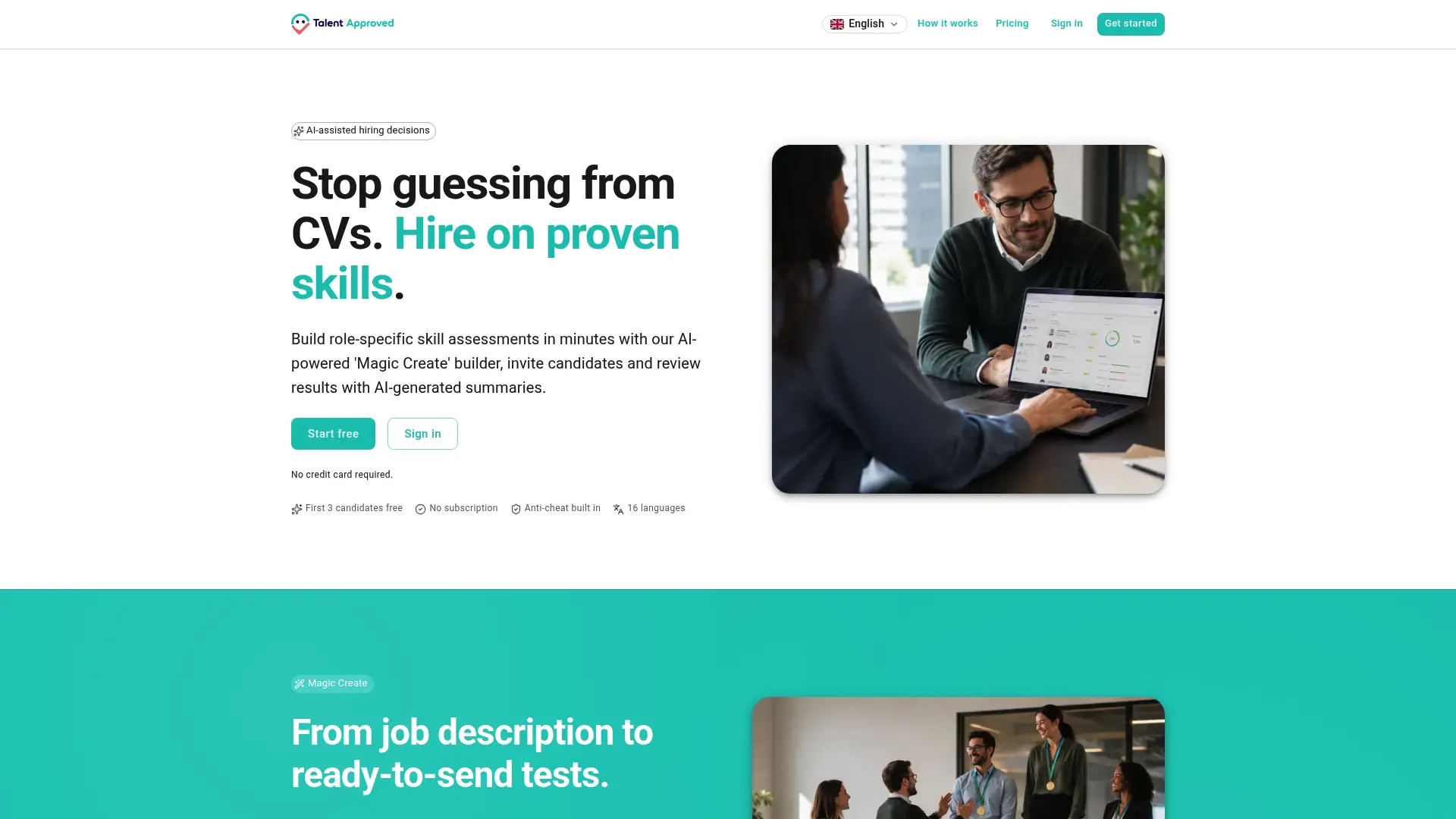
That makes Talent Approved a natural fit for the 30-day pilot phase: one role, one assessment, measurable reduction in screening time. You get objective capability data instead of CV guesswork, fewer interviews per hire, and a standardized decision point that reduces the “defects” waste category from day one. Build your first skill test and run it as part of your lean experiment.
Useful sources and further reading
- Improving a recruitment process through lean mindset — Academic thesis covering the seven wastes and pull-system principles applied to hiring.
- Lean hiring practices could lead to better hires, cost savings — ADP SPARK practitioner overview of lean hiring benefits and audit starting points.
- Lean talent acquisition: one team’s journey of improvement — Emerald case study documenting VSM and rapid improvement events in a healthcare TA team.
- More Than a Buzzword: How to Infuse Lean Principles into Talent Acquisition — JRG Partners practitioner guide on VSM, pull systems, and kaizen in TA.
- Lean Recruitment: Definition, Process & More — Practical overview of automation priorities and recruiter role shifts in lean hiring.
FAQ
What is a lean recruitment strategy in simple terms?
Lean recruitment is a hiring approach that removes waste from the hiring process — delays, redundant steps, and unnecessary manual work — so teams hire faster and better without adding resources.
What are the seven wastes in lean recruitment?
The seven wastes are waiting, delays, unnecessary movement, overprocessing, overproduction, defects, and underutilized talent. Each maps to a specific inefficiency in the hiring cycle, from slow feedback loops to over-interviewing candidates.
How long does it take to implement a lean hiring process?
A focused pilot covering one role family typically runs 30–60 days. Full implementation across a TA team, including a recurring kaizen cadence, usually takes 60–90 days from the initial audit.
Which metrics matter most in lean recruitment?
Time-to-fill and candidate drop-off rate are the most actionable daily metrics. Pair them with cost-per-hire and quality-of-hire for a complete picture of whether your lean changes are improving outcomes.
How does Talent Approved support a lean recruitment approach?
Talent Approved’s AI test generation, anti-cheat proctoring, and AI-generated summaries remove the screening waste that consumes the most recruiter time, replacing manual resume review with objective, role-specific capability data.