
How to Choose the Right Skills to Test Applicants

Choosing the right skills to test applicants is the single most important decision in building a fair, accurate hiring process. Skills assessment, the industry term for structured pre-employment testing, gives recruiters objective evidence of what candidates can actually do before an interview ever happens. Competency frameworks from SHRM and CIPD recommend anchoring every assessment to defined, job-relevant behaviors rather than gut instinct or CV claims. Effective assessments typically run 30–90 minutes, a range that balances data quality against candidate drop-off. Get the skill selection right, and every other part of your hiring process gets easier.
How to identify the right skills to test applicants for each role
The foundation of any effective skills evaluation is a thorough job analysis. That means breaking the role into three categories: technical skills (the specific tools, methods, or knowledge the job requires), thinking skills (how candidates reason, analyze, and solve problems), and foundation skills (literacy, numeracy, and digital fluency that underpin everything else). Foundation skills are frequently overlooked, yet they directly affect a candidate’s ability to collaborate and perform consistently.
Once you have those categories mapped, narrow your focus. Most roles have dozens of relevant skills, but competency-based frameworks recommend testing no more than 3–5 high-leverage competencies per role. Spreading an assessment across too many skills dilutes its predictive power and frustrates candidates. A senior data analyst role, for example, might prioritize SQL proficiency, statistical reasoning, and data visualization over general communication skills.
Role complexity also shapes your selection. Entry-level roles benefit from testing foundation skills heavily, since candidates have limited track records. Senior or specialist roles demand deeper technical and judgment-based testing. A skills-based hiring process that accounts for role complexity produces far more reliable shortlists than one-size-fits-all testing.
- Map the role into technical, thinking, and foundation skill categories before selecting any test.
- Identify the 3–5 competencies most predictive of success in that specific role.
- Adjust skill weighting based on seniority: foundation skills for entry-level, judgment and technical depth for senior roles.
- Validate your selection with hiring managers who know what separates strong performers from average ones.
Pro Tip: Pull your competency list directly from the job description and recent performance reviews for people already succeeding in the role. That real-world grounding makes your skill selection defensible and accurate.
What types of assessments best measure different skill categories?
Not every skill type responds to the same test format. Matching the assessment method to the skill category is what separates a useful evaluation from a frustrating one.

Work sample assessments are the most reliable format for technical skills. They ask candidates to complete a task that mirrors actual job work, such as writing a code function, editing a document, or building a spreadsheet model. Work samples deliver strong predictive power with lower legal risk than abstract aptitude tests.
Cognitive ability tests measure thinking skills: logical reasoning, numerical analysis, and verbal comprehension. These tests are powerful predictors of performance, but they carry adverse impact risk when used alone. Pairing cognitive tests with work samples retains predictive accuracy while improving the candidate experience and reducing legal exposure.
Soft skills and behavioral competencies require a different approach entirely. Behavioral interview questions (structured around the STAR method: Situation, Task, Action, Result) and situational judgment tests both work well here. Situational judgment tests present realistic workplace scenarios and ask candidates to choose the best response, making them especially useful for roles that require judgment under pressure.
| Skill category | Recommended assessment type | Key strength |
|---|---|---|
| Technical skills | Work sample or practical task | Directly mirrors job demands |
| Thinking skills | Cognitive ability test | Strong predictor of learning speed |
| Foundation skills | Literacy and numeracy tests | Baseline performance indicator |
| Soft skills | Behavioral interview or SJT | Captures real-world judgment |
| Situational judgment | Scenario-based test | Predicts decision quality |
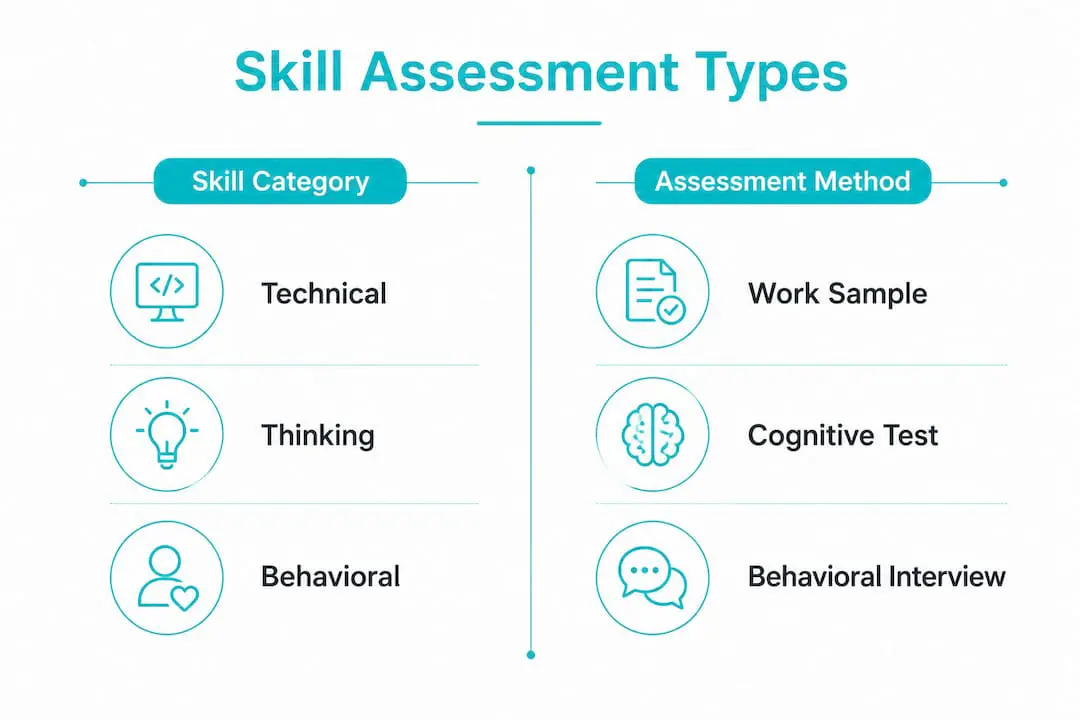
Combining assessment types consistently outperforms single-method approaches, particularly for complex roles. A technical role might use a work sample plus a short cognitive test. A customer-facing role might pair a situational judgment test with a structured behavioral interview. The combination gives you a fuller picture without adding excessive time to the process.
How to design or select skill tests aligned to real job demands
The most common mistake in skills evaluation for job applicants is using generic, off-the-shelf tests that have no connection to the actual job. A customer service test built for retail will not predict performance in a B2B account management role, even if both involve “communication skills.” Role-specific, realistic tasks predict candidate job performance meaningfully better than abstract puzzles or trivia-style questions.
Follow these steps to build or select tests that hold up:
- Start with real work problems. Pull anonymized tasks or scenarios from recent projects in the role. A content writer test should use a real brief. A finance analyst test should use a real dataset with identifying information removed.
- Define scoring criteria before you review responses. Pre-define what “strong,” “acceptable,” and “weak” look like for each task. Rubric-based evaluation reduces bias and keeps scoring consistent across reviewers.
- Set a realistic time limit. Keep the total assessment within the 30–90 minute window. Longer tests increase candidate drop-off without proportionally improving data quality.
- Check legal defensibility. Every test must be job-related and consistent with business necessity. If you cannot explain why a test item connects to the role, remove it.
- Pilot the test internally. Ask a current employee in the role to complete it. If they struggle with the time limit or find questions irrelevant, revise before sending to candidates.
Pro Tip: For role-specific test design, involve the hiring manager in reviewing the scoring rubric before the first candidate sits the test. Their input catches misaligned criteria early and builds confidence in the results.
How to implement skill assessments within a structured hiring process
Placement within the hiring funnel matters as much as test quality. Positioning assessments before interviews filters out unqualified candidates early, saving interview time and reducing overall hiring costs. Recruiters who test after the first interview often waste hours on candidates who would have failed a basic skills check.
Asynchronous video pre-screening works well as a preliminary filter before formal testing. Video prescreening reduces assessment spend by eliminating obvious mismatches before they reach a skills test. Think of it as a “Step 0” that protects your assessment budget and keeps the candidate pool focused.
Once assessments are in place, avoid overreliance on test scores alone. Skill test results should inform interviews, not replace them. Use scores to prioritize who gets interview time and to focus conversation on areas where the candidate showed weakness or where the test could not fully capture their capability.
Candidate communication also affects completion rates. Tell applicants upfront how long the test takes, what skills it covers, and how results will be used. Transparency builds trust and reduces the anxiety that leads to drop-off or poor performance unrelated to actual ability.
- Test before the first interview to filter unqualified candidates early.
- Use asynchronous video pre-screening as a low-cost first filter before skills testing.
- Combine test scores with structured interview data rather than relying on either alone.
- Communicate test purpose, duration, and scoring criteria to candidates before they begin.
- Review completion rates and score distributions after each hiring cycle to catch test design problems early.
For practical guidance on building this workflow end to end, the skills evaluation guide from Talent Approved covers implementation steps in detail.
Key Takeaways
Choosing the right skills to test applicants requires job analysis, competency mapping, matched assessment types, and structured placement within the hiring funnel to produce reliable, legally defensible results.
| Point | Details |
|---|---|
| Start with job analysis | Break each role into technical, thinking, and foundation skills before selecting any test. |
| Limit to 3–5 competencies | Focus on the highest-leverage skills per role to maintain predictive power. |
| Match test type to skill | Use work samples for technical skills, cognitive tests for reasoning, and SJTs for judgment. |
| Define rubrics before scoring | Pre-set strong, acceptable, and weak criteria to reduce bias across reviewers. |
| Test before interviews | Place assessments early in the funnel to filter candidates and protect interview time. |
Why most skill testing fails before it starts
The real problem with applicant testing is not the tests themselves. It is the selection process that precedes them. Most hiring teams pick tests based on what is available or familiar rather than what the role actually demands. That produces assessments that feel rigorous but measure the wrong things entirely.
I have seen organizations run the same cognitive reasoning test across every role from warehouse coordinator to senior software engineer. The test was well-designed. The problem was that it had no connection to what made either role succeed. Candidates who scored well on abstract reasoning still failed in the job, because the test never touched the specific judgment, technical depth, or interpersonal skills the work required.
Competency-based assessment changes that equation. When you anchor every test item to a defined, observable behavior that predicts performance in a specific role, the results become genuinely useful. The challenge is that soft skills and situational judgment are genuinely hard to test well. A behavioral interview question can be coached. A situational judgment test can be gamed if the scenarios are too obvious. The answer is not to avoid these skill types but to use realistic, nuanced scenarios drawn from actual workplace situations rather than textbook examples.
The other mistake I see consistently is treating assessment as a one-time setup. Test effectiveness degrades over time as roles evolve and candidate pools shift. Reviewing score distributions and correlating test results with 90-day performance data every six months is the only way to know whether your assessments are still doing their job.
— Jimmie
How Talent Approved makes skill test creation faster and more accurate
Building role-specific assessments from scratch takes time most recruiting teams do not have. Talent Approved’s AI-powered platform removes that barrier by generating tailored skill tests directly from a job description in minutes.
The Magic Create feature produces structured, role-specific questions aligned to the competencies you define, without requiring test design expertise. AI-generated skill tests mean you can move from job description to live assessment in a single session. Built-in candidate ranking and AI scoring surface your strongest applicants automatically, while anti-cheat proctoring protects the integrity of every result. For HR teams that need reliable, bias-reduced evaluation without the overhead of manual test design, Talent Approved delivers exactly that.
FAQ
What skills should I prioritize when testing job applicants?
Prioritize the 3–5 competencies most directly tied to job performance in that specific role. Start with a job analysis that identifies technical, thinking, and foundation skills before selecting any test format.
How long should a skills assessment be for job applicants?
Effective skills assessments run 30–90 minutes. Shorter tests risk missing critical competencies, while longer ones increase candidate drop-off without improving data quality.
What is the most reliable assessment type for technical skills?
Work sample assessments are the most reliable format for technical skills. They mirror actual job tasks and deliver strong predictive validity with lower legal risk than abstract aptitude tests.
How do I make sure my skill tests are legally defensible?
Every test must be job-related and consistent with business necessity. Document the connection between each test item and the role’s core responsibilities before the assessment goes live.
Should I test candidates before or after the first interview?
Test before the first interview. Placing assessments early in the funnel filters unqualified candidates before you invest interview time, reducing costs and improving the quality of your shortlist.