
How to Evaluate Part-Time Applicant Skills Quickly

The fastest way to evaluate part-time applicant skills quickly is to use structured, job-specific assessments that test what the role actually demands. Part-time hiring carries a hidden trap: managers often treat it as a scaled-down version of full-time hiring, skipping the rigor and relying on gut instinct. That approach produces bad hires. The industry term for what you need is pre-employment skills assessment, and when it is designed around autonomy, scope clarity, and self-management, it predicts part-time performance far better than a resume review ever will. This guide gives you a repeatable process for assessing part-time candidate skills without wasting hours on every opening.
How to evaluate part-time applicant skills quickly: prerequisites and tools
Speed without structure produces noise. Before you run a single assessment, map the role’s three to five core outcomes. A customer support rep hired for 20 hours a week needs to triage tickets independently, not wait for direction. A part-time bookkeeper needs to close a monthly reconciliation without hand-holding. Defining those outcomes first means every tool you choose tests something that actually predicts success.
Mapping assessment criteria to specific part-time business outcomes prevents filtering out high-potential candidates who lack a polished resume but have genuine job readiness. That distinction matters because part-time roles often attract career changers, parents returning to work, and students, all of whom may look unconventional on paper.

The table below compares the main tool categories available for rapid part-time skills evaluation.
| Tool category | Time to administer | Best for | Key limitation |
|---|---|---|---|
| AI-powered screening | Under 2 minutes per candidate | Initial shortlisting at volume | Requires accurate job criteria input |
| Work sample tests | 15–30 minutes | Role-specific skill verification | Takes more setup time upfront |
| Structured interviews | 20–30 minutes | Autonomy and judgment assessment | Interviewer training needed |
| Automated skills tests | 10–20 minutes | Technical and foundation skills | Generic tests reduce predictive value |
AI-powered screening tools can reduce time-to-hire by 20% to over 80% compared to manual review. That compression frees your team to spend time where it counts: evaluating the shortlist, not building it.
Step-by-step methods to assess part-time candidates efficiently
A structured sequence keeps your process fast and valid. The steps below move from highest volume to highest depth, so you spend the most time only on candidates who have already cleared earlier filters.
-
Run AI-driven resume screening first. AI-driven tools can evaluate each applicant in roughly 1 second per resume, producing a ranked shortlist without manual keyword searches. Manual screening of 100 resumes typically takes 20–30 hours. Automated tools cut that to under 2 hours.
-
Send a short work sample test. Work samples are more predictive of job performance than standard multiple-choice tests because they measure skill application, not just knowledge. Keep the task under 30 minutes and tie it directly to a real output from the role.
-
Conduct a focused structured interview. Limit the interview to 20–25 minutes. Ask three to four questions that probe autonomy, prioritization, and communication habits. Avoid open-ended questions that invite vague storytelling.
-
Ask for a first-month plan. Give shortlisted candidates a one-page summary of the role and ask them to outline what they would focus on in their first 30 days. Strong candidates define ownership and scope clearly, simplify problems fast, and identify missing inputs. Weak candidates produce generic lists.
-
Apply a three-dimensional scoring framework. Effective skills assessments combine technical skills, thinking skills, and foundation skills such as communication and reliability. Score each dimension separately so you can see where a candidate is strong and where they need support.
-
Combine inputs for a final decision. Combining multiple evaluation types reduces unconscious bias and produces data-driven decisions. A candidate who scores well on the work sample but poorly on the first-month plan exercise tells you something specific about their self-direction.
Pro Tip: Ask every candidate the same structured questions in the same order. Consistency is what makes your scores comparable across candidates and defensible if a hiring decision is ever questioned.
What are the most common pitfalls in quick skills evaluations?
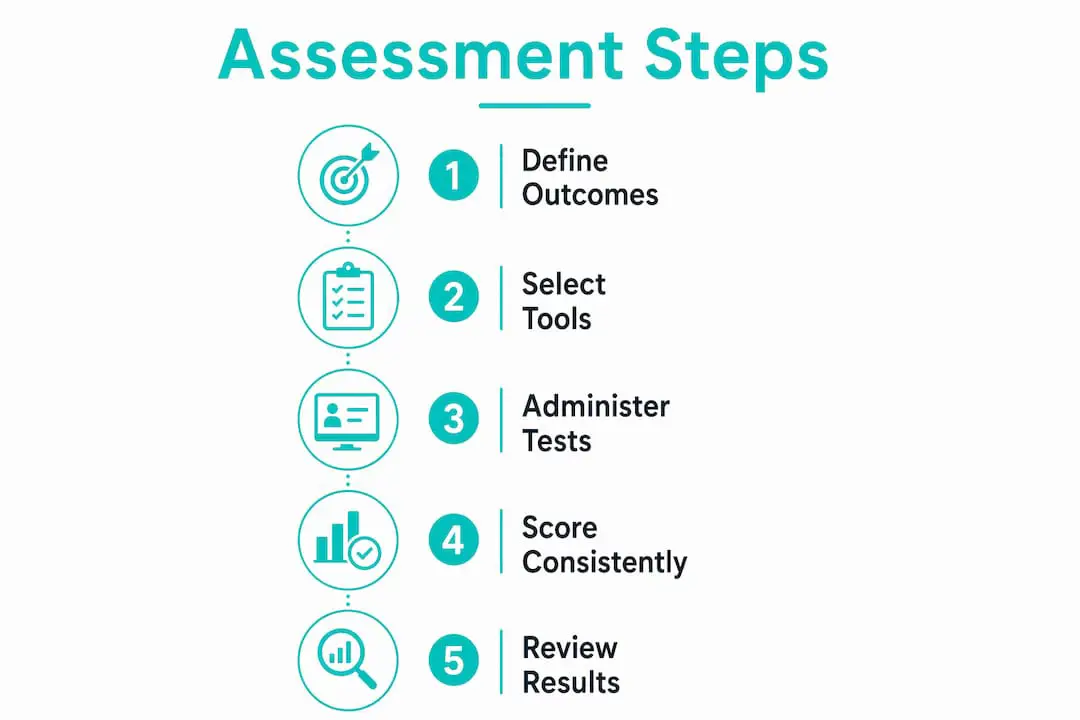
Speed creates pressure to cut corners. The most common mistake is using a generic skills test that was not designed for the specific role. A generic test measures something, but rarely the thing that predicts success in your part-time position. Evaluating part-time applicants requires the same rigor as full-time hiring, with a deliberate shift toward autonomy and scope clarity.
Watch for these specific failure points:
- Convenience over validity. Recruiters consistently warn that prioritizing a fast, easy test over a valid one produces unreliable results. A 5-minute personality quiz is not a substitute for a role-specific work sample.
- Vague candidate answers left unprobed. When a candidate says “I manage my time well,” that is not evidence. Follow up with: “Walk me through how you structured your last week when you had three competing deadlines.”
- Inconsistent administration. Giving some candidates extra time or different instructions invalidates your comparisons. Standardized scoring enhances both validity and fairness.
- Ignoring self-management signals. Candidates who demonstrate time-blocking and communication batching succeed more in part-time roles than those who rely on manager direction.
Pro Tip: When reviewing a candidate’s first-month plan, look for evidence that they identified what they would NOT do. Scope discipline is a stronger signal of part-time readiness than ambition.
How do you measure and improve your evaluation results over time?
A quick assessment process that never gets reviewed will drift. The first metric to track is the correlation between assessment scores and 90-day performance ratings. If your work sample scores do not predict manager ratings at 90 days, the test needs recalibration.
The table below outlines a simple improvement cycle for your assessment process.
| Review trigger | Action | Frequency |
|---|---|---|
| New hire 90-day review | Compare assessment score to performance rating | Every hire |
| Role requirements change | Update work sample and scoring criteria | As needed |
| Candidate feedback collected | Adjust test length and clarity | Quarterly |
| Hiring team feedback | Recalibrate structured interview questions | Twice per year |
Candidate feedback is an underused data source. A test that confuses candidates or feels irrelevant signals a design problem, not a candidate problem. Collecting a short post-assessment survey takes two minutes and surfaces issues you would not otherwise see.
Standardizing how you collect and store scores matters too. If each hiring manager keeps notes in a different format, you cannot spot patterns across roles or time periods. A centralized scoring sheet, even a simple spreadsheet, gives you the data you need to improve quality of hire over successive hiring cycles. The goal is a process that gets sharper with every hire, not one that resets from scratch each time.
Key Takeaways
The most effective way to assess part-time candidates quickly is to combine AI-powered screening, role-specific work samples, and structured interviews built around autonomy and scope clarity.
| Point | Details |
|---|---|
| Map outcomes before testing | Define three to five core role outcomes before selecting any assessment tool. |
| Use AI screening first | AI tools cut manual resume review from 20–30 hours to under 2 hours per 100 candidates. |
| Work samples beat generic tests | Role-specific tasks predict job performance better than multiple-choice knowledge checks. |
| First-month plan reveals readiness | Candidates who define scope and ownership clearly outperform those who produce generic lists. |
| Track scores against performance | Link assessment results to 90-day ratings to recalibrate tests and improve predictive accuracy. |
Why autonomy is the real test in part-time hiring
Part-time hiring gets treated as a lower-stakes version of full-time hiring. That assumption is wrong, and it costs teams real money. A part-time hire who needs constant direction consumes more manager time than the hours they save. The actual test is not whether someone can do the work. It is whether they can do it with minimal oversight, in a compressed schedule, without losing track of what matters most.
I have seen hiring managers skip the first-month plan exercise because it feels like extra work. Every time, they regret it. The candidates who struggle with that exercise are the same ones who, three months in, are asking for clarification on things that were in the job description. That exercise is not extra work. It is the fastest signal you have.
The other mistake I see constantly is treating self-management as a personality trait you either have or do not. Self-management systems like time-blocking and communication batching are observable behaviors. You can ask about them directly, and you can verify them with a work sample that has a real deadline. If a candidate cannot describe how they would structure a 20-hour work week to hit a specific deliverable, that is a concrete answer.
AI screening tools do not replace that judgment. They free you to apply it where it counts. When you are not spending three hours sorting resumes, you have time to run a proper structured interview and actually listen to the answers. The combination of AI-driven assessment and human evaluation is not a compromise. It is the most accurate process available.
— Jimmie
Talent Approved makes fast, valid part-time assessments practical
Building a rigorous assessment process from scratch takes time most hiring teams do not have. Talent Approved removes that barrier with AI-powered skill assessments that can be configured in minutes using a job description or a list of target skills.
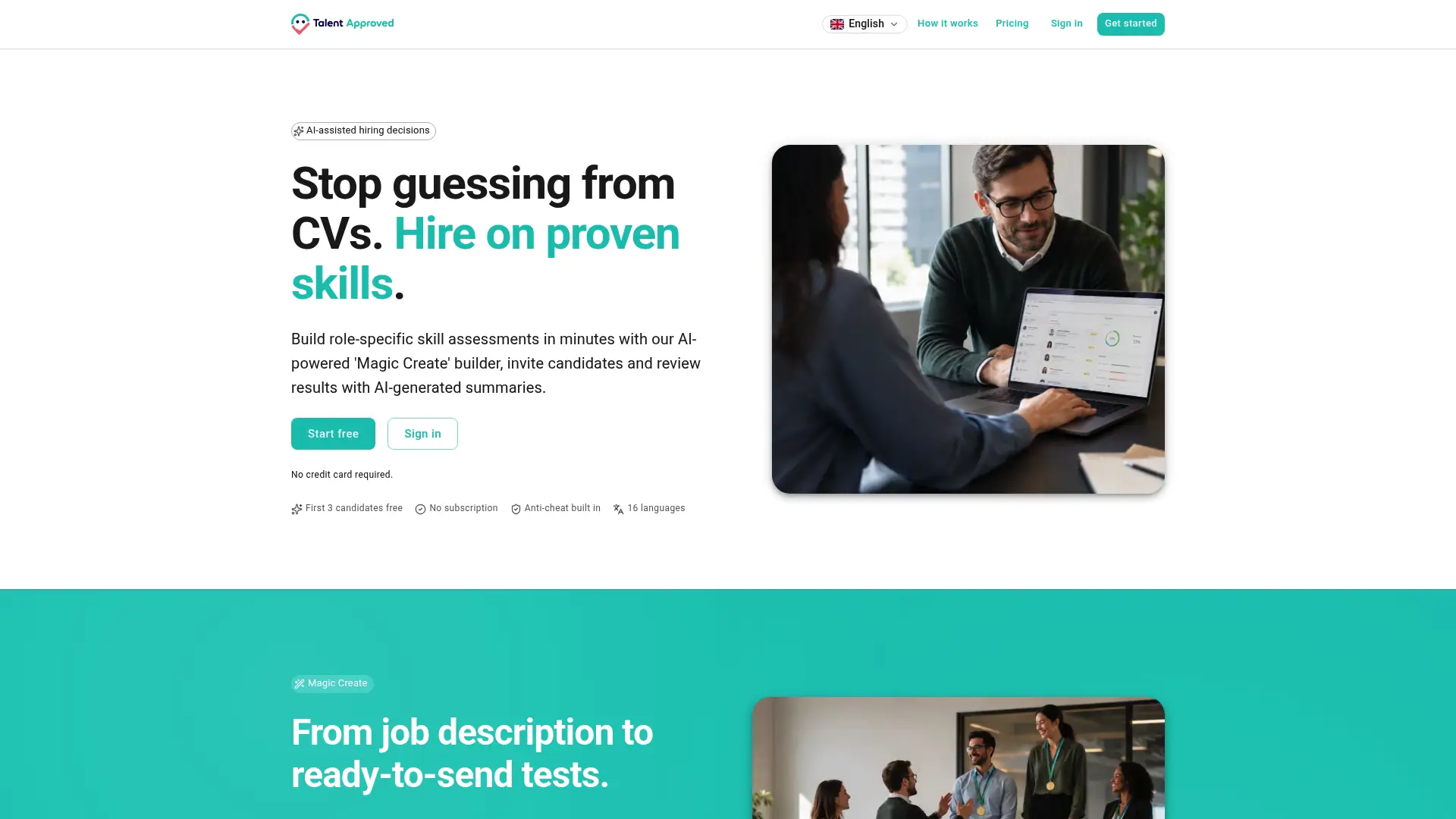
The Magic Create feature generates role-specific tests without manual question writing. Built-in anti-cheat mechanisms and AI-generated candidate summaries mean your team reviews results, not raw data. Talent Approved customers report cutting weeks from their hiring cycle while gaining structured, comparable scores across every candidate. For HR teams hiring part-time staff at any volume, that combination of speed and validity is hard to replicate manually. See how Talent Approved works and explore assessment pricing to find the right fit for your team.
FAQ
What is the fastest way to screen part-time applicants?
AI-powered screening tools evaluate each applicant in roughly 1 second per resume and produce a ranked shortlist, cutting manual review from 20–30 hours to under 2 hours per 100 candidates.
Why do part-time roles need different assessment criteria?
Part-time roles require candidates who can work with high autonomy and scope clarity. Treating part-time work as reduced full-time work misses the distinct self-management demands these roles place on candidates.
Are work samples better than skills tests for part-time hiring?
Work samples are more predictive of job performance than standard multiple-choice tests because they measure how a candidate applies skills, not just whether they know the theory.
How do I assess self-management in a short interview?
Ask candidates to describe how they structured a recent week with competing deadlines. Look for specific behaviors like time-blocking and communication batching, not general claims about being organized.
How often should I update my part-time assessment process?
Review your process at every 90-day new hire evaluation, whenever the role changes, and at least twice per year based on hiring team feedback to keep your assessments accurate and relevant.