
How Role-Specific Tests Are Built for Better Hiring

Role-specific tests are assessments designed to measure the exact competencies and skills a particular job demands, giving HR teams objective evidence to hire on ability rather than assumptions. Understanding how role-specific tests are built is the foundation of any hiring process that consistently selects high performers. The industry term for this practice is competency-based assessment design, and it draws on structured job analysis, validated competency frameworks, and iterative test validation. Talent Approved applies this framework with AI assistance, cutting the time from job brief to deployable assessment to minutes rather than weeks.
What steps are involved in building role-specific assessments?
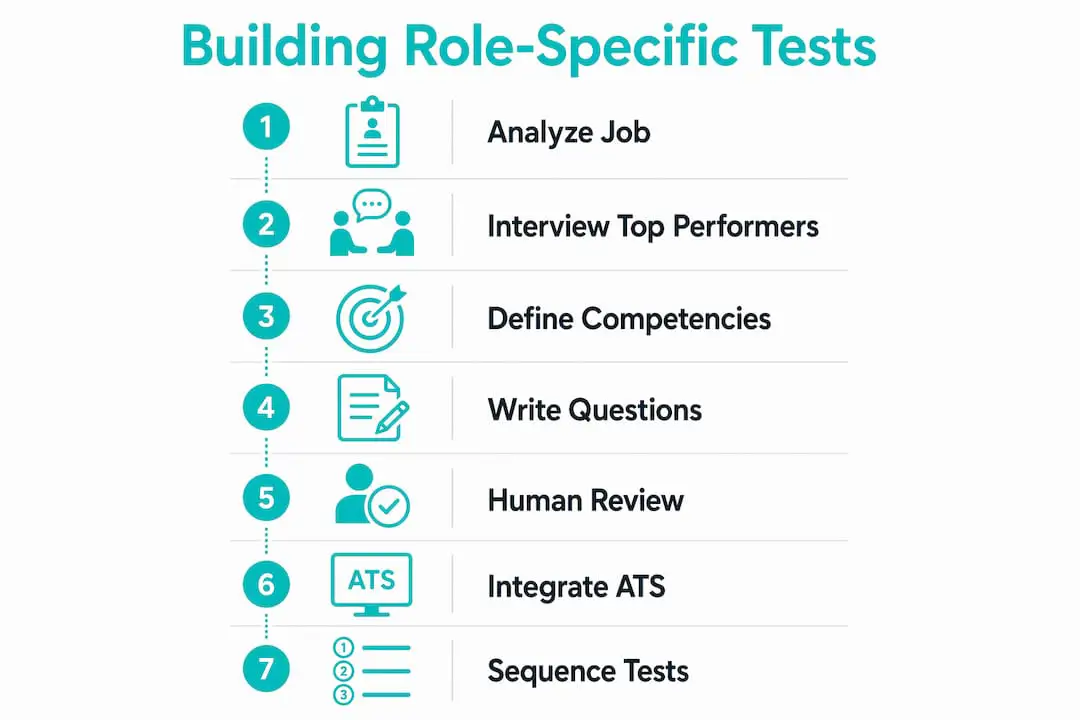
Effective role-specific assessments begin with a thorough job analysis. That means interviewing hiring managers and top performers, observing actual work tasks, and documenting the behaviors that predict success in the role. Without this foundation, every question you write is a guess.
Once you have the job analysis, the process follows a clear sequence:
- Define measurable competencies. Translate job duties into observable skills. A customer success manager role, for example, requires active listening, conflict resolution, and product knowledge, not just “communication skills.”
- Build an assessment blueprint. Map each competency to a question type. Technical skills suit coding challenges or case studies. Behavioral competencies suit structured scenario questions. Cultural fit suits values-based situational prompts.
- Write scenario-based tasks. The strongest questions simulate real job challenges. A logistics coordinator test should include a task where the candidate must reprioritize shipments under a time constraint, not just answer abstract reasoning questions.
- Weight the scoring rubric. Balancing hard constraints such as required certifications with weighted competencies like customer empathy produces a rubric that reflects actual job demands. Must-have criteria act as filters; weighted competencies differentiate strong from average candidates.
- Pilot and iterate. Run the test with a small group, review where candidates cluster or drop off, and refine questions that produce no signal. Stakeholder feedback at this stage prevents costly errors at scale.
Pro Tip: Interview your two or three best current employees in the role before writing a single question. Their answers reveal the competencies your job description probably undersells.
How does AI assist in generating effective role-specific tests?

AI has changed the speed at which creating job-specific tests is possible. AI-driven generators can build full role-specific tests in under 2 minutes when given comprehensive input including job briefs and competency arrays. That speed matters when you are hiring across ten roles simultaneously.
The quality of AI output depends entirely on what you put in. Providing detailed job titles, must-have skills, behavioral outcomes, and examples of strong versus weak responses produces far better questions than a generic job title alone. Think of it as prompt engineering for HR: the richer the context, the more targeted the output.
AI systems also generate structured, role-specific question sets by leveraging screening data and careful prompt design. These systems improve consistency by producing questions tied to the candidate’s identified gaps and the role’s specific demands, not a generic bank of interview questions.
The practical uses of AI in test construction include:
- Rapid generation of technical coding questions calibrated to seniority level
- Behavioral prompts drawn from the competency framework you define
- Scenario-based tasks that mirror real job situations
- Variation sets that reduce answer-sharing between candidates
The risk is real, though. Without comprehensive input, AI produces generic, ineffective tests that measure nothing specific.
“AI test generation quality depends heavily on prompt engineering. Insufficient context leads to generic questions that fail to differentiate strong candidates from average ones. The model needs your job analysis, not just your job title.”
Human oversight is required to review AI-generated questions for bias and accuracy before deployment. AI does not know that your senior developer role requires AWS experience but not Azure. You do. That contextual knowledge must stay in the loop.
What are best practices and common pitfalls when designing role-specific tests?
The most common mistake in developing targeted assessments is confusing activity with measurement. A long test is not a valid test. Every question must map to a competency that predicts job performance.
Best practices that consistently produce valid, fair assessments:
- Align to validated competency frameworks. Use established HR competency models or your own validated scorecards as the source of truth, not intuition.
- Include all three dimensions. Effective test designs balance behavioral, technical, and cultural fit questions tailored by role level and department. Leadership tests weight decision quality and team outcomes more heavily. Technical tests prioritize depth of skill.
- Exclude irrelevant criteria. Any question that does not predict job performance introduces bias. Removing irrelevant criteria is not just fair practice; it is legally defensible practice.
- Use objective evidence. Structured rubrics with clear scoring criteria reduce the influence of personal preference on results. A candidate’s answer to a scenario question should be scored against defined indicators, not gut feeling.
- Maintain an audit trail. Competency-based blueprints that map must-have constraints and weighted competencies to evidence examples and disposition reasons create the documentation you need for fair hiring audits.
- Refine with live data. After each hiring cycle, analyze which questions predicted performance and which did not. Drop or rewrite the ones that produce no signal.
Pro Tip: Build a candidate evaluation criteria checklist before writing questions. It forces you to agree on what “good” looks like before you start measuring it.
The most overlooked pitfall is skipping human review for borderline candidates. Automated scoring handles clear passes and clear fails well. The middle range requires a human who understands context.
How to operationalize role-specific tests within your hiring workflow?
Building a great assessment means nothing if it sits outside your actual hiring process. Operationalizing role-specific tests involves integrating blueprints with your Applicant Tracking System, automating scoring, sequencing assessments correctly, and maintaining human review at key decision points.
Connecting assessments to your ATS
Map each assessment element to the corresponding ATS data field. Competency scores should populate candidate profiles automatically, not require manual entry. This creates a consistent record and reduces the chance of scoring errors caused by copy-paste workflows.
Sequencing to reduce candidate drop-off
Assessment sequencing directly affects completion rates. Place short screening questions early in the process to filter for hard constraints. Reserve longer scenario-based tasks for candidates who pass the initial screen. This respects candidate time and keeps your pipeline moving.
| Stage | Assessment type | Purpose |
|---|---|---|
| Initial screen | Hard constraint check | Filter for non-negotiable requirements |
| Mid-funnel | Competency-based tasks | Measure role-specific skills |
| Final stage | Scenario or case study | Evaluate judgment and depth |
Portable blueprints by role type and seniority
A single blueprint does not fit every hire. Build separate templates for individual contributor, team lead, and senior leadership roles. Each template should reflect the competency weights appropriate to that level. A junior developer test and a principal engineer test should share a structure but differ significantly in depth and complexity.
Pro Tip: Tag each blueprint with the role family and seniority level in your ATS. When a similar role opens, you pull an existing blueprint and update it rather than starting from scratch.
Key Takeaways
Role-specific tests built on validated competency frameworks and supported by human oversight produce the most accurate and defensible hiring outcomes.
| Point | Details |
|---|---|
| Start with job analysis | Interview top performers and map their behaviors before writing any questions. |
| Use competency blueprints | Map each question to a specific, weighted competency to keep tests valid and auditable. |
| Apply AI with rich input | AI generates tests faster when given detailed job briefs, skill lists, and response examples. |
| Sequence assessments by stage | Place short filters early and deeper tasks mid-funnel to protect completion rates. |
| Maintain human review | Automated scoring handles clear results; humans must review borderline and complex cases. |
Why I think most hiring teams build tests in the wrong order
Most HR teams write questions first and define competencies second. That is backwards, and it produces assessments that feel thorough but measure nothing predictable. I have seen organizations run candidates through 45-minute tests that could not distinguish a top performer from an average one because the questions were never tied to actual job outcomes.
The teams that get this right start with scorecards, not question banks. They agree on what “excellent” looks like in the role before they write a single prompt. Then they use AI to accelerate the drafting phase, not to replace the thinking phase. AI is genuinely useful for generating question variations, calibrating difficulty, and producing scenario tasks at scale. It is not useful for deciding which competencies matter. That judgment requires someone who understands the role, the team, and the business context.
The other thing I would push back on is the idea that more questions equal more accuracy. Shorter, well-designed assessments with five targeted questions outperform 30-question generic tests in both candidate experience and predictive validity. The goal is signal, not volume.
Iterative improvement is where most teams leave value on the table. Every hiring cycle produces data. Which questions separated your best hires from the rest? Which ones produced no difference? That feedback loop, built into your process from the start, is what turns a good assessment into a great one over time.
— Jimmie
How Talent Approved supports role-specific test creation
Talent Approved’s AI-powered platform puts the full assessment design process into a single workflow built for HR teams.
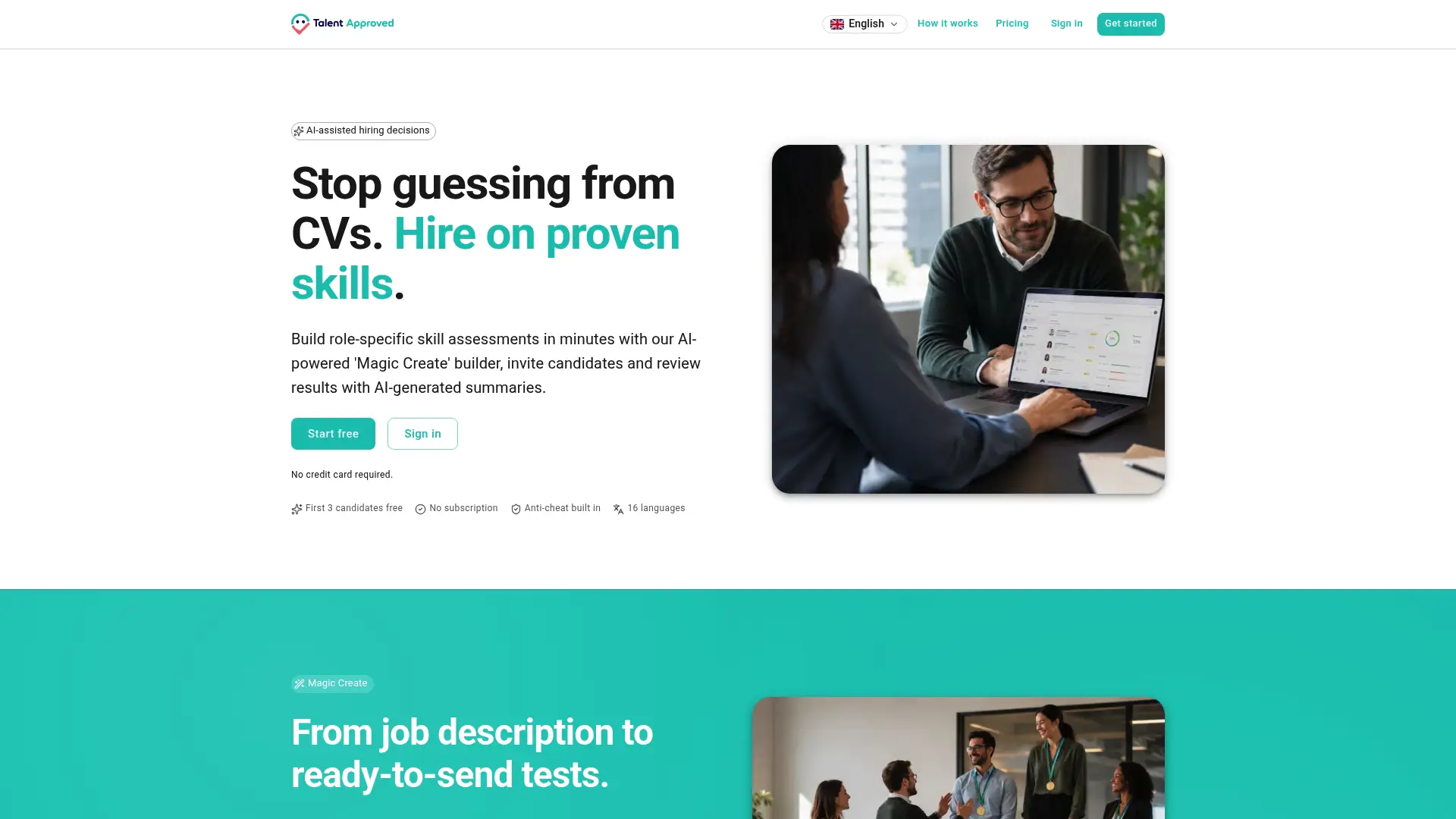
The Magic Create feature parses your job description and generates a tailored skill assessment in minutes, with competency-mapped questions ready for your review. Built-in anti-cheat tools and AI-generated candidate summaries keep the process fair and auditable. The platform connects directly to your hiring workflow, so scores populate candidate profiles automatically. HR teams can also review assessment results with AI to catch borderline cases and maintain quality at every stage. Talent Approved gives you the structure of a validated assessment process without the weeks of manual design work.
FAQ
What is a role-specific test in hiring?
A role-specific test is a competency-based assessment designed to measure the exact skills and behaviors a particular job requires. It differs from a general aptitude test by mapping directly to the duties and performance standards of the role.
How does AI generate role-specific tests?
AI generates role-specific tests by processing job briefs, competency arrays, and skill requirements to produce targeted questions and tasks. Output quality depends on the detail and specificity of the input provided to the AI system.
How long should a role-specific assessment be?
A well-designed role-specific assessment typically includes five to ten targeted questions or tasks. Shorter, competency-mapped tests produce better candidate completion rates and stronger predictive validity than longer, generic ones.
What is a competency blueprint?
A competency blueprint is a structured document that maps each assessment question or task to a specific competency, its weight in the scoring rubric, and the evidence indicators that define a strong response. It is the foundation of a valid, auditable assessment.
How often should role-specific tests be updated?
Role-specific tests should be reviewed after every hiring cycle using performance data from new hires. Questions that fail to differentiate strong from average performers should be rewritten or replaced to keep the assessment accurate over time.