
How to Design Job-Specific Candidate Screening Tests

Job-specific candidate screening tests are structured assessments that measure whether an applicant can actually perform the tasks a role requires, not just describe their experience on a CV. When you design job-specific candidate screening tests correctly, you replace gut-feel hiring with evidence. The 70-30 hiring rule holds that candidates need to demonstrate 70% of required skills before starting, with the remaining 30% learned on the job. That principle defines exactly what your screening test should measure. The industry term for this practice is competency-based assessment, and it sits at the foundation of every effective hiring process.
How do you design job-specific candidate screening tests that actually predict performance?
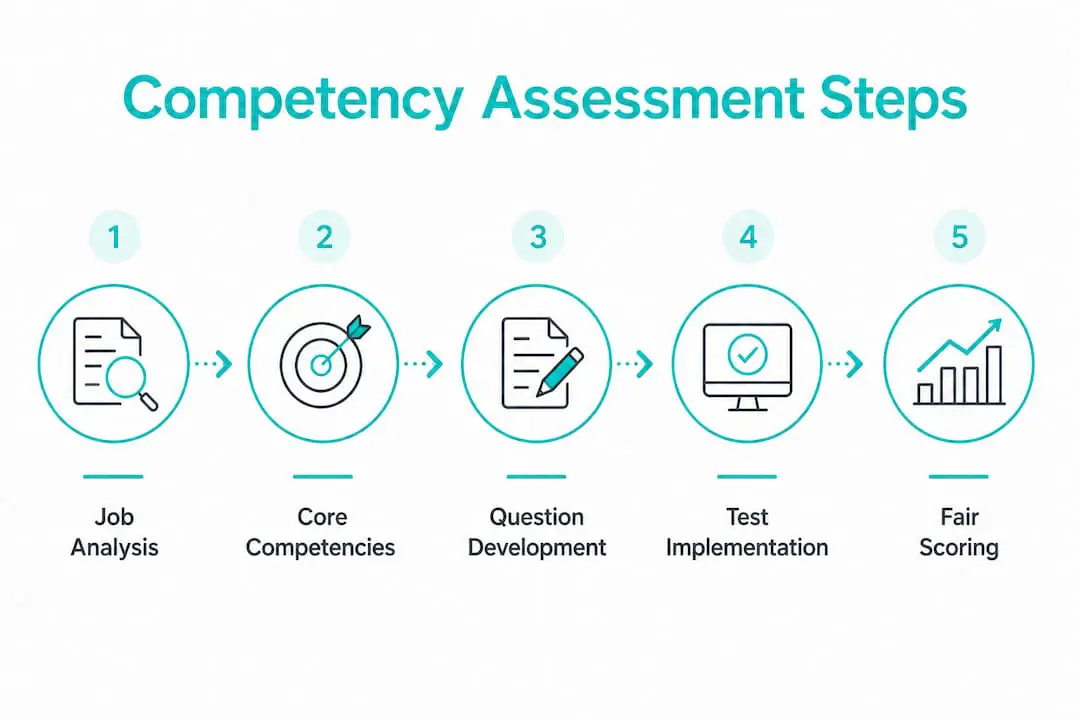
The answer starts with a job task analysis. Before you write a single question, list the five to seven tasks the new hire will perform in their first 90 days. Every test item should trace back to one of those tasks. Assessments built this way achieve higher predictive validity than abstract or irrelevant questions. Predictive validity means the test score correlates with actual job performance, which is the only metric that matters.
Generic screening tests fail because they measure what candidates know, not what they can do. A customer service rep who scores well on a vocabulary test may still struggle to de-escalate an angry caller. A UX designer who lists Figma on their resume may not be able to explain a design decision under pressure. Custom candidate assessments close that gap by putting applicants in realistic scenarios from day one of the evaluation.

What core competencies should you assess for different job roles?
Competency mapping is the process of identifying which skills, behaviors, and knowledge areas predict success in a specific role. The output of that mapping becomes the blueprint for your test. Competencies fall into three categories:
- Technical skills: Role-specific hard skills such as SQL proficiency for a data analyst, visual hierarchy for a graphic designer, or usability testing for a UX designer.
- Cognitive skills: Problem-solving, analytical reasoning, and the ability to work through ambiguous situations without a clear answer.
- Behavioral skills: Communication, collaboration, adaptability, and how a candidate handles feedback or conflict.
Seniority changes the weighting. An entry-level hire needs strong technical foundations and learning agility. A senior hire needs demonstrated judgment, cross-functional collaboration, and the ability to mentor others. A director-level candidate needs strategic thinking and stakeholder management. Your test should reflect those differences explicitly, not treat all applicants to the same generic battery.
For creative roles, graphic designer screening benefits from assessing visual hierarchy, design-system thinking, accessibility awareness, and cross-functional collaboration. For technical roles, software proficiency and debugging logic are non-negotiable. Mapping these competencies before you build the test prevents you from measuring the wrong things entirely.
Pro Tip: Use the job description as your first competency source, then interview two or three high performers in the role. Ask them what skills they use daily. Their answers will surface competencies that never appear in formal job postings.
What tools and methods can you use to create effective screening tests?
The format of your test determines what you can actually measure. Each method has a specific strength, and the best tests combine two or three formats rather than relying on one.
- Work-sample tests: Candidates complete a task that mirrors actual job work. A copywriter drafts a 200-word product description. A data analyst cleans a messy dataset. These tests have the strongest predictive validity of any assessment type.
- Situational judgment tests (SJTs): Candidates read a realistic workplace scenario and choose or write their response. SJTs measure judgment and decision-making without requiring access to proprietary tools.
- Cognitive ability tests: Short, timed exercises that measure reasoning speed and accuracy. These predict learning potential and are especially useful for roles that require fast problem-solving.
- Personality and behavioral assessments: Structured questionnaires that identify work style, communication preferences, and risk tolerance. Use these as supplementary data, not as primary filters.
- AI-driven simulations and voice interviews: Candidates respond to dynamic prompts that adapt based on their answers. Work-sample simulations assess 3–5 core competencies in real time, improving prediction of on-the-job performance.
Test length is a practical constraint most recruiters underestimate. A test that takes longer than 30–45 minutes will reduce completion rates, especially for passive candidates. Keep each section focused on one competency. Remove any question you cannot directly score against a rubric.
Pro Tip: Write scenario-based questions in the second person. “You receive a brief from a client who wants a logo that contradicts your brand guidelines. What do you do?” That framing activates practical thinking rather than theoretical recall.
How do you implement and score screening tests for consistency and fairness?
Consistent scoring requires a rubric built before the first candidate takes the test. Without a rubric, two reviewers will score the same answer differently, which introduces the exact bias you designed the test to remove.
The table below shows a scoring structure for a UX designer role. It illustrates how to weight competencies and set knockout thresholds.
| Competency | Weight | Knockout threshold | Scoring scale |
|---|---|---|---|
| Usability testing methodology | 30% | Yes — fail = disqualified | 1–5 |
| User research integration | 25% | No | 1–5 |
| Prototyping and iteration | 25% | No | 1–5 |
| Cross-functional collaboration | 20% | No | 1–5 |
AI-powered interviews evaluate these competencies with structured scoring and knockout rules. Candidates who fail a knockout competency like usability testing are automatically disqualified, preserving recruiter time for qualified applicants.
Weighted composite scores give you a single number that reflects role priorities. A candidate who scores 5/5 on usability testing but 2/5 on collaboration ranks higher than a candidate with the reverse profile, because the weighting reflects what the job actually demands. Establishing knockout criteria and weighted rubrics tailored to job requirements produces efficient, fair, and legally defensible screening.
Automated scoring tools remove the subjectivity from open-ended responses by flagging answers that lack specific detail. That flag triggers a follow-up question, which reveals whether the candidate can elaborate or was simply pattern-matching to expected answers.
What are common pitfalls in designing screening tests?
Most screening test failures trace back to a small set of repeatable mistakes. Recognizing them before you build saves significant rework.
- Measuring aesthetics instead of reasoning. For design roles, assessing only final outputs misses predictive value. Candidates who explain their design rationale demonstrate higher success probability than those who submit polished work without context.
- Using questions that don’t match the actual job. A test full of brain teasers or abstract logic puzzles measures neither job performance nor cultural fit. Every question needs a direct line back to a real task.
- Leaving responses unscored. Vague open-ended questions with no rubric produce data you cannot use. If you cannot score it, cut it or rewrite it.
- Making the test too long. Thoroughness is good. A 90-minute test for a junior role is not. Respect candidate time and you will see higher completion rates and a better applicant experience.
- Never iterating. A test built in 2023 may not reflect the role as it exists today. Review your assessments every six months against actual hire performance data.
Pro Tip: After each hiring cycle, compare test scores against 90-day performance reviews. If high scorers are underperforming, the test is measuring the wrong competencies. Adjust the weighting before the next cycle.
How can AI and modern technology enhance your candidate screening tests?
AI changes what is measurable in a screening test. Traditional assessments capture what candidates know at a single point in time. AI-driven assessments capture how candidates think under pressure, across multiple follow-up prompts.
- Automated follow-up probing: Effective screening tests automatically follow up on vague answers to reveal problem-solving methodology. This distinguishes candidates who understand a concept from those who have memorized the terminology.
- Dynamic question generation: Talent Approved’s Magic Create feature builds a full tailored assessment from a job description input in minutes, mapping questions directly to the competencies the role requires.
- Objective scoring reports: AI screening reports include dimension scores, transcript evidence, and hiring recommendations. That output gives recruiters a defensible record of every evaluation decision.
- Bias reduction: Structured AI scoring applies the same rubric to every candidate. Human reviewers unconsciously favor candidates who communicate in familiar styles. AI does not.
“Modern assessments must be dynamic and probing, challenging candidates to demonstrate deep understanding rather than rote knowledge. The goal is not to catch candidates out, but to surface the reasoning that predicts real performance.”
AI does not replace recruiter judgment. It removes the low-value work of reading through 200 unscored responses and lets you focus on the top candidates who have already proven they can do the job.
Key Takeaways
Competency-based assessment is the most reliable method for designing screening tests that predict actual job performance rather than interview confidence.
| Point | Details |
|---|---|
| Start with job task analysis | List the top tasks for the first 90 days before writing a single test question. |
| Weight competencies by role priority | Assign higher weights to the skills that matter most and set knockout thresholds for non-negotiables. |
| Use scenario-based questions | Realistic scenarios measure decision-making and practical skill, not memorized answers. |
| Probe candidate reasoning | Tests that capture rationale and tradeoffs predict performance better than those measuring final output alone. |
| Iterate after every hiring cycle | Compare test scores to 90-day reviews and adjust competency weights based on real performance data. |
Why most screening tests fail before the first candidate logs in
I have reviewed hundreds of screening tests built by HR teams who genuinely wanted to hire well. The most common failure is not a bad question. It is a test built around what is easy to measure rather than what the job actually requires. Teams default to multiple-choice knowledge checks because they are fast to score. They avoid open-ended scenario questions because they feel harder to evaluate. That trade-off produces data that is clean but useless.
The second failure I see consistently is treating the test as a one-time artifact. A test built for a role in 2024 reflects the job as it existed then. Roles change. Tools change. The skills that predicted success two years ago may be table stakes today. Teams that review their assessments against actual hire performance data every six months consistently outperform those that treat the test as a fixed document.
The third failure is underestimating candidate experience. A poorly designed test signals something about your organization. Candidates talk. A test that feels irrelevant, too long, or technically broken will cost you applicants you actually wanted. Treat the assessment as the first real interaction a candidate has with your hiring process. It should reflect the same care you put into your job posting.
The candidate evaluation criteria you set before the test goes live determines everything that follows. Get that right first.
— Jimmie
Talent Approved makes job-specific test design faster and more accurate
Building competency-based screening tests from scratch takes time most recruiting teams do not have. Talent Approved removes that bottleneck.
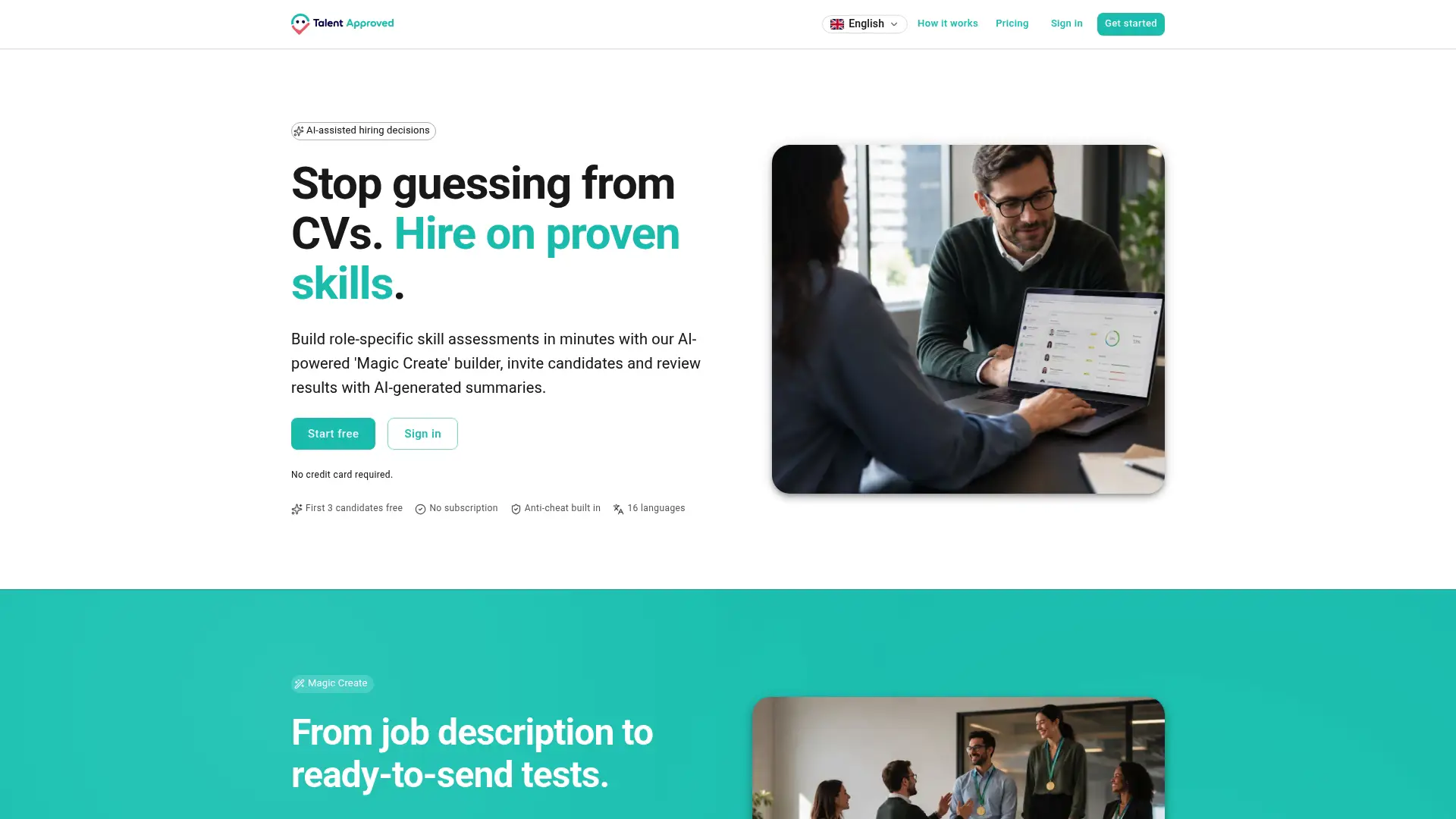
Talent Approved’s AI-powered platform generates custom skill assessments directly from a job description, mapping questions to the competencies your role requires. The Magic Create feature builds a complete test in minutes. Built-in anti-cheat mechanisms protect result integrity, and AI-generated summaries give you a clear picture of each candidate’s strengths without reading through raw transcripts. The AI candidate ranking feature scores and shortlists applicants automatically, so your team spends time on the candidates who have already proven they can do the work.
FAQ
What is a job-specific candidate screening test?
A job-specific candidate screening test is a structured assessment that measures whether an applicant can perform the actual tasks a role requires. It uses competency-based questions, work samples, or simulations tied directly to the job description.
How many competencies should a screening test cover?
Most effective screening tests assess 3–5 core competencies per role. Covering more than five dilutes focus and increases test length without improving predictive accuracy.
What makes a screening test legally defensible?
A test is legally defensible when every question directly relates to a documented job requirement and scoring rubrics are applied consistently to all candidates. Knockout criteria must reflect genuine role requirements, not preferences.
How do you score open-ended screening test responses fairly?
Build a scoring rubric before the test launches, assigning point values to specific answer elements. AI-assisted scoring tools can flag vague responses and trigger follow-up questions to capture deeper candidate reasoning.
How often should you update a candidate screening test?
Review and update screening tests after every hiring cycle by comparing test scores against 90-day performance reviews. Adjust competency weights when high scorers consistently underperform in the role.