
Technical Assessment Formats for HR: A 2026 Guide

What are technical assessment formats in HR?
Technical assessment formats are standardized methods HR teams use to evaluate candidates’ job-related skills before making a hiring decision. Rather than relying on a resume alone, these formats give you direct evidence of what a candidate can actually do.
The six main formats used across hiring workflows today include:
- Algorithmic and coding challenges: Timed tests measuring syntax, logic, and problem-solving
- Project-based tasks: Deliverable-driven assignments that simulate real work
- Real-world simulations: Task-based tests mirroring daily job activities
- Multiple-choice technical quizzes: Fast knowledge checks for foundational concepts
- Pair programming sessions: Live collaborative coding that reveals thinking and communication
- Take-home assignments: Extended tasks assessing quality, organization, and depth
Each format maps to specific job requirements. A coding challenge fits a software engineer role; a simulation fits a data analyst or systems administrator. The goal is always the same: predict job performance with evidence, not assumptions.
Table of Contents
- What objectives do technical assessments serve in hiring?
- Which technical assessment formats should HR teams know?
- How do HR teams typically conduct technical assessments?
- Best practices to make your technical assessments more effective
- A practical example: assessing a mid-level software engineer
- Expert insights on improving technical assessments with real-world context
- Talent Approved makes building technical assessments faster and fairer
- Key Takeaways
- FAQ
What objectives do technical assessments serve in hiring?
Technical assessments do more than filter candidates. When designed well, they shift the entire hiring conversation from credentials to capability.
- Early screening efficiency: Validating technical skills before a live interview saves your team hours per hire.
- Bias reduction: Standardized scoring and benchmarks replace gut-feel judgments with measurable criteria.
- Practical skill identification: Assessments reveal how candidates approach problems, not just whether they know the right answer.
- Hire quality improvement: Aligning tasks to real job functions means the candidates who score well are the ones who will perform well.
- Diversity and inclusion support: Skill-focused evaluation levels the field for candidates from non-traditional backgrounds who might be screened out by resume filters alone.
These objectives reinforce each other. A well-structured assessment that reduces bias also tends to surface stronger candidates, which in turn improves retention and team performance over time.
Which technical assessment formats should HR teams know?
The format you choose shapes what you learn about a candidate. Here is a breakdown of the most widely used types and when each one earns its place in your process.
Coding and programming tests are the default for software roles. Delivered online and usually timed for about an hour to an hour and a half, they test syntax, algorithmic thinking, and debugging under pressure. Platforms that administer these asynchronously let candidates complete them on their own schedule, which improves completion rates.
Project-based assessments ask candidates to produce a deliverable, such as a working feature, a data model, or a written technical proposal. These take longer but yield richer signal on how someone organizes their work and handles ambiguity.

Live coding and pair programming put the candidate in front of a problem with an interviewer present. The value here is not just the solution. You see how they communicate, ask clarifying questions, and recover from mistakes. For collaborative roles, this format is hard to replace.
Multiple-choice technical quizzes are fast and easy to score at scale. They work well for screening large applicant pools on foundational knowledge, though they should rarely stand alone as the only evaluation method.

Take-home assignments suit senior roles where depth matters more than speed. Keeping them to a reasonable length and compensating candidates for their time improves both acceptance rates and the quality of submissions.
Real-world simulations are the closest proxy to actual job performance. A support engineer troubleshooting a live ticket, a DevOps candidate configuring a staging environment, or a data analyst cleaning a messy dataset all produce evidence that translates directly to day-one readiness.
How do HR teams typically conduct technical assessments?
Administering technical assessments consistently across candidates requires more than picking a format. It requires a repeatable process.
- Align format to role requirements: Start with the job description and identify the two or three skills that most predict success. Choose the format that tests those skills directly.
- Use automated platforms for async tests: Asynchronous delivery removes scheduling friction and lets candidates perform at their best. It also creates a consistent experience across every applicant.
- Schedule live sessions with calibrated rubrics: For pair programming or system design interviews, use a structured scoring rubric with competency ratings on a defined scale. A 1–4 rubric per competency is a practical standard.
- Brief candidates clearly: Tell candidates exactly what to expect: format, time limit, tools allowed, and how results will be used. Transparency reduces anxiety and improves performance quality.
- Integrate results into scorecards: Assessment scores should feed into a shared evaluation document alongside interview notes and reference check findings. No single data point should carry the whole decision.
- Maintain consistent administration: Every candidate for the same role should receive the same instructions, the same time limits, and the same scoring criteria. Inconsistency is both a fairness problem and a legal risk.
For teams structuring technical interviews for professional services roles, the same principles apply: define the competencies first, then choose the format that surfaces them most clearly.
Best practices to make your technical assessments more effective
Getting the format right is only half the work. How you design and run the assessment determines whether it actually predicts performance.
- Use job-relevant tasks: Abstract puzzles test memorization, not job readiness. Build tasks around scenarios your team encounters weekly.
- Keep assessments concise: Completion rates drop sharply for tests longer than 90 minutes. Shorter, focused assessments attract stronger candidates and reduce drop-off.
- Apply structured scoring: Define what a “3” versus a “4” looks like before the assessment runs. Vague criteria produce inconsistent scores.
- Pilot test before launching: Run the assessment internally or with a small group to catch ambiguous questions, unrealistic time limits, or unintentional bias.
- Implement AI-aware integrity measures: Platforms like HackerRank and CodeSignal now include AI-assistance detection. Use flags as a prompt for follow-up conversation, not automatic disqualification.
- Communicate timing and next steps: Candidates who know when to expect feedback are more likely to stay engaged and complete the process.
- Train your reviewers: Inconsistent evaluation is one of the most common sources of bias. Calibration sessions where reviewers score the same sample response together close that gap fast.
Pro Tip: Pilot your assessment with two or three current employees in the target role. If they find it confusing or unreasonably long, your candidates will too. Adjust before it goes live.
For a deeper look at practical skills evaluation versus abstract testing, the distinction matters more than most hiring teams realize.
A practical example: assessing a mid-level software engineer
Here is how a structured technical assessment plays out for a mid-level backend engineer role at a mid-size SaaS company.
Scenario overview:
- Role: Mid-level backend engineer (Python, REST APIs, PostgreSQL)
- Hiring goal: Identify candidates who can own features independently and collaborate with a distributed team
- Volume: 80 applicants after resume screen
Assessment design:
- Async coding test (75 minutes): Candidates receive a small buggy Python service and must identify and fix three defects. The task is drawn from a real internal codebase, anonymized. Scoring covers correctness, test coverage added, and code clarity.
- Live pair programming session (45 minutes): A senior engineer works through a new feature request with the candidate. Scoring covers communication, question quality, and how the candidate handles an intentional ambiguity in the requirements.
Candidate experience: Total time commitment is moderate across two sessions scheduled within one week. Candidates receive a written brief 24 hours before the async test and a prep note before the live session.
Results integration: Scores from both stages feed into a shared scorecard alongside the hiring manager interview. No candidate advances on async score alone. The live session score carries equal weight.
What this reveals: Top candidates in the debug task read failing tests first before examining the source code, which signals a methodical, test-driven approach. In the live session, the strongest performers ask clarifying questions before writing a single line.
After the first hiring cycle, the team reduced the async test duration after data showed no meaningful score difference between the longer and shorter limits.
Expert insights on improving technical assessments with real-world context
The most common mistake in technical hiring is optimizing for the wrong signal. Algorithm memorization tests are easy to administer, but experts argue that day-to-day work scenarios produce far better evaluation of engineering candidates than abstract puzzle-based tests.
For senior roles specifically, debugging an unfamiliar codebase outperforms whiteboard algorithms as a predictor of performance. The reasoning is straightforward: senior engineers spend most of their time reading and improving existing code, not writing greenfield solutions from scratch.
Stat to know: Hiring processes that take several weeks or require extensive candidate time tend to show high drop-off and low validity. Keeping total candidate time moderate across all stages is the practical benchmark most high-performing teams use.
Beyond technical accuracy, strong assessments evaluate communication and decision-making. How a candidate explains a trade-off, asks for clarification, or documents their reasoning tells you as much about their fit as whether the code compiles. Structured async tests combined with live pair programming give you both signals without overloading the candidate.
Tracking pass rates, time-to-hire, and 90-day performance reviews against assessment scores lets you calibrate difficulty over time. If your pass rate is above 70%, the assessment is probably too easy. Below 20%, you may be filtering out qualified candidates with poorly scoped tasks. The right range depends on your pipeline volume, but monitoring these metrics turns your assessment into a self-improving system.
For guidance on training hiring managers to interpret and act on assessment results consistently, that calibration step is where most teams leave the most value on the table.
Talent Approved makes building technical assessments faster and fairer
Most HR teams know what they want to test. The friction is in building the assessment, scoring it consistently, and reviewing results without spending hours on manual work.
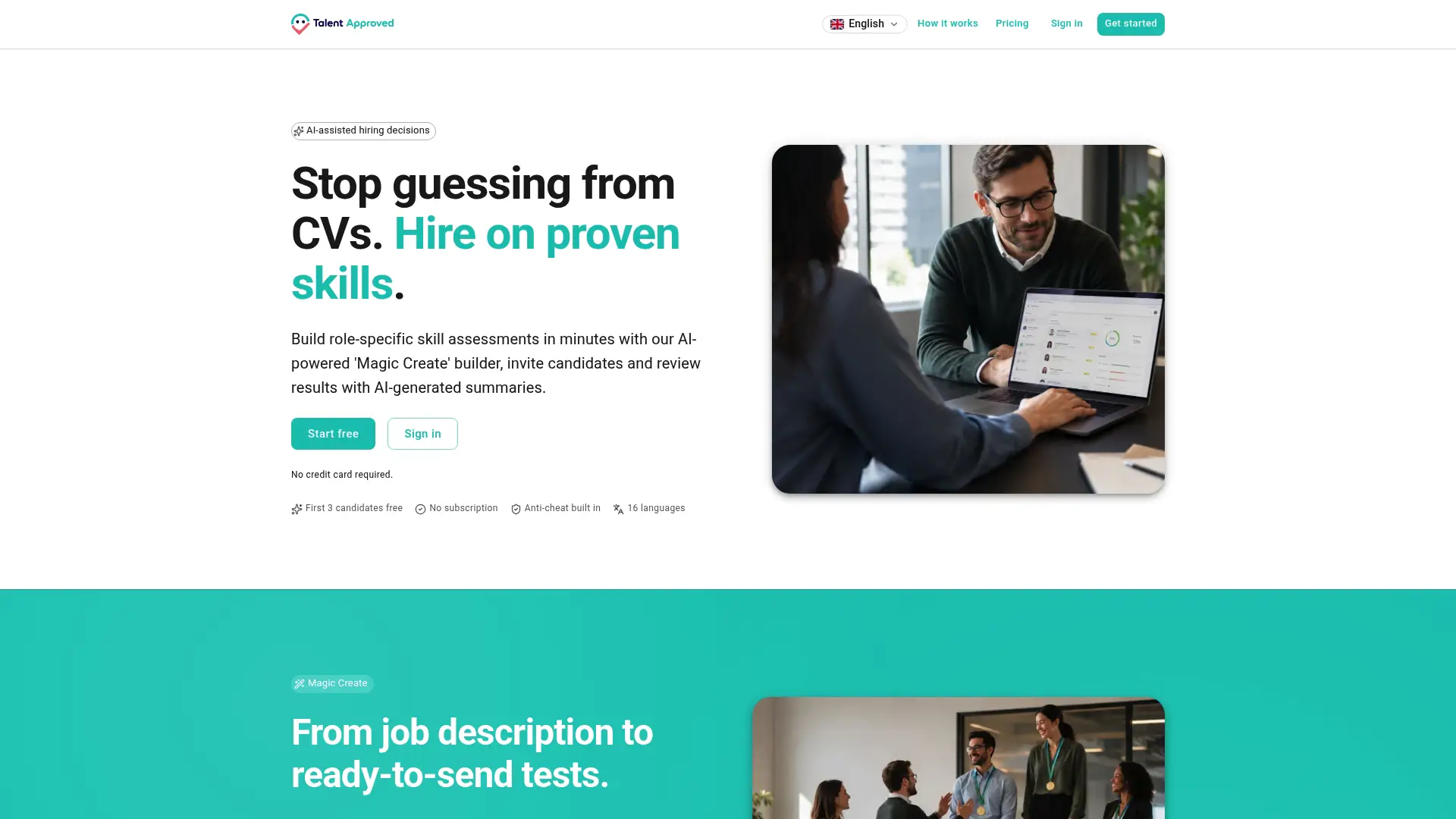
Talent Approved removes that friction. Its Magic Create feature generates a tailored, role-specific assessment in minutes from a job description or a list of target skills. No starting from scratch, no guessing at question quality. Built-in anti-cheat proctoring handles integrity automatically, and AI-generated candidate summaries give your team a clear, structured view of every result without reading through raw responses. The platform is built for HR teams that need to move fast without sacrificing fairness or accuracy. If you are ready to replace ad-hoc testing with a structured, scalable process, see how Talent Approved works and build your first assessment today.
Key Takeaways
The most effective technical assessment formats combine short async tests with live evaluation, keep total candidate time under three hours, and score every stage against a defined rubric.
| Point | Details |
|---|---|
| Match format to role | Choose the assessment type that directly tests the two or three skills most critical to the job. |
| Keep it under 90 minutes | Completion rates drop sharply for async tests longer than 90 minutes; shorter tests attract stronger candidates. |
| Score with a rubric | Define rating criteria before the assessment runs to reduce reviewer bias and inconsistency. |
| Combine async and live | Pairing an async coding test with a live session gives you both technical accuracy and communication signal. |
| Talent Approved | Magic Create builds role-specific assessments from a job description in minutes, with built-in anti-cheat and AI scoring. |
FAQ
What are the different types of technical assessments?
The six main types are algorithmic coding challenges, project-based tasks, real-world simulations, multiple-choice quizzes, pair programming sessions, and take-home assignments. Each format tests a different combination of skills and suits different role levels.
What is a technical assessment form in HR?
A technical assessment form is the structured document or digital tool HR uses to define the task, scoring criteria, and evaluation rubric for a candidate evaluation. It standardizes how every reviewer scores the same candidate, reducing subjectivity.
What is the technical assessment process?
The process typically runs in stages: an async screening test early in the funnel, followed by a live coding or pair programming session, and then a system design or domain-specific interview. Each stage is scored separately and feeds into a shared hiring scorecard.
What are the different types of assessments in HR?
HR uses technical assessments, behavioral interviews, cognitive ability tests, situational judgment tests, and reference checks. Technical assessments focus specifically on job-related skills and are most common in engineering, IT, data, and operations roles.
How do you choose the right technical assessment format?
Start with the job description and identify the skills that most predict success in the role. Match the format to those skills: coding tests for syntax and logic, simulations for operational roles, take-home tasks for senior positions where depth matters more than speed.