
Affordable Talent Evaluation: A Practical HR Guide

Affordable talent evaluation is defined as the use of objective, data-driven assessment methods that measure candidate skills accurately without high costs. The industry term for this practice is “structured candidate assessment,” and it covers everything from scored interviews to validated skill tests. Structured evaluations reduce mis-hires by 30–40% compared to resume-based screening alone. That figure matters because a single bad hire at the manager level can cost a business more than a year’s salary in lost productivity and rehiring expenses. For HR professionals and small business owners, affordable talent evaluation is not a compromise. It is a smarter way to hire.
What is affordable talent evaluation, and how does it work?
Affordable talent evaluation replaces gut-feel hiring with structured, repeatable methods that any team can apply without a large budget. The core idea is simple: measure the skills that actually predict job success, then score every candidate against the same standard. Combining multiple valid selection methods achieves predictive validity of r=0.60–0.65, which is the strongest result available in hiring research. That is more than three times the predictive power of a standard unstructured interview.
The three building blocks of cost-effective talent assessment are structured interviews, weighted scorecards, and validated skill tests. Each method adds a different layer of evidence. Together, they give you a complete picture of a candidate’s capabilities before you make an offer. The goal is not to run candidates through an expensive battery of tests. The goal is to pick the right combination of simple, proven methods.

Budget-friendly talent evaluation also improves fairness. Structured methods reduce the influence of unconscious bias because every candidate answers the same questions and gets scored on the same criteria. That consistency protects your hiring process legally and ethically, which matters as much as cost savings.
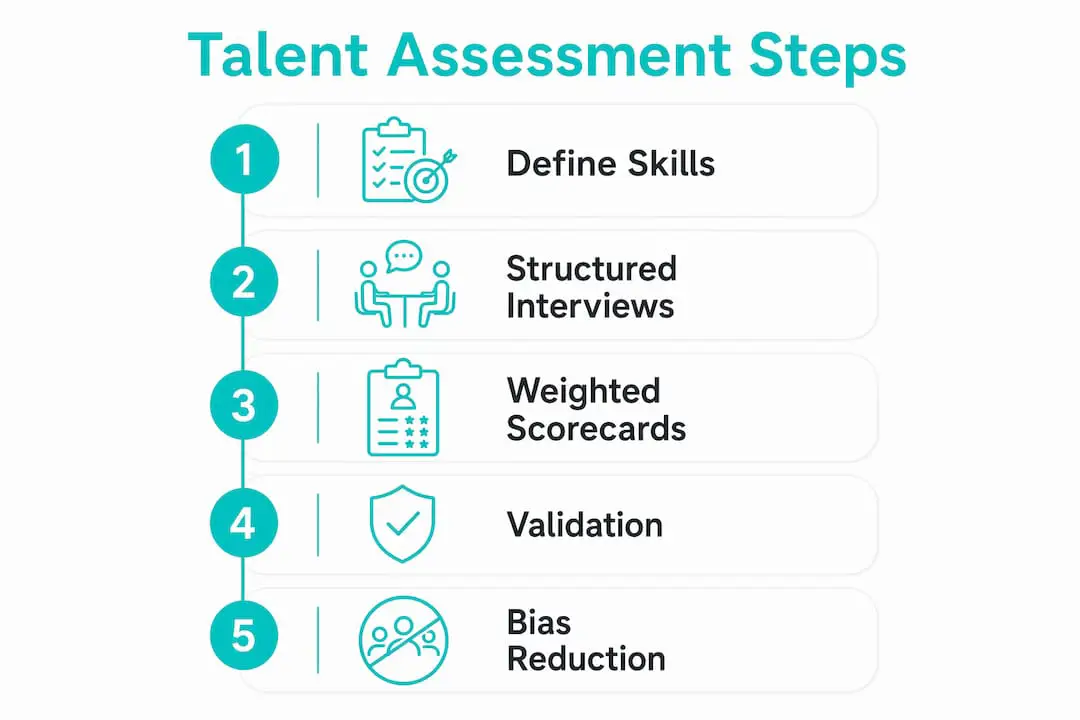
Core components of a cost-effective talent assessment
A well-designed, budget-friendly evaluation process uses four proven components. Each one is affordable to implement and backed by hiring research.
- Structured interviews with predetermined questions. Structured interviews predict job performance at r=0.42, roughly double the predictive power of unstructured interviews. They use fixed questions, behaviorally anchored rating scales, and multiple independent interviewers to keep scoring consistent.
- Weighted scorecards focused on 5–7 critical skills. Focusing on 5–7 key competencies keeps the evaluation sharp and manageable. Each skill gets a weight based on how much it affects job performance, so your final scores reflect real priorities rather than general impressions.
- Validated skill assessments and work samples. Role-specific skill tests give candidates a chance to demonstrate what they can actually do. Work samples, such as a short writing task or a data analysis exercise, are among the highest-validity methods available and cost almost nothing to create.
- Multi-method sequencing. Running methods in sequence, starting with a skill screen and ending with a structured interview, saves time and reduces cost per hire. You only invest deeper evaluation resources in candidates who pass earlier stages.
Pro Tip: Resist the urge to measure every skill that sounds relevant. Measuring too many skills dilutes evaluation accuracy and increases candidate drop-off. Stick to the 5–7 competencies that most directly predict success in the role.
How to implement affordable talent evaluation in your hiring process
Applying these methods does not require a dedicated assessment team or a large software budget. The steps below work for HR teams of one and small businesses hiring their first employees.
- Define your 5–7 critical competencies. Start with the job description. Identify the hard skills and soft skills that separate strong performers from weak ones. For a customer support role, that might be written communication, problem-solving, and product knowledge. For a data analyst, it might be SQL proficiency, attention to detail, and data storytelling.
- Build a weighted scorecard. Assign each competency a weight based on its impact on the role. A skill that drives 40% of job performance should carry 40% of the scorecard weight. You can build this in a spreadsheet at no cost, or use an existing validated assessment library to speed up the process.
- Write structured interview questions. For each competency, write two or three behavioral questions that ask candidates to describe past situations. Use the STAR format (Situation, Task, Action, Result) as your scoring anchor. Behaviorally anchored rating scales and multiple interviewers keep scoring consistent across your panel.
- Add a skill test or work sample. Place this early in the process to screen candidates before you invest interview time. A short, role-specific test takes 20–40 minutes for candidates and gives you objective data that resumes cannot provide. Talent Approved’s AI skill test creation tool builds these tests from a job description in minutes.
- Score independently, then calibrate. Have each interviewer score candidates before comparing notes. This prevents anchoring bias, where one person’s opinion shapes everyone else’s rating. Calibration takes 10 minutes and significantly improves the reliability of your final decision.
- Review AI-generated summaries for efficiency. If you use an AI-assisted platform, review the candidate summaries before the calibration meeting. Talent Approved’s AI result review feature condenses assessment data into clear candidate rankings, saving hours of manual review.
Pro Tip: Balance cost, accuracy, and candidate experience from the start. A process that takes candidates three hours to complete will lose strong applicants to faster-moving employers. Keep your total candidate time under 90 minutes for most roles.
How does affordable evaluation compare to traditional hiring?
Traditional hiring relies heavily on resume screening and unstructured interviews. Both methods feel familiar, but the data on their effectiveness is discouraging.
Unstructured interviews have a predictive validity of r=0.20. That means they explain only about 4% of the variance in job performance. Resume screening performs similarly. No single assessment method is sufficient on its own, and relying on resumes plus an unstructured chat is one of the weakest combinations available.
| Evaluation method | Predictive validity | Relative cost | Bias risk |
|---|---|---|---|
| Unstructured interview | r=0.20 | Low | High |
| Structured interview | r=0.42 | Low to medium | Medium |
| Skill test or work sample | r=0.45–0.54 | Low | Low |
| Combined multi-method approach | r=0.60–0.65 | Medium | Low |
The table shows a clear pattern. Combining methods delivers the highest predictive validity at a cost that remains manageable. Assessment-based hiring reduces turnover and aligns talent with business needs over the long term, which compounds the financial benefit of getting the initial hire right.
The risks of staying with traditional methods are concrete:
- Mis-hires that cost 30–40% more to correct than the original hiring investment
- Legal exposure from inconsistent, subjective evaluation criteria
- Weaker candidate pools because top performers accept faster, more structured offers first
- Slower team performance because the wrong hire affects colleagues, not just the role itself
Common misconceptions about budget-friendly talent evaluation
The biggest barrier to adopting structured assessment is not cost. It is the belief that effective evaluation requires expensive, custom-built tools. Weighted scorecards with 5–7 vital competencies can be implemented using a spreadsheet and a validated question bank. The method is what creates value, not the price tag on the software.
A second misconception is that structured evaluation takes more time than traditional hiring. The opposite is true. When you screen candidates with a skill test before scheduling interviews, you spend interview time only on candidates who have already demonstrated baseline competence. That cuts total hiring time, not extends it.
A third misconception involves bias. Some HR professionals worry that structured scoring feels cold or unfair to candidates. Research shows the opposite. Candidates rate structured processes as fairer because the criteria are transparent and consistent. Combining multiple simple assessment methods reduces bias more effectively than any single complex tool.
Common pitfalls to avoid when implementing inexpensive talent measurement methods:
- Measuring too many skills and diluting the scorecard’s predictive power
- Using the same questions for every role without adjusting for competency differences
- Skipping the calibration step and letting one interviewer’s opinion dominate
- Treating a skill test score as the only data point rather than one input among several
Pro Tip: Start with one role and one structured process before rolling it out company-wide. A pilot gives you real data on time savings and candidate quality before you commit to a full process change.
Key Takeaways
Affordable talent evaluation delivers higher hiring accuracy than traditional methods at a fraction of the cost, when you combine structured interviews, weighted scorecards, and validated skill tests focused on 5–7 critical competencies.
| Point | Details |
|---|---|
| Define 5–7 competencies | Limit skills measured to the ones that most directly predict job performance in the role. |
| Combine multiple methods | Structured interviews plus skill tests reach r=0.60–0.65 predictive validity, far above resumes alone. |
| Structure every interview | Use predetermined questions, behaviorally anchored scales, and multiple independent scorers. |
| Sequence your process | Screen with a skill test first, then invest interview time only in qualified candidates. |
| Avoid the custom-tool myth | Weighted scorecards built from validated libraries are affordable and equally effective. |
Why structured assessment is the most underused hiring advantage
I have reviewed hundreds of hiring processes across small businesses and mid-size HR teams, and the pattern is consistent. The organizations that struggle most with bad hires are not the ones with the smallest budgets. They are the ones still treating the resume as the primary filter and the interview as a conversation rather than a measurement tool.
The shift to structured skills-based hiring is not a trend. It is a correction. Decades of hiring research point to the same conclusion: combining structured interviews with objective skill data produces better hires than any amount of resume review. Small businesses can apply this today without enterprise software or a dedicated HR team.
The part most articles miss is the compounding effect. One better hire improves team performance. Better team performance raises the bar for future hires. Over two or three hiring cycles, a structured process pays for itself many times over. The organizations that figure this out early gain a real advantage in talent quality, not just cost savings.
Emerging AI tools are making this even more accessible. Platforms that generate role-specific assessments from a job description remove the hardest part of the process, which is building valid questions from scratch. The method is proven. The tools are now affordable. The only remaining barrier is the decision to start.
— Jimmie
Talent Approved makes skill-based hiring accessible
Talent Approved gives HR teams and small businesses a practical way to run structured, data-driven evaluations without building everything from scratch.
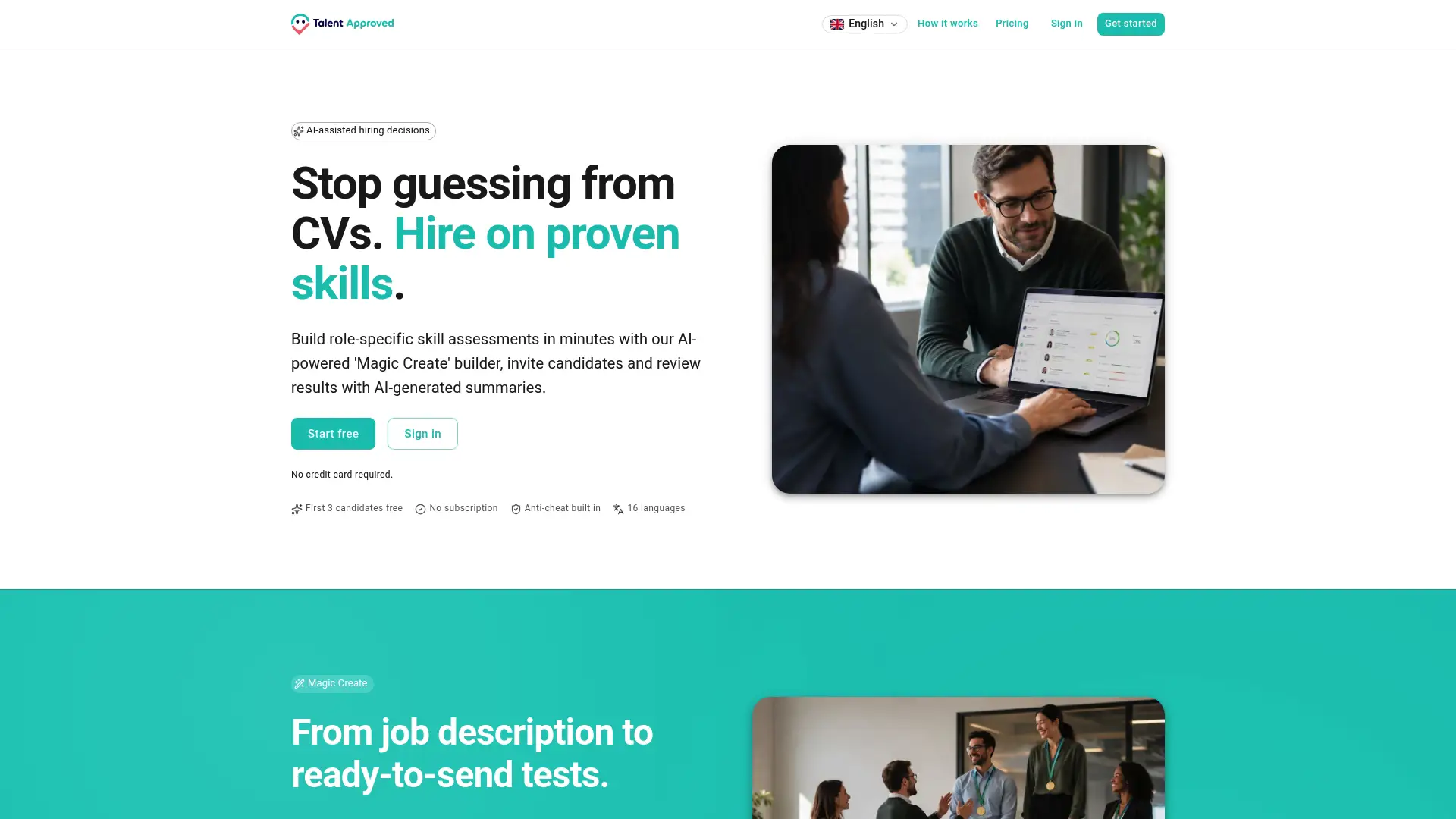
The platform’s Magic Create feature generates a complete, role-specific skill test from a job description in minutes. Every test includes built-in anti-cheat proctoring and AI-generated candidate summaries, so you spend less time reviewing and more time deciding. You can create a skill test with AI and have your first assessment ready before your next posting goes live. For teams that want to see the full picture, the AI-powered assessment overview covers every step from test creation to candidate ranking.
FAQ
What is affordable talent evaluation?
Affordable talent evaluation is the use of structured, data-driven methods, including scored interviews, weighted competency scorecards, and validated skill tests, to assess candidates accurately without high costs. Combined approaches reach predictive validity of r=0.60–0.65, far above resume screening alone.
How many skills should a talent evaluation measure?
Effective evaluations focus on 5–7 critical hard and soft skills for the role. Measuring more than that dilutes scoring accuracy and increases candidate drop-off rates.
Are structured interviews really more effective than traditional interviews?
Structured interviews predict job performance at r=0.42, more than double the r=0.20 validity of unstructured interviews. The difference comes from predetermined questions, consistent scoring rubrics, and multiple independent interviewers.
Can small businesses run affordable talent evaluations without expensive software?
Small businesses can build effective evaluations using weighted scorecards in a spreadsheet combined with a short work sample or skill test. AI-assisted platforms like Talent Approved reduce setup time further by generating role-specific tests directly from a job description.
How does combining evaluation methods reduce mis-hires?
Using structured interviews alongside skill tests and behavioral rubrics reduces mis-hires by 30–40% compared to unstructured hiring. Each method captures different evidence, and the combination produces a more complete and reliable picture of candidate fit.