
How Fast Candidate Evaluation Works for Recruiters

Candidate evaluation speed is defined as the time between receiving an application and reaching a hiring decision, and AI-assisted screening now compresses that window from weeks to days. The industry term for this process is “candidate assessment velocity,” though recruiters commonly ask how fast candidate evaluation works when searching for practical benchmarks. Two forces drive the biggest gains: AI-powered resume screening and structured interview frameworks with standardized scoring rubrics. Together, they cut manual workload by over 90% while doubling predictive hiring accuracy. This article breaks down the mechanics, the data, and the exact steps you can apply to your next hiring cycle.
How fast candidate evaluation works with AI-assisted screening
AI-assisted screening is the single largest lever for compressing candidate evaluation process time. Manual screening of 100 resumes takes 12–18 hours, while AI-assisted screening completes the same task in 10–15 minutes. That is not a marginal improvement. It is a structural shift in how recruiting teams allocate their time.
The speed gain comes from how AI reads resumes. Rather than scanning for keyword matches, AI platforms evaluate full resume content, including context, career progression, and role relevance. This produces a shortlist that reflects actual fit, not just surface-level word matching. Recruiters who rely on keyword filters alone routinely miss qualified candidates who describe the same skills with different terminology.
AI triage routing takes the shortlist one step further. AI classifies candidates into Priority, Review, and Reject buckets within 24 hours of application, so your team focuses human attention on the candidates most likely to succeed. Reject-bucket candidates receive a structured, rationale-backed response automatically. That consistency protects your employer brand without adding recruiter hours.

The downstream effect on outreach speed is equally significant. AI-powered screening reduces time-to-first-contact from an average of 3.7 days to as little as 4 hours. Faster first contact directly correlates with higher candidate response rates, since top candidates typically receive multiple offers within days of applying.
| Metric | Manual process | AI-assisted process |
|---|---|---|
| Time to screen 100 resumes | 12–18 hours | 10–15 minutes |
| Time-to-first-contact | 3.7 days (average) | 4 hours |
| Shortlist quality | Keyword-dependent | Content and context-based |
| Triage routing | Manual, inconsistent | Priority / Review / Reject buckets |
Pro Tip: Set your AI triage thresholds before a role opens, not after applications arrive. Calibrating Priority and Review criteria in advance prevents rushed threshold decisions that let strong candidates slip into the wrong bucket.
Do structured interviews actually speed up hiring decisions?
Structured interviews speed up decisions by removing ambiguity from the scoring process. Structured interviews using consistent questions and 1–5 scoring rubrics improve predictive hiring accuracy approximately 2x compared to unstructured, conversational interviews. The accuracy gain matters for speed because fewer wrong hires means fewer repeat searches.
The mechanics are straightforward. You define 3–5 competencies for the role before interviews begin. Each competency gets a set of pre-written questions and a scoring rubric with clear behavioral anchors at each level (1 through 5). Every interviewer uses the same questions in the same order. After the interview, each interviewer scores independently before any group discussion takes place.
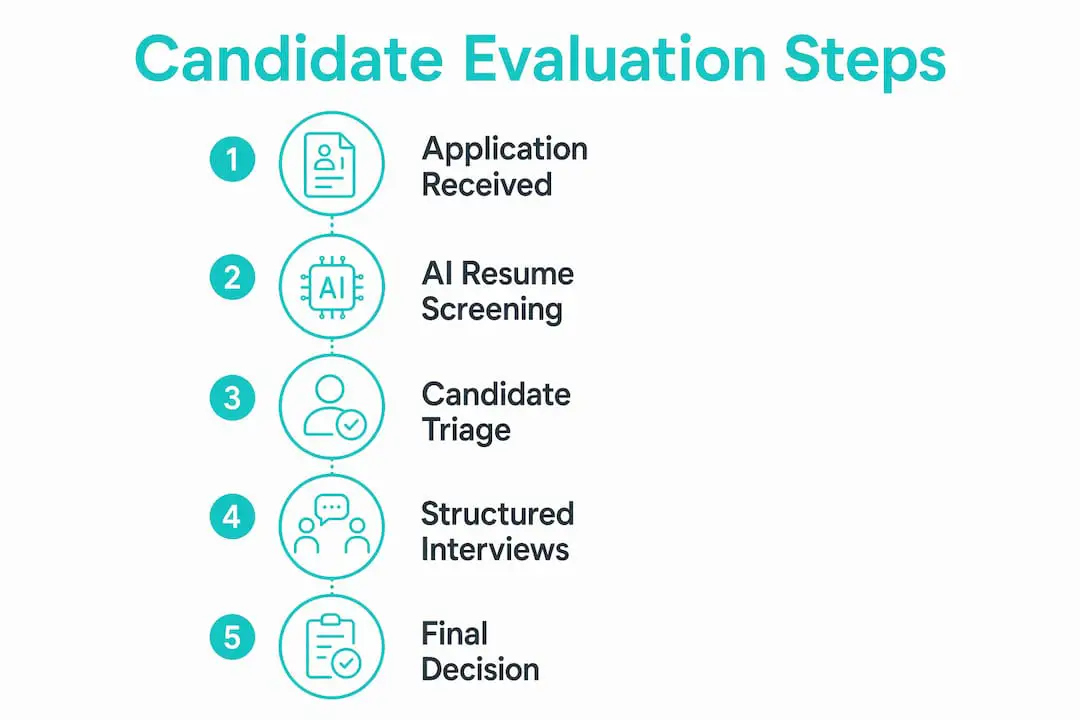
Best structured interviews run approximately 50 minutes, covering 3–5 competencies with pre-defined rubrics that are reusable across similar roles. The reusability is the hidden time saver. Once you build a rubric for a software engineer role, you use it for every software engineer hire. Setup cost drops to near zero after the first use.
Scoring immediately after each interview, rather than at the end of a hiring panel, reduces memory decay and prevents the “halo effect” where one strong answer colors the entire evaluation. Recruiters who score within 30 minutes of an interview consistently produce more calibrated assessments than those who score at end-of-day or the following morning.
Key practices that make structured interviews faster and more reliable:
- Write questions before posting the role. Pre-written questions eliminate the ad hoc preparation that delays interview scheduling.
- Use a shared scoring template. A shared digital rubric lets all interviewers submit scores simultaneously, cutting debrief prep time.
- Limit competencies to five. Evaluating more than five competencies per interview produces diminishing returns and extends scoring time without improving accuracy.
- Score the same day. Same-day scoring preserves recall and keeps the decision timeline tight.
- Reuse rubrics across cohorts. Consistent rubrics build a scoring baseline that makes future comparisons faster and more reliable.
Pro Tip: Pilot your rubric on two or three internal candidates before a live search. Calibration sessions where your team scores the same mock interview reveal scoring drift early, before it affects a real hire.
How do you balance automation with human judgment in candidate evaluation?
The primary bottleneck in candidate evaluation is administrative burden, not decision-making. Separating information gathering via automation from human judgment frees recruiters to focus on the decisions that actually require expertise. When recruiters spend 70% of their time reading resumes, they have 30% left for the work that determines hire quality.
Automation handles the tasks that do not require judgment: collecting applications, routing candidates into triage buckets, sending status updates, and scheduling interviews. Human reviewers then enter the process at the point where judgment is genuinely needed, which is evaluating fit, culture alignment, and role-specific nuance. This division of labor is what makes efficient candidate assessment possible without cutting corners.
Automating screening of less qualified profiles produces consistent, rationale-backed responses that improve the candidate experience at scale. Every applicant receives a clear response with a reason, not a generic rejection email. That consistency builds trust in your hiring process, which matters for employer reputation in competitive talent markets.
The practical sequence for balancing automation with human review looks like this:
- Automate application intake. Use structured application forms that capture role-specific information rather than free-form cover letters.
- Run AI triage immediately. Route all applications into Priority, Review, and Reject buckets within hours of receipt.
- Apply video or skills screening to the Review bucket. Short video responses or skills tasks give reviewers objective data before a live interview.
- Reserve live interviews for Priority candidates. Human interview time goes only to candidates who have already cleared automated and structured screening.
- Collect structured scores before debrief. Prevent group-think by requiring independent scoring before any team discussion.
This sequence keeps human judgment at the center of the final decision while removing the administrative drag that slows most hiring processes.
What are the best practices for fast, effective candidate evaluation?
Fast candidate evaluation requires a process architecture, not just faster individual actions. The following practices produce the most consistent gains in candidate evaluation speed without sacrificing quality or compliance.
Set internal time targets. Commit to reviewing your initial AI-generated shortlist within 24 hours of a role closing. Delays at the shortlist stage compound across the entire pipeline. A 48-hour shortlist review can push total time-to-hire by a week or more.
Use data to calibrate AI thresholds. Track the conversion rate from Priority bucket to offer accepted. If your Priority bucket consistently produces candidates who do not advance past the first interview, your threshold criteria need adjustment. Outcome tracking is what separates a well-calibrated AI process from one that just moves fast.
Score candidates independently before group discussions. Independent scoring before group debrief prevents anchoring bias, where the first person to speak shapes everyone else’s assessment. Simultaneous score sharing, where all reviewers reveal scores at the same moment, keeps the debrief focused on evidence rather than seniority or persuasion.
Adopt structured interview frameworks consistently. Consistency across roles and hiring managers is what makes your data comparable over time. A structured framework applied to 80% of roles produces better calibration data than a perfect framework applied to 20%.
Pair AI screening with skills-based assessments. Resume screening tells you what candidates claim. Skills assessments tell you what they can do. Combining both produces a shortlist that is faster to evaluate and more accurate to hire from. Talent Approved’s AI skill assessment platform builds role-specific tests from job descriptions in minutes, giving recruiters objective performance data before the first live interview.
Key Takeaways
Fast candidate evaluation works best when AI handles administrative triage and humans focus exclusively on judgment-intensive decisions within a structured scoring framework.
| Point | Details |
|---|---|
| AI screening cuts time dramatically | AI screens 100 resumes in 10–15 minutes versus 12–18 hours manually. |
| Triage routing focuses recruiter time | Priority, Review, and Reject buckets direct human attention to the best-fit candidates first. |
| Structured interviews double accuracy | Consistent questions and 1–5 rubrics improve predictive accuracy approximately 2x over unstructured interviews. |
| Independent scoring reduces bias | Team members should score candidates before group debrief to prevent anchoring and peer pressure effects. |
| Set time targets and track outcomes | Reviewing shortlists within 24 hours and tracking conversion rates keeps the process calibrated and fast. |
Speed without shortcuts: what I’ve actually seen work
The teams that hire fastest are not the ones with the most technology. They are the ones with the clearest process. I have seen recruiting teams adopt AI screening tools and still take three weeks to fill a role because the bottleneck was never the resume review. It was the debrief meeting that no one scheduled, the hiring manager who needed two rounds of approval, and the scoring sheet that lived in someone’s inbox.
The honest truth about improving quality of hire is that speed and quality are not in tension. They are both symptoms of process clarity. When you know exactly what you are evaluating, who evaluates it, and when decisions get made, the whole process accelerates naturally. The structured interview rubric is not just a fairness tool. It is a time-saving tool because it eliminates the “what do we think?” conversation that can stretch a debrief from 20 minutes to two hours.
My strongest advice: do not implement AI screening and leave your interview process unchanged. The gains from AI triage evaporate if candidates then enter an unstructured, inconsistent interview stage. The two systems have to work together. Automate the front end, structure the middle, and protect human judgment for the final call. That combination is what actually produces fast, accurate hiring at scale.
— Jimmie
What Talent Approved does for candidate evaluation speed
Talent Approved builds the skills-based layer that sits between AI resume screening and live interviews. With the Magic Create feature, you input a job description and receive a tailored skills assessment in minutes. No test-writing experience required.
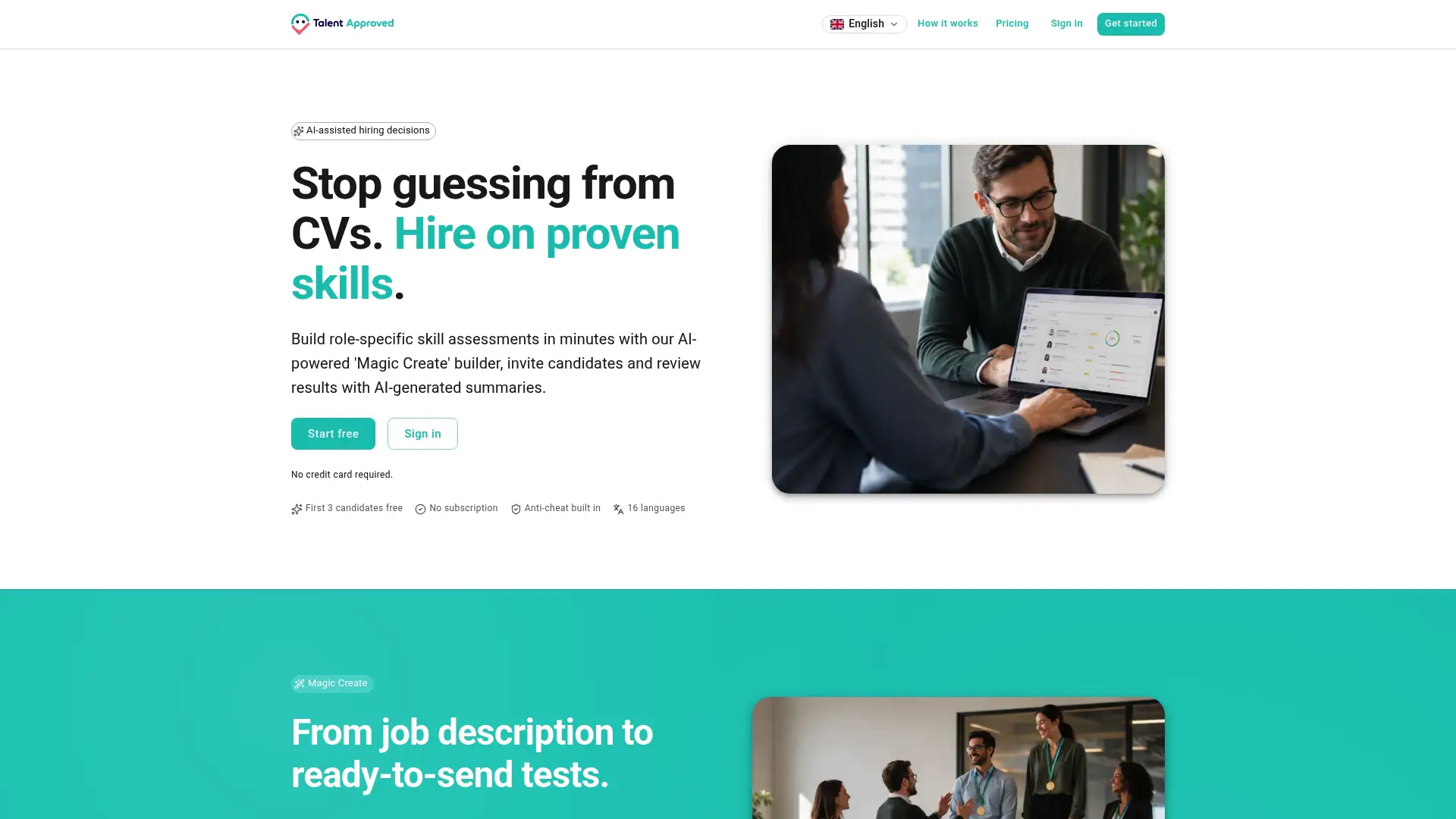
Candidates complete the assessment on their own time. Talent Approved’s AI scoring and candidate ranking then ranks every submission automatically, so you open your dashboard to a prioritized list rather than a stack of raw scores. The built-in anti-cheat mechanisms protect result integrity. AI-generated summaries give you the key findings from each assessment without reading every response manually. If you want to create a skill test from a job description and start evaluating candidates on proven ability rather than resume claims, Talent Approved is built for exactly that workflow.
FAQ
How fast can AI screen 100 job applications?
AI-assisted screening processes 100 resumes in 10–15 minutes. Manual screening of the same volume takes 12–18 hours.
What is the most accurate method for evaluating candidates quickly?
Structured interviews with consistent questions and 1–5 scoring rubrics produce approximately 2x the predictive accuracy of unstructured interviews. Pairing structured interviews with skills-based assessments adds objective performance data to the evaluation.
How does AI triage routing work in candidate evaluation?
AI triage routing classifies candidates into Priority, Review, and Reject buckets based on full resume content and role criteria. Recruiters then focus live review time on Priority candidates first, typically within 24 hours of application.
How do you prevent bias when evaluating candidates fast?
Independent scoring before group debrief prevents anchoring bias. Each team member scores candidates simultaneously and shares results at the same moment, keeping the discussion focused on evidence rather than the loudest voice in the room.
What is a realistic time-to-first-contact with AI screening?
AI-powered screening reduces time-to-first-contact from an average of 3.7 days to as little as 4 hours. Faster outreach increases response rates from top candidates who are actively fielding multiple offers.