
Recruiting Test Guide for HR Teams: What to Use and Why

A recruiting test is a standardized, role-specific assessment that measures whether a candidate can actually do the work the job requires, rather than just describe it on a resume. If you’re building your first one, start narrow: pick the single most job-critical skill for the open role and run a short work-sample test against it before you expand to a full battery.
A defensible recruiting test needs three things in place before it ever reaches a candidate:
- Job relevance — the content maps directly to tasks the person will actually perform.
- Consistent administration — every candidate gets the same instructions, time limits, and conditions.
- Validity evidence — some documented basis showing the test predicts job performance, not just a vendor’s marketing claim.
Pro Tip: Never let one uncited test knock a candidate out of the running. Under EEOC guidance, a screening tool has to be job-related and validated, and a single score should never be the entire decision.
Key Takeaways
A recruiting test earns its place in the hiring process only when it’s job-relevant, consistently administered, and backed by real validation evidence, not vendor claims alone.
| Point | Details |
|---|---|
| Start with job analysis | Identify critical tasks and KSAOs before choosing a test format. |
| Match format to need | Use work samples for task performance, cognitive tests for general ability. |
| Validate before you scale | Pilot with incumbents and document reliability and validity evidence. |
| Never rely on one score | Combine test results with structured interviews and resume data. |
| Talent Approved builds the test fast | Magic Create generates role-specific assessments with anti-cheat and AI summary review built in. |
Table of Contents
- What Are the Main Types of Recruiting Tests?
- When Should You Use a Recruiting Test in Hiring?
- How Do You Design and Validate a Recruiting Test?
- How Do You Administer Tests Securely and Fairly?
- How Should You Score and Interpret Test Results?
- What Do Recruiter-Specific Test Tasks Look Like?
- How Do You Roll Out a Recruiting Test Program?
- How Does Talent Approved Support a Defensible Testing Process?
- Recruiting Test Strategy for HR Teams: A Practical Guide
- Build Your First Recruiting Test in Minutes
- Sources
- FAQ
What Are the Main Types of Recruiting Tests?
Most hiring teams default to whatever test their applicant tracking system bundles in, and that’s usually the wrong starting point. The right question is what decision you’re trying to make, then which test format actually answers it.
Cognitive ability tests measure reasoning speed and problem-solving capacity. They tend to generalize well across roles, but they carry higher adverse-impact risk than task-based alternatives, so pair them with other measures rather than using them alone. Work samples and performance tasks ask candidates to do a scaled-down version of the real job, and research on selection procedures consistently shows these are strong predictors of on-the-job success because the task itself is the evidence.
Situational judgment tests present realistic workplace scenarios and ask candidates to choose the best response, which works well for gauging judgment in ambiguous, people-facing roles. Personality and traits assessments measure disposition rather than skill, useful for team-fit conversations but risky if used as a hard pass/fail gate. Technical and coding tests verify a specific hard skill, ideal for engineering and technical hires. Assessment centers combine several exercises, in-tray tasks, group discussions, presentations, into one multi-hour evaluation, common for leadership pipelines. Integrity and ethics tests screen for reliability in roles with financial or safety exposure. Language proficiency tests confirm communication readiness for client-facing or multilingual roles.
| Test Type | What It Measures | Best Use Case | Common Format |
|---|---|---|---|
| Cognitive ability | General reasoning, problem-solving | Roles needing fast learning curves | Timed online questions |
| Work sample | Actual task performance | Skilled trades, writing, design, sales | Live or simulated task |
| Situational judgment | Decision-making under ambiguity | Customer service, management | Scenario multiple-choice |
| Technical/coding | Specific hard skill mastery | Engineering, IT, data roles | Timed coding challenge |
| Assessment center | Multiple competencies at once | Leadership, senior hires | Half-day or full-day exercises |
| Integrity/ethics | Reliability, honesty tendencies | Finance, security, healthcare | Self-report questionnaire |
When Should You Use a Recruiting Test in Hiring?
Tests add the most value at three decision points: screening a large applicant pool down to a manageable shortlist, validating that a finalist actually has the technical skill their resume claims, and corroborating culture and working-style fit before an offer goes out. Used this way, they don’t replace judgment, they sharpen it.
Combined with resumes and structured interviews, test scores improve hiring accuracy more than any single measure alone, a pattern borne out across decades of selection research. A practical flow looks like this:
- Screen stage: short cognitive or situational judgment test to cut volume fast.
- Qualify stage: work sample or technical test to confirm hard skills.
- Validate stage: structured interview plus reference checks to round out the picture.
Candidates notice how a test is framed. Clear instructions and a short explanation of why the test exists reduce dropout and improve fairness perceptions, so tell applicants what’s coming and roughly how long it takes.
How Do You Design and Validate a Recruiting Test?
Skipping validation is the single most common way HR teams turn a useful test into a legal liability. The fix is a repeatable process, not a one-time favor to legal.
- Run a job analysis. Identify the critical tasks and the knowledge, skills, abilities, and other characteristics (KSAOs) tied to measurable business outcomes.
- Match the format to the analysis. A role heavy on task execution calls for a work sample; a role demanding fast learning calls for cognitive ability.
- Draft items and a scoring rubric. Write clear pass criteria before you see a single candidate response.
- Pilot it. Run the draft test on incumbents or a holdout sample before it touches live applicants.
- Check reliability and early validity signals. Look at inter-rater agreement, parallel-form consistency, and correlation with performance proxies.
- Document everything. Save the job analysis, pilot data, and validation evidence in an audit-ready file.
Pro Tip: A vendor’s psychometric report is a starting point, not proof. Pearson’s TalentLens materials and similar published instruments come with solid research behind them, but the employer still has to confirm that validation applies to the specific job in question.
Under UGESP and EEOC enforcement, the employer carries the ultimate burden to show that any screening test is job-related and consistent with business necessity. Relying on a vendor’s general validation study, without confirming it fits your role, does not satisfy that burden.
A short internal guide on psychometric testing fundamentals is worth keeping on hand for hiring managers who haven’t worked through this process before.
How Do You Administer Tests Securely and Fairly?
Delivery method shapes both integrity and candidate experience. In-person testing gives you the tightest security but doesn’t scale for high-volume hiring. Remote-proctored testing scales well and, per public-sector aptitude testing programs, can maintain fairness through structured timing and practice items. Unproctored online tests scale best but carry the highest cheating risk.
Demand these anti-cheat controls from any vendor:
- Session replay and screen recording.
- Webcam snapshots at intervals.
- Rotating question pools so no two candidates see identical items.
- Fixed timeboxing per section.
Build reasonable accommodations into the process from the start, extended time or alternate formats, without changing what the test actually measures. Confirm the vendor’s data retention policy, consent language, and security practices before you send a single candidate through. Our guide on remote candidate evaluation techniques covers the tradeoffs in more depth.
Pro Tip: Security and candidate experience pull in opposite directions. Webcam monitoring cuts cheating but can feel invasive; strike the balance by disclosing exactly what’s being monitored and why, upfront.

How Should You Score and Interpret Test Results?
Scoring falls into three camps: objective item-scoring (right or wrong answers, tallied automatically), rubric-based scoring (human raters applying a defined scale), and hybrid models where automated tools flag results for human review. Each has a place depending on the test format.
Set cutoffs from pilot data, not gut feel, and consider banding candidates into ranges (strong, borderline, weak) instead of a hard pass/fail line. Combine the test score with interview ratings and resume signals in a weighted model rather than letting any one input dominate.
- 80 to 100: Strong match, move to final interview.
- 60 to 79: Borderline, corroborate with a structured interview before deciding.
- Below 60: Weak signal, but not automatic disqualification, EEOC guidance treats assessments as one input among several, not a sole gatekeeper.
What Do Recruiter-Specific Test Tasks Look Like?
Testing recruiters themselves, rather than the candidates they screen, calls for different exercises entirely. A few that work well:
- Source identification task (20 minutes): Given a job description, find five plausible candidate profiles from public channels. Score on relevance and quality, not just volume.
- Cold outreach writing exercise (15 minutes): Draft a first-contact message to a passive candidate. Score on personalization and clarity, and check for compliance with data privacy norms in how contact information is referenced.
- Negotiation role-play (15 minutes): Handle a candidate pushing back on a salary offer. Score on tone, problem-solving, and whether the recruiter stayed within approved ranges.
- ATS data-cleanup task (10 minutes): Correct a messy candidate record set. Score on accuracy and speed.
Pilot these against your current top performers first, so you have a baseline before scoring new applicants against the same rubric. Our breakdown of practical skills evaluation approaches has more examples you can adapt directly.
How Do You Roll Out a Recruiting Test Program?
Moving from pilot to full adoption works best as a phased rollout, not a company-wide switch overnight.
- Weeks 1 to 2: Finalize job analysis and draft the test with a small working group.
- Weeks 3 to 4: Pilot on incumbents or a small holdout sample; gather reliability data.
- Weeks 5 to 6: Train hiring managers and assessors on scoring and legal boundaries.
- Week 7: Publish candidate communication templates and consent language.
- Week 8 onward: Integrate scoring into the ATS workflow and set turnaround-time targets for reviewing results.
Assign clear roles early, hiring managers own the decision, assessors own scoring consistency, and an HR or legal partner owns documentation. Our assessment template scaling guide walks through the operational side of this timeline in more detail.
How Does Talent Approved Support a Defensible Testing Process?
Every checklist item above, job analysis, piloting, anti-cheat controls, documentation, maps to a specific feature set rather than a generic promise. Talent Approved’s Magic Create tool builds a role-specific assessment directly from a job description in minutes, which shortens the gap between job analysis and a usable draft test. Reusable question libraries mean a validated item doesn’t get rewritten from scratch for every requisition.
- Anti-cheat session replays and webcam monitoring address the integrity controls covered earlier.
- AI-generated summaries cut review time without removing human judgment from the final call.
- Candidate rankings give hiring managers a consistent way to compare scores across a pool.
A test is only as defensible as the paper trail behind it. Features that export documentation and log administration details turn a one-off pilot into an audit-ready process.
Recruiting Test Strategy for HR Teams: A Practical Guide
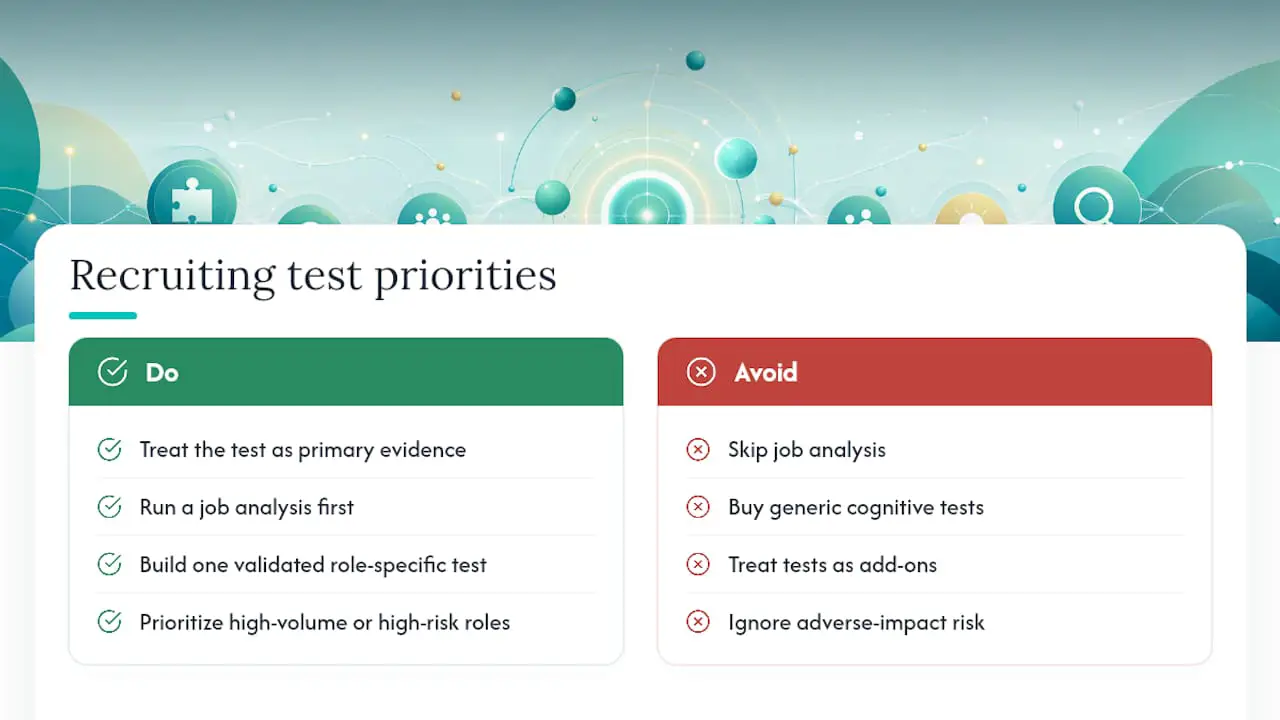
The conventional advice on recruiting tests treats them as an add-on step, something you bolt onto a hiring process after the resume screen and before the final interview. That framing undersells what a well-built test actually does. The strongest hiring programs treat the test as the primary evidence and the resume as a secondary filter, because a resume tells you what someone claims, and a work sample tells you what they can actually do.
Where most HR teams get it wrong is skipping the job analysis step entirely and buying a generic cognitive test because it’s easy to license. That shortcut is exactly what creates adverse-impact exposure down the line, since a test with no documented connection to your specific role has no defense if a rejected candidate challenges it.
Prioritize this first: build one validated, role-specific test for your highest-volume or highest-risk position before you touch anything else. Everything else, scoring models, rollout timelines, vendor comparisons, matters less than getting that first test right.
Build Your First Recruiting Test in Minutes
Every checklist in this guide—job analysis, item drafting, piloting, documentation—takes real time when done manually, which is exactly why so many HR teams default to generic tests instead. Talent Approved’s Magic Create feature collapses that timeline: paste in a job description or a list of skills, and it generates a role-specific assessment ready to pilot the same day, no test-writing background required.
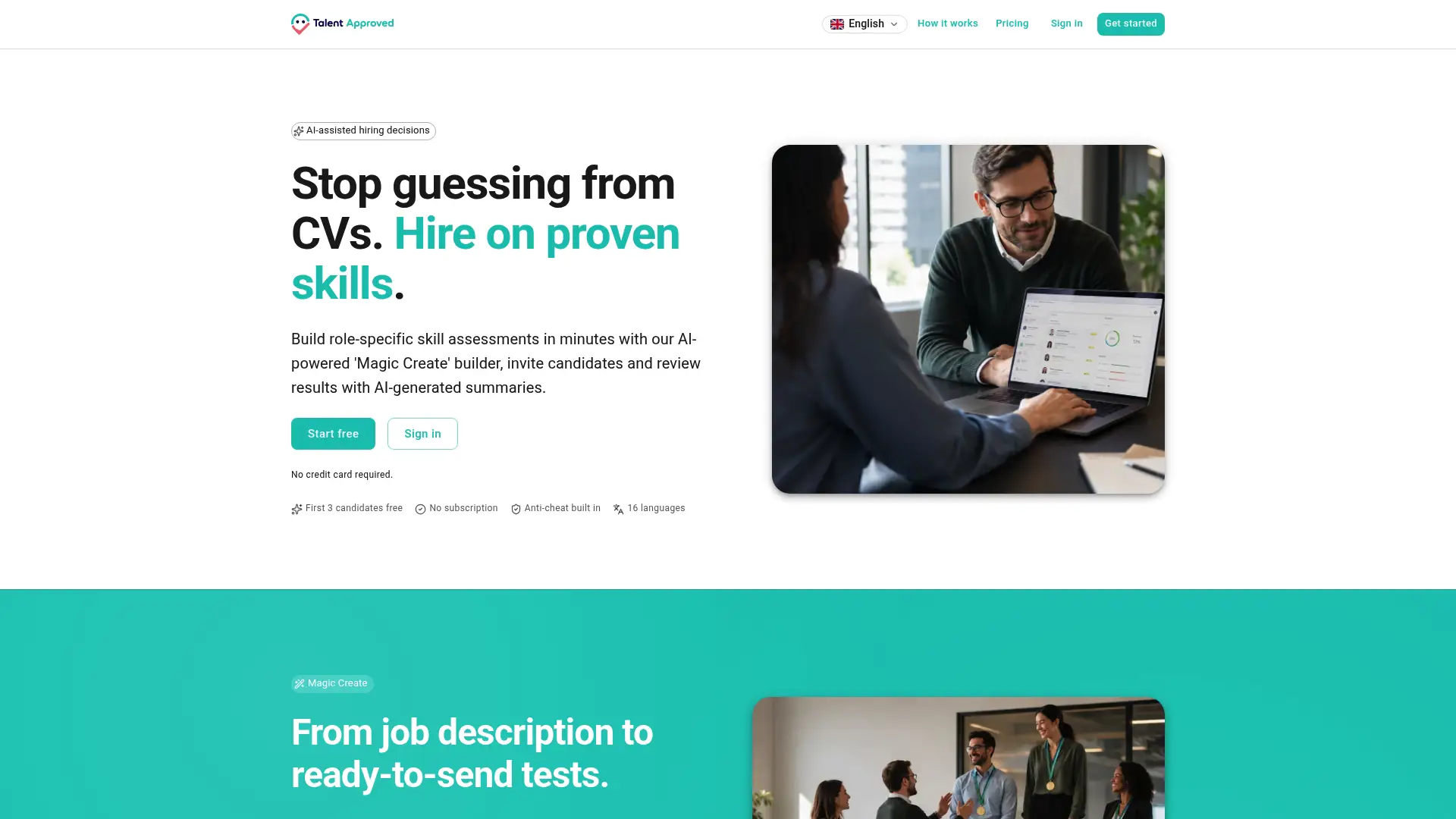
The platform charges a fee per completed candidate assessment, with no subscription commitment, so you can pilot a single role before deciding whether to expand across your hiring pipeline. Built-in anti-cheat controls, screen and webcam monitoring, session replays, cover the security checklist from this guide out of the box, and AI-generated summaries mean your hiring managers get a clear recommendation instead of a raw score to interpret alone. If you’ve been putting off building a validated test because of the setup work, try Talent Approved on your next open role and see a draft assessment before your next candidate applies.
This article is general information, not a substitute for advice from a qualified lawyer. Consult a qualified legal professional about your own circumstances before acting on anything here.
Sources
- Employment Tests and Selection Procedures | U.S. Equal Employment Opportunity Commission
- Recruitment Aptitude Tests | Defence Careers
FAQ
What is a recruitment test?
A recruitment test is a standardized assessment that measures a candidate’s job-relevant skills, knowledge, or abilities before a hiring decision is made. It’s designed to predict how well someone will perform the actual work, not just how well they interview.
What happens when you fill out a recruiting questionnaire?
Your responses are scored against a rubric or answer key, then combined with other hiring inputs like your resume and interview performance. Employers should never use the questionnaire alone as the entire basis for a hiring decision, per EEOC guidance.
Can you still get hired if you fail an assessment test?
Yes. A weak score on one assessment doesn’t automatically disqualify you, since tests are meant to be one component of a multi-measure selection process, not a single automatic gate.
What are recruiter screening questions?
Screening questions are the initial filters, often about experience, availability, or basic qualifications, used to narrow an applicant pool before deeper testing or interviews begin. They typically pair with a skills or situational judgment test at the qualify stage for a fuller picture of fit.