
High-Volume Recruiting Best Practices for HR and TA Teams

Do these five things now to cut time-to-hire and protect quality at scale: enforce a role rubric before you automate anything, deploy automated screening and scheduling, add a short skills check to every pipeline, centralize all feedback in one system, and build a reusable talent pool from every completed cycle. The execution order matters: rubric → structured questions → automation → measurement → talent pool. Skip step one and you scale inconsistency, not quality.
- Enforce a role rubric first. Define must-have criteria and scoring weights before any automation touches a candidate.
- Automate screening and scheduling. These two stages carry the highest repetitive volume and deliver the fastest ROI.
- Add a short skills check. A short role-specific assessment filters on demonstrated ability, not credentials.
- Centralize feedback. One shared system prevents decisions from living in email threads and Slack messages.
- Build a talent pool. Every silver-medal candidate is a future hire. Tag them, re-engage them, and reduce sourcing cost next cycle.
Pro Tip: Run a two-week pilot on a single role family before rolling out to the full program. Validate your scoring rubric against actual hiring outcomes, then tune before scaling. Teams that skip this step often discover their knockout criteria are eliminating qualified candidates at a rate that only becomes visible at scale.
The EEOC’s Uniform Guidelines on Employee Selection Procedures apply to any selection tool used at scale, including automated screening. Build compliance checkpoints in from the start, not as an afterthought. Research from Cadient confirms that automation converts reactive manual processes into predictable, repeatable flows, which protects both service levels and recruiter capacity.

Table of Contents
- What high-volume recruiting is and when you need it
- Why a repeatable high-volume hiring program pays off
- Common pitfalls in high-volume hiring and how to avoid them
- Core best practices: the strategy checklist for high-volume hiring
- What technology stack does high-volume hiring actually require?
- A step-by-step implementation playbook for your team
- KPIs, dashboards, and quality controls that protect hire quality
- A structural operating model and a skills-screening example
- Key Takeaways
- What experienced TA leaders actually focus on when scaling fast
- Skills assessments that speed and de-risk your high-volume pipeline
- Useful sources and further reading
- FAQ
What high-volume recruiting is and when you need it
High-volume recruiting is any hiring program that requires repeatable, automated, and auditable processes to function reliably because ad-hoc recruiter effort alone cannot sustain throughput or consistent quality. The distinction is architectural, not just numerical.
Operationally, most teams hit the wall at a moderate to high volume of hires per quarter on a single role family, or when a single requisition draws a large number of applications. At those thresholds, manual inbox workflows collapse: recruiters spend only seconds scanning each resume when volume spikes, which increases the risk of missing qualified candidates and amplifies bias.
Common role families where this model applies include hourly retail, contact center agents, warehouse and logistics staff, seasonal hospitality workers, and large-scale tech support. What they share is predictable demand patterns, high application-to-hire ratios, and a business cost when positions stay open too long.
The key insight: adding recruiters does not fix a broken process. The workflow itself must be redesigned for scale. Systems design, not headcount, is the primary lever.

Why a repeatable high-volume hiring program pays off
A well-built high-volume hiring capability delivers measurable returns across speed, quality, cost, and compliance. The benefits compound quickly once the operating model is in place.
- Faster time-to-fill. Automated screening and scheduling remove the manual bottlenecks where most time-to-fill is lost. Organizations leveraging AI-led automation meet high-volume targets more efficiently, moving candidates through screening and interview scheduling rapidly.
- Protected quality of hire. Structured rubrics and skills assessments produce consistent evaluation criteria across every recruiter and every site, reducing the variance that degrades quality at scale.
- Lower early turnover. Candidates assessed on actual job skills are better matched to role demands, which reduces early no-shows and turnover within the first few months.
- Predictable capacity. A documented, repeatable process lets TA ops teams forecast recruiter bandwidth and pipeline throughput against hiring targets, rather than reacting to demand spikes.
- Recruiter productivity gains. When automation handles screening, scheduling, and status updates, recruiters redirect time to high-judgment conversations: final interviews, offer negotiations, and hiring manager alignment.
Statistic callout: A single bad hourly hire can cost a company between $3,000 and $5,000 in lost productivity, retraining, and re-hiring expenses. At volume, even a modest improvement in quality-of-hire screening pays back the investment in the program quickly.
For enterprise teams, the benefits extend to compliance risk reduction. Consistent, documented selection criteria protect against EEOC adverse impact claims. Maintaining a strong candidate experience at scale also protects employer brand, which directly affects offer acceptance rates and pipeline quality in future cycles.
Common pitfalls in high-volume hiring and how to avoid them
High-volume hiring can fail in predictable ways. Knowing the failure modes in advance lets you design against them rather than discover them mid-campaign.
Manual inbox workflows. When recruiters manage candidates through email and spreadsheets, information gets siloed, steps get skipped, and nothing is auditable. At scale, this creates compliance exposure and makes it impossible to identify where the pipeline is stalling.
Inconsistent evaluation. Without a shared rubric, two recruiters screening the same role apply different criteria. The result is not just unfair to candidates; it produces a data set that cannot be analyzed or improved. Automating without standardized rubrics merely scales inconsistency and noise.
Slow scheduling. Calendar coordination across multiple stakeholders becomes a full-time job at volume. Candidates who applied Monday may not hear back until Thursday. In a competitive labor market, that window is often enough for a faster-moving employer to extend an offer first.
Data fragmentation. When sourcing, screening, ATS, and feedback live in separate systems with no integration, recruiters cannot see the full candidate journey. Bottlenecks stay invisible until they become crises.
Bias at speed. When recruiters spend only seconds per resume, pattern-matching on familiar signals replaces structured evaluation. This harms both quality and diversity. Structured assessments and rubrics are the mitigation.
Seasonality spikes. Seasonal peaks can require significantly increased capacity in short windows. A stack that performs well at average volume can seize under peak load if it has never been tested at that scale.
The cost of ignoring these failure modes is concrete. A single bad hourly hire runs $3,000–$5,000 in direct costs. Multiply that across a high-volume program with weak screening, and the financial case for fixing the architecture becomes straightforward.
Core best practices: the strategy checklist for high-volume hiring
These strategies are ordered by implementation priority. Quick wins can be deployed within days; program-level investments require planning but deliver compounding returns.
1. Build role rubrics before anything else (program-level)
A rubric defines must-have criteria, scoring weights, and disqualifying factors for each role family. Without it, every downstream tool, from AI screening to structured interviews, operates on undefined standards.
- Map the three to five criteria that actually predict performance in the role.
- Assign numeric weights so scorers apply them consistently.
- Review rubrics quarterly against early-turnover data to confirm they are predictive.
2. Write structured interview questions tied to the rubric (program-level)
Structured questions reduce interviewer variance and produce comparable data across candidates. Each question should map to one rubric criterion with a defined scoring guide.
- Use behavioral or situational formats (“Tell me about a time when…” or “What would you do if…”).
- Limit to four to six questions per interview to keep sessions under 30 minutes.
- Train every hiring manager on the scoring guide before they conduct a single interview.
3. Automate screening and scheduling (quick win)
Screening and scheduling automation deliver the fastest ROI at volume because they process the highest repetitive workload. Automated pre-screening questionnaires, AI resume summaries, and calendar-sync scheduling tools remove the manual bottleneck at the key stages where most time-to-fill is lost.
- Configure knockout questions in your ATS to auto-advance or auto-decline based on hard requirements.
- Deploy a scheduling tool that syncs hiring manager calendars and sends candidates self-serve booking links.
- Set automated status-update messages at every stage transition so candidates are never left waiting.
Pro Tip: Start your automation pilot with scheduling only, before adding AI screening. Scheduling is lower-risk, immediately visible to candidates, and produces clean ROI data within two weeks. Use that proof to build internal support for the broader automation program.
4. Add short, role-specific skills assessments (quick win)
A brief skills check placed after initial screening filters on demonstrated ability rather than resume claims. This is one of the highest-leverage moves in high-volume hiring because it replaces a subjective resume review with an objective, comparable data point.
- Design assessments around two to three tasks that mirror actual job duties.
- Keep total completion time under 20 minutes to protect candidate completion rates.
- Use assessment templates to deploy consistently across role families without rebuilding from scratch each cycle.
5. Implement programmatic job advertising (program-level)
Programmatic advertising automates job placement and budget allocation across channels, directing spend toward the sources producing qualified applicants to reduce cost per hire over time. This replaces manual job board management and reduces cost-per-qualified-applicant over time.
- Connect your ATS to a programmatic platform that tracks source-to-hire conversion, not just source-to-apply.
- Set bid rules that shift budget automatically toward channels with higher qualified-candidate rates.
- Review source performance monthly and cut underperforming channels without hesitation.
6. Build and maintain a talent pool (program-level)
Every candidate who reaches the final stages but does not receive an offer is a future hire. Tagging, segmenting, and re-engaging these candidates reduces sourcing cost and time-to-fill in subsequent cycles.
- Segment talent pools by role family, location, and assessment score.
- Set automated re-engagement sequences triggered by new openings in the relevant segment.
- Audit pool data quality every quarter; stale records reduce deliverability and recruiter trust.
7. Use batch and asynchronous interviews (quick win)
Group information sessions, batch interview days, and one-way video assessments allow a single recruiter to evaluate dozens of candidates in the time a traditional phone screen covers five. Asynchronous video also removes scheduling friction for candidates in different time zones or with limited availability.
- Schedule weekly batch interview slots for high-volume roles rather than booking individually.
- Use one-way video for initial screening; reserve live interviews for final-stage candidates.
- Provide candidates with clear instructions and a short deadline (48–72 hours) to complete async submissions.
8. Centralize feedback and run calibration sessions (program-level)
Feedback that lives in email threads cannot be analyzed, audited, or improved. Centralizing all interviewer notes in the ATS and running regular calibration sessions keeps scoring consistent across recruiters and hiring managers.
- Require all feedback to be submitted in the ATS within 24 hours of an interview.
- Run a 30-minute calibration session with hiring managers at the start of each new campaign.
- Compare scores across interviewers monthly to identify drift and correct it before it affects decisions.
9. Localize workflows for multi-site hiring (program-level)
A single workflow template rarely fits every location. Shift differentials, local labor market conditions, certification requirements, and on-site manager authority levels all vary. Build a core workflow and then configure location-specific variations rather than building from scratch at each site.
- Identify which workflow steps are non-negotiable (rubric, assessment, compliance checks) and which can flex by site.
- Empower on-site managers to screen and extend offers directly for hourly roles where speed is critical.
- Maintain a single reporting dashboard that aggregates metrics across all sites so TA ops can see the full picture.
10. Train hiring managers specifically for high-volume decisions (program-level)
Hiring managers who are accustomed to deliberate, low-volume searches often slow down a high-volume pipeline by over-deliberating or applying inconsistent standards. Training them on the rubric, the scoring guide, and the expected decision timeline is not optional.
- Deliver a 60-minute onboarding session for every new hiring manager before their first high-volume campaign.
- Set a clear service-level agreement: feedback submitted within 24 hours, offers extended within 48 hours of final interview.
- Share pipeline conversion data with managers monthly so they can see how their decision speed affects fill rates.
11. Apply anti-cheat and proctoring to assessments (program-level)
At scale, assessment integrity is a real risk. Candidates sharing answers, using AI tools, or having others complete assessments on their behalf undermines the entire screening layer. Proctoring tools, screen recording, and time-per-question tracking catch anomalies before they reach the interview stage.
- Enable screen recording and tab-switching detection for any assessment used in a competitive pipeline.
- Review flagged sessions before advancing candidates, not after offers are extended.
- Communicate proctoring clearly in candidate instructions to deter attempts and set expectations.
12. Track conversion and quality metrics in real time (program-level)
You cannot improve what you cannot see. A live dashboard showing stage-by-stage conversion rates, source quality, assessment pass rates, and early-turnover data gives TA ops the visibility to catch problems before they compound.
- Build a dashboard that updates daily, not weekly.
- Set threshold alerts: if a stage conversion rate drops below a defined floor, trigger a review.
- Connect fast candidate evaluation data to early-turnover metrics to validate whether your screening criteria are predicting performance.
What technology stack does high-volume hiring actually require?
The right stack reduces friction at every handoff and integrates cleanly so data flows without manual re-entry. The categories below are the minimum viable set for a functioning high-volume program.
- ATS/CRM with bulk actions. The ATS is the system of record. It must support bulk status updates, configurable knockout logic, and integration with every other tool in the stack.
- Programmatic job advertising platform. Automates placement and budget allocation across job boards based on source-to-hire performance data.
- Conversational AI/chatbot. Handles candidate questions 24/7, guides applicants through the process, and captures initial screening responses without recruiter involvement.
- AI resume screening. Generates summaries, highlights key qualifications, and ranks applicants by fit before a recruiter reviews a single profile.
- Scheduling and SMS tools. Calendar-sync scheduling with automated reminders reduces no-shows and eliminates back-and-forth coordination.
- Skills assessment and proctoring platform. Delivers role-specific tests with anti-cheat controls and produces comparable, auditable scores for every candidate.
- Interview capture and AI notes. Records structured interviews, generates transcripts, and surfaces key moments so reviewers spend time on decisions, not documentation.
- Analytics dashboard. Aggregates pipeline metrics, source performance, and quality indicators in one view.
Vendor-selection checklist:
- Does it integrate natively with your ATS, or does it require a custom build?
- Can you configure it for your specific role families without vendor involvement?
- Does it produce an auditable record for every automated decision (EEOC compliance)?
- How does pricing scale during peak season? Is there a per-transaction or per-seat model?
- Has it been load-tested at your expected peak volume?
The recommended deployment sequence is: screening and scheduling automation first, then assessments, then programmatic sourcing, then analytics. Start with the highest-volume bottleneck and prove ROI before expanding. Seasonal teams should test the full stack under realistic load during a quiet period, not during the peak campaign itself.
For multi-site or PEO-managed hiring programs, coordinating HR infrastructure across locations adds complexity. Streamlining HR for a growing organization often requires aligning your recruiting stack with your payroll and compliance systems from the start.
A step-by-step implementation playbook for your team
Use this timeline as a starting template. Adjust phase lengths based on your organization’s size and existing infrastructure.
| Week | Phase | Key Activities | Owner | Success Metric |
|---|---|---|---|---|
| 1–2 | Discovery | Audit current workflow, identify top bottleneck, set KPI baselines | TA Ops Lead | Bottleneck documented, baseline metrics captured |
| 3–4 | Design | Build role rubrics, structured questions, and assessment templates | TA Lead + Hiring Managers | Rubric signed off by stakeholders |
| 5–6 | Pilot | Deploy screening + scheduling automation on one role family | Recruiter + TA Ops | Time-to-interview reduced; no-show rate tracked |
| 7–8 | Optimize | Review pilot metrics, tune knockout criteria, calibrate scores | TA Ops Lead | Conversion rates stable; rubric adjusted if needed |
| 9–10 | Scale | Roll out to additional role families and sites | Full TA Team | Multi-site pipeline live; dashboard reporting active |
| 11–12 | Sustain | Manager training, compliance audit, seasonal load test | TA Ops + HR Compliance | All managers trained; stack tested at 2x volume |
Staffing ratios and capacity planning:
- Hourly/frontline roles with full automation: one recruiter per 50–75 active candidates in pipeline.
- Professional roles with structured interviews: one recruiter per 20–30 active candidates.
- Formula for capacity planning: divide your quarterly hire target by your average pipeline conversion rate to get required applicant volume, then divide by recruiter capacity to get headcount needed.
Cost considerations:
- Pilot budget line items: ATS configuration, assessment platform license, scheduling tool, and 10–15 hours of TA ops time for rubric design.
- ROI typically materializes within 3–6 months for focused pilots when properly measured against baseline time-to-fill and cost-per-hire.
- Build seasonal headroom into your platform contracts: negotiate burst capacity pricing before peak season, not during it.
Launch readiness checklist:
- All integrations tested end-to-end with live data
- Hiring managers trained on rubric and scoring guide
- Candidate messaging templates approved and loaded
- Compliance review completed (EEOC, data privacy, state-level requirements)
- Dashboard live with baseline metrics captured
For organizations managing hiring across multiple states or using a PEO arrangement, cost reduction strategies tied to consolidated HR services can offset a meaningful portion of the technology investment.
KPIs, dashboards, and quality controls that protect hire quality
Measurement is what separates a high-volume program that improves over time from one that runs at the same error rate indefinitely. Track these metrics at minimum.
Core KPIs:
- Time-to-interview: Days from application to first interview. Reveals scheduling and screening bottlenecks.
- Time-to-offer: Days from application to offer extended. The headline metric for pipeline speed.
- Qualified candidates per hire: How many screened candidates it takes to produce one hire. Tracks sourcing and screening efficiency together.
- Source conversion rate: Which channels produce candidates who advance past screening. Drives programmatic budget allocation.
- Day-1 no-show rate: Percentage of accepted offers that do not show up on day one. A leading indicator of candidate experience and offer quality.
- Assessment pass rate: Percentage of candidates who meet the assessment threshold. If it drops suddenly, check whether the assessment changed or the candidate pool shifted.
- 90-day early turnover: The ultimate quality-of-hire signal. If it rises, trace back to the screening and interview stages to find the gap.
Dashboard structure: Build one view for TA ops (pipeline throughput, stage conversion, recruiter capacity) and a separate view for hiring managers (open roles, candidates in pipeline, time-to-offer by role). Keep each dashboard to eight metrics or fewer; more than that and nothing gets acted on.
Quality control audit checklist:
- Monthly calibration session: compare scores across interviewers on the same role family.
- Quarterly rubric review: validate scoring criteria against 90-day turnover data.
- Spot audits of assessment proctoring flags: review flagged sessions before advancing candidates.
- Data integrity check: confirm ATS records match actual hire outcomes monthly.
Escalation rules: If time-to-offer exceeds your defined threshold by more than 20%, pause new sourcing spend and diagnose the bottleneck first. If early turnover spikes above your baseline, suspend the current screening criteria and run an emergency calibration before the next campaign launches.
Reviewing AI-generated assessment summaries as part of your quality audit process gives TA ops a fast way to spot scoring anomalies without reviewing every individual response manually.
A structural operating model and a skills-screening example
The most durable high-volume programs share a common architecture. Metaview’s six-piece operating model describes it clearly: rubrics, structured questions, calibration, centralized feedback, workflow automation, and AI signals must interlock. Remove any one element and the system degrades under pressure.
The recommended implementation order is:
- Rubrics (define what good looks like before any tool touches a candidate)
- Structured questions (standardize the human evaluation layer)
- Centralized feedback (make all data visible and auditable)
- Workflow automation (remove the manual tax on repetitive steps)
- AI signals (add predictive scoring once the data underneath it is clean)
This order matters because automating without standardized rubrics scales inconsistency. Teams that skip to automation first often find their AI screening is amplifying the same biases their manual process had, just faster.
Skills-screening example: A contact center operation running 300 hires per quarter added a 12-minute role-specific assessment after the application stage, covering written communication and basic problem-solving. The assessment was built from the job description in under 10 minutes using a templated creation tool. Anti-cheat screen recording flagged a small percentage of sessions for review before any candidate advanced. AI-generated summaries allowed reviewers to evaluate each candidate in under two minutes rather than reading full response transcripts. The result: time-to-interview dropped, and hiring managers reported higher confidence in candidates who reached the interview stage.
Assessment features that matter at scale:
- Fast creation from a job description or skills list (no assessment design expertise required)
- Anti-cheat recording with tab-switch and screen-share detection
- AI-generated candidate summaries for fast reviewer triage
- Candidate ranking and scoring that surfaces top performers before human review begins
- Configurable passing thresholds by role family
Pro Tip: Design your assessment to mirror one real task from the job, not a generic aptitude test. A customer service candidate who can write a clear, empathetic response to a sample complaint is demonstrating exactly what the role requires. Generic tests measure general ability; role-specific tasks predict actual performance.
Key Takeaways
High-volume recruiting succeeds when it is treated as a systems problem: rubrics and structured questions must come before automation, and measurement must be built in from the start.
| Point | Details |
|---|---|
| Systems before sourcing | Manual workflows collapse at scale; redesign the architecture before adding headcount or tools. |
| Rubrics before automation | Install scoring rubrics and structured questions first; automating without them scales inconsistency. |
| Pilot at the bottleneck | Start screening and scheduling automation on one role family; ROI typically materializes within 3–6 months. |
| Measure quality, not just speed | Track 90-day early turnover and assessment pass rates alongside time-to-offer to protect hire quality. |
| Talent Approved for assessments | Talent Approved’s Magic Create builds role-specific skills assessments from a job description in minutes, with built-in anti-cheat and AI summaries to speed reviewer triage at scale. |
What experienced TA leaders actually focus on when scaling fast
The teams that scale high-volume hiring without losing quality share one habit: they enforce process discipline before they approve new tools. The instinct under pressure is to buy software. The better move is to fix the rubric, train the managers, and then automate the clean process.
Priorities that hold up under scrutiny:
- Enforce rubrics without exceptions. Every deviation from the scoring standard is a data point you cannot use later.
- Protect recruiter time for judgment calls. Automation should handle everything a rule can decide; humans should handle everything a rule cannot.
- Run fast, narrow pilots. A two-week pilot on one role family produces more useful data than a six-month platform evaluation.
- Invest in manager training early. A hiring manager who does not understand the rubric is the single biggest quality risk in the program.
- Own the metrics. TA leaders who present pipeline data to business stakeholders weekly build the credibility to get budget for the next improvement.
Change management is the part most TA leaders underestimate. Hiring managers who have always hired by gut feel will resist structured scoring until they see that it produces better outcomes for them. Show them the data from the pilot. Connect early-turnover reduction to their own team performance metrics. That conversation moves faster than any training session.
Skills assessments that speed and de-risk your high-volume pipeline
Building a high-volume hiring program takes real investment in process design, technology, and training. Once the rubric and workflow are in place, the assessment layer is where you protect quality at the highest-volume stage: screening.
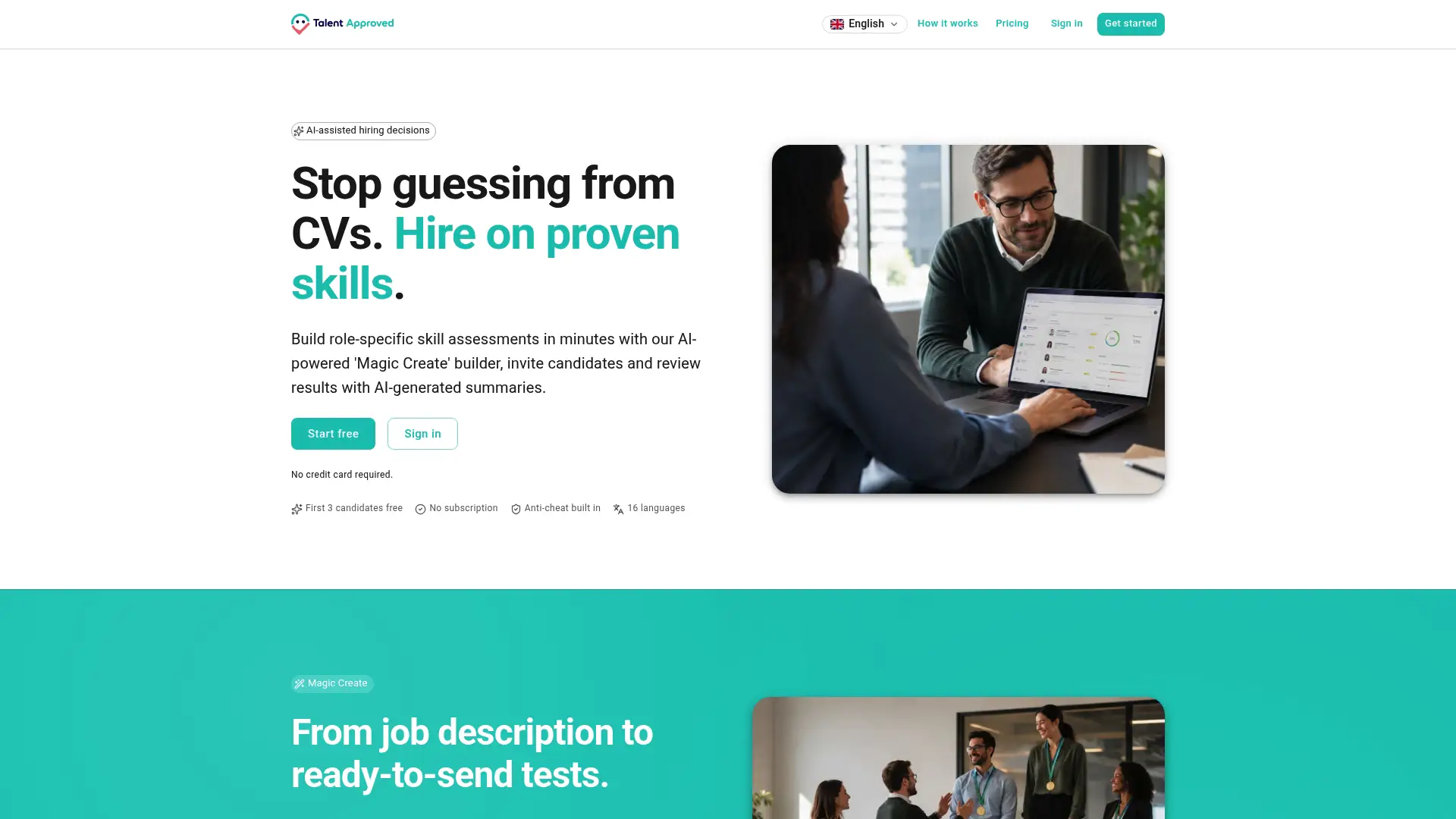
Talent Approved is built for exactly this moment. Its Magic Create feature generates a tailored skills assessment from a job description in minutes, no assessment design expertise required. Every assessment includes anti-cheat screen recording and tab-switch detection, so integrity is protected at scale without manual oversight. AI-generated candidate summaries let reviewers evaluate each submission in under two minutes, and built-in candidate ranking surfaces your top performers before a human reviewer opens a single response.
- Fast creation: Paste a job description, get a role-specific assessment. Deploy across role families without rebuilding from scratch.
- Built-in integrity controls: Screen recording and proctoring flags catch anomalies before candidates advance, protecting the quality of your pipeline data.
See how the platform works and start building your first assessment at Talent Approved.
Useful sources and further reading
These sources informed the research and recommendations throughout this article. Each is worth bookmarking for ongoing reference.
- High Volume Recruiting: How to Build a Hiring System That Scales Without Breaking — Covers why high-volume hiring is an architecture problem, not a sourcing problem. Relevant to the definition, challenges, and operating model sections.
- High-Volume Recruiting Strategies: The 6-Fix Operating Model — Metaview’s structural model (rubrics → structured questions → calibration → centralized feedback → automation → AI signals). Primary citation for the operating model and implementation order.
- Volume Recruiting with AI: 2026 Guide — Covers automation ROI, programmatic sourcing, pilot sizing, seasonal load planning, and the $3,000–$5,000 cost of a bad hourly hire. Supports the strategies, technology, and challenges sections.
- Why High-Volume Hiring Needs Automation | Cadient — Makes the case for automation as a strategic necessity for large hourly workforces. Supports the BLUF and benefits sections.
- High-Volume Recruitment 101: Challenges, Mistakes, and What to Do Instead | Phenom — Comprehensive framework covering the five phases of high-volume hiring and the 90% efficiency improvement from AI-led automation. Supports the strategies and technology sections.
- High-Volume Hiring Is Breaking Your Recruiting Process | Eightfold — Explains how steady-state workflows collapse under volume spikes and why architecture is the fix. Supports the definition and challenges sections.
- The Employer’s Guide to High Volume Hiring | Paylocity — Practical guidance on candidate engagement, communication cadence, and analytics for high-volume programs. Supports the measurement and candidate experience sections.
- EEOC Uniform Guidelines on Employee Selection Procedures — The primary compliance reference for any automated selection tool. Relevant to the legal and compliance considerations throughout.
- SHRM — Authoritative HR industry resource for benchmarks, legal guidance, and talent acquisition best practices.
- Talent Approved: AI Skill Assessments — Platform overview for teams ready to add structured skills screening to their high-volume pipeline.
FAQ
What is high-volume recruiting and when does it apply?
High-volume recruiting is a hiring model that relies on repeatable, automated, and auditable processes rather than ad-hoc recruiter effort. It typically applies when a team needs to fill a moderate to high volume of hires per quarter on a single role family, or when a single requisition draws a large number of applications.
Why does high-volume hiring need automation?
Manual workflows that work at low volume collapse when application counts spike, forcing recruiters to spend only seconds per resume and creating inconsistent decisions. Automation converts those manual bottlenecks into predictable, repeatable flows that protect both quality and service levels.
What are the most common high-volume hiring challenges?
The most frequent failure modes are manual inbox workflows, inconsistent evaluation criteria, slow scheduling, data fragmentation across disconnected systems, bias introduced by speed, and inadequate capacity planning for seasonal peaks.
What KPIs should you track in a high-volume hiring program?
Track time-to-interview, time-to-offer, qualified candidates per hire, source conversion rate, day-1 no-show rate, assessment pass rate, and 90-day early turnover. Together, these metrics reveal both pipeline speed and hire quality.
How does Talent Approved support high-volume recruiting?
Talent Approved’s Magic Create feature builds role-specific skills assessments from a job description in minutes, with built-in anti-cheat proctoring and AI-generated candidate summaries that let reviewers evaluate submissions quickly. Its candidate ranking feature surfaces top performers before human review begins, reducing the time recruiters spend triaging large applicant pools.