
Remote Candidate Evaluation Techniques for Hiring Teams

Which remote candidate evaluation techniques actually work?
The most effective remote candidate evaluation techniques combine asynchronous video screening, live synchronous interviews, and AI-powered skill assessments in a deliberate sequence. Each method serves a distinct purpose: async filters for communication and role comprehension, synchronous sessions capture interpersonal cues, and structured skill tests verify actual capability. Used together, they reduce scheduling friction, minimize bias, and produce hiring decisions you can defend.
Here is what a well-structured remote evaluation process covers:
- Async video interviews for initial screening across time zones
- Synchronous video interviews for culture fit and interpersonal assessment
- AI-powered skill assessments for objective, role-specific testing
- Structured scorecards with mandatory evidence fields to reduce reviewer bias
- Identity verification and legal compliance integrated throughout the process
1. Utilizing asynchronous video interviews in remote hiring
Async video screening achieves significantly higher completion rates than live phone screens for international candidate pools, because candidates record responses on their own schedule rather than coordinating across time zones. That scheduling flexibility is the format’s biggest practical advantage.
The tradeoff is real, though. Meta-analytic research indicates candidates have less favorable attitudes toward async interviews than synchronous ones, although observer-rated performance is similar across both formats. Recruiters who ignore that perception gap risk losing strong candidates who interpret the format as impersonal.
Use async interviews as a qualification layer, not a deep-dive tool. They work well for filtering communication clarity and role comprehension. For technical depth, pair them with a separate skills task.
Best practices for async video screening:
- Limit responses to 2–3 questions with a defined time cap per answer
- Write self-contained questions that give candidates all the context they need
- Use behavioral prompts grounded in real past experience, not hypotheticals
- Score every response with a structured scorecard before any group discussion
| Stage | What you assess | Format |
|---|---|---|
| Initial screen | Communication, professionalism | a few async video questions |
| Role comprehension | Clarity of thinking, structure | Written async questionnaire |
| Skills verification | Practical capability | Take-home task or simulation |
| Panel review | Calibration, bias reduction | Async scorecard review |
2. Optimizing synchronous video interviews for interpersonal insights
Live video interviews give you something async cannot: real-time verbal and non-verbal cues. Social Information Processing Theory explains why this matters. Synchronous formats provide richer information for forming interpersonal impressions than asynchronous or telephonic methods, because both parties exchange cues in real time.
Reserve live interviews for later stages. By the time a candidate reaches a synchronous session, async screening and skills testing should have already confirmed baseline qualifications. The live conversation then focuses on culture fit, team dynamics, and nuanced judgment calls that no scorecard can fully capture.
Synchronous virtual interviews effectively capture interaction cues compared to async formats, making them the right tool for evaluating interpersonal fit and team alignment at the final stages of the hiring process.
Practical guidelines for synchronous sessions:
- Schedule interviews within reasonable local daytime hours to reduce dropout
- Brief every interviewer with the candidate’s async responses and scorecard before the call
- Assign distinct signal targets to each interviewer (technical depth, collaboration, values)
- Build 10–15 minute recovery breaks into multi-session virtual onsites
Treating live interview time as a limited resource changes how your team prepares for it. Interviewers who arrive with context ask better questions and reach decisions faster.

3. Applying AI-powered skill assessments for objective evaluation
Skill assessments close the gap that interviews leave open. A candidate who communicates well in a video interview may still lack the technical ability the role requires. AI-powered assessments test actual capability against role-specific criteria, independent of how well someone presents.
Talent Approved’s Magic Create feature builds tailored assessments in minutes from a job description or a list of target skills. That speed matters in high-volume hiring, where building custom tests manually creates bottlenecks. The platform’s built-in anti-cheat mechanisms and AI-generated summaries let reviewers focus on decisions rather than manual scoring.
Why structured assessments reduce bias:
- Every candidate answers the same questions under the same conditions
- Scorecards require reviewers to quote specific candidate responses, not general impressions
- AI summaries surface patterns across responses that individual reviewers might miss
- Results integrate directly with async screening stages for a continuous evaluation record
Pro Tip: Require reviewers to complete their scorecard independently before any group debrief. Discussion-first evaluation amplifies the opinion of whoever speaks first, usually the most senior person in the room.
Pairing AI assessments with async video screening also improves accuracy. Async interviews reveal how candidates communicate; skill tests reveal whether they can do the work. Neither alone gives you the full picture.
4. Balancing efficiency and candidate experience in remote evaluations
Speed and fairness are not opposites in remote hiring, but they require deliberate design. Candidates who feel the process respects their time and communicates clearly are more likely to complete it and accept offers.
Scheduling is the most visible signal. Asking a candidate in Singapore to join a call at 6 AM because it suits your New York team sends a message before the interview even starts. The standard is straightforward: never schedule outside a candidate’s local 7 AM to 9 PM window.
Pro Tip: Personalize async interview briefs with the hiring manager’s name, the team’s context, and a brief explanation of why each stage exists. Candidates who understand the process complete it at higher rates.
Additional practices that protect candidate experience without slowing the process:
- Use diverse reviewer panels to catch blind spots in scoring
- Provide a technology check before any live session to reduce anxiety-driven errors
- Send a clear timeline at the start so candidates know what to expect and when
- Keep take-home tasks proportionate: screeners under 20 minutes, skills tasks under two hours
Recruiters who optimize remote hiring workflows with structured communication sequences consistently report higher offer-acceptance rates than those who rely on unstructured video calls alone.
5. Methods to assess cultural fit and remote work adaptability
Cultural fit in a remote context is not about personality. It is about how a candidate operates without the ambient cues of an office: self-direction, written communication habits, and comfort with async workflows.
Behavioral interview questions grounded in real past experience are the most reliable tool here. Ask candidates to describe a time they managed a project with no in-person contact, or how they handled a miscommunication over email. Vague hypotheticals produce rehearsed answers; specific past-experience prompts reveal actual behavior.
Work sample tasks also expose remote adaptability in ways interviews cannot. A candidate who submits a well-structured, clearly written deliverable on time, without follow-up prompts, has demonstrated the core skill set for distributed work. Personality assessments can complement this picture, particularly when used alongside video interviews rather than as standalone filters.
For assessing remote applicants on cultural alignment, build specific competency anchors into your scorecard: proactive communication, documentation habits, and comfort with written feedback. Generic traits like “team player” produce inconsistent ratings across reviewers.
6. Strategies to verify candidate identity and prevent fraud
Identity fraud in remote hiring is a real operational risk, particularly for technical roles where candidates may submit work completed by someone else. A layered verification approach addresses this without creating friction for legitimate candidates.
Start with document verification at the offer stage, using a clear country-specific checklist that explains what will be requested and why. Candidates who understand the process submit complete documentation faster, which accelerates background checks.
During skill assessments, anti-cheat mechanisms matter. Talent Approved’s platform includes built-in controls that flag anomalies during testing. For live coding or task-based interviews, requiring candidates to explain their reasoning in real time, rather than just submit a solution, is one of the most effective fraud deterrents available.
Additional verification practices worth building into your process:
- Request work samples with a verbal walkthrough during a synchronous session
- Use AI-powered similarity detection for code submissions
- Cross-reference LinkedIn profiles and professional references before extending offers
- For senior roles, conduct a structured reference call with a former direct manager
The candidate experience of verification matters too. Framing checks as standard practice rather than suspicion-driven keeps the process professional and reduces candidate anxiety.
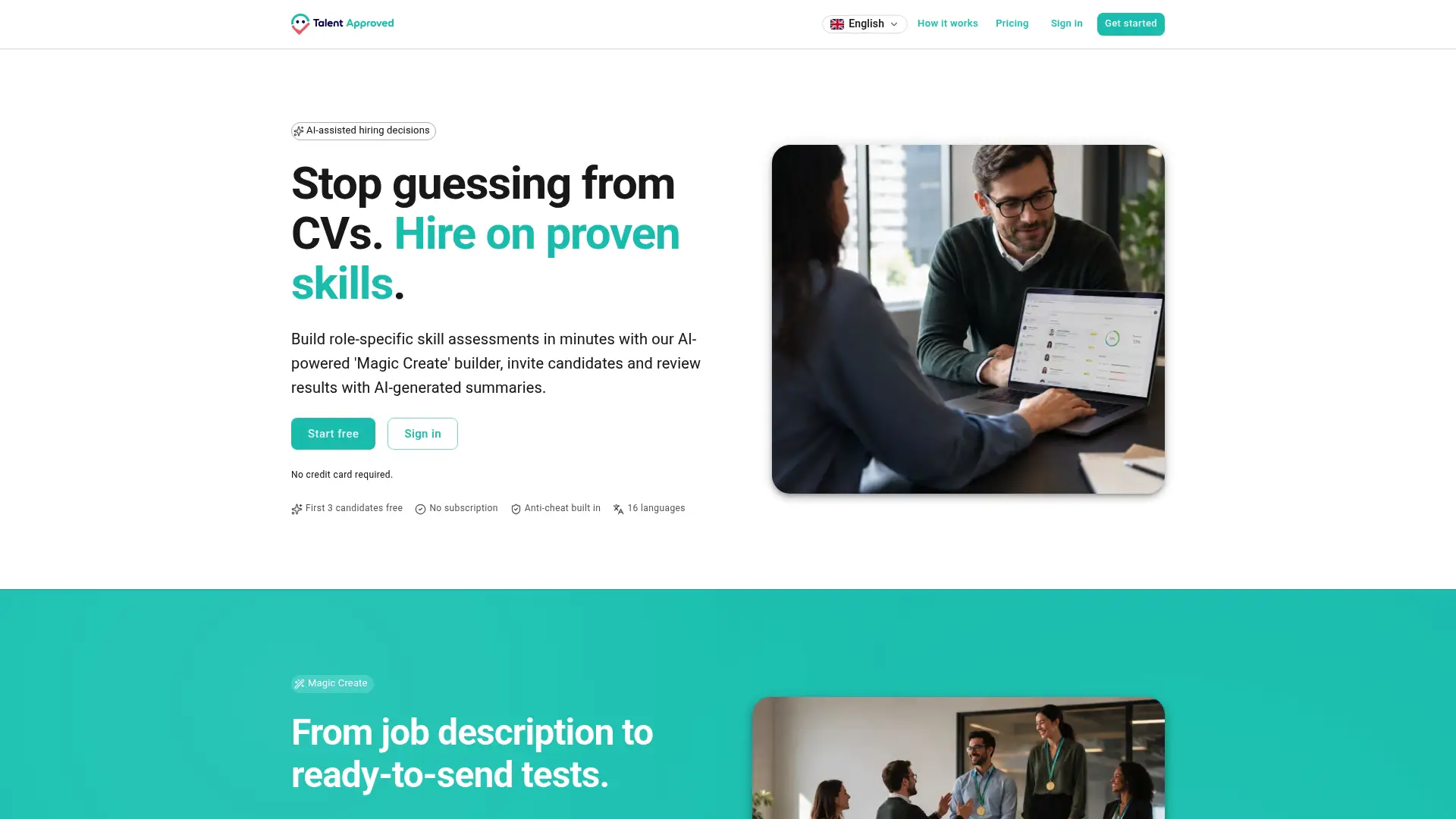
Talent Approved makes it straightforward to build role-specific skill assessments that integrate anti-cheat controls and AI-generated summaries into a single workflow. You can create a skill test from a job description in minutes, then review assessment results with AI-assisted scoring that surfaces the evidence your team needs to make confident decisions.
Key Takeaways
The most effective remote hiring process sequences async screening, live interviews, and AI skill assessments so each stage builds on the last and no single method carries the full evaluation burden.
| Point | Details |
|---|---|
| Async video for screening | Use async interviews to filter communication clarity and role comprehension before live stages. |
| Sync interviews for fit | Reserve live video sessions for culture fit and interpersonal assessment at final hiring stages. |
| AI assessments reduce bias | Structured, role-specific skill tests evaluate actual capability independent of interview performance. |
| Scorecards require evidence | Mandate that reviewers quote specific candidate responses to prevent subjective or groupthink ratings. |
| Schedule within local hours | Never ask candidates to interview outside their local 7 AM to 9 PM window to protect completion rates. |
FAQ
What is the most effective format for remote candidate screening?
Async video interviews are the most practical first-stage screening tool for distributed hiring, because candidates complete them on their own schedule and completion rates are significantly higher for international pools than live phone screens.
When should synchronous video interviews be used in remote hiring?
Reserve live video interviews for later stages focused on culture fit and interpersonal assessment. Research supports synchronous formats provide richer information for forming interpersonal impressions because both parties exchange cues in real time.
Do candidates perform worse in async interviews than in live ones?
No. Meta-analytic findings show observer-rated performance is similar across async and synchronous formats, even though candidates report less favorable attitudes toward async methods.
How do structured scorecards reduce bias in remote evaluations?
Scorecards with mandatory evidence fields require reviewers to reference specific candidate responses rather than general impressions, which prevents dominant-person bias during group evaluations and produces more consistent ratings across distributed review panels.
How can recruiters prevent fraud in remote skill assessments?
Combine AI-powered anti-cheat controls during testing with verbal walkthroughs of submitted work in a synchronous session. Requiring candidates to explain their reasoning in real time is one of the most reliable fraud deterrents for technical roles.