
US HR Playbook for Adverse Impact Testing: Run, Read, Fix

If your hiring process is producing a notably lower selection rate for any protected group compared to your highest-scoring group, you have a signal worth investigating. Run the impact ratio and a significance test (using appropriate methods for larger or smaller samples) before you make another hiring decision with that procedure. If either flags a problem, validate the assessment under UGESP or swap in a less discriminatory alternative that predicts job performance comparably.
TL;DR:
- Adverse impact can occur even with neutral selection procedures like tests or interviews, producing statistically significant disparities without deliberate intent.
- Validating assessments involves calculating selection rates, impact ratios below 0.80, and conducting significance tests with appropriate sample sizes, pooling multiple hiring cycles for accuracy.
- Organizations must keep detailed records of applicant data, validation efforts, and impact analyses to comply with UGESP and prepare for audits, especially for federal contractors.
- Task-specific, role-based assessments and structured interviews reduce disparities better than generic screens, particularly when designed with job analysis upfront.
- Continuous monitoring of impact ratios and AI tools, with vendor validation, is essential to sustain fair hiring practices and avoid recurring disparities over time.
Table of Contents
- What Adverse Impact Testing Actually Measures
- How to Run the Numbers: Selection Rates, Impact Ratios, and Significance Tests
- Reading the Results Without Overreacting or Underreacting
- Fixing the Pipeline: Job Analysis, Structured Interviews, and Better Assessments
- Validation and Recordkeeping: What UGESP Expects You to Keep
- Keeping AI and Algorithmic Screening Tools in Check
- A Practical Checklist for Building Fairer Assessments
- What Adverse Impact Testing Looks Like Across Industries
- Where Adverse Impact Testing Falls Short
- Building Adverse Impact Checks Into Ongoing Governance
- Build Fairer Tests Faster With Talent Approved
- Sources
- FAQ
What Adverse Impact Testing Actually Measures
Adverse impact is a statistical outcome, not a motive. It shows up when a neutral-looking selection procedure, a cognitive test, an interview rubric, a resume screen, produces meaningfully different pass rates across race, sex, age, or other protected groups, regardless of what anyone intended. That distinction separates it from disparate treatment, which requires proof someone was singled out on purpose. Adverse impact analysis asks a colder question: did the numbers land unevenly, and if so, why?
The legal scaffolding comes from three places. Title VII of the Civil Rights Act prohibits employment practices that disproportionately screen out a protected group unless the employer can justify the practice. The Uniform Guidelines on Employee Selection Procedures (UGESP), adopted jointly by federal agencies in 1978, spells out how employers should evaluate their selection tools and when they owe the government a validation study. The EEOC enforces Title VII and issues interpretive guidance, while the OFCCP applies parallel standards to federal contractors and often runs the statistical testing during compliance audits.
Validation gets triggered the moment adverse impact analysis turns up a disparity that clears statistical and practical significance thresholds. At that point, EEOC guidance is direct: the employer must show the procedure is job-related and consistent with business necessity, or move to a less discriminatory alternative.
Federal law protects these groups in the employment testing context:
- Race and color
- Sex, including pregnancy and gender identity
- National origin
- Religion
- Age (40 and older, under the ADEA)
- Disability status (ADA)
Every one of these categories needs its own selection-rate comparison. Lumping them together, or checking only race and skipping age, is how disparities go unnoticed until a charge lands on your desk.
How to Run the Numbers: Selection Rates, Impact Ratios, and Significance Tests
Testing for bias in your hiring pipeline follows a fixed sequence. Skip a step and you either miss a real problem or chase a phantom one.
- Calculate the selection rate for each group. Divide the number selected by the number of applicants in that group. If 80 women applied and 20 were hired, the selection rate is 25%.
- Identify the highest-selection-rate group. This becomes your comparison baseline, regardless of group size.
- Compute the impact ratio. Divide each group’s selection rate by the baseline group’s rate. A ratio below 0.80 trips the four-fifths rule.
- Run a significance test. For samples of 30 or more per group, use the two-sample binomial Z-test. For smaller samples, use Fisher’s exact test, which doesn’t rely on large-sample approximations.
- Interpret against your alpha level. Most practitioners use an alpha level representing about 95% confidence, though some agencies apply stricter thresholds for two-tailed comparisons.
Statistic Callout: OFCCP treats an absolute Z-value at a threshold considered statistically significant approximately corresponding to a 95% confidence level, roughly aligning with a 95% confidence threshold. That number, not just the four-fifths ratio, is what a federal compliance officer will actually calculate during an audit.
The four-fifths rule is a screening device, not a verdict. EEOC guidance describes it as a rule of thumb that agencies apply with discretion. A ratio of 0.79 in a pool of six applicants means almost nothing statistically. A ratio of 0.83 across 4,000 applicants might still represent a real, significant disparity. The rule flags where to look. The Z-test or Fisher’s exact test tells you whether what you’re looking at is noise.
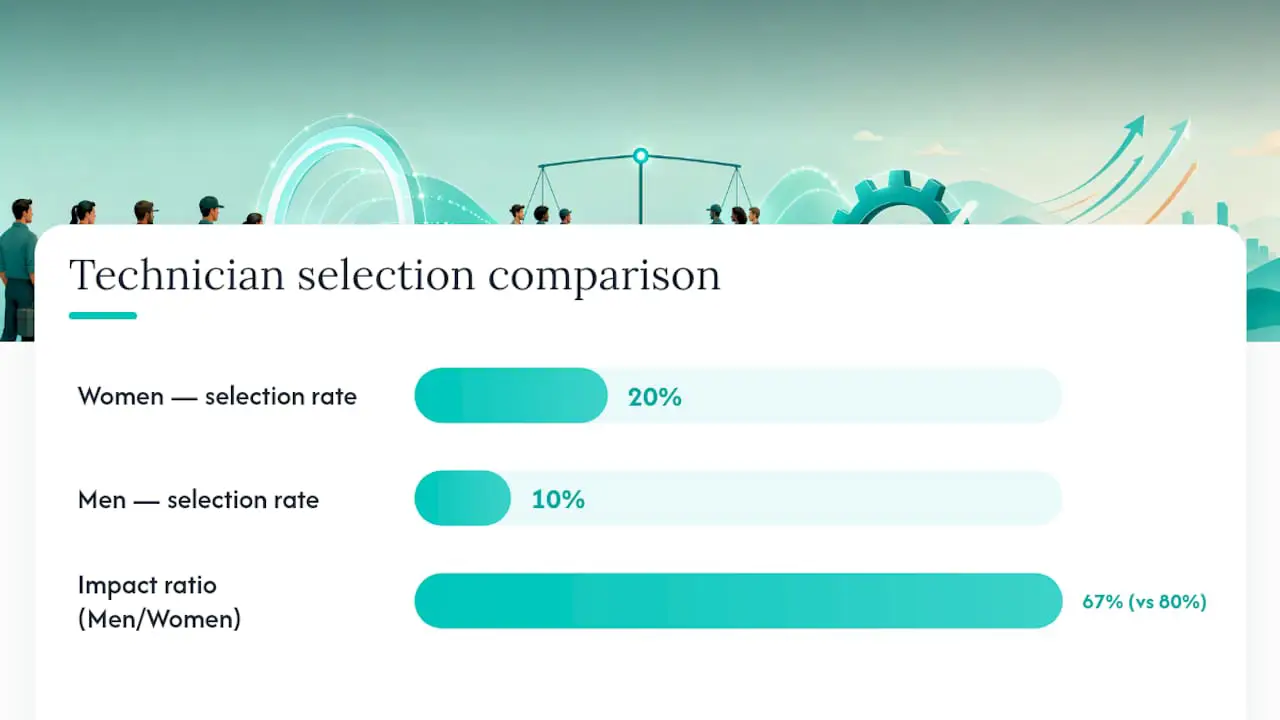
Here’s a simplified walk-through. Say 200 men and 150 women apply for a technician role. The impact ratio is 20/30, or 0.67, well under the 0.80 threshold. Running a two-sample Z-test on those numbers (both groups exceed 30) would tell you whether that 10-point gap is likely due to chance or reflects a structural problem in the assessment itself.
Reading the Results Without Overreacting or Underreacting
A flagged ratio is a starting point for inquiry, not an automatic finding of discrimination, and a clean ratio doesn’t guarantee your process is fair. Small applicant pools distort both the four-fifths ratio and significance tests: a handful of hires can swing a selection rate by 10 or 15 points, so a single hiring cycle rarely tells the full story on its own.
Watch for these common missteps:
- Testing dozens of subgroups without adjusting your alpha, which inflates the odds of a false positive somewhere in the data purely by chance.
- Ignoring confidence intervals and treating a borderline ratio as definitively fine or definitely broken.
- Overreacting to one bad quarter instead of pooling several hiring cycles to see if the pattern holds.
- Underreacting to a “passing” four-fifths ratio that hides a statistically significant Z-score, since the two measures answer different questions.
Every significance test involves a trade-off between Type I error (flagging a fair process as biased) and Type II error (missing a genuinely biased one). A stricter alpha reduces false alarms but makes it easier for real disparities to slip through in smaller samples, which is exactly why regulators lean on Fisher’s exact test rather than a Z-test when group sizes are thin.
Pro Tip: Pool at least two or three hiring cycles before you decide whether a disparity is real. One outlier quarter with 12 applicants can produce a dramatic-looking ratio that vanishes once you add the next 200 candidates to the dataset.
When a result clears both the four-fifths threshold and a significance test across multiple cycles, that’s your cue to move to validation or pilot a replacement, not just monitor and hope it self-corrects.
Fixing the Pipeline: Job Analysis, Structured Interviews, and Better Assessments
Mitigation works best when it starts before you ever post a job, not after adverse impact analysis turns up a problem.
- Start with a job analysis. Define the actual tasks and competencies the role requires before you pick or build any test. A generic cognitive-ability screen for a data-entry role invites disparities a task-based typing and accuracy test would avoid.
- Favor task-based, role-specific assessments over broad screens. Structured, job-relevant tests that mirror actual job duties tend to produce smaller group differences than abstract aptitude tests while still predicting performance well.
- Use structured interviews with fixed questions and scoring rubrics. Unstructured interviews, where each interviewer asks whatever comes to mind, are where subjective bias creeps in hardest.
- Build scorecards and train raters to calibrate against them. Two interviewers scoring the same answer should land within a point of each other, not three points apart.
- Pilot alternatives when a tool flags adverse impact. UGESP requires employers to evaluate suitable alternatives and adopt the one with substantially equal validity and less impact.
Pro Tip: Don’t retire an assessment just because it shows a disparity. Compare its validity against the proposed replacement first. Swapping a well-validated test for an untested one can trade a legal risk for a bad-hire risk.
Structured, task-based screening tools mapped directly to job competencies consistently outperform generic screens on both fairness and predictive accuracy, largely because they measure what the job actually demands rather than a proxy for it.

Validation and Recordkeeping: What UGESP Expects You to Keep
UGESP requires a validation study once adverse impact analysis crosses statistical and practical thresholds, and the guidelines recognize three types of evidence: content validity (the test mirrors job tasks directly), criterion-related validity (scores correlate with actual job performance), and construct validity (the test measures an underlying trait tied to success on the job).
Local validation, a study run on your own applicant population, carries the most weight. Transported validity, where you rely on a validation study from a similar job elsewhere, is acceptable when the roles and settings are genuinely comparable, but regulators scrutinize the fit closely.
Keep these records on file and audit-ready:
- Applicant flow data broken out by protected group, for every requisition
- Selection rates and impact ratio calculations for each hiring cycle
- Any validation study documentation, including methodology and results
- Vendor materials describing how a purchased assessment was built and validated
CFR §1607.4 outlines recordkeeping expectations tied directly to four-fifths rule enforcement. Treat these records the way you’d treat tax documents: retained for years, organized by cycle, and ready to hand over on short notice.
Keeping AI and Algorithmic Screening Tools in Check
An algorithm doesn’t get a pass just because a human didn’t write the scoring rules by hand. EEOC technical guidance is explicit that there’s no algorithmic exemption. Software, resume-ranking tools, and AI-driven screening must meet the same job-relatedness and validation bar as a paper-and-pencil test from 1985.
Build a monitoring cadence, not a one-time check:
- Rerun impact ratios and significance tests every hiring cycle or quarter, whichever comes first
- Track selection rates by protected group at every stage the tool touches, not just the final decision
- Ask vendors directly for their validation evidence, a description of their training data, and any fairness testing they’ve run
- Have a remediation path ready: model adjustments, added human review, or swapping in an alternative assessment
Pro Tip: Request a vendor’s adverse impact documentation before you sign, not after your first flagged quarter. Ongoing oversight of AI screening tools works far better as a standing practice than a scramble.
A Practical Checklist for Building Fairer Assessments
Fair testing starts with design, not damage control. Map job tasks to test content, build items around those tasks, pilot with a real applicant sample, measure impact ratios, then validate or revise before full rollout.
- Map core job tasks before writing a single question
- Build task-based items, not generic aptitude questions
- Pilot with a representative applicant sample
- Measure impact ratios and significance before full deployment
- Validate or iterate based on what the pilot shows
Anti-cheat safeguards and AI-generated scoring summaries speed up this cycle considerably. When every candidate takes the same task-based test under the same monitored conditions, and every score comes with a documented rationale, you get cleaner data for impact ratio calculations and a paper trail ready for an audit.
What Adverse Impact Testing Looks Like Across Industries
The mechanics stay the same everywhere, but the tools that trigger scrutiny shift by sector. In manufacturing and logistics, physical ability tests and strength assessments have historically produced some of the widest gaps by sex, prompting many employers to move toward task-simulation tests that mirror the actual lifting or motion required rather than raw strength benchmarks.
In tech and finance, cognitive ability tests and coding assessments draw the most scrutiny. A generic logic puzzle test can produce disparities by race or national origin that a role-specific coding challenge, scored against the actual language and task stack the job uses, often narrows considerably.
Retail and hospitality hiring leans heavily on structured interviews and personality assessments, where unstructured, freewheeling interview formats remain one of the most common sources of rater-driven disparity. Healthcare systems increasingly test licensure-adjacent skills (patient charting accuracy, medication math) rather than broad aptitude, largely because those task-based measures hold up better under both validity and adverse impact review.
Public-sector and government contractor hiring sits under the tightest scrutiny of all, since OFCCP compliance reviews routinely pull applicant flow data and rerun the Z-test independently. Any employer with federal contracts should assume their numbers will be recalculated by someone outside the building.
Where Adverse Impact Testing Falls Short
The four-fifths rule and significance testing are useful tools but have limitations. Both methods share a structural weakness: they measure outcomes at the group level, which means they can miss individual-level unfairness entirely, or flag a disparity that has nothing to do with the test itself and everything to do with an unrepresentative applicant pool.
Sample size cuts both ways. Too few applicants in a group and the four-fifths ratio swings wildly on one or two hires. Fisher’s exact test handles small samples better than a Z-test approximation, but small samples limit statistical power., but even that can’t manufacture statistical power from a pool of eight applicants. At the other extreme, very large applicant pools can produce a statistically significant Z-score for a gap so small it has no practical meaning for anyone’s career outcome.
Data quality is its own weak point. Self-reported demographic data has gaps and inconsistencies. Multi-stage hiring funnels make it easy to lose track of which candidates dropped out voluntarily versus which were screened out by the tool you’re testing. And testing dozens of job categories or locations at once, without adjusting for multiple comparisons, inflates the odds that something looks flagged purely by chance.
None of this makes the methodology useless. It means adverse impact testing is one input into a judgment call, not a formula that spits out a clean pass or fail on its own.
Building Adverse Impact Checks Into Ongoing Governance
The biggest mistake I see is treating this as a one-time audit instead of a standing discipline. Run the ratios once, fix the flagged test, move on, and the same gap often resurfaces two hiring cycles later under a slightly different guise. Build it into quarterly reviews, train hiring managers to spot warning signs before HR has to catch them after the fact, and put legal, HR, and analytics in the same room when a number moves. Ownership split across three departments with no shared dashboard is how disparities linger for years unnoticed.
— Jimmie
Build Fairer Tests Faster With Talent Approved
Talent Approved offers tools to help create task-based assessments quickly, which can be useful when adverse impact analysis indicates a need to pilot an alternative promptly. The Magic Create feature builds role-specific tests directly from a job description or skill list, the kind of task-mapped assessment this guide recommends over generic cognitive screens.
Built-in monitoring and AI-generated performance summaries aim to provide clean, documented scoring data useful for validation studies or reviews. That documentation trail, tied directly to the mitigation steps covered above, is often the difference between a quick compliance answer and a scramble through old spreadsheets. If your current screening tool has ever made you nervous about its selection rates across groups, start building a role-specific assessment on Talent Approved and see how fast a fairer test comes together.
Sources
- Employment tests and selection procedures | EEOC
- CFR §1607.4 — Discrimination defined: Relationship between use of selection procedures and discrimination
FAQ
What Is the Difference Between Adverse Impact and Disparate Treatment?
Adverse impact is a statistical disparity in outcomes across protected groups from a neutral procedure, while disparate treatment requires proof of intentional discrimination against a specific person or group.
What Is the Four-Fifths Rule in Employment Testing?
It flags a possible problem when a protected group’s selection rate falls below 80% of the highest-selection-rate group’s rate, though EEOC guidance treats it as a screening tool, not a legal absolute.
When Should I Use a Z-Test Versus Fisher’s Exact Test?
Use the two-sample binomial Z-test when each group has 30 or more applicants; use Fisher’s exact test for smaller samples, where large-sample approximations become unreliable.
Do AI Hiring Tools Need Adverse Impact Testing Too?
Yes. The EEOC has clarified there is no exemption for algorithmic tools from adverse impact analysis, so software and AI-driven screening tools must be tested and validated the same way traditional assessments are.
What Happens if My Assessment Shows Adverse Impact?
You must show the procedure is job-related and consistent with business necessity, or adopt a less discriminatory alternative with comparable validity, and platforms like Talent Approved can help you pilot and document that alternative quickly.