
The Role of AI in Bulk Candidate Screening: 2026 Guide

AI automates the triage stage of high-volume hiring, surfaces skill-based matches from hundreds of applications in minutes, and reallocates recruiter time to interviews and relationship work that actually requires human judgment. That is the core value proposition, and the research supports it. Here is what to expect from this guide:
- Operational changes: AI screening cuts time-to-review significantly, applies consistent criteria across every applicant, and handles volume spikes without adding headcount.
- Governance requirement: No AI screening system should operate without human-in-loop review, audit logging, and periodic adverse impact testing. The technology augments your decisions; it does not replace them.
- Where skill assessments fit: Tools like Talent Approved slot into the mid-pipeline stage, converting job descriptions into validated assessments that feed stronger, more auditable signals into your screening models.
The sections below cover how AI screening works technically, the KPIs to track, U.S. legal considerations under EEOC guidance, a vendor checklist, and a step-by-step rollout plan you can copy.
Table of Contents
- How does AI screening actually work inside a hiring pipeline?
- What are the risks and legal considerations for AI screening in the U.S.?
- What should you look for when evaluating AI screening tools?
- How do you implement AI screening at scale, from pilot to production?
- Which workflows benefit most from AI screening combined with assessments?
- How does Talent Approved strengthen AI screening pipelines?
- Key Takeaways
- AI screening works best when you treat it as a co-pilot, not a decision-maker
- Talent Approved makes skill-based bulk screening practical at any volume
- Useful sources
- FAQ
How does AI screening actually work inside a hiring pipeline?
Understanding the mechanics helps you evaluate vendor claims and design a pilot that will hold up under scrutiny.
Comparing the three core screening techniques
| Technique | Primary inputs | Output | Main failure mode | Recruiter control |
|---|---|---|---|---|
| Knockout rules | Structured fields (yes/no, dropdown) | Pass/fail decision | Over-filtering on rigid criteria | High — rules are configurable |
| Scoring/matching models | Resume text, skills, job profile | Ranked shortlist | Bias in training data; opaque rankings | Medium — requires explainability layer |
| Conversational screening | Free-text answers, video responses | Qualitative data appended to profile | Candidate drop-off; inconsistent prompts | Medium — prompt design matters |
Automated candidate screening guidance recommends keeping rule-based automation for predictable tasks and reserving AI for interpretive work like semantic matching and summary generation. That separation keeps the pipeline auditable.
Pro Tip: The single biggest driver of screening quality is the data you feed in. Structured skills data from validated assessments outperforms free-text resume parsing by a wide margin. Before you configure a scoring model, insert a role-specific skill assessment at the mid-pipeline stage. The assessment output gives the model a clean, standardized signal rather than noisy resume text. Talent Approved’s AI test generator converts a job description into a tailored assessment in minutes, which makes this step practical even at scale.
What are the risks and legal considerations for AI screening in the U.S.?
AI screening carries real legal and ethical exposure in the U.S. context, and the EEOC’s guidance on employment selection procedures applies to automated tools just as it does to human decisions. A screening system that produces disparate impact on a protected class can create liability regardless of whether a human or an algorithm made the call.
The core principle: AI does not solve fairness on its own. Research shows only modest bias mitigation from AI screening unless it is accompanied by explainability, deliberate governance, and human oversight. Efficiency gains are real and measurable; fairness gains require active work.
Legal and ethical documentation checklist
- Adverse impact testing results, run at regular intervals and whenever screening criteria change
- Audit trail showing which criteria drove each pass/fail or ranking decision
- Candidate disclosure language explaining that automated tools are used in screening
- Vendor data handling agreements covering storage, retention, and deletion of candidate data
- Human-review thresholds defining which decisions require a recruiter to review before action
- Explainability documentation showing how scores are calculated in plain language
Adverse impact testing in practice
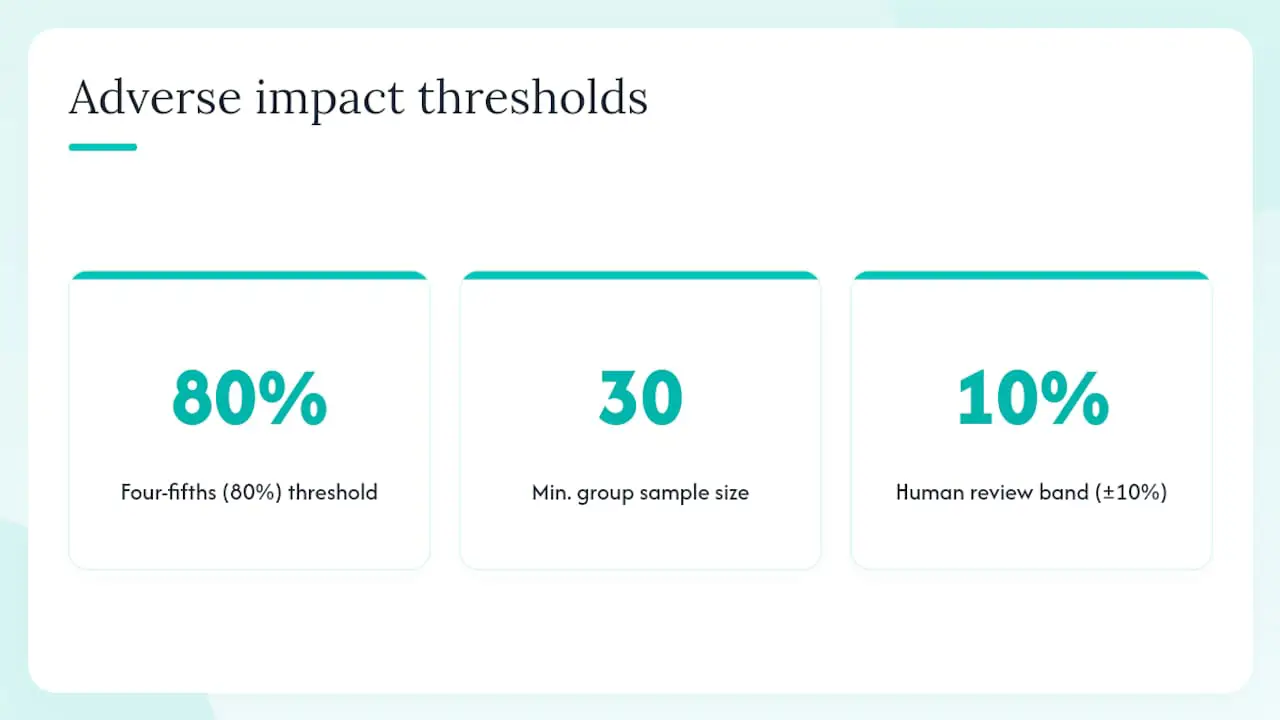
Adverse impact testing compares selection rates across protected groups (race, sex, national origin, age, disability) to check whether a screening tool disproportionately excludes any group. The standard reference point in U.S. employment law is the four-fifths rule: if the selection rate for any group is less than 80% of the rate for the highest-selected group, adverse impact is indicated. Run this analysis at each funnel stage, not just at the final hire decision, and document the results. Sample sizes below 30 per group reduce statistical reliability, so plan your pilot around roles with sufficient volume.
Known limitations to plan around: AI models trained on historical hiring data can encode past biases. Resume parsing can disadvantage non-traditional career paths. Conversational screening can penalize candidates with non-native English phrasing. None of these are reasons to avoid AI screening; they are reasons to monitor it continuously.
Pro Tip: Set a default human-in-loop rule for any candidate whose score falls within 10% of your shortlist cutoff. Log every borderline rejection with the criteria that drove it. This simple escalation rule catches the cases most likely to generate complaints and gives you an auditable record if a decision is ever challenged.
What should you look for when evaluating AI screening tools?
Procurement decisions for AI screening tools are consequential. The wrong choice creates compliance risk, poor candidate experience, and data you cannot trust. The right checklist separates tools that will hold up in production from those that look good in a demo.
Must-have vs. nice-to-have features
| Feature | Must-have | Nice-to-have |
|---|---|---|
| Explainability (plain-language score rationale) | ✓ | |
| Human-in-loop override controls | ✓ | |
| ATS integration (native or API) | ✓ | |
| Audit log for all screening decisions | ✓ | |
| Configurable knockout rules | ✓ | |
| SOC 2 Type II certification or equivalent | ✓ | |
| Adverse impact testing / reporting | ✓ | |
| Assessment integration (skill-based signals) | ✓ | |
| Conversational / chatbot screening | ✓ | |
| Anti-cheat proctoring for assessments | ✓ | |
| Multi-language candidate support | ✓ | |
| Candidate NPS / experience tracking | ✓ |
Questions to ask vendors during a demo
- Show me the audit log for a rejected candidate. What criteria drove that decision?
- How does your system flag potential adverse impact, and how often should I run that report?
- What does the human-override workflow look like, and who receives the escalation?
- How does your tool handle candidates who do not match the training data distribution (career changers, non-traditional backgrounds)?
- What is your SOC 2 status, and can you share your data retention and deletion policy?
- How do assessment scores from third-party tools integrate into your ranking model?
Automated screening guidance consistently emphasizes that configurable criteria, explainable AI, and override controls are the non-negotiable baseline. Any vendor that cannot demonstrate all three in a live demo is not ready for production use.
How do you implement AI screening at scale, from pilot to production?
A structured rollout protects you from the most common failure modes: deploying on the wrong role type, missing a baseline metric, or discovering adverse impact after thousands of decisions have already been made.
Pilot success criteria to set in advance
- 30% or greater reduction in time-to-review compared to baseline
- No adverse impact above the four-fifths threshold on any protected group
- Recruiter override rate below 15% (high override rates signal model miscalibration)
- Candidate completion rate above 70% for any conversational or assessment stage
- Improved interview-to-offer conversion rate compared to pre-pilot baseline
Monitoring dashboard items
- Score distribution across all applicants (watch for clustering at cutoff thresholds)
- Adverse impact flags by funnel stage and protected group
- False-positive and false-negative samples (candidates advanced or rejected incorrectly)
- Candidate NPS or satisfaction scores from post-screening surveys
- System uptime and integration error rates
For assessment integration specifically, Talent Approved’s platform supports reviewing AI-generated summaries and score breakdowns that feed directly into recruiter workflows, making it straightforward to incorporate assessment outputs into your monitoring dashboard.
Which workflows benefit most from AI screening combined with assessments?
Four use cases consistently show the strongest return from combining AI screening with validated skill assessments.
Seasonal retail hiring
A retailer opening 500 seasonal positions in six weeks cannot manually review every application. The workflow: inbound applications trigger automated knockout rules (availability, location, work authorization), followed by a short role-specific assessment covering customer service scenarios and basic numeracy. AI ranks remaining candidates by assessment score and availability match. Recruiters review only the top-ranked shortlist. The assessment stage is where the biggest quality gain occurs: it replaces resume-based guesswork with a direct measure of role-relevant capability.
Contact center ramp-up
Speed matters more here than almost anywhere else. The workflow: applications enter, a conversational screening bot collects availability and handles basic knockout questions, then a typing speed and communication skills assessment filters for role-critical abilities. AI scoring ranks candidates by combined assessment and conversational screening outputs. Recruiters schedule interviews from the ranked list. Designing job-specific screening tests for this use case takes under an hour with an AI test generator.
Entry-level tech and campus hiring
Resume parsing struggles with new graduates because job titles are absent and experience is thin. Semantic matching helps, but validated assessments are the real differentiator. The workflow: applications are parsed and semantically matched against a skills profile, then a technical assessment (coding, data analysis, or role-specific problem-solving) provides a standardized signal. Candidates are ranked by assessment performance, not GPA or institution name. This approach directly reduces the credential bias that manual screening tends to amplify.
Marketplace and freelancer screening
Platforms screening large pools of freelancers need fast, repeatable qualification checks. The workflow: applicants complete a short skill assessment before any human review occurs. Knockout rules filter for minimum scores. AI ranks remaining candidates by score and profile completeness. Anti-cheat proctoring, including screen recording and webcam monitoring, raises confidence in remote assessment integrity.
Roles where validated skill assessments consistently outperform CV-only screening: technical roles (coding, data, finance), task-based roles (customer service, data entry, logistics coordination), and any role where the required skill is not reliably signaled by job title or education level.
How does Talent Approved strengthen AI screening pipelines?
Skill assessments are only as useful as the signal quality they produce. A poorly designed assessment adds noise, not clarity. Talent Approved addresses this at the point of test creation and at the point of result interpretation, which are the two stages where signal quality most often breaks down.
Where Talent Approved inserts into the pipeline
- Model input improvement: assessment scores replace or supplement resume-parsed skill claims, giving ranking models a cleaner, more standardized input. Candidate ranking and AI scoring features show how scores are calculated and interpreted, supporting the explainability requirement.
Key platform features for bulk screening
- AI test generator — paste a job description or skill list, and the platform builds a tailored assessment in minutes. Consistency across hundreds of candidates is automatic.
- Anti-cheat proctoring — session replays, screen monitoring, and webcam recording flag suspicious behavior without requiring a live proctor.
The platform operates on a pay-as-you-go model at $5 per completed candidate assessment, with no subscription required. That pricing structure makes it practical to run pilots on a single role before committing to a broader rollout.
Human review remains the right call for final hiring decisions. Talent Approved’s summaries and rankings accelerate that review; they do not replace it.
Key Takeaways
AI bulk candidate screening delivers the strongest results when it combines automated triage, validated skill assessments, and human-in-loop review with continuous adverse impact monitoring.
| Point | Details |
|---|---|
| AI automates triage, not decisions | AI ranks and filters candidates efficiently; final hiring decisions require human review and documented rationale. |
| Governance is non-negotiable | Adverse impact testing, audit logs, and explainability are required from day one, not added after deployment. |
| Assessments improve signal quality | Inserting validated skill assessments mid-pipeline gives ranking models cleaner inputs than resume text alone. |
| Track the right KPIs | Monitor time-to-review, cost-per-hire, quality-of-hire proxies, and diversity metrics at every funnel stage. |
| Talent Approved as the assessment layer | Talent Approved’s AI test generator, candidate ranking, and anti-cheat proctoring slot directly into bulk screening pipelines to raise signal quality and auditability. |
AI screening works best when you treat it as a co-pilot, not a decision-maker
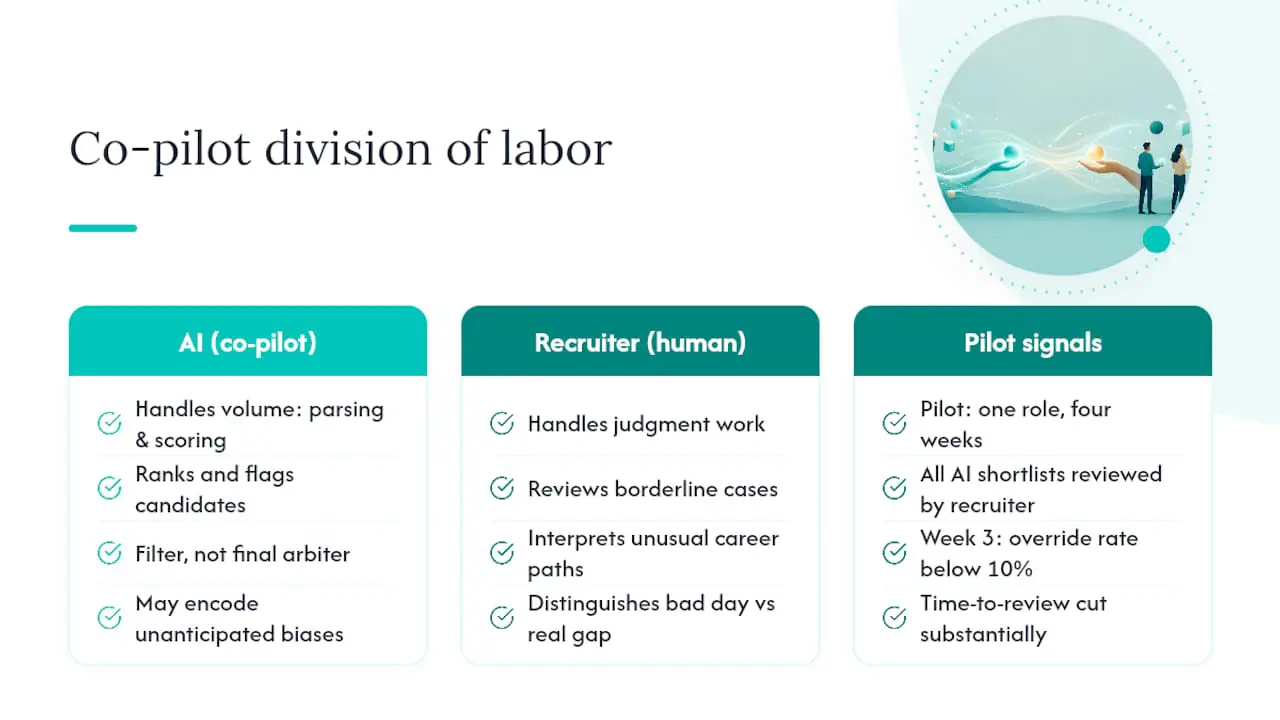
The most common mistake in AI screening rollouts is treating the technology as a final arbiter rather than a filter. Recruiters who hand off shortlisting entirely to an algorithm tend to discover two problems at once: the model encodes biases they did not anticipate, and candidates who would have been excellent hires get dropped before anyone with judgment ever sees their application.
The better frame is co-pilot. The AI handles the volume work: parsing, scoring, ranking, flagging. The recruiter handles the judgment work: reviewing borderline cases, reading between the lines of an unusual career path, deciding whether a candidate’s assessment score reflects a bad day or a real skill gap. That division of labor is where the efficiency gains and the quality gains happen together.
What often gets overlooked is the organizational readiness piece. A well-configured AI screening tool deployed into a team that has not aligned on what “quality hire” means will produce a ranked list that nobody trusts. Before you configure scoring criteria, get hiring managers and recruiters in the same room to define the two or three skills that actually predict success in the role. That conversation is worth more than any algorithm tuning.
One pattern that works well in practice: a mid-size employer running a contact center ramp-up pilots AI screening on a single role for four weeks, with every AI shortlist decision reviewed by one recruiter. By week three, the recruiter’s override rate has dropped below 10%, the time-to-review has been cut substantially, and the adverse impact analysis comes back clean. That is the signal to scale. The pilot duration matters less than the metrics you commit to measuring before you start.
Talent Approved makes skill-based bulk screening practical at any volume
Bulk hiring without a reliable skill signal is just fast guessing. Talent Approved gives your screening pipeline what it actually needs: role-specific assessments built from job descriptions in minutes, AI-generated candidate summaries that cut review time, and proctoring that makes remote results trustworthy.
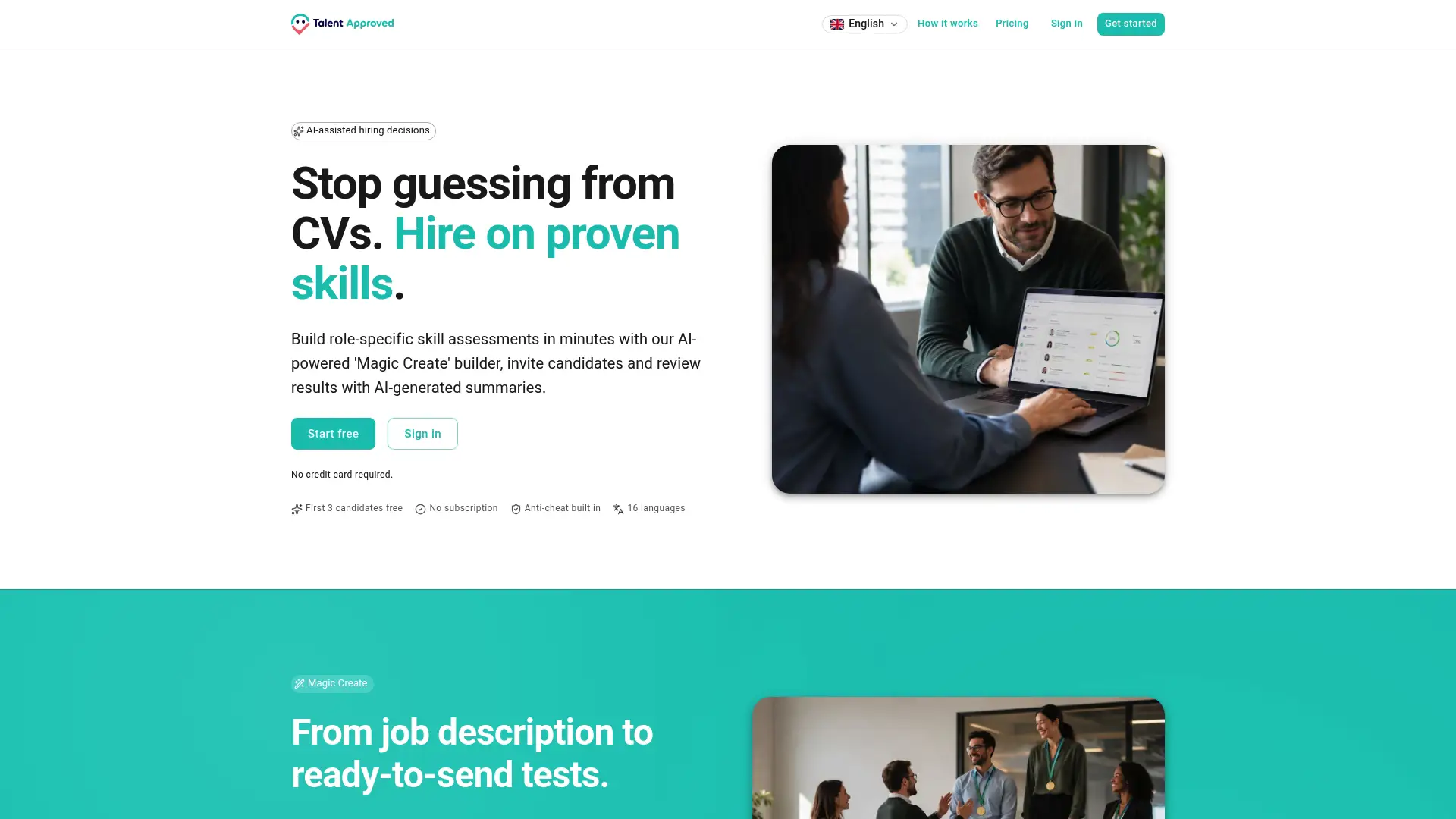
The AI test generator converts any job description into a tailored assessment without a test-design specialist. Candidates complete it remotely; screen recording and webcam monitoring flag integrity issues automatically. After completion, ranked scores and AI summaries let your team review a shortlist in a fraction of the time manual review would take. Every result is logged with an audit trail that supports your adverse impact documentation.
There is no subscription. At $5 per completed candidate, you can run a four-week pilot on one role, measure the KPIs, and decide whether to scale. See how Talent Approved works and set up your first assessment today.
Useful sources
The sources below are the primary references for policy, empirical evidence, and platform documentation cited in this guide.
- AI in Recruiting | IBM
- Transformations in Talent Acquisition: Measuring…
- The Evolving Role of AI in Recruitment and Retention
- Automated Candidate Screening: What It Is & How to Use It
- How Talent Approved works - AI skill assessments
- How to review assessment results with AI - Talent Approved
- AI test generator from a job description
This article provides general information about AI screening practices and U.S. employment considerations. It is not legal advice. Confirm current EEOC requirements and adverse impact procedures with a qualified employment attorney or HR compliance specialist before deploying automated screening tools.
FAQ
What is the role of AI in bulk candidate screening?
AI automates the triage stages of high-volume hiring: parsing resumes, applying knockout rules, scoring candidates by skill fit, and ranking shortlists. It reallocates recruiter time from administrative review to interviews and final decisions.
Does AI screening reduce bias in hiring?
Research shows AI screening produces only modest bias mitigation (β = 0.21) without deliberate governance. Adverse impact testing, explainability, and human-in-loop review are required to translate efficiency gains into fairer outcomes.
What KPIs should recruiters track when using AI screening?
Track time-to-review, time-to-fill, cost-per-hire, quality-of-hire proxies (90-day retention, hiring manager satisfaction), candidate response rates, and diversity metrics at each funnel stage.
How does Talent Approved fit into an AI screening pipeline?
Talent Approved inserts at the mid-pipeline stage: its AI test generator builds role-specific assessments from job descriptions, candidate ranking and AI summaries speed recruiter review, and anti-cheat proctoring supports integrity for remote assessments.
What U.S. legal requirements apply to automated candidate screening?
The EEOC’s Uniform Guidelines on Employee Selection Procedures apply to automated tools. Employers must document adverse impact testing results, maintain audit trails, disclose automated screening to candidates, and preserve human-review controls for final decisions.