
Stop Biased Hiring: Assessment Localization Strategy Checklist for HR

Assessment localization means adapting a hiring test’s language, content, scoring, and delivery so it stays valid and fair for candidates across different languages and regions, not just translated word for word. The first move HR should make is a scope decision: pick which languages you actually need, and decide whether each version will be used for selection (hiring decisions) or only development. Selection use demands equivalence testing, not just a clean translation.
TL;DR:
- Using translated assessments without evidence of measurement invariance can lead to biased hiring decisions and unfair candidate comparisons across languages.
- Establishing scalar equivalence and conducting DIF analysis require several hundred respondents per language, making staged rollouts essential for high-stakes evaluations.
- Source version optimization and professional forward/back translation improve translatability, but full psychometric validation is necessary only for high-volume, high-stakes languages.
- Consistent assessment administration and security controls are crucial to maintain equivalence survey data, regardless of translation quality.
- Approaching localization with a structured, phased process reduces costly rework and ensures assessments remain valid and fair across diverse languages and cultures.
Table of Contents
- Why Assessment Localization Strategy Matters More Than HR Teams Assume
- A Step-by-Step Playbook for Localizing Hiring Assessments
- The Go/No-Go Checklist for Approving a Localized Assessment
- How Talent Approved Supports a Localization Strategy in Practice
- What Actually Trips Up Localization Projects
- Put This Strategy Into Practice With Talent Approved
- Key Standards and Studies Behind This Strategy
- Sources
- FAQ
Why Assessment Localization Strategy Matters More Than HR Teams Assume
A translated test is not automatically an equivalent test. Treat two language versions as interchangeable without evidence, and you risk comparing candidates on scores that don’t mean the same thing in each language, which can quietly bias who gets hired. The International Test Commission’s guidelines exist precisely because this happens more often than most HR teams realize, and the AERA/APA/NCME Standards for Educational and Psychological Testing (Chapter 9) sets a similar expectation: any claim that a test works the same way across populations needs evidence, not assumption.
The technical term is measurement invariance, and researchers have documented real cases where it fails. A widely cited paper on linking assessments across languages found that cultural, linguistic, and even administration-mode differences (paper versus screen, proctored versus remote) can shift how an item performs across groups. That’s differential item functioning, or DIF: an item that behaves differently for equally skilled candidates depending on language or background.
What tends to go wrong when localization is rushed:
- Idioms or culture-bound scenarios get translated literally, changing item difficulty without anyone noticing.
- Scores get compared across languages as if a scalar equivalence had been established, when it hadn’t.
- A test normed on a US population gets used internationally with no adjustment, comparing candidates against a baseline that was never built for them.
Quick fact: The three-phase equivalence framework used across the testing industry, configural, metric, and scalar, exists specifically because a translated test can look fine on the surface while measuring something structurally different underneath.
A Step-by-Step Playbook for Localizing Hiring Assessments
Localization works best as a sequence, not a checklist you jump around in. Here’s the order that avoids expensive rework.
-
Decide scope before you translate anything. Pull applicant volume by language, weigh how high-stakes the decision is (a final-round hiring test needs more rigor than a screening quiz), and match the investment to that risk. A role with five candidates a year in a given language rarely justifies full psychometric validation.
-
Optimize the source version first. Strip out idioms, region-specific references, and culturally loaded scenarios before translation starts. A question about “batting a thousand” or a scenario built around a US tax form creates translation problems that better source writing avoids entirely. Reusable, structured item libraries make this easier to standardize across roles, as outlined in guidance on scaling hiring with assessment templates.
-
Use qualified translators, not bilingual staff as a favor. Forward translation (source to target language) followed by back translation (target back to source, by a different translator) catches drift that a single pass misses. cApStAn’s guidance on adapting psychometric tests stresses semantic equivalence over literal accuracy: a grammatically correct translation can still shift what an item is actually measuring.
-
Run a translatability review before finalizing items. Independent reviewers check for items likely to cause construct drift, and document their concerns item by item. This upstream step, recommended in the ITC’s guidelines on translating and adapting tests, reduces how much rework happens after data collection instead of before it.
-
Test for equivalence in three phases. Configural equivalence confirms the same factor structure holds across languages. Metric equivalence confirms item loadings match, which lets you compare relationships between variables. Scalar equivalence confirms intercepts match, and only then can you defensibly compare mean scores across language groups. Skipping straight to comparing averages without scalar evidence is one of the more common, and more consequential, shortcuts in multilingual testing.
-
Run DIF analysis on flagged items. Methods like Mantel-Haenszel or IRT-based approaches identify items that function differently for otherwise equally skilled candidates. A flagged item doesn’t automatically get deleted. It gets revised, replaced, or interpreted with documented caution depending on how much it affects the overall score.
-
Set realistic sample-size expectations. Confirmatory factor analysis and DIF work typically need several hundred respondents per language to produce stable results. That’s a real constraint. Stage your rollout, starting with your highest-volume languages, rather than trying to validate a dozen versions simultaneously with fifty candidates each.
-
Standardize delivery and lock down security. Consistent instructions, timing, and proctoring matter as much as translation quality. Anti-cheat controls, session monitoring, and device parity reduce administration variability that would otherwise contaminate your equivalence data before you even get to analyze it. Consistency here also depends on how hiring managers actually run sessions day to day, which is where training on assessment administration closes a gap that translation alone can’t fix.
-
Interpret scores within-language until scalar evidence says otherwise. Rank candidates against others who took the same language version rather than pooling everyone into one cross-language leaderboard, unless you’ve established scalar equivalence. Document that limitation on the report itself.
Pro Tip: Don’t wait for perfect equivalence data before launching a language version. Launch with within-language norms, label the limitation clearly on candidate reports, and upgrade to cross-language comparisons once you’ve collected enough data to justify it. A transparent interim approach beats a stalled rollout.
The Go/No-Go Checklist for Approving a Localized Assessment
Before a language version goes live for real hiring decisions, run it against this list. Missing items don’t necessarily mean stop, but they mean you need a documented remediation plan.
- A written scope statement naming the language, intended use (selection vs. development), and expected volume.
- Translator credentials on file, ideally with forward and back translation completed by different people.
- A documented translatability assessment with item-level notes on flagged content.
- Either equivalence evidence (configural at minimum) or an active data collection plan with a target date.
- A realistic sample-size target, generally in the hundreds per language for full CFA and DIF work.
- Security controls consistent with other language versions: proctoring, anti-cheat, session logging.
- Candidate-facing transparency about which score comparisons are and aren’t supported.
- A technical report or summary documenting known limitations per language.
| Evidence level | What it supports | What it doesn’t |
|---|---|---|
| Translation + translatability review only | Development use, coaching feedback | Cross-candidate ranking decisions |
| Configural equivalence established | Confirming the construct structure holds | Comparing score averages across languages |
| Scalar equivalence established | Comparing mean scores across language groups | Nothing further needed for that comparison |
When resources are limited, prioritize by volume and stakes together: the language with the most candidates in your highest-stakes role goes first, even if it’s not the language with the most total applicants company-wide.
How Talent Approved Supports a Localization Strategy in Practice
Talent Approved’s feature set maps directly onto the steps above rather than replacing the psychometric work they require. Magic Create builds role-specific assessments from a job description or skill list, which speeds up source-version optimization since you’re starting from structured, consistent items rather than a patchwork of legacy questions. Multi-language support lets you deploy the same structured assessment across language versions without rebuilding it from scratch each time.
- Session replays and webcam/screen anti-cheat monitoring support consistent administration, one of the quieter requirements for defensible equivalence data.
- AI-generated performance summaries help HR teams review candidates faster without losing the item-level detail equivalence work depends on.
- Candidate ranking features work best when paired with within-language norms until scalar equivalence is documented, matching the interpretation guidance above.
Pro Tip: Run a small pilot before a full rollout: pick one role, deploy it in two languages in parallel, and use the resulting data as your first equivalence evidence rather than waiting for a perfect, large-scale validation study.
What Actually Trips Up Localization Projects

The mistake I see most often isn’t a bad translation. It’s shipping a translated version straight into selection decisions with zero equivalence evidence, then discovering months later that one language group scores systematically lower for reasons that have nothing to do with skill.
Standardizing administration matters just as much as the translation itself; inconsistent proctoring quietly corrupts equivalence data before analysis even starts. Full psychometric validation isn’t always necessary. A professionally reviewed translation with a documented translatability check is often defensible for lower-stakes or lower-volume languages, as long as you’re honest with candidates about what the score does and doesn’t support. Save full equivalence testing for your highest-volume, highest-stakes languages, and consider how hiring across borders adds its own risk layer beyond the assessment itself. Stage your rollout, and never let a thin sample masquerade as strong evidence.
— Jimmie
Put This Strategy Into Practice With Talent Approved
Building this playbook by hand, source-version cleanup, translation vendor management, equivalence tracking, is a real undertaking for a small HR team. Talent Approved handles the operational half so you can focus on the psychometric decisions instead of the logistics.
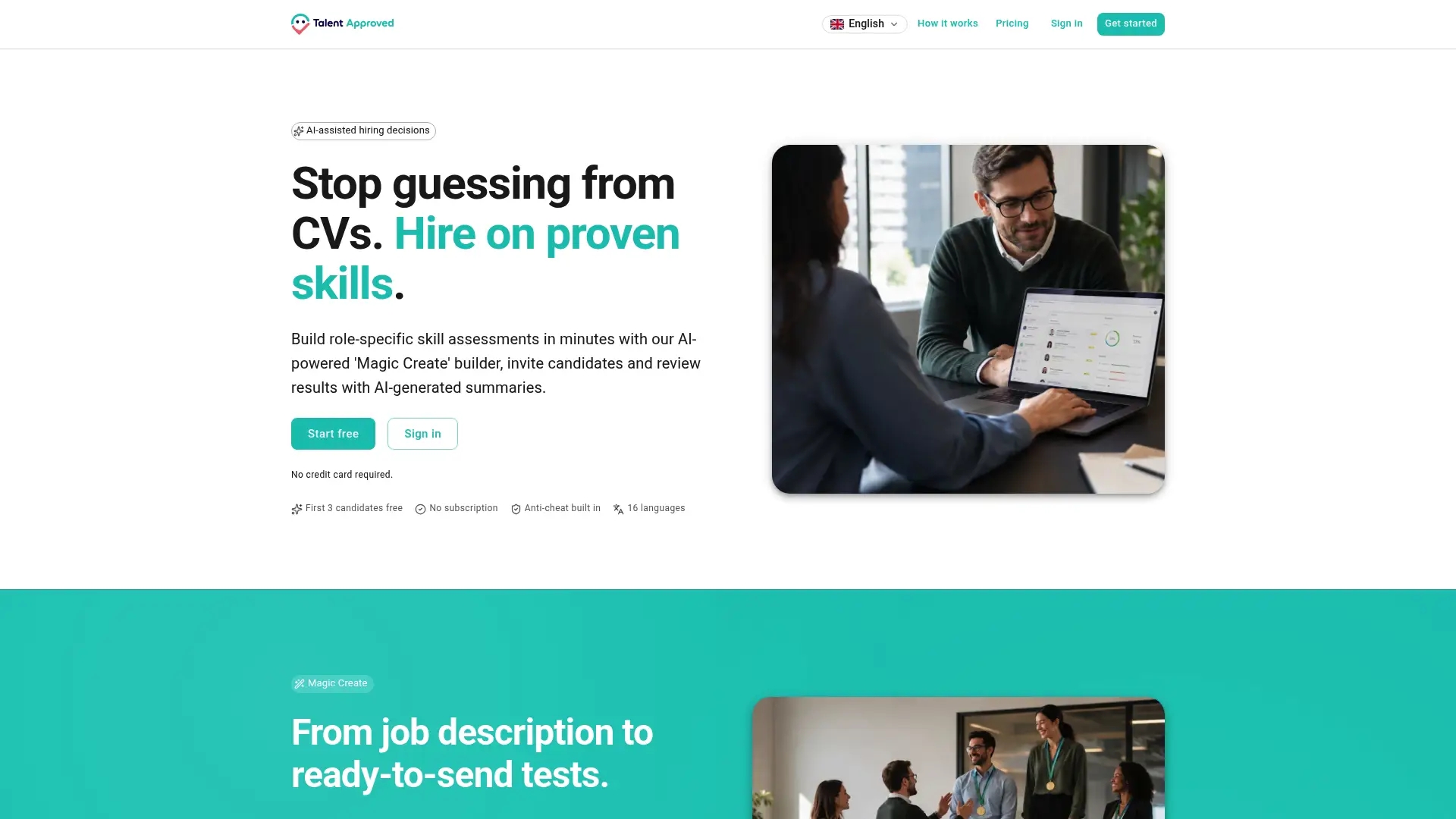
Magic Create builds structured, role-specific assessments from a job description in minutes, giving you the clean source version that translation and equivalence work depend on. Multi-language support deploys that same structured item set across languages, while built-in anti-cheat and session monitoring keep administration consistent, one of the quiet requirements equivalence data needs to be trustworthy. AI-generated summaries speed up review without sacrificing the item-level detail your localization checklist calls for. If you’re planning a pilot in a second language, start by building your source assessment on Talent Approved and running it in parallel across two language groups to generate your first real equivalence data.
Key Standards and Studies Behind This Strategy
- ITC Guidelines for Translating and Adapting Tests, the core procedural framework for equivalence testing.
- AERA/APA/NCME Standards for Educational and Psychological Testing, Chapter 9, on cross-language interpretation.
- cApStAn’s guidance on translation verification and transadaptation.
- JobCannon’s guide to multilingual assessment localization quality, covering sample sizes and deployment planning.
- Testing and assessment: An employer’s guide to good practices, on legal and professional standards for employment testing.
Sources
- ITC Guidelines for Translating and Adapting Tests (Second Edition)
- Psychometric tests often have high stakes: how to address potential biases and other challenges when adapting them in multiple languages | cApStAn
- Multilingual Assessment Localisation Quality · JobCannon
- Russell T. Warne — analysis of online cognitive tests and norms
FAQ
What Does Assessment Localization Mean for Hiring Tests?
It means adapting a hiring assessment’s language, content, scoring, and delivery so the test stays valid and fair for candidates in a different language or region, not simply translating the words.
How Many Languages Should We Localize First?
Prioritize by applicant volume and decision stakes together: localize the language with the highest combination of candidate volume and high-stakes use first, then stage additional languages as resources allow.
Is a Professional Translation Enough, or Do We Need Equivalence Testing?
A professionally reviewed translation with a translatability review can suffice for development use or lower-stakes screening, but selection decisions that compare candidates across languages require equivalence testing, starting with configural evidence at minimum (see International Test Commission’s guidelines).
How Large a Sample Do We Need for Equivalence Testing?
Confirmatory factor analysis and DIF analysis typically require several hundred respondents per language, which is why staged rollouts starting with your highest-volume languages tend to work better than validating many languages at once.
Can Talent Approved Help With Multi-Language Assessment Rollouts?
Yes. Talent Approved’s Magic Create builds structured, role-specific assessments that support consistent multi-language deployment, while anti-cheat controls and session data help teams maintain the administration consistency equivalence testing depends on.