
Structured HR Interview Questions That Actually Predict Job Performance

For reliable, bias-reducing hiring of HR professionals, use skills-based, structured assessments anchored to a job task analysis (JTA), not a loose list of favorite interview questions passed down from the last hiring manager. Structured interviews grounded in job analysis predict performance far better than free-form conversations, and they hold up better under legal scrutiny too, according to Uniform Guidelines.
This guide gives you what you need to run that process end to end:
- A competency-organized question bank covering five core HR skill areas
- Scoring rubrics and calibration guidance for consistent rater judgment
- A design checklist for building assessments from a JTA
- A bias-mitigation checklist you can run before every hiring cycle
- Pilot and validation steps to confirm the assessment actually works
Platforms like Talent Approved support this exact workflow, generating role-specific assessment content and scoring structure without months of manual design work.
Key Takeaways
Structured, JTA-anchored, multi-method HR interviews predict job performance more reliably than unstructured conversations and hold up better under legal review.
| Point | Details |
|---|---|
| Anchor everything to a JTA | Map every question and work sample back to a real, observable task from your job task analysis. |
| Score with anchored rubrics | Use 3 to 5 point behaviorally anchored scales with example responses at each level. |
| Combine methods, not just questions | Pair structured interviews with work samples or situational judgment tests to reduce adverse impact. |
| Calibrate raters before hiring rounds | Run a short scoring calibration session so two raters converge before real interviews start. |
| Pilot, then validate | Track scores against post-hire performance at three to six months and revise rubrics accordingly. |
| Use Talent Approved to operationalize it | Magic Create, anti-cheat monitoring, and AI summaries turn this process into something you can run at volume. |
Table of Contents
- How to Score Human Resources Interview Questions Consistently
- Competency-Based Question Bank for HR Roles
- Building Assessments From a Job Task Analysis
- Reducing Bias Without Slowing Down the Hiring Process
- Running Structured Interviews at Scale Without Losing Fairness
- Training Interviewers to Score the Same Way Every Time
- Sample Structured Interview Guide for an HR Manager Role
- Why Most HR Interview Processes Still Fail the People Running Them
- How Talent Approved Puts This Process Into Practice
- Sources
- FAQ
How to Score Human Resources Interview Questions Consistently
The questions matter less than what happens after the candidate answers. Without a shared scoring standard, two interviewers can hear the same response and reach opposite conclusions. Fixing that starts with the rubric, not the question list.
- Build a 3 to 5 point behaviorally anchored rubric for each competency, with a concrete example response at each score level so raters aren’t guessing what “good” sounds like.
- Use at least two trained raters per candidate where staffing allows, and decide in advance whether scores are compensatory (averaged across competencies) or hurdle-based (a minimum score required at each stage).
- Map every question back to a specific task identified in your job task analysis, and steer clear of medical, disability, or age-related inquiries that violate ADA boundaries.
- Run a short calibration session before the hiring round starts: have raters independently score a sample response, then compare and discuss gaps until scoring converges.
Structured interviews with standardized questions, a fixed order, and controlled timing consistently outperform unstructured conversations for predicting job performance, per Uniform Guidelines on employer testing practices.
Pro Tip: Give every rater a one-page scoring card with the rubric and anchor examples printed on it. Raters who scroll through a shared doc mid-interview score less consistently than raters holding a physical reference.
Competency-Based Question Bank for HR Roles
Organize your question bank around the actual work HR professionals do, not generic soft-skill prompts. Below are five competency groups, each with behavioral, situational, and short work-sample prompts, plus quick scoring cues.
Recruitment and sourcing
- “Tell me about a time you filled a hard-to-source role. What sourcing channels did you use, and what changed your approach midway?” (STAR)
- “A hiring manager rejects every candidate you send for being ‘not quite right’ but can’t articulate why. What do you do?” (situational)
- “Walk me through how you’d write a Boolean search string for a senior data engineer.” (technical)
- Work sample (15 minutes): Give the candidate a real job description and ask them to draft outreach messaging for passive candidates.
- Scoring cue: A score of 1 gives a vague process with no data; a 3 names specific channels and metrics; a 5 diagnoses the hiring manager problem and proposes a structured intake fix.
Employee relations and conflict resolution
- “Describe a workplace conflict you mediated between two employees. What was your process, and what was the outcome?” (STAR)
- “An employee reports a manager for a pattern of dismissive behavior, but there are no witnesses. Walk me through your investigation steps.” (situational)
- “How do you decide when a performance issue becomes a documentation issue?” (behavioral)
- Work sample (20 minutes): Present a short written complaint and ask the candidate to draft an investigation plan.
- Scoring cue: A 1 skips documentation entirely; a 3 follows a reasonable investigation sequence; a 5 balances confidentiality, timeline, and legal exposure explicitly.
Talent development and learning
- “Tell me about a training program you built from scratch. How did you measure whether it worked?” (STAR)
- “Engagement scores show new managers are struggling six months in. Design a 90-day intervention.” (situational)
- “What’s the difference between a competency model and a career ladder, and when would you use each?” (technical)
- Work sample (15 minutes): Ask the candidate to outline a learning path for a first-time people manager.
- Scoring cue: A 1 offers generic training ideas; a 5 ties the design to measurable business outcomes and a follow-up assessment.
HR operations and compliance
- “Describe a time you caught a compliance gap before it became a problem.” (STAR)
- “Your HRIS data doesn’t match payroll for 40 employees two days before a pay run. What’s your triage sequence?” (situational)
- “What’s your process for staying current on state-level leave law changes?” (behavioral)
- Work sample (20 minutes): Give a sample audit spreadsheet with three planted errors and ask the candidate to find and explain them.
- Scoring cue: A 3 finds most errors; a 5 finds all of them and explains the downstream risk of each.
Strategic HR and leadership
- “Tell me about a time you influenced a leadership decision without formal authority.” (STAR)
- “The CEO wants to cut headcount 10% next quarter. What data do you bring to that conversation?” (situational)
- “How do you translate a business goal into an HR metric leadership will actually track?” (behavioral)
- Work sample (15 minutes): Hand the candidate a mock quarterly business review and ask them to draft three HR talking points tied to revenue goals.
- Scoring cue: A 1 lists HR activities with no business tie-in; a 5 connects HR action directly to a business metric leadership cares about.
Building Assessments From a Job Task Analysis
Every defensible HR interview question traces back to a real, observable task the role requires, not a hunch about what “good HR people” are like.
- Run a job task analysis, or at minimum, structured interviews with three to five high performers currently in the role, to identify the critical tasks and expected outputs.
- Match methods to tasks: work samples for task execution, situational judgment tests for on-the-fly decision-making, structured interviews for past behavior patterns.
- Pilot the assessment on a small group first, then track post-hire performance data and revise rubrics based on what actually predicted success.
- Weigh your constraints honestly: applicant volume, hiring budget, and time-to-fill all shape which methods are realistic, according to OPM’s assessment strategy guidance.
- Cheap, fast screens (SJTs, short questionnaires) come first to pare down volume.
- Costlier, labor-intensive methods (work samples, structured panels) get reserved for finalists.
Reducing Bias Without Slowing Down the Hiring Process
Bias creeps into HR interviews through inconsistency, not malice. Structured rubrics, multiple trained raters, and blind review of written work samples where feasible all narrow the gap between what a candidate actually did and what a rater remembers liking about them.
Combining general aptitude measures with structured interviews or work samples produces stronger predictive validity than either method alone, though cognitive tests used in isolation can create adverse impact. Building a multi-method battery with compensatory scoring, rather than a single pass-fail gate, spreads that risk across measures instead of resting it on one test.
- Use diverse assessor panels wherever staffing allows.
- Run item-level audits on your question bank at least once a year.
- Keep a human reviewing any AI-assisted score before it affects a hiring decision.
Cross-functional collaboration between HR and whoever builds or configures your assessment tools measurably reduces algorithmic bias risk, since misalignment between HR and technical teams is one of the more common sources of unfair scoring patterns in AI-assisted hiring.
Running Structured Interviews at Scale Without Losing Fairness
High applicant volume doesn’t excuse skipping structure, it just changes the sequencing. A multiple-hurdle approach puts low-cost screens like situational judgment tests first, then reserves work samples and structured panel interviews for candidates who clear that bar.
- Give every candidate the same instructions and a realistic preview of the role before they start.
- Use screen and webcam monitoring on work samples to protect the integrity of the results.
- Let AI-generated summaries speed up reviewer triage, but keep a person checking edge cases and any score close to a cutoff.
Pro Tip: If your applicant volume spikes seasonally, build your multiple-hurdle sequence once and reuse it. Rebuilding the screening order every hiring cycle is where consistency quietly breaks down.
Adaptive AI-based elicitation methods can help surface skills fairly across candidates with different self-presentation styles, but research on AI skill elicitation is clear that these tools still need audited question pools and human oversight to stay fair.
Training Interviewers to Score the Same Way Every Time
A rubric only works if the people using it interpret it the same way. Interviewer training closes that gap, and it’s the step most hiring teams skip once they’re under time pressure.
Start every training session with a live calibration exercise: give two or three raters the same recorded or written candidate response and have them score it independently before comparing notes. The conversation that follows, where raters explain why they gave a 3 instead of a 5, does more to align judgment than any written policy. Repeat this until scores land within one point of each other consistently.
Cover the legal boundaries explicitly, not just the scoring mechanics. New interviewers need to know which questions cross into ADA-protected territory, how to handle a candidate who volunteers medical or family information unprompted, and why documentation of scoring rationale matters if a hiring decision is ever challenged.
Rotate interviewers through mock sessions using your actual question bank before they sit in on real candidates. A rater who has never used the rubric live will default to gut instinct the moment a candidate gives an unexpectedly strong or weak answer. Refresh training at least twice a year, since rubrics evolve as you validate them against post-hire data, and a rater trained on last year’s version is scoring against an outdated standard.
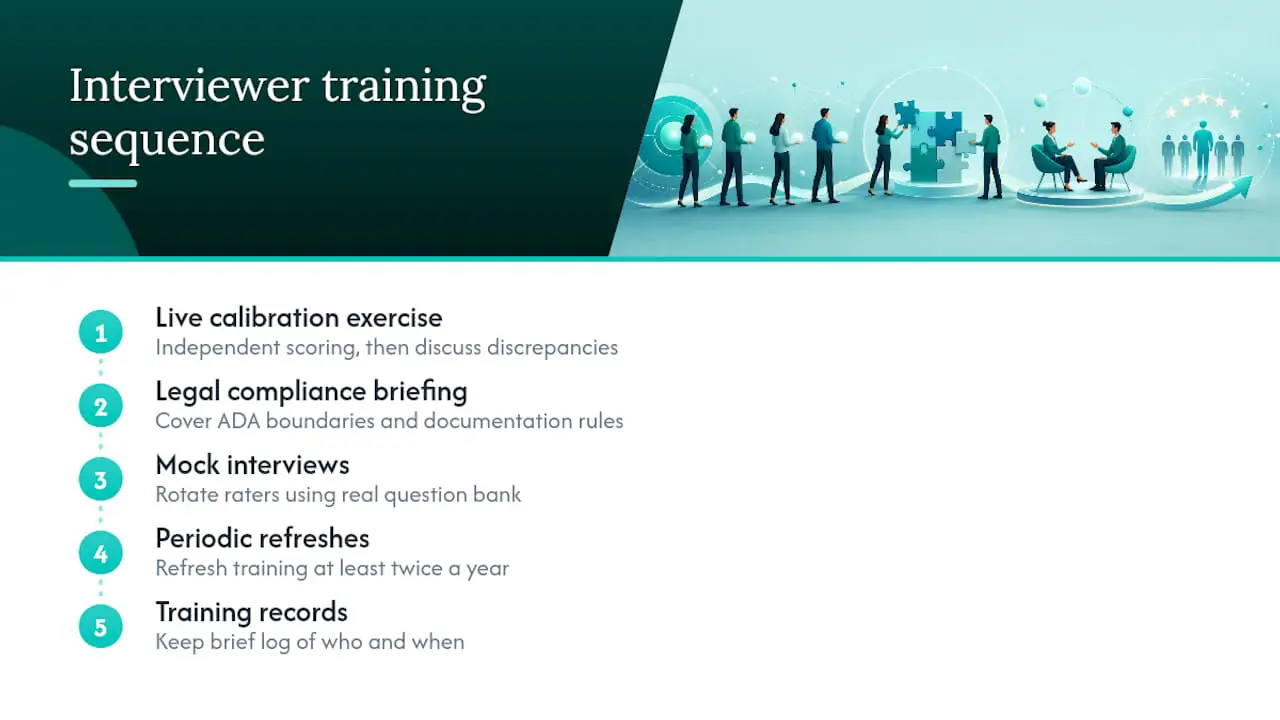
Keep a short record of who’s been trained and when. It matters for consistency, and it matters if your assessment process is ever reviewed for compliance.
Sample Structured Interview Guide for an HR Manager Role
A complete guide ties everything above into one document an interviewer can run without improvising. Here’s the shape one takes for a mid-level HR manager role.
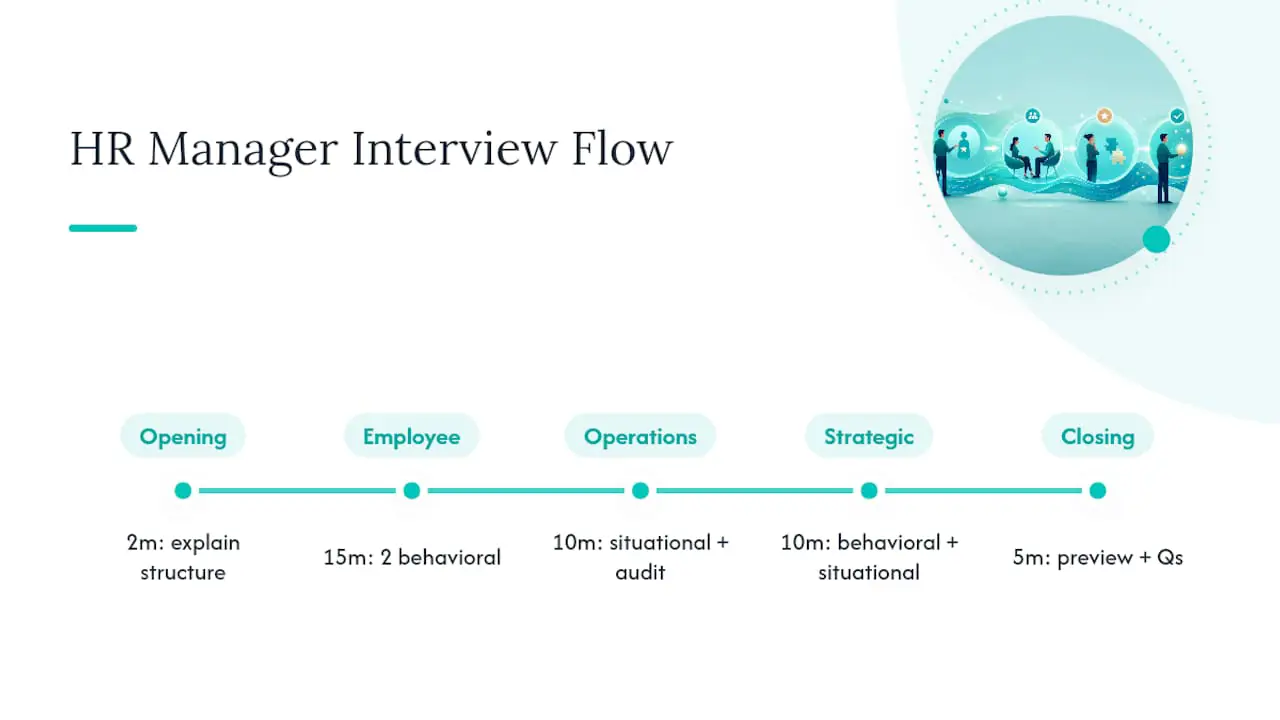
Opening (2 minutes): State the structure plainly. Tell the candidate how many questions you’ll ask, roughly how long each section takes, and that you’re using a standardized rubric so every candidate gets the same experience.
Section one, employee relations (15 minutes): Two behavioral questions from the competency bank above, each scored independently against the rubric before moving to the next question.
Section two, HR operations (10 minutes): One situational question plus the audit work sample, timed and scored against the planted-error rubric.
Section three, strategic HR (10 minutes): One behavioral and one situational question focused on influence and business alignment.
Closing (5 minutes): Realistic job preview, where the interviewer describes an actual hard week in the role, followed by candidate questions. Offering that preview and explaining why each assessment stage exists measurably improves how candidates perceive the process, even when they don’t advance.
Templates for other HR functions, recruiting coordinator, HRBP, compliance specialist, follow the same skeleton: fixed sections, fixed timing, one rubric per competency, and a closing preview. Talent Approved’s assessment library includes reusable structures like this one that HR teams adapt to their own competency list, rather than rebuilding the whole guide role by role.
Why Most HR Interview Processes Still Fail the People Running Them
The conventional advice on hiring HR professionals leans hard on “culture fit” and gut read, which is exactly backwards for a function whose entire job is building fair, defensible processes for everyone else. If an HR manager candidate can’t survive a structured, rubric-scored interview, that’s a preview of how they’ll run interviews once hired.
What’s overrated here is the unstructured “tell me about yourself” conversation that most HR interviews still open with. It feels warm and low-pressure, but it produces almost no comparable signal across candidates. What’s underrated is the short work sample, the 15-minute audit exercise, the mock investigation plan, because it shows judgment under mild time pressure instead of a rehearsed answer.
If you take one thing from this guide, prioritize the job task analysis before you touch a single interview question. Question banks are replaceable. A rubric built on tasks that don’t actually reflect the role isn’t fixable with better questions, it’s fixable with better analysis. Get that right first, and the bias-reduction and scoring work downstream gets dramatically easier.
How Talent Approved Puts This Process Into Practice
Building the question bank and rubrics above by hand, competency by competency, is exactly the work Talent Approved’s Magic Create feature is built to shortcut. Feed it a job description or a list of target skills for your HR manager or recruiter role, and it generates a structured, role-specific assessment in minutes instead of the days it takes to draft one from scratch.
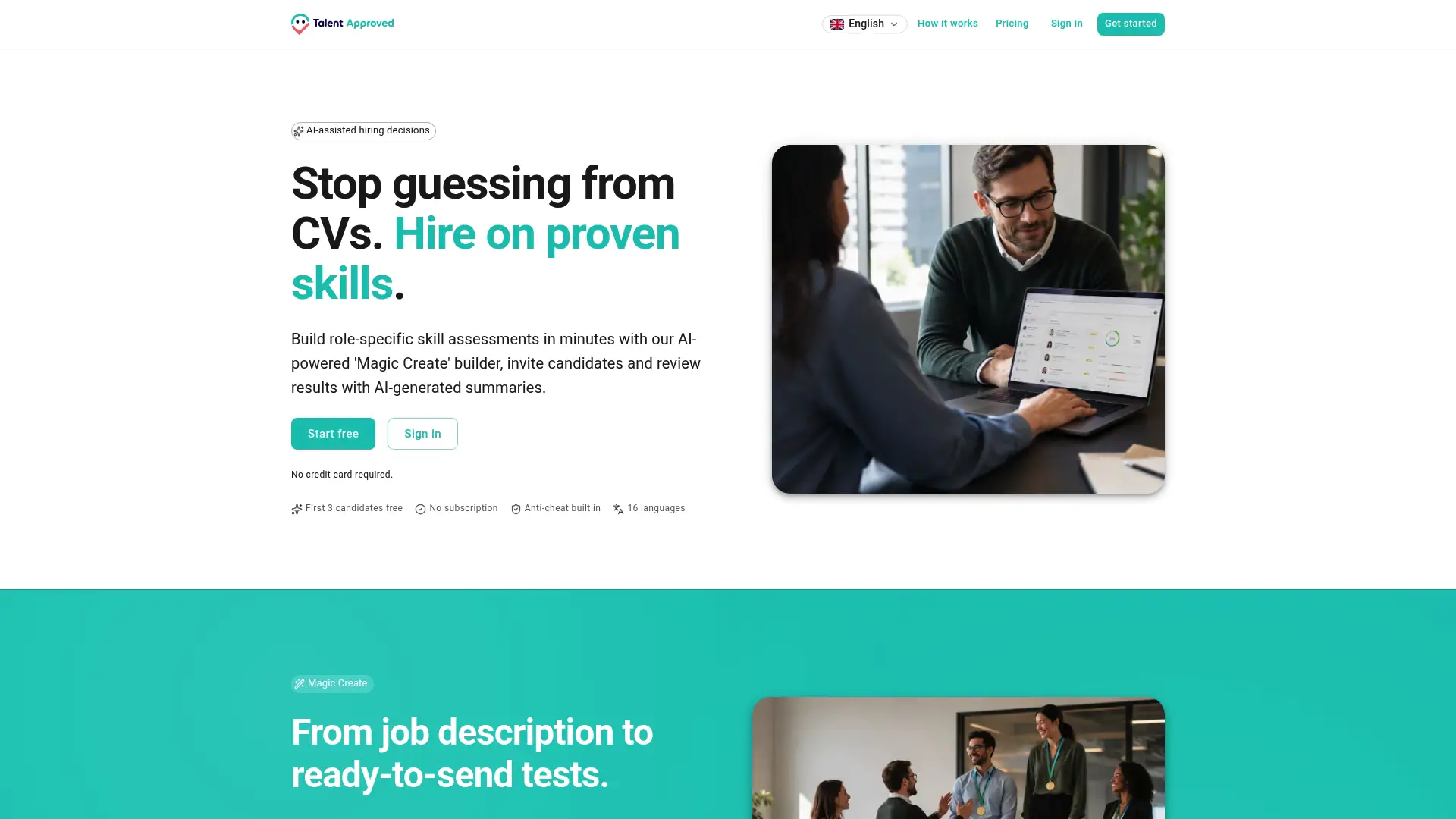
The operational side matters just as much as the question design. Talent Approved includes built-in anti-cheat monitoring with screen and webcam checks, session replays for any answer you want to review more closely, and candidate rankings that sit alongside AI-generated summaries, so your reviewers spend less time reading transcripts and more time deciding. That combination is what makes the multiple-hurdle approach described earlier actually workable at volume, instead of a nice idea that collapses once fifty applications come in. If you’re screening high volumes of applicants, pairing that workflow with proven high-volume screening practices tightens the whole pipeline.
The most useful next step is a small one: pick a single open HR role, build one assessment in Talent Approved, and track how those scores line up with performance three to six months after hire. Start building an assessment and see how it compares to whatever process you’re running today.
Sources
- Designing an assessment strategy (OPM)
- Testing and assessment: an employer’s guide to good practices (Uniform Guidelines excerpt)
- Interactive AI for skill elicitation (arXiv preprint)
FAQ
What Makes an HR Interview Question “Structured”?
A structured question has a fixed wording, a set order across candidates, and a predefined scoring rubric, which is why it predicts job performance better than an open-ended conversation.
How Many Interviewers Should Score Each HR Candidate?
Use at least two trained raters scoring independently when staffing allows, then compare and discuss any scores that differ by more than one point on the rubric.
Can AI Help Write Human Resources Interview Questions?
Yes. Platforms like Talent Approved use tools such as Magic Create to generate role-specific questions and rubrics from a job description, though human reviewers should still audit the final question set for fairness.
What’s the Difference Between a Work Sample and a Situational Judgment Question?
A work sample has the candidate actually perform a task, like drafting an investigation plan, while a situational judgment question asks how they’d handle a scenario without producing a deliverable.
How Soon Should You Validate a New HR Assessment?
Track candidate scores against actual job performance starting around three to six months after hire, then revise rubrics based on which items and questions actually predicted success.