
STAR Interview Examples and Answers: Rubrics for Hiring Teams

Use STAR-format prompts paired with behaviorally-anchored rating scales (BARS) and independent scoring to produce defensible, comparable hiring decisions. Three moves get you there today:
- Pick 3 core competencies for the open role and write 1-2 STAR prompts for each.
- Build a 1-5 BARS with labeled anchors before you interview anyone.
- Pilot the rubric on two recent hires or mock candidates before you use it live.
This approach draws on guidance from the Office of Personnel Management, Google’s structured interviewing program, and rubric-building frameworks from AIHR.
Key Takeaways
Rubric-first STAR interviewing works because independent, anchor-based scoring turns subjective impressions into evidence-backed, comparable hiring decisions.
| Point | Details |
|---|---|
| Map competencies before writing prompts | Tie each role outcome to 2-4 competencies, then write STAR prompts around them with SME input. |
| Use five-level BARS anchors | Label each score 1 through 5 with a concrete behavioral description, not a vague adjective. |
| Score independently, then debrief | Every interviewer rates before group discussion starts, which is the core defense against anchoring bias. |
| Pilot before going live | Test the rubric on mock interviews and aim for 80%+ inter-rater agreement within one point. |
| Weight competencies by role priority | Not every skill matters equally for every job, so weighted totals should reflect that. |
| Automate the drafting work | Talent Approved’s Magic Create generates STAR prompts and scoring templates directly from a job description. |
Table of Contents
- What Does STAR Mean for Interview Designers?
- How to Write STAR-Style Prompts That Get Real Evidence
- Designing a Behaviorally-Anchored Rating Scale
- Rubric Templates You Can Use for Common Roles
- How Should Interview Panels Score Without Bias?
- How Do You Pilot and Calibrate a New Rubric?
- Why Rubrics Beat Gut Feel in Hiring
- Let Talent Approved Build Your STAR Rubrics for You
- Sources
- FAQ
What Does STAR Mean for Interview Designers?
For an interviewer building the assessment, STAR (Situation, Task, Action, Result) is a structure for pulling verifiable evidence out of a candidate, not a script the candidate follows. You’re not grading storytelling. You’re extracting facts you can score against a fixed anchor.
The real work happens before the interview: mapping a role outcome to competencies, then to prompts.
- Outcome: Reduce support ticket backlog by 30%.
- Competency: Problem-solving and prioritization.
- STAR prompts: “Tell me about a time you inherited a backlog of unresolved issues” or “Walk me through a project where you had to triage competing priorities with limited time.”
- Evidence to listen for: A specific method for ranking urgency, a measurable before/after result, and the candidate’s actual role versus the team’s.
Run this mapping past a subject-matter expert (SME) who currently does the job. A hiring manager who has never touched the ticket queue will write vaguer prompts than the person managing it daily, and vague prompts produce evidence you can’t defensibly score. This is also where behavioral interviewing earns its reputation: it links questions directly to job tasks instead of hypothetical personality traits.
How to Write STAR-Style Prompts That Get Real Evidence
Good prompts share five traits. Keep them in front of you when drafting:
- Anchor to a specific timeframe (“in the last year,” “at your most recent job”).
- Require the candidate to state their individual role, not just the team’s outcome.
- Avoid leading language that hints at the “right” answer.
- Predefine your probes before the interview, not mid-conversation.
- Write one behavioral (past-tense) and one situational (hypothetical) version per competency where the role calls for judgment under untested conditions.
Behavioral prompts work best when the role has enough tenure candidates that most will have a real story. Situational prompts fill the gap for early-career candidates or brand-new functions where past experience is thin. Here are two STAR prompts for six competencies you can copy directly into an interview guide:
Problem-solving
- “Describe a time you diagnosed a problem no one else on your team had noticed.”
- “If a key process broke down the day before a deadline, walk me through how you’d handle it.”
Ownership
- “Tell me about a project you owned end-to-end, including a mistake you had to fix yourself.”
- “Describe a time you took responsibility for an outcome that wasn’t technically your job.”
Communication
- “Give an example of explaining a technical or complex issue to someone without that background.”
- “Tell me about a time your message was misunderstood and how you corrected it.”
Teamwork
- “Describe a conflict with a teammate and how you resolved it.”
- “Tell me about a project that only succeeded because of close collaboration.”
Adaptability
- “Tell me about a time your priorities changed suddenly and how you adjusted.”
- “Describe a moment you had to learn a new tool or process fast, with no formal training.”
Customer empathy
- “Tell me about a time you turned around a frustrated customer or client.”
- “Describe a situation where you had to say no to a customer request and how you handled it.”
Designing a Behaviorally-Anchored Rating Scale
A BARS ties each numeric score to a written description of what that score actually looks like in a real answer, which is why it beats a bare 1-5 gut check. OPM’s structured interview guidance recommends five proficiency levels with behavioral examples drafted by SMEs, and that granularity matters: three levels leaves too much gray area between “fine” and “great.” Anchored scoring paired with calibration is also linked to stronger predictive validity than unstructured interviewing, according to CultureMatch’s scoring rubric research.
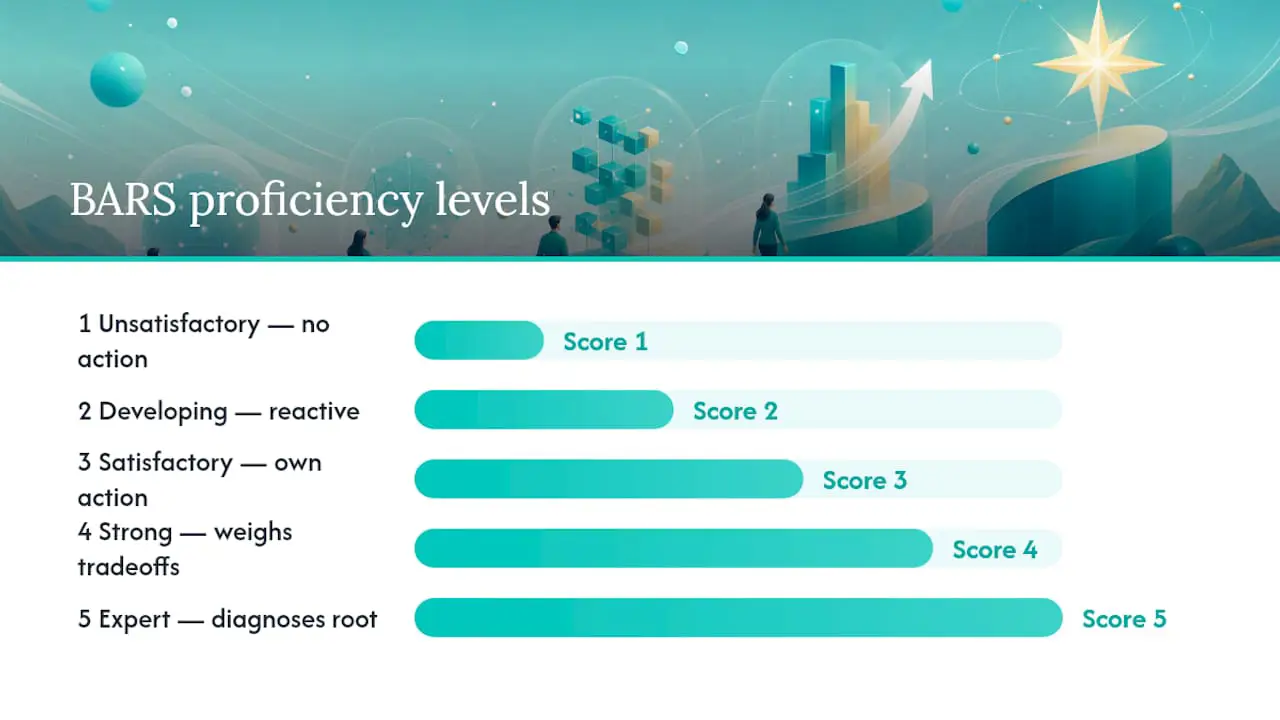
Here’s a five-level BARS for problem-solving:
| Score | Label | Behavioral Anchor |
|---|---|---|
| 1 | Unsatisfactory | Cannot describe a specific problem or defaults to team-level generalities with no personal action. |
| 2 | Developing | Identifies a problem but the action taken was reactive or directed by someone else. |
| 3 | Satisfactory | Describes a clear problem, a specific action they personally took, and a measurable result. |
| 4 | Strong | Same as level 3, plus evidence of weighing tradeoffs or anticipating downstream effects. |
| 5 | Expert | Diagnoses a root cause others missed, acts independently, and quantifies a result tied to a business outcome. |
Standardize your probes so every candidate gets the same follow-up questions in the same order:
- “What was your specific role versus the team’s?”
- “What was the measurable outcome?”
- “What would you do differently now?”
Pro Tip: Write your probes on the rubric itself, not on a separate sheet. Interviewers skip probes they have to hunt for, and skipped probes are the fastest way to lose the Result half of STAR.
Rubric Templates You Can Use for Common Roles
A rubric works when it forces evidence into writing next to a score, not when the score floats alone. AIHR’s rubric framework recommends weighting competencies by role priority rather than scoring everything equally, since a support role and a sales role don’t share the same critical skill.
A sample completed score row for a customer support candidate answering the empathy prompt might look like this: evidence note, “candidate described de-escalating a billing dispute by offering a documented refund policy exception, cited a 4.8 to 4.9 CSAT recovery”; raw score, 4 out of 5; weighted contribution, 4 x 0.30 = 1.2.
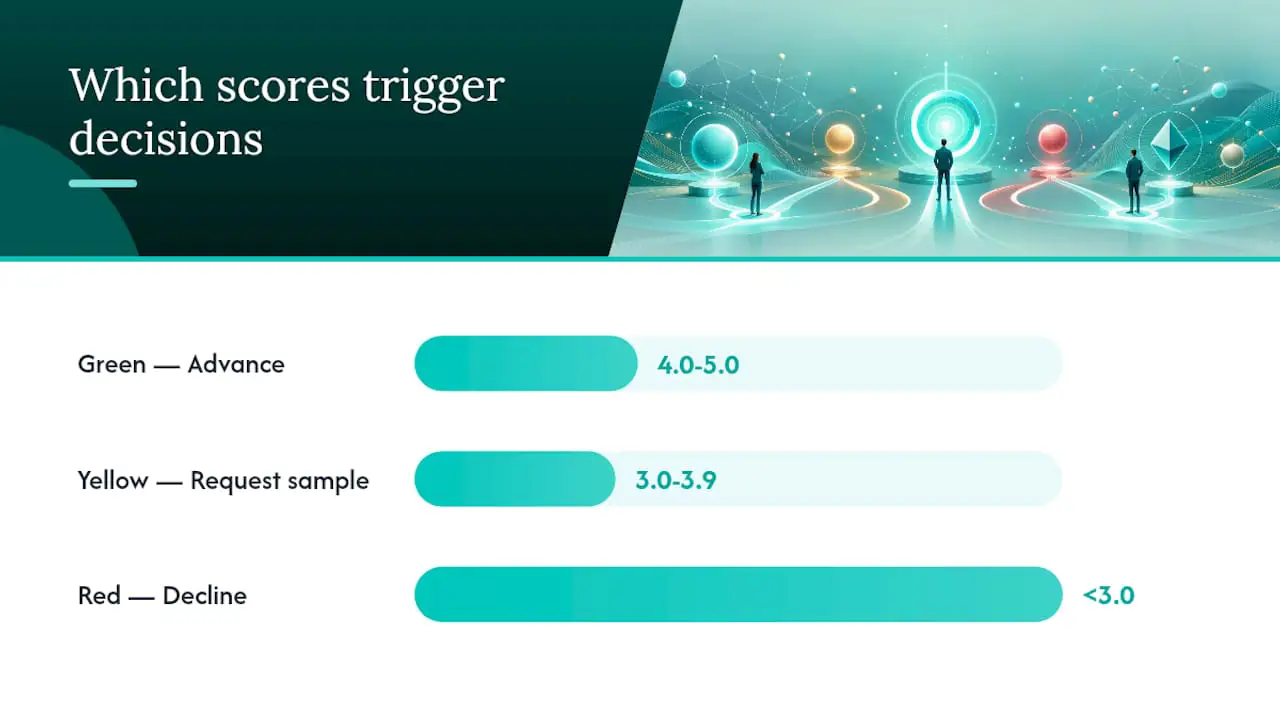
Sum weighted scores across all competencies for a single total, then apply decision thresholds:
- Green (4.0+): Advance to offer or final round without reservation.
- Yellow (3.0 to 3.9): Request a work sample or a second interview focused on the weakest competency.
- Red (below 3.0): Decline unless a specific mitigating factor is documented.
Pair this with your candidate evaluation criteria checklist so scoring stays consistent across every open req, not just the one you’re filling this week.
How Should Interview Panels Score Without Bias?
The single highest-leverage rule in this entire process: every interviewer scores independently before anyone talks. Indeed’s rubric guidance points to independent scoring as the standard defense against anchoring bias, where the first person to speak in a debrief quietly sets the ceiling for everyone else’s opinion.
During the interview itself, interviewers should:
- Score each competency immediately after the relevant answer, not at the end of the call.
- Record two evidence bullets per answer, tied to specific words the candidate used.
- Flag explicitly when Action or Result is missing, rather than guessing what the candidate meant.
A simple note-taking template keeps this consistent: Situation (one line), Task (one line), Action (bulleted), Result (with a number if the candidate gave one), a direct quote worth remembering, and total minutes spent on that answer.
Pro Tip: Assign each panelist one or two competencies to own for the whole loop instead of asking everyone to score everything. Focused attention produces sharper evidence notes than divided attention across six competencies at once.
How Do You Pilot and Calibrate a New Rubric?
Run the rubric before you trust it. A short pilot exposes vague anchors faster than any amount of internal debate.
- Select two or three SMEs who know the role well.
- Run three mock interviews, or replay recorded interviews from two recent hires.
- Have each rater score independently using the new BARS.
- Compute agreement across raters and flag any competency where scores diverge by more than one point.
- Reconvene the SMEs to rewrite any anchor that produced disagreement.
Target inter-rater agreement of 80% or higher within one point before rolling the rubric out to live candidates. If agreement lands below that, the anchor language is usually the problem, not the raters. Rewrite the level 3 and level 4 descriptions first. They tend to blur together more than the extremes.
Why Rubrics Beat Gut Feel in Hiring
Rubrics don’t remove judgment from hiring. They force that judgment onto paper where it can be checked, argued with, and defended later if a hiring decision gets questioned. Talent Approved built its assessment templates around that same principle. Every anchor and prompt in this guide reflects patterns field-tested across the roles our platform’s users hire for most, from support to engineering to sales.
Let Talent Approved Build Your STAR Rubrics for You
Writing prompts and BARS anchors by hand for every open role gets slow fast, especially when you’re hiring across five or six job families at once. Talent Approved’s Magic Create feature generates role-specific STAR prompts and scoring criteria directly from a job description in minutes, so your team spends time interviewing instead of drafting rubrics from scratch.
Three features map directly onto the workflow in this guide:
- Magic Create turns a pasted job description into ready-to-use, competency-mapped prompts.
- Anti-cheat monitoring with screen and webcam checks keeps skills-based evidence honest before it ever reaches your rubric.
- AI-generated evidence summaries condense candidate responses for faster, calmer debriefs, which pairs naturally with the candidate ranking tools recruiters already lean on to shortlist quickly.
Start a free assessment on Talent Approved and see how quickly a rubric-first hiring process comes together when the templates build themselves.
Sources
These sources shaped the frameworks in this guide:
- Structured Interviews Guide - Office of Personnel Management (OPM)
- Interview Rubric: How To Build Yours + FREE Template - Indeed
- Interview Rubric: How To Build Yours + FREE Template - AIHR
- A guide to structured interviewing for better hiring practices - re:Work with Google
- Build a Structured Interview Scoring Rubric in 90 Minutes (No HRIS Required) | CultureMatch
FAQ
What is a STAR-format interview question?
A STAR-format question asks a candidate to describe a Situation, Task, Action, and Result from real experience, giving interviewers structured evidence to score against a rubric rather than a general impression.
How many STAR questions should we ask per interview?
Most panels cover 2-4 competencies per interview, with 1-2 STAR prompts per competency, which keeps the session focused without rushing past the Result portion of any answer.
What is a behaviorally-anchored rating scale?
A BARS is a rating scale, typically 1 to 5, where each score level has a written behavioral description so interviewers score consistently instead of relying on gut feel.
Why should interviewers score independently before discussing candidates?
Independent scoring prevents the first speaker in a debrief from anchoring everyone else’s judgment, a bias that rubric research identifies as one of the most common threats to fair hiring decisions.
Can software help build STAR prompts and rubrics faster?
Yes. Platforms like Talent Approved use AI to generate role-specific STAR prompts and scoring templates directly from a job description, cutting the manual drafting time significantly for teams hiring across multiple roles.