
Spot Top Candidates Faster: Screening for Recruiters

The fastest path to a strong shortlist combines structured knockout filters, short role-specific skill tests, and AI-powered ranking. Apply all three in sequence and you cut unqualified interviews by a significant margin while keeping the process fair and repeatable. Here is a seven-action checklist you can put in place within 48–72 hours:
- Set 2–3 hard knockout questions at the application stage to remove disqualifying candidates automatically.
- Deploy a short role-specific skills test (15–20 minutes maximum) immediately after the knockout gate.
- Enable AI scoring and candidate ranking so reviewers see a prioritized list, not a raw pile of submissions.
- Use asynchronous video for communication and culture-fit checks instead of scheduling live phone screens.
- Configure your ATS filters to flag candidates who meet minimum score thresholds before any human reviews them.
- Set a 48-hour SLA for automated screening completion and a three-business-day SLA for human review.
- Track your screen-to-interview ratio from day one so you have a baseline to measure improvement against.
Done consistently, this sequence produces a shortlist in days rather than weeks and reduces the number of interviews your team runs before extending an offer.
Key Takeaways
Structured knockout filters combined with short role-specific assessments and AI ranking consistently reduce time-to-shortlist while keeping hiring quality measurable and defensible.
| Point | Details |
|---|---|
| Start with knockout questions | Use 2–3 binary gates at application to remove disqualifying candidates before any human review. |
| Add a short skills test | A 15–20 minute role-specific test placed immediately after knockouts filters on demonstrated ability, not self-reported experience. |
| Track five core metrics | Monitor time-to-interview, screen-to-interview ratio, completion rate, pass rate, and 90-day quality-of-hire from day one. |
| Document automated decisions | Log every knockout rule, score threshold, and removal reason to meet ADT compliance standards and reduce legal exposure. |
| Talent Approved for fast pilots | Talent Approved’s pay-as-you-go model ($5 per completed candidate) lets teams run a low-risk 30-day pilot with AI test creation, ranking, and anti-cheat built in. |
Table of Contents
- How do you spot top candidates faster with proven screening strategies?
- What does a repeatable screening process look like step by step?
- Which tool categories actually speed up candidate screening?
- How does Talent Approved shorten the path from application to shortlist?
- How do you measure screening speed without sacrificing quality?
- What actually changes when you overhaul a screening workflow
- Talent Approved gives you a faster shortlist without a long-term commitment
- Sources
- FAQ
How do you spot top candidates faster with proven screening strategies?
Efficient candidate assessment starts with choosing the right filter for the right stage. Not every tactic works equally well across all role types and volumes, so understanding the tradeoffs saves you from applying a high-volume tool to a senior executive search and wondering why it feels wrong.
Knockout and pre-screen questions
Knockout questions are binary gates: a candidate either meets the requirement or they do not. Effective knockout logic targets non-negotiable criteria only, such as work authorization, required certifications, or a minimum years of experience that the role genuinely demands. Asking too many knockout questions creates false negatives; one or two well-chosen questions is usually enough to remove a significant portion of unqualified applicants before any human reads a single CV. For a customer support role, a typical knockout might be: “Do you have at least one year of experience handling inbound calls in a B2C environment?” For a software engineering role: “Are you authorized to work in the United States without sponsorship?”
The key is to weight knockouts only on criteria that are truly non-negotiable. If a candidate who answers “no” could still succeed in the role with training, it is not a knockout criterion.
Role-specific automated assessments
Structured assessments give you uniform rubrics and real-time data that CVs simply cannot provide. A 15–20 minute skills test placed immediately after the knockout gate filters on demonstrated ability rather than self-reported experience. Work samples and short scenario-based tasks are particularly strong for technical, writing, and analytical roles because they show what a candidate can actually do under realistic conditions. For a deeper look at why this approach outperforms traditional interviews, trial projects as a screening method are worth reviewing.

Set a minimum passing score threshold before you launch the test. Without a pre-set threshold, reviewers tend to grade on a curve relative to the current pool, which defeats the purpose of objective filtering.
Asynchronous video for fast communication checks
One-way video responses let candidates record answers to two or three structured questions on their own schedule. Reviewers watch them in batches, which eliminates the scheduling friction of live phone screens entirely. This tactic works best for roles where communication style, clarity, or presentation matters, such as sales, customer success, or client-facing positions. For purely technical roles where output quality is the primary signal, async video adds less value and can be skipped.
Remote evaluation techniques that combine async video with proctored skills tests give you both a quality signal and a communication signal without a single calendar invite.
AI-enabled filtering and candidate ranking
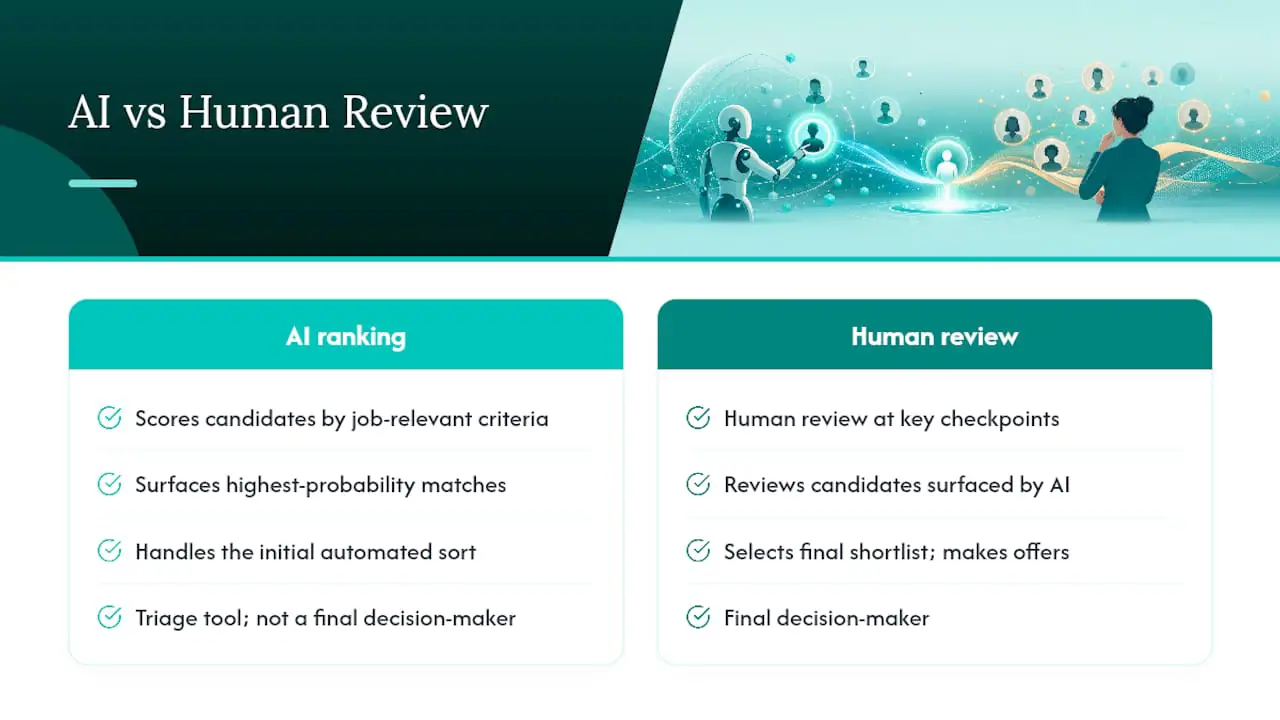
AI ranking tools score candidates against job-relevant criteria and surface the highest-probability matches for human review. The practical limit to understand here: AI ranking is a triage tool, not a final decision-maker. Use it to prioritize who gets human attention first, not to make offers. LinkedIn’s guidance on efficient candidate screening consistently recommends keeping human review at key checkpoints even when automation handles the initial sort.
ATS filters and structured workflows
Your ATS can do more than store applications. Configured correctly, it routes candidates through stages automatically based on test scores, knockout answers, and minimum qualifications. Combine automated routing with defined human checkpoints, such as a hiring manager review at the shortlist stage, and you get speed without losing accountability.
Pro Tip: Never rely on a single snapshot metric to eliminate a candidate. A low score on one short test can reflect test anxiety or an off day. Build in a secondary review step for candidates who score just below your threshold before removing them from the pipeline.
What does a repeatable screening process look like step by step?
Converting strategy into a daily operating process requires clear ownership, timing targets, and handoff points. Here is a five-step flow that takes a candidate from application to shortlist with minimal scheduling friction.
-
Application + knockout gate (Day 0–1). The candidate submits their application and immediately receives the knockout questions. Automated logic removes disqualifying responses. No human time required at this stage.
-
Role-specific skills test (Day 1–2). Candidates who pass the knockout gate receive a test link within 24 hours. The test runs 15–20 minutes. A 48-hour completion window balances speed with candidate convenience. Designing job-specific screening tests well at this stage is what determines whether your pass rates are meaningful.
-
AI scoring and ranked shortlist (Day 2–3). Once tests are submitted, AI scoring generates a ranked candidate list and an AI summary for each submission. The recruiting coordinator reviews the ranked list and flags the top candidates for the hiring manager.
-
Hiring manager review (Day 3–5). The hiring manager reviews AI summaries and anti-cheat session data for the top-ranked candidates. They confirm or adjust the shortlist. This is the primary human checkpoint in the process.
-
Shortlist handoff and interview scheduling (Day 5–7). The confirmed shortlist moves to interview scheduling. A brief handoff note for each candidate should include their test score, AI summary highlights, and any reviewer notes. This keeps context intact when multiple people are involved in the final decision.
Role responsibilities at a glance:
- Sourcer / TA coordinator: manages application flow, sends test links, monitors completion rates.
- Recruiting lead: reviews AI-ranked list, flags edge cases for secondary review.
- Hiring manager: reviews shortlist summaries, confirms candidates for interviews.
For high-volume recruiting, this same flow scales by batching test reviews weekly rather than reviewing each submission individually.
Which tool categories actually speed up candidate screening?
Picking the right class of tool matters more than picking a specific vendor. Each category solves a different bottleneck, and buying the wrong one for your stage wastes both budget and implementation time.
| Tool category | Core capability | How it speeds screening | Pricing model |
|---|---|---|---|
| Knockout-question engines | Binary pass/fail gates at application | Removes unqualified applicants before any human review | Usually included in ATS or low-cost add-on |
| Skills-assessment platforms | Role-specific tests, scoring, ranking | Replaces CV review with objective ability data | Per-candidate fee or subscription |
| Async video platforms | Structured one-way video responses | Eliminates live phone screen scheduling | Subscription, often per seat |
| AI ranking/scoring engines | Candidate prioritization from test or profile data | Surfaces top candidates for human review first | Included in assessment platforms or standalone |
| ATS + automation flows | Application routing, stage triggers, notifications | Removes manual handoffs between stages | Subscription, often bundled |
What to check before buying any assessment tool:
- SOC 2 Type II certification: confirms the vendor has audited security controls for data handling.
- CSA STAR registry listing: the Cloud Security Alliance STAR registry lets you verify a vendor’s self-reported and third-party security posture before committing to a pilot.
- Anti-cheat and proctoring controls: look for screen recording, webcam monitoring, and session replay so test integrity holds for remote candidates.
- Data residency: confirm candidate data stays within the United States if your legal team requires it.
- ATS integration: a tool that does not connect to your existing ATS creates a manual data-transfer step that erodes the time savings.
Budget considerations vary by category. Skills-assessment platforms with per-candidate pricing, such as Talent Approved’s $5-per-completed-candidate model, are cost-effective for variable hiring volumes because you pay only when a candidate actually completes a test. Subscription models make more sense when volume is high and predictable.
How does Talent Approved shorten the path from application to shortlist?
Talent Approved’s workflow maps directly to the five-step process above, with AI handling the most time-consuming steps. The platform’s Magic Create feature generates a role-specific skills test from a job description in minutes. You paste the job description or a list of required skills, and the AI builds a structured test with scored questions. No test-design expertise required.
The full platform workflow runs like this:
- Job description in → test out. Magic Create produces a ready-to-send assessment in minutes, pulling role-relevant questions from the platform’s library and generating new ones where needed.
- Candidate takes the test. Anti-cheat controls, including screen recording and webcam monitoring, run automatically during the session. Session replays are available for review if a score looks anomalous.
- AI scoring and ranking. Once submitted, AI scoring ranks candidates by performance and generates a summary for each. Reviewers see a prioritized list with key highlights, not a stack of raw responses.
- Reviewer summary and handoff. The hiring manager reads the AI-generated summary, checks the anti-cheat session data for any flagged behavior, and confirms the shortlist. The entire review step takes minutes per candidate rather than hours.
For a 30-day pilot, measure three KPIs: time-to-shortlist (from application to confirmed shortlist), candidate completion rate (percentage of invited candidates who finish the test), and pass rate (percentage who meet your minimum score threshold). These three numbers tell you whether your test is calibrated correctly and whether your candidate experience is creating unnecessary drop-off.
Pro Tip: Keep your pilot test under 20 minutes. Completion rates drop measurably for tests that exceed 25 minutes, which means longer tests create selection bias toward candidates with more available time rather than more relevant skill.
The platform documentation walks through each step in detail, including how to configure score thresholds and set up multi-language assessments for diverse candidate pools.
How do you measure screening speed without sacrificing quality?
Speed and quality are not opposites in screening, but they do require deliberate measurement to stay in balance. Track these five metrics from the first week of any new screening process:
- Time-to-interview: the number of calendar days from application submission to the first scheduled interview. This is your headline speed metric.
- Screen-to-interview ratio: the number of candidates screened for every one who reaches an interview. A ratio above 10:1 often signals that your knockout criteria are too loose or your test threshold is too low.
- Candidate completion rate: the percentage of candidates who finish the skills test after receiving the link. Rates below 60% usually indicate the test is too long, the instructions are unclear, or the candidate experience has friction points.
- Pass rate: the percentage of completers who meet your minimum score threshold. A pass rate above 80% suggests your threshold may be set too low; below 20% suggests the test or threshold needs recalibration.
- Quality-of-hire proxy: first 90-day performance rating or hiring manager satisfaction score for candidates who came through the new process. This is the lagging indicator that confirms whether faster screening is also producing better hires.
Running a simple A/B test to optimize your process
To validate that skills-test screening outperforms CV-only screening, run a controlled comparison on matched roles. Assign one open role to the new assessment-first process and a comparable role to your existing CV-review process. Run both for four weeks or until you have at least 20 hires to compare. Your primary KPI is time-to-interview; secondary KPIs are screen-to-interview ratio and 90-day performance scores. Four weeks and 20 data points give you enough signal to make a confident process decision without waiting for a full quarter.
Compliance checklist for automated screening
Automated decisioning tools carry documentation requirements in several U.S. jurisdictions. The NYC Department of Consumer and Worker Protection’s ADT guidance sets a clear standard for disclosure, recordkeeping, and candidate review rights when automated employment decision tools are used in hiring. Even if your organization operates outside New York City, this framework is a useful baseline:
- Document every knockout rule and the business rationale behind it.
- Record the score thresholds used for automated advancement or removal.
- Maintain a log of candidates who were removed by automated filters and the reason.
- Provide candidates with a way to request a human review of an automated decision.
SHRM’s analysis of real recruitment costs reinforces why this documentation matters beyond compliance: structured, auditable processes reduce the risk of costly mis-hires and legal exposure that can dwarf the cost of the screening tools themselves.
What actually changes when you overhaul a screening workflow
Most teams that shift to assessment-first screening report the same early surprise: the bottleneck was never the volume of applicants. It was the time reviewers spent reading CVs that told them very little about actual job performance. Once knockout questions and a short skills test handle the first two filters, the human review step shrinks from hours to minutes per candidate.
Three lessons come up consistently in implementation:
Start smaller than you think you need to. Running the new process on one role or one team first lets you calibrate thresholds, fix candidate experience issues, and train reviewers before the stakes are high. A pilot on a single high-volume role teaches you more in 30 days than a full rollout teaches you in six months.
Validate your thresholds before you trust them. A passing score that looks reasonable on paper may be set too high or too low for your actual candidate pool. Compare the first cohort of “passed” candidates against their eventual 90-day performance before locking in the threshold permanently. Adjust once, then hold it steady so your data stays comparable over time.
Communicate with candidates throughout. Faster screening only improves your hiring outcomes if candidates actually complete the process. Clear instructions, a realistic time estimate for the test, and a prompt acknowledgment after submission keep completion rates high. Candidate experience during screening directly affects your employer brand, particularly in competitive talent markets. Best practices for candidate experience at scale are worth building into your process from the start, not retrofitting later.
Three immediate actions to copy into your hiring playbook: set a 48-hour test completion window (not 72 or 96), review AI summaries before reading raw test responses, and schedule a threshold review after your first 25 completions.
Talent Approved gives you a faster shortlist without a long-term commitment
Recruiters who want to implement the process above without building a test library from scratch get the fastest start with Talent Approved. The Magic Create feature turns a job description into a scored, role-specific assessment in minutes, with anti-cheat screen recording and webcam monitoring running automatically. AI scoring and candidate ranking then surface your top candidates before any human spends time reviewing submissions.
There is no subscription required. At $5 per completed candidate, you pay only for the assessments that actually get finished, which makes a 30-day pilot genuinely low-risk. Measure time-to-shortlist, completion rate, and pass rate over the pilot period, and you will have concrete data to justify a full rollout. Start your pilot at Talentapproved and see how quickly your shortlist comes together.
Sources
- Automated employment decision tools (ADT) — NYC Department of Consumer and Worker Protection
- Real costs of recruitment | SHRM
- Candidate assessment tools: what to look for | Workday blog
FAQ
How do you screen job applicants faster?
Use a two-gate approach: knockout questions at application to remove disqualifying candidates automatically, followed immediately by a short role-specific skills test. AI scoring then ranks completers so reviewers see a prioritized list rather than raw submissions.
What is the 70/30 rule in recruiting?
The practical implication is that automated assessments should handle the majority of early filtering, with human judgment reserved for the final shortlist stage.
What is the 80/20 rule for interviews?
Applied to screening, it reinforces the value of structured, open-ended questions that give candidates room to demonstrate knowledge rather than confirm what the interviewer already expects.
What red flags should you look for when screening candidates?
Watch for inconsistencies between CV claims and skills-test results, unusually short tenures without explanation, and incomplete or abandoned assessments without contact. Anti-cheat session data, such as screen-switching or webcam anomalies during a proctored test, is also a signal worth reviewing before advancing a candidate to interviews.