
Why Trial Projects Assess Candidates Better Than Interviews

Trial projects are defined as short, paid, production-adjacent work assignments given to candidates before a final hiring decision. They are the most direct method to assess candidates because they generate real evidence of job performance, communication style, and cultural fit. Traditional interviews test how well someone presents themselves, not how well they do the work. Paid working interviews reveal async communication and autonomous problem-solving in ways no interview panel can replicate. For HR professionals and recruiters, understanding why trial projects assess candidates so effectively is the first step toward building a hiring process that reduces costly mistakes.
Why trial projects assess candidates more accurately than traditional methods
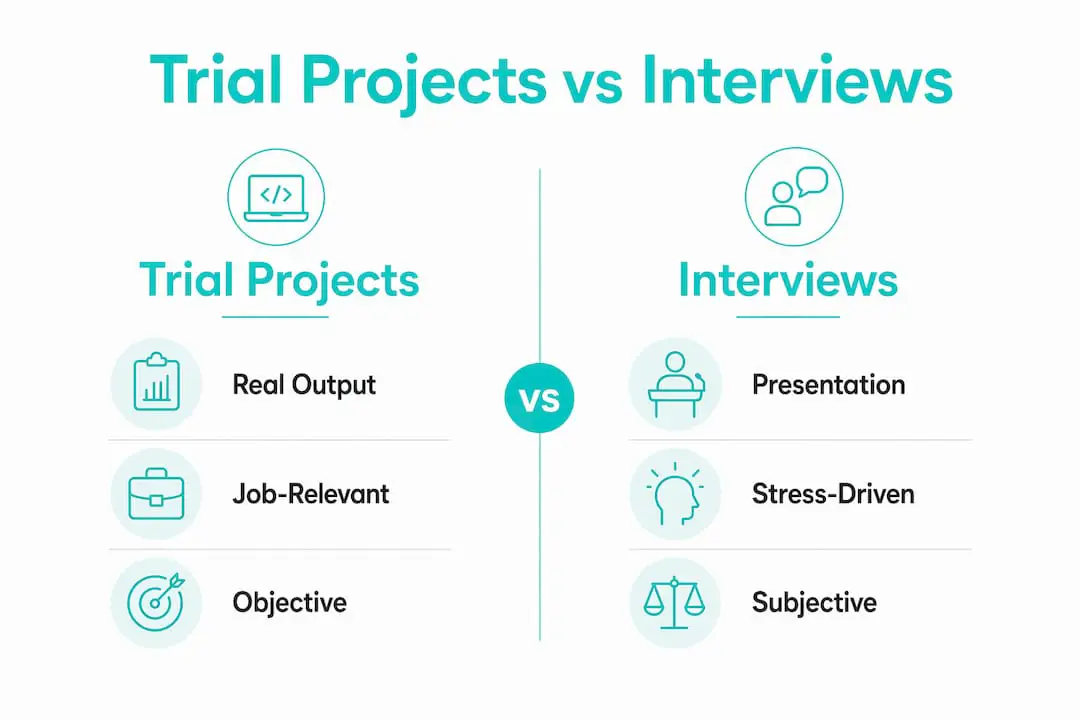
Trial projects test actual job tasks instead of a candidate’s ability to perform under interview pressure. Interviews reward charm and rehearsed answers. Trial projects reward output, judgment, and communication. That distinction matters enormously when you are hiring for roles that require independent thinking or remote collaboration.
Traditional interviews emphasize appearance and social skills, while trial projects reveal production reality. A candidate who interviews brilliantly may struggle with ambiguous requirements or slow feedback loops. A quieter candidate may produce exceptional work and communicate proactively throughout the project. You only discover this through a real task.

Trial projects also reduce false positives. A false positive hire costs far more than the time spent running a trial. Small, scoped experiments like trial projects offer a 100:1 efficiency ratio in avoiding hiring waste. That ratio reflects a simple truth: a one-week paid trial is far cheaper than three months of onboarding a poor fit.
The benefits of trial projects over traditional hiring methods include:
- Real output over rehearsed answers. You evaluate actual deliverables, not interview performance.
- Async communication signals. You see how candidates handle unclear requirements and delayed feedback.
- Cultural fit evidence. You observe how they interact with your tools, processes, and team norms.
- Reduced interviewer bias. Tangible work samples replace gut feelings and first impressions.
- Mutual evaluation. Trial periods enable candidates to assess your company culture before committing.
Pro Tip: Pay candidates for trial projects. Unpaid work signals disrespect and filters out high-quality candidates who have other options.
How to design trial projects that attract and evaluate top talent
The design of a trial project determines its value. A poorly scoped task produces noise, not signal. A well-designed trial produces clear evidence of how a candidate will actually perform on your team.
Use production-adjacent tasks, not toy problems
Top recruiters emphasize that trial projects must reflect actual legacy issues and edge cases, not isolated toy problems. A software developer trial should include real code with real constraints. A content writer trial should use your actual brand guidelines and target audience. Manufactured tasks disengage serious candidates and produce misleading results.
Standardize with a project bank
A standardized project bank prevents bias and keeps workloads manageable. When every candidate for a given role receives the same task, you compare apples to apples. Using a standardized project bank prevents bias and ensures consistent evaluations across all candidates. Rotating tasks periodically prevents answers from circulating online.
Set clear scope, duration, and compensation
Follow these steps when structuring a trial project:
- Define the deliverable clearly. State exactly what you expect at the end of the trial period.
- Cap unpaid tasks at 60–90 minutes. Unpaid trial tasks capped at this length reduce dropout risk significantly.
- Compensate trials longer than two hours. Budget at least $1,000 for a one-week mid-level trial to attract candidates with real alternatives.
- Provide the tools they will actually use. Give access to your actual systems, not simulated environments.
- Share the rubric upfront. Candidates perform better and evaluations stay consistent when criteria are transparent.
- Schedule a debrief after submission. Post-trial debriefs capture candidate thinking on trade-offs and response to feedback, which reveals adaptability and communication skills.
The trial project selection criteria you use matter as much as the task itself. Rubrics reduce inter-rater variance and keep your team aligned on what good looks like.
Pro Tip: Send a brief mid-project check-in message. How a candidate responds to that message tells you as much as the final deliverable.
Key elements of a well-designed trial project:
- A real task drawn from your current backlog or recent work
- A written brief with clear success criteria
- Compensation proportional to time required
- Access to the tools and context a new hire would have
- A structured debrief session after submission
Common challenges and misconceptions about trial projects
The most common objection to trial projects is that they exploit candidates with unpaid work. This concern is valid when trials are long, vague, and uncompensated. It disappears when trials are scoped, paid, and treated as mutual due diligence. Trial periods provide high-signal data on job fit before legal and financial hiring commitments, benefiting both sides equally.
A second misconception is that trial projects slow down hiring. They do add time upfront. But they reduce the far greater cost of a bad hire. Paid 1–2 week trial projects help companies avoid costly bad hires by verifying candidate performance in production-adjacent environments. The upfront investment is small compared to the risk it eliminates.
Common concerns and how to address them:
- “It’s free labor.” Pay candidates. Treat the trial as a short contract. The output belongs to them unless they accept the role.
- “Top candidates won’t do it.” Top candidates respect a rigorous process. Vague, unpaid tasks repel them. Paid, scoped trials attract them.
- “It introduces bias.” Standardized rubrics and identical tasks remove the subjectivity that interviews introduce.
- “It takes too long.” A one-week trial is faster than three rounds of interviews followed by a bad hire.
Pro Tip: Tell candidates explicitly that the trial output will not be used in production unless they join the team. This removes the free-labor concern and builds trust immediately.
Trial projects encourage objective evaluation by moving teams from biased personal impressions to evidence-based decisions with tangible work samples. That shift improves inclusivity because it removes the advantage that polished interviewers have over quieter, equally capable candidates.
How do trial projects fit within a broader candidate assessment strategy?
Trial projects do not replace skills assessments or structured interviews. They occupy a specific position in the hiring funnel, and understanding that position helps you use them correctly.
Skills assessments test whether a candidate has the foundational knowledge for a role. Structured interviews test judgment, values, and communication. Trial projects test how all of those elements combine in real work conditions. Each method answers a different question.
| Assessment method | Best for | Key limitation |
|---|---|---|
| Skills assessments | Screening foundational knowledge at scale | Does not reveal work rhythm or communication style |
| Structured interviews | Evaluating judgment, values, and culture fit | Rewards presentation over performance |
| Trial projects | Verifying real output, async skills, and team integration | Requires time and compensation investment |
“Testing real job tasks before committing changes hiring evaluation from subjective debate into objective inquiry, leading to more evidence-driven decisions. The greatest value lies in observing candidate work rhythm, communication style, and handling of real problems, not just technical skills.”
The industry trend for 2026 favors paid, scoped trials for remote and async teams. Quality of hire improvements come directly from replacing gut-feel decisions with work-sample evidence. AI-powered assessment platforms now integrate trial project data with structured scoring, giving hiring teams a complete picture of each candidate. The best hiring processes treat each trial as a small experiment, review what the data shows, and refine the rubric over time.
Key Takeaways
Trial projects are the most reliable candidate assessment method because they replace interview performance with real work evidence, reducing hiring risk and improving quality of hire.
| Point | Details |
|---|---|
| Real output over interviews | Trial projects reveal actual job performance, not rehearsed answers or presentation skills. |
| Pay and scope matter | Compensate trials over two hours and cap unpaid tasks at 60–90 minutes to retain top candidates. |
| Standardize for fairness | A project bank with identical tasks and rubrics removes bias and keeps evaluations consistent. |
| Debrief is non-negotiable | Post-trial debriefs reveal adaptability and communication skills that the deliverable alone cannot show. |
| Mutual due diligence | Candidates evaluate your culture during the trial, improving offer acceptance rates and early retention. |
The part most hiring teams skip entirely
I have reviewed a lot of hiring processes, and the pattern is consistent. Teams invest significant effort in designing the trial task, then skip the debrief entirely. They grade the output, make a decision, and move on. That is where most of the signal gets lost.
The debrief is where you learn how a candidate thinks. Ask them what trade-offs they made. Ask what they would do differently with more time. Ask how they handled the moment they got stuck. Those answers tell you far more about how someone will perform on your team than the deliverable itself.
The other mistake I see regularly is using trial projects as a filter rather than a conversation. The best trials feel collaborative, not adversarial. When candidates feel evaluated rather than engaged, the best ones withdraw. The ones who stay are often the ones with fewer options.
Treat the trial as the beginning of a working relationship, not a test to pass. Share context generously. Respond to questions promptly. Give honest feedback after the debrief regardless of the outcome. That approach attracts candidates who value transparency, which is exactly who you want on your team.
The candidate motivation assessment matters as much as the output. A candidate who asks sharp questions during the trial and pushes back on unclear requirements is showing you exactly how they will operate as a hire. Do not penalize that. Reward it.
— Jimmie
Talent Approved makes trial project evaluation faster and fairer
Running trial projects at scale requires consistent scoring, clear rubrics, and a way to compare candidates without bias creeping in. Talent Approved’s AI-powered platform gives HR teams and recruiters the tools to build structured, role-specific assessments that integrate directly with your hiring workflow.
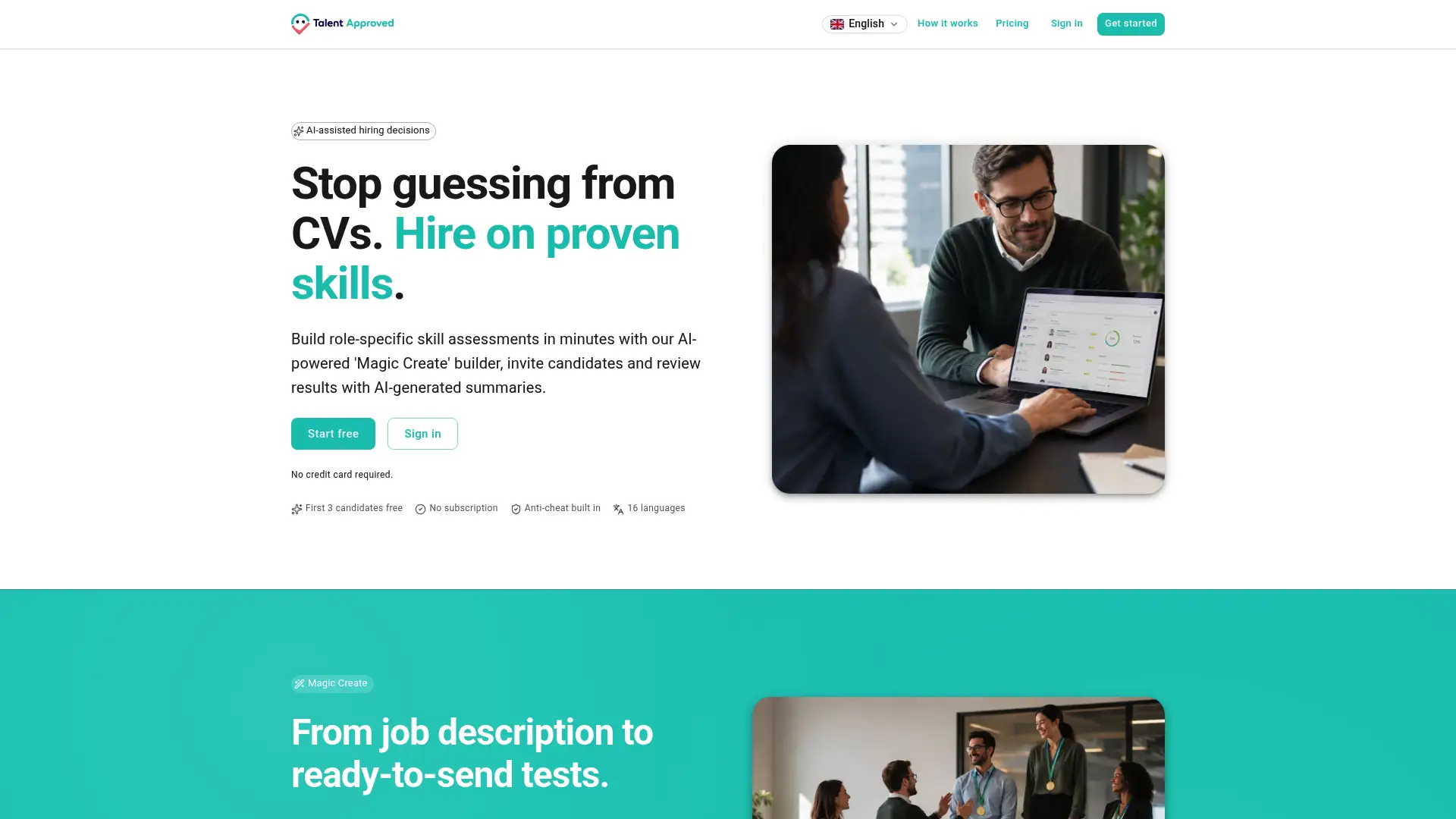
The Magic Create feature builds tailored assessments in minutes from a job description or skill list. Built-in anti-cheat mechanisms and AI-generated candidate summaries mean your team spends less time reviewing and more time deciding. If you want to see how it works, the platform is built specifically for teams that want to hire on evidence, not instinct. Transparent pricing plans make it accessible for hiring teams of any size.
FAQ
Why do trial projects assess candidates better than interviews?
Trial projects produce real work output under actual job conditions. Interviews test presentation skills, while trials reveal how candidates handle ambiguity, communicate asynchronously, and deliver results.
How long should a trial project be?
Unpaid trial tasks should stay within 60–90 minutes. Trials requiring more than two hours of work should be compensated, with a budget of at least $1,000 for mid-level roles lasting one week.
Should candidates be paid for trial projects?
Paying candidates for trial work is the standard for attracting high-quality candidates who have other options. Unpaid trials over the recommended length increase dropout rates and limit your talent pool.
What is the best way to evaluate trial project results?
Use a rubric shared with candidates before the trial begins. Follow every trial with a structured debrief to assess how candidates explain their decisions, handle feedback, and communicate under real conditions.
How do trial projects fit with skills assessments?
Skills assessments screen for foundational knowledge at scale. Trial projects verify how that knowledge applies in real work conditions. The two methods work best together as sequential stages in the hiring funnel.