
How to Screen High Volume Applicants Efficiently

To screen high volume applicants efficiently, prioritize these six actions in order: write a narrow job description with 3–5 hard must-haves and a clear compensation range; lock down your screening rubric before activating any automation; add 2–3 targeted application questions that map directly to those must-haves; deploy role-specific skills assessments with anti-cheat controls; assign reviewer ownership with defined SLAs; and track time-to-shortlist as your primary health metric. Teams that follow this sequence typically cut first-pass screening time significantly and surface qualified candidates faster, without sacrificing decision quality.
Quick-win sequencing:
- Within 24 hours: Revise the job description to remove vague requirements, add compensation range, and insert 2–3 knockout questions in the application form.
- Within one week: Build your screening rubric and scorecard before turning on any ATS automation or AI triage. Define what “strong match,” “worth a second look,” and “not a match” look like for this role.
- Within 30 days: Run a pilot on one role family. Measure time-to-shortlist and application-to-screen conversion. Schedule a weekly funnel diagnostic and a monthly rubric calibration session.
Expected outcomes from a well-sequenced pilot: teams using the MIND Interview rubric-first framework report measurable reductions in time-to-shortlist and more consistent interview-to-offer conversion rates after several weeks.
Pro Tip: Never activate AI triage or automated scoring before your rubric is finalized. Automation scales whatever logic you give it. If your criteria are vague, the system will consistently surface the wrong candidates at volume.
Key Takeaways
Screening high volumes of applicants efficiently requires rubric-first sequencing, role-specific assessments, defined SLAs, and consistent metric tracking, with time-to-shortlist for the top 5% as the primary health indicator.
| Point | Details |
|---|---|
| Rubric before automation | Finalize your screening rubric before activating any ATS automation or AI triage to avoid scaling inconsistent decisions. |
| Narrow JD reduces noise | A job description with 3–5 hard must-haves and a posted compensation range cuts unqualified applications before they enter your funnel. |
| Role-specific assessments | Short, short work-sample tests mapped to 90-day success criteria outperform resume filters for predicting job performance. |
| SLAs and ownership | Assign one reviewer per role family, acknowledge applications within within a few days, and complete top-5% first-pass review within a short time. |
| Talent Approved | Talent Approved’s Magic Create generates role-specific assessments from a job description, with built-in anti-cheat and AI-ranked candidate scoring. |
Table of Contents
- How do you reduce unqualified applicants before posting the job?
- How should you automate intake without losing good candidates?
- How do you design and proctor skills assessments at scale?
- What workflows and SLAs keep candidate flow moving at scale?
- Which metrics tell you if your screening process is actually working?
- How do you protect candidates and stay compliant while scaling?
- A 30–90 day implementation checklist you can start this week
- What high-volume hiring programs actually teach you over time
- Talent Approved cuts your time-to-shortlist without adding headcount
- Sources
- FAQ
How do you reduce unqualified applicants before posting the job?
The fastest way to manage large applicant pools is to shrink them before they form. A well-written job description does more filtering work than any ATS rule.
Write a narrow, role-specific job description. List 3–5 hard must-haves (specific tools, certifications, or demonstrated outputs) and 2–3 nice-to-haves. Remove credential inflation: a degree requirement that does not predict job performance will exclude qualified candidates and invite scrutiny. Brookings research confirms that skills-based hiring requires redesigning job definitions and scoring rubrics, not simply removing degree requirements.
Include compensation and schedule expectations. A posted salary range reduces mismatched applications and improves self-selection. Candidates who would decline an offer at that range will opt out before applying, saving everyone time.
Add targeted screening questions. Two or three short questions tied directly to your must-haves do the work of a phone screen for the bottom 40–50% of applicants. Examples:
- “This role requires proficiency in [specific tool]. Describe a project where you used it and the outcome.”
- “The schedule is [specific hours/days]. Can you confirm availability?”
- “This position is on-site in [city]. Are you currently located within commuting distance or actively relocating?”
Choose sourcing channels deliberately. A customer service role filled from a niche industry job board will attract more relevant applicants than the same posting on a general aggregator. Build talent-pool routing rules so returning candidates and referrals enter a prioritized queue rather than the general stack.
Screen language and EEOC compliance. Use neutral, behavior-based language in job descriptions and screening questions. Avoid questions about protected characteristics. The EEOC’s publications on nondiscriminatory hiring are the authoritative reference for what is and is not permissible when using application filters and automated tools.
Strong job descriptions are not about being exclusive. They are about being precise enough that the right candidates recognize themselves in the posting and the wrong ones self-select out. That precision is the first and cheapest filter in your funnel.
Pro Tip: Run your job description through a plain-language check. If a qualified candidate with five years of relevant experience would be confused by a requirement, rewrite it. Ambiguous criteria attract broad applications and create downstream screening noise.
How should you automate intake without losing good candidates?
Automation applied to a well-built rubric accelerates hiring. Applied before one exists, it scales inconsistency. Metaview’s high-volume recruiting framework is explicit on this: build rubrics and structured questions first, then centralized capture, then workflow automation, then AI.
Define a three-tier sort, not a binary reject. Configure your ATS to route candidates into “strong match,” “worth a second look,” and “not a match” queues. A binary auto-reject at the top of the funnel creates legal exposure and eliminates candidates with non-traditional backgrounds who may be strong performers.
Configure parsing and scoring rules against your rubric. Map ATS resume-scoring fields to your must-haves. Surface compensation mismatch, location or timezone gaps, and required certifications as flags in the recruiter queue. Recruiters should see a prioritized list with flag reasons, not a raw stack of 300 resumes.
Flag AI-generated or fraudulent resume signals. The FBI’s Internet Crime Complaint Center tracks mass-submission fraud patterns that increasingly affect high-volume roles. Flag suspicious signals (identical phrasing across multiple applications, implausible employment timelines) for human review rather than auto-rejecting, which preserves your audit trail.
Run a historical pilot before going live. Pull a closed requisition, run your new automation logic against it, and compare the shortlist it produces to the one your team actually selected. Measure false-negative rate: how many candidates your team hired that the automation would have filtered out.
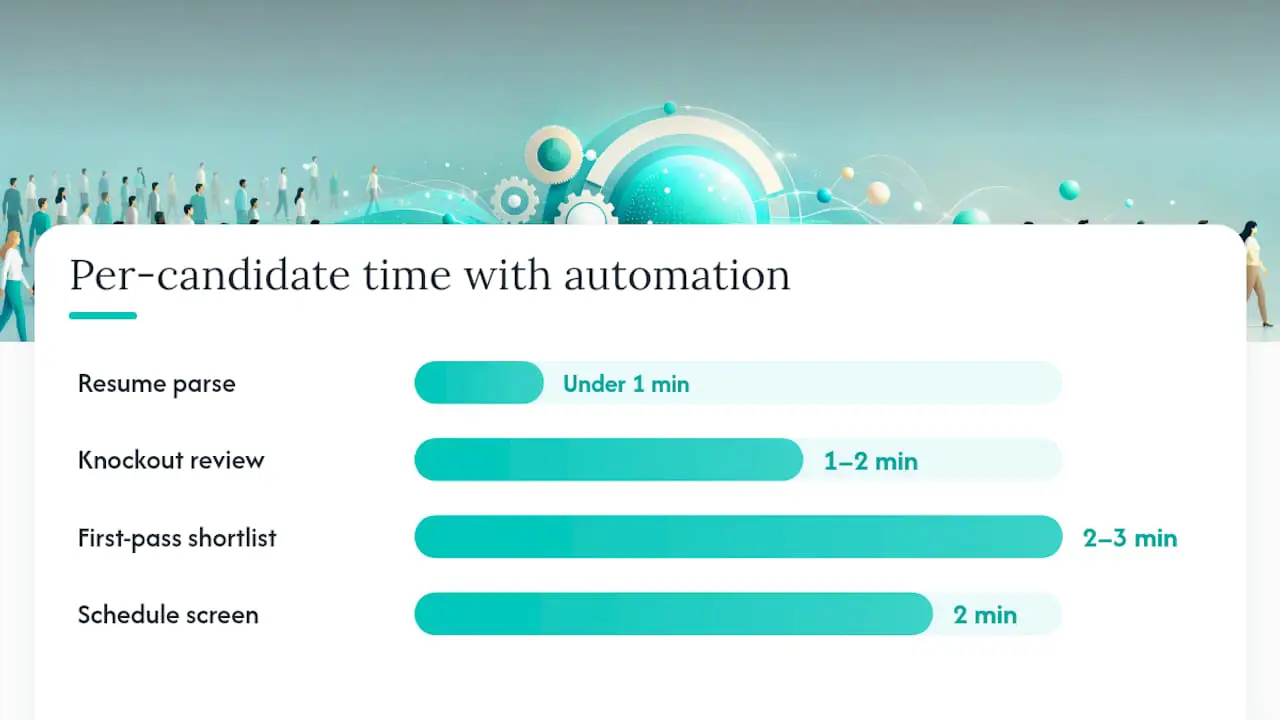
For faster candidate evaluation, the goal is a recruiter queue that shows ranked candidates with flag reasons, not a raw inbox.
| Funnel stage | Manual time per candidate | With automation | Primary time driver |
|---|---|---|---|
| Resume parse and sort | a few minutes | Under 1 min | ATS scoring rules |
| Knockout question review | 3–5 min | 1–2 min | Pre-screen logic |
| First-pass shortlist decision | 5 min | 2–3 min | Rubric-matched scoring |
| Scheduling first screen | 8 min | 2 min | Calendar automation |
Pro Tip: Set a “flag for human review” threshold rather than an auto-reject threshold. Any candidate who clears most of your must-haves but fails one criterion should land in a review queue, not a rejection folder. This protects against rubric gaps and EEOC exposure.
How do you design and proctor skills assessments at scale?
Resume filters tell you what candidates claim. A well-designed work-sample test tells you what they can actually do. SHRM’s 2025 talent trends research identifies skills-based assessment as a top priority for recruiting teams managing high application volumes.
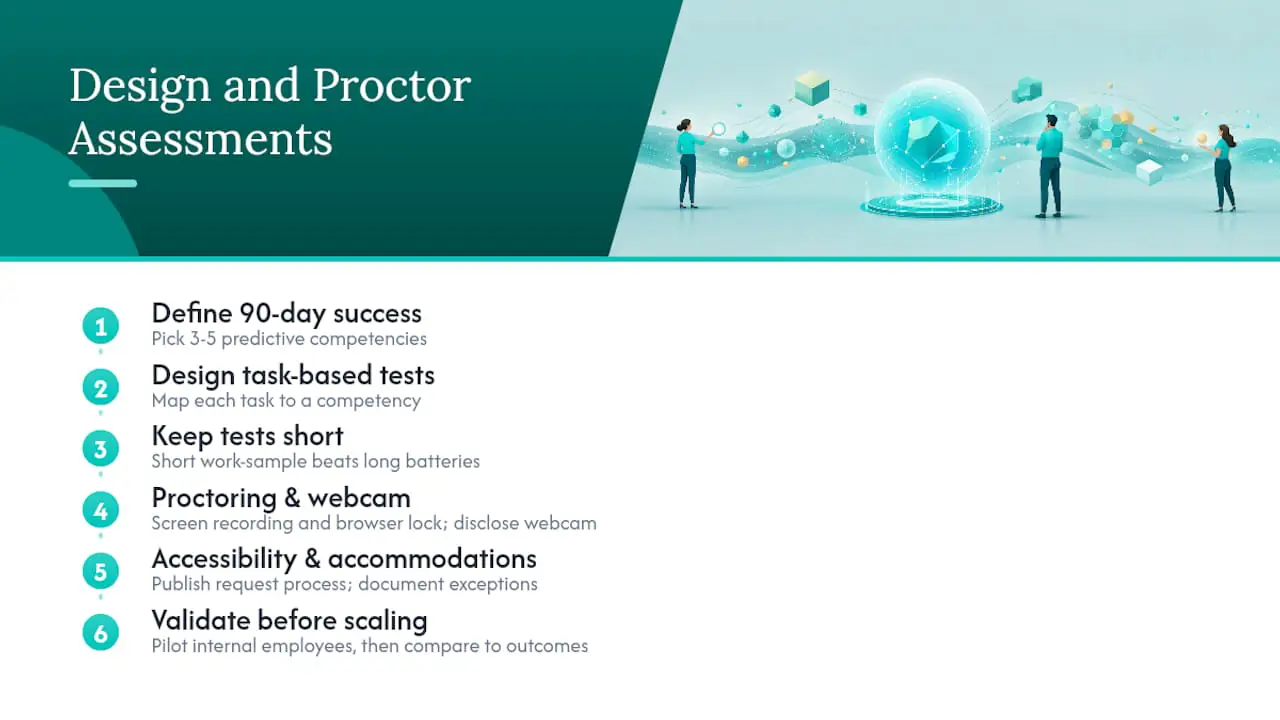
Map assessments to 90-day success criteria. Before building a test, define what success looks like in the first 90 days. Identify 3–5 competencies that predict that outcome. Build assessment tasks that directly measure those competencies, not general aptitude.
Keep tests short and task-based. A short work-sample assessment produces more predictive signal than a 90-minute general ability battery. Candidates are more likely to complete it, and your completion rate stays high enough to generate a usable ranking. For guidance on designing job-specific screening tests, the key is mapping each task to a specific competency, not testing everything at once.
Anti-cheat and proctoring requirements. For roles where test integrity matters, require screen recording and browser lock at minimum. Webcam monitoring is optional and should be disclosed clearly in the candidate instructions. Document your proctoring policy and apply it consistently across all candidates for the same role.
Accessibility and accommodations. Publish a clear process for requesting accommodations before the assessment window opens. Document every exception. Consistent accommodation handling is both a legal requirement and a candidate experience factor.
Validate before scaling. Run your assessment on a small cohort of candidates first. Compare scores to hiring outcomes after a few months. If high scorers are not performing better on the job, the assessment needs recalibration. Capterra’s pre-employment testing shortlist shows the range of tools available; evaluate any platform against your validity and integration requirements.
Work-sample tests consistently outperform unstructured resume reviews for predicting job performance. The predictive advantage is strongest when the task mirrors an actual deliverable from the first 30 days of the role.
Pro Tip: Pilot every new assessment with internal employees in the same role before sending it to candidates. If your current top performers score inconsistently, the test is measuring the wrong thing.
What workflows and SLAs keep candidate flow moving at scale?
Bottlenecks in high-volume hiring are almost always process problems, not volume problems. OPM’s structured interview guidance recommends consistent, documented decision processes precisely because they make selection defensible and repeatable at scale.
Define role ownership clearly. Assign one person to own intake for each role family. A second reviewer handles first-pass shortlist decisions. Exception cases (non-traditional backgrounds, flagged applications) escalate to a senior reviewer with a defined turnaround time.
Set SLAs and hold to them:
- Acknowledge every application within a few days.
- Complete first-pass review of the top 5% of applicants within a short time of application.
- Send assessment invitations within 72 hours of first-pass approval.
- Communicate a decision or next step within five business days of assessment completion.
Use centralized scorecards, not shared spreadsheets. Every reviewer scores against the same rubric in the same system. Shared ad-hoc spreadsheets create version-control problems and make calibration impossible.
Rubric template outline (copy and adapt):
- Role: [Title]
- Must-haves (scored 1–3): [List 3–5 criteria]
- Nice-to-haves (scored 1–2): [List 2–3 criteria]
- Disqualifiers: [List hard no’s]
- Overall recommendation: Strong / Worth a second look / Not a match
- Reviewer notes: [Free text, 2–3 sentences max]
| SLA checkpoint | Target time | Owner | Escalation trigger |
|---|---|---|---|
| Application acknowledgement | within a few days | ATS automation | System failure only |
| Top 5% first-pass review | a short turnaround | Intake reviewer | Queue exceeds 50 unreviewed |
| Assessment invitation | 72 hours post-approval | Recruiter | Candidate no-show after a short turnaround |
| Post-assessment decision | several business days | Hiring manager | Scorecard incomplete |
Pro Tip: Schedule a 30-minute weekly funnel diagnostic and a 60-minute monthly rubric calibration session to continuously improve your screening process. The weekly session catches SLA breaches before they compound. The monthly session catches rubric drift before it affects hiring quality.*
Which metrics tell you if your screening process is actually working?
Tracking the right numbers turns a reactive hiring process into a predictable one. BLS employment situation data gives you the external labor-market context; your internal funnel metrics tell you where your process is losing good candidates.
Primary metrics to track:
- Time-to-shortlist: Days from job posting to a ranked shortlist of qualified candidates. This is your leading indicator.
- Application-to-screen conversion: Percentage of applicants who advance to a first screen. A rate below 5% often signals a JD problem; above 25% often signals criteria that are too loose.
- Screening cost per candidate: Total recruiter hours plus tool costs divided by candidates screened.
- Interview completion rate: Percentage of invited candidates who complete the assessment or interview. Below 60% usually points to a candidate experience or scheduling problem.
- Interview-to-offer conversion: Percentage of interviewed candidates who receive an offer. A rate below 20% often means the assessment is not filtering effectively.
- Offer acceptance rate: Percentage of offers accepted. Below 80% often signals a compensation or process-speed problem.
- Quality-of-hire (30/60/90-day): Manager rating of new hire performance at 30, 60, and 90 days. This is your lagging indicator and the ultimate validation of your screening criteria.
How to use drop-off rates. A spike in drop-offs at the application stage points to a JD or UX problem. Drop-offs at the assessment stage point to a length or scheduling problem. Drop-offs after the offer point to compensation or competing offers.
NBER labor-market research](https://www.nber.org/papers/w27736) on hiring frictions confirms that faster response times and skill-validated screening improve match quality.** Teams that reduce time-to-shortlist below 10 days see measurably better candidate engagement and offer acceptance rates.
How do you protect candidates and stay compliant while scaling?
Speed and compliance are not in conflict. The teams that move fastest through high-volume screening are usually the ones with the most consistent communication and the clearest audit trails.
Communication templates and cadence. Send an automated acknowledgement within 24 hours of every application. Include a clear next-step timeline. For candidates who reach the assessment stage, send a personalized note with context. For candidates who are not advancing, send a timely, respectful decline. Candidates who receive no communication drop out of your pipeline and leave negative reviews that affect future applicant quality.
For candidate experience at scale, consistent communication is the single highest-leverage action that costs almost nothing to implement.
Recordkeeping for EEOC compliance. The EEOC’s publications specify what records to retain and for how long when using tests and automated tools in hiring. At minimum, retain application data, screening scores, rubric decisions, and reviewer notes for each candidate for the period your legal team specifies (typically one to two years for non-hires, longer for hires). Every automated decision should have a human-readable reason attached.
Accessible assessments. Publish accommodation request instructions before the assessment window. Document every accommodation granted or denied, with the reason. Apply the same process to every candidate who requests one.
AI and automation controls. Every automated triage decision should be explainable: a recruiter should be able to read the flag reason and understand why a candidate was routed to a specific queue. Retain human decision logs. No candidate should be rejected solely by an automated system without a human review step.
Consistency is your legal protection. If your rubric, your questions, and your scoring are applied identically to every candidate for a role, you have a defensible record. If they vary by reviewer or by day, you have exposure.
Pro Tip: Build a notification template that includes a brief appeal or review path for any candidate who was flagged by automation. “If you believe this decision does not reflect your qualifications, reply to this message within five business days” costs nothing and significantly reduces legal risk.
A 30–90 day implementation checklist you can start this week
A focused pilot on one role family is the fastest path to validated, scalable screening. MIND Interview’s playbook recommends a several week pilot with fixed score anchors and recurring calibration before expanding to additional role families.
30-day phase (build and pilot):
- Revise job description for one role family: 3–5 must-haves, compensation range, 2–3 screening questions.
- Build screening rubric and scorecard in your ATS.
- Configure intake automation against the rubric (three-tier sort).
- Launch role-specific assessment for the pilot role.
- Assign reviewer ownership and communicate SLAs.
- Send candidate acknowledgement template on day one.
60-day phase (measure and calibrate):
- Run weekly funnel diagnostics: time-to-shortlist, completion rate, conversion rates.
- Hold first rubric calibration session: compare reviewer scores on the same 10 candidates.
- Identify one bottleneck and fix it before expanding.
- Collect 30-day quality-of-hire data on first hires from the pilot.
90-day phase (scale and document):
- Document what worked and what changed in the rubric.
- Expand the validated process to a second role family.
- Build a reusable question library for the role families you have piloted.
- Schedule monthly calibration as a recurring calendar event.
Copy-ready templates:
Candidate acknowledgement message: “Thank you for applying for [Role] at [Company]. We have received your application and will review it within [X] business days. If you advance, you will hear from us by [date]. Questions? Reply to this message.”
Intake must-haves checklist (for recruiter use):
- [ ] Compensation range confirmed in JD
- [ ] 3–5 must-haves listed with measurable criteria
- [ ] Screening questions mapped to must-haves
- [ ] Rubric finalized before posting goes live
- [ ] Reviewer assigned and SLA communicated
The teams that scale screening successfully are not the ones with the most tools. They are the ones that ran a disciplined pilot, measured what broke, fixed it, and then expanded. Skipping the pilot to save time is the most common reason high-volume hiring programs stall at 200 applicants.
Pro Tip: Insist on a several week pilot before expanding automation to additional role families. The pilot is not a delay. It is the data you need to avoid scaling a broken process.
What high-volume hiring programs actually teach you over time
The failure mode I see most often in high-volume hiring is not a tool problem. It is a sequencing problem. Teams buy an ATS, activate AI scoring, and then try to build the rubric afterward. The result is a system that confidently surfaces the wrong candidates, and a team that has lost trust in the automation before it ever had a fair test.
The second failure mode is inconsistent intake. Two recruiters working the same requisition with different mental models of “qualified” will produce different shortlists. No amount of automation fixes that. The fix is a shared role brief and a calibration session before the first application arrives, not after the first 500 have piled up.
The teams that get this right share one habit: they treat calibration as a recurring operational event, not a one-time setup task. Volume grows. Role requirements shift. The labor market changes. A rubric that was accurate in January may be filtering out strong candidates by June. Monthly calibration keeps the criteria current and the team aligned.
One observation worth carrying into any scaling effort: the metric that predicts everything else is time-to-shortlist for the top 5% of applicants. If that number is above 14 days, something in your process is broken, and it is usually upstream: a vague JD, a missing rubric, or an SLA that nobody is enforcing.
Talent Approved cuts your time-to-shortlist without adding headcount
High-volume screening stalls when teams have to build assessments from scratch for every new role. Talent Approved solves that directly: its Magic Create feature generates a role-specific skills assessment in minutes from a job description or a list of competencies. No test-design expertise required.
Every assessment includes built-in anti-cheat screen recording and proctoring, so test integrity holds at scale without manual oversight. AI-generated candidate summaries and ranked scoring with explainable reasons mean your reviewers see a prioritized queue with context, not a raw stack of completed tests. The pay-as-you-go model charges $5 per completed candidate assessment, with no subscription required, so you can run a several week pilot on one role family without a long-term commitment.
Teams using Talent Approved during a pilot typically report faster time-to-shortlist and better interview-to-offer conversion because the assessment filters on demonstrated skill, not claimed experience. To see how the platform works end to end, visit Talent Approved’s assessment platform and set up your first role-specific test.
Sources
These resources support the guidance in this article and are worth bookmarking for ongoing reference:
- Bls
- Opm
- Eeoc
- High-Volume Recruitment Playbook: Screen 1,000+ Applicants With Consistent Rubrics | MIND Interview
- Metaview
- Brookings
- Shrm
- Capterra
FAQ
What is the 70/30 rule in hiring?
The rule in hiring suggests that most of a hiring decision should be based on demonstrated skills and competencies, with the remainder weighted toward cultural fit and growth potential. It is a heuristic for reducing over-reliance on subjective impression during interviews.
How do you manage high-volume recruiting without losing quality?
Build your screening rubric before activating automation, use role-specific work-sample assessments to filter on demonstrated ability, assign clear reviewer ownership with defined SLAs, and track time-to-shortlist as your primary quality signal. Teams that follow this sequence consistently report better interview-to-offer conversion rates.
What is the 80/20 rule for interviews?
The 80/20 rule for interviews holds that candidates should speak roughly 80% of the time and the interviewer 20%. It is a structured interview principle that improves the quality of information gathered and reduces interviewer bias, consistent with OPM’s structured interview guidance.
How long should a high-volume screening assessment take?
A short task-based assessment is the practical target for high-volume roles. Longer assessments reduce completion rates and create scheduling friction; shorter ones often lack enough signal to rank candidates reliably.
What records do you need to keep for EEOC compliance in high-volume hiring?
Retain application data, screening scores, rubric decisions, and reviewer notes for every candidate. The EEOC’s publications specify retention periods and documentation requirements, particularly when using automated tools or pre-employment assessments.