
EEOC Testing Guidelines: What Employers Must Know

EEOC testing guidelines require that any employment test causing adverse impact on a protected group be job-related and consistent with business necessity, or the employer risks liability under Title VII. That’s the entire rule in one sentence, but making it stick takes documentation. You need three things in place before you screen a single candidate:
- Run an adverse-impact check on every stage of your selection process, not just the final test.
- Document your job analysis and explain why you chose a particular validation strategy.
- Keep records organized and ready for inspection, because the EEOC can request them during any charge investigation.
The authorities behind this aren’t optional reading. The U.S. Equal Employment Opportunity Commission enforces Title VII, the ADA, and the ADEA, and the Uniform Guidelines on Employee Selection Procedures (29 C.F.R. Part 1607) sets the technical standard every court and investigator uses to judge whether a test holds up.
Key Takeaways
Compliant testing requires job-related content, adverse-impact monitoring, documented validation, and complete records employers can produce on demand.
| Point | Details |
|---|---|
| Anchor tests to job analysis | Build every test item from documented essential functions, never from generic assessment libraries. |
| Run the four-fifths check | Calculate selection rates by group at every hiring stage, not only the final decision. |
| Match validation type to test | Use criterion, content, or construct validity depending on test type and available data. |
| Separate ADA stages strictly | Never ask disability-related questions or require medical exams before a conditional offer. |
| Use a documented platform | Talent Approved’s Magic Create and audit trail features help HR teams build and record job-related assessments. |
Where to Verify EEOC Testing Requirements Directly
- Uniform Guidelines on Employee Selection Procedures, 29 C.F.R. Part 1607
- EEOC guidance on employment tests and selection procedures
- ADA pre-employment inquiry and medical exam rules
- Talent Approved’s guide to designing job-specific screening tests
This article is general information, not a substitute for advice from a qualified lawyer. Consult a qualified legal professional about your own circumstances before acting on anything here.
Table of Contents
- What Is the EEOC Testing Guidelines Framework Built On?
- Which Employment Tests Does the EEOC Regulate?
- How Do Title VII, ADA, and ADEA Rules Differ for Testing?
- What Is the EEOC 80% Rule for Adverse Impact?
- What Validation Documentation Do Employers Need to Keep?
- What Best Practices Keep a Testing Program Defensible?
- What Happens When Employers Get Testing Wrong?
- How Do You Build a Compliant Testing Program Step by Step?
- Sources
- FAQ
What Is the EEOC Testing Guidelines Framework Built On?
Two documents do most of the work. UGESP, adopted in 1978 under 29 C.F.R. Part 1607, is the technical rulebook: it covers hiring, promotion, retention, transfer, demotion, and dismissal decisions, and it spells out exactly what counts as validity evidence. EEOC guidance and its published Q&As translate that regulatory language into plain-English answers for employers who don’t have a psychometrician on staff.
Three statutes sit underneath this framework, each enforced differently:
- Title VII bars intentional discrimination and disparate impact based on race, color, religion, sex, or national origin.
- The ADA restricts disability-related questions and medical exams to specific hiring stages.
- The ADEA protects applicants and employees 40 and older from age-based screening bias.
Here’s what trips up a lot of HR teams: “selection procedure” is defined broadly. It’s not just a written cognitive test. Resume screens, structured interviews, reference checks, and algorithmic ranking tools all qualify, and all of them can trigger adverse-impact scrutiny under the same standards.
Which Employment Tests Does the EEOC Regulate?
If it influences a hiring, promotion, or termination decision, it’s covered. The EEOC’s list of common test types includes:
- Cognitive ability tests — measure reasoning or problem-solving; historically show some of the largest adverse-impact gaps by race.
- Personality assessments — screen for traits like conscientiousness; low adverse impact but weak validity if not tied to job duties.
- Skills and work-sample tests — have candidates perform actual job tasks; generally strong validity when built correctly.
- Physical and fitness tests — common in public safety and labor roles; scrutinized for disparate impact by sex.
- Medical exams — tightly restricted by the ADA to specific hiring stages.
- Drug tests — generally not classified as medical exams under the ADA.
- Credit and criminal background checks — can trigger adverse impact against certain racial groups if not job-related.
- Structured interviews — lower legal risk when questions are standardized and scored consistently.
- Algorithmic and AI screening tools — treated exactly like traditional tests under EEOC guidance, regardless of how the vendor markets it.
- Situational judgment tests — present hypothetical scenarios; moderate validity for supervisory roles.
- Integrity tests — assess honesty; require careful validation to avoid overbroad exclusion.
- Language proficiency tests — legal only when job-related, not used as a proxy for national origin.
An algorithm that ranks candidates isn’t exempt just because a human clicks “approve” at the end.
How Do Title VII, ADA, and ADEA Rules Differ for Testing?
Title VII gives you the disparate-impact standard: a neutral test that disproportionately screens out a protected group is unlawful unless you can prove job-relatedness and business necessity under UGESP. That burden shifts to you, the employer, the moment adverse impact shows up in your numbers.
The ADA works differently. It doesn’t ask whether a test has disparate impact. It restricts when you can ask disability-related questions or require medical exams, based on three stages:
| Hiring stage | What’s allowed |
|---|---|
| Pre-offer | No disability-related questions or medical exams of any kind |
| Post-offer, pre-start | Medical exams allowed if required of all entering employees in that job category |
| During employment | Medical exams allowed only if job-related and consistent with business necessity |
The EEOC’s ADA guidance also clarifies that not everything feels like a “medical exam” but qualifies as one. Physical agility tests, drug tests, and polygraphs generally don’t count, but a physician-administered strength assessment might. Get the stage wrong and you’ve created ADA liability regardless of intent.
The ADEA rounds this out by protecting applicants 40 and older from tests designed around, or defaulting to, younger workforce norms. Recordkeeping ties back to your EEO-1 reporting obligations. If you’re required to file EEO-1 data, keep testing records organized by demographic group so you can reconcile the two if the EEOC ever asks.
What Is the EEOC 80% Rule for Adverse Impact?
The four-fifths rule is a screening tool, not a legal verdict. It compares selection rates across groups: if any group’s selection rate falls below 80% of the highest group’s rate, the EEOC treats that as evidence of adverse impact worth investigating further.

Here’s the math in practice. Say 80 white applicants take a test and 48 pass, a 60% selection rate. Fifty Black applicants take the same test and 20 pass, a 40% selection rate. Divide 40% by 60% and you get 66.7%, well under the 80% threshold. That’s a red flag, not a conviction; courts also weigh statistical significance and sample size before ruling.
Pro Tip: Run this calculation on every stage of your process separately, not just the final hire decision. A resume screen with adverse impact can offset a perfectly fair interview stage, and the EEOC looks at each step.
When the ratio falls short, UGESP gives you two paths: validate the component causing the gap, or adopt an alternative procedure with less adverse impact and similar predictive value. Ignoring the gap isn’t a third option.
What Validation Documentation Do Employers Need to Keep?
UGESP recognizes three validity strategies, and which one fits depends on your test type and how much data you have to work with.
| Validity type | Best suited for | Core evidence required |
|---|---|---|
| Criterion-related | Large applicant pools, existing performance data | Statistical correlation between test scores and job performance |
| Content | Skills and work-sample tests | Test content directly mirrors actual job tasks |
| Construct | Cognitive or personality traits tied to performance | Evidence the trait measured is genuinely required for the job |
Whichever strategy you use, the EEOC expects a paper trail. Keep your job analysis, the validation plan and its results, scoring rules, adverse-impact calculations by demographic group, a record of alternative procedures you considered, and test administration logs. The EEOC’s Q&A guidance on UGESP stresses that this isn’t a one-time file. Validation needs periodic monitoring, and if your applicant pool or the job itself shifts materially, revalidate.

What Best Practices Keep a Testing Program Defensible?
Start with the job analysis and build outward from there. Every test question or skill demonstration should map back to a documented, essential function of the role, not a nice-to-have.
- Standardize administration and scoring so every candidate takes the test under the same conditions.
- Apply accommodations consistently and document each request and response.
- Keep medical information in files separate from the general personnel file, per ADA confidentiality rules.
- If you buy a test or algorithmic tool from a vendor, require their validation documentation in writing, then run your own adverse-impact analysis on your actual applicant pool.
Pro Tip: Never assume a vendor’s national validation study transfers cleanly to your workforce. Demographics, job requirements, and applicant volume all vary enough that your own impact numbers can look completely different.
What Happens When Employers Get Testing Wrong?
Noncompliance isn’t abstract risk. Employers found liable for discriminatory testing can face back pay awards, attorneys’ fees, mandated corrective monitoring, and in government-contractor cases, loss of federal contracts. Common failure patterns the EEOC flags during investigations:
- A cognitive test rolled out without any job analysis or validation study behind it.
- Medical exams requested before a conditional offer, violating ADA stage limits.
- An algorithmic screening tool inherited from a vendor with no adverse-impact testing on the employer’s own applicant data.
A vendor’s marketing claim that its tool is “EEOC-compliant” carries no legal weight. Employer liability for adverse impact doesn’t transfer to the vendor, ever.
How Do You Build a Compliant Testing Program Step by Step?
- Conduct a job analysis (2 to 4 weeks). Identify essential functions, required knowledge, skills, and abilities, involving supervisors and subject-matter experts who actually know the role.
- Select or build the test (1 to 3 weeks). Match test content directly to what the job analysis identified as essential.
- Pilot and validate (4 to 12 weeks, depending on applicant volume). Bring in a psychometrician or vendor with documented methodology if sample size allows criterion-related validity.
- Analyze adverse impact (ongoing). Run the four-fifths calculation at every stage, not just the final score.
- Finalize administration rules and accommodations (1 to 2 weeks). Standardize instructions, timing, and accommodation procedures in writing.
- Implement and monitor (ongoing). Legal counsel should sign off before launch; HR owns day-to-day monitoring afterward.
How Should HR Handle Ongoing Validation Audits?
Treat your testing program like a living file, not a project you close out. Keep a version history of your job analysis, test forms, scoring rubrics, adverse-impact reports, accommodation logs, and every piece of vendor correspondence.
Pro Tip: Set a recurring calendar reminder, quarterly for high-volume roles, annually otherwise, to re-run your impact analysis. Applicant pools shift, and a test that looked clean last year can drift into adverse-impact territory without anyone changing a single question.
Employers using third-party platforms still own the validation and monitoring obligation in full, so build the audit trail into your workflow rather than treating it as a one-time compliance checkbox.
A Practitioner’s View on Getting This Right
Most HR teams can’t validate every role on day one, and that’s fine. Prioritize your highest-volume or highest-risk positions first. Train hiring managers hard on standardized administration; the biggest adverse-impact problems I’ve seen trace back to well-meaning managers improvising follow-up questions, not to the test itself. Document the job analysis now, even if full validation waits.
Build Defensible Assessments Without the Guesswork
Talent Approved gives HR teams a faster path to job-related, documented testing than building a validation program from scratch. Its Magic Create feature turns a job description into a structured, role-specific assessment in minutes, so your test content maps directly to the essential functions your job analysis identified rather than to generic off-the-shelf questions.
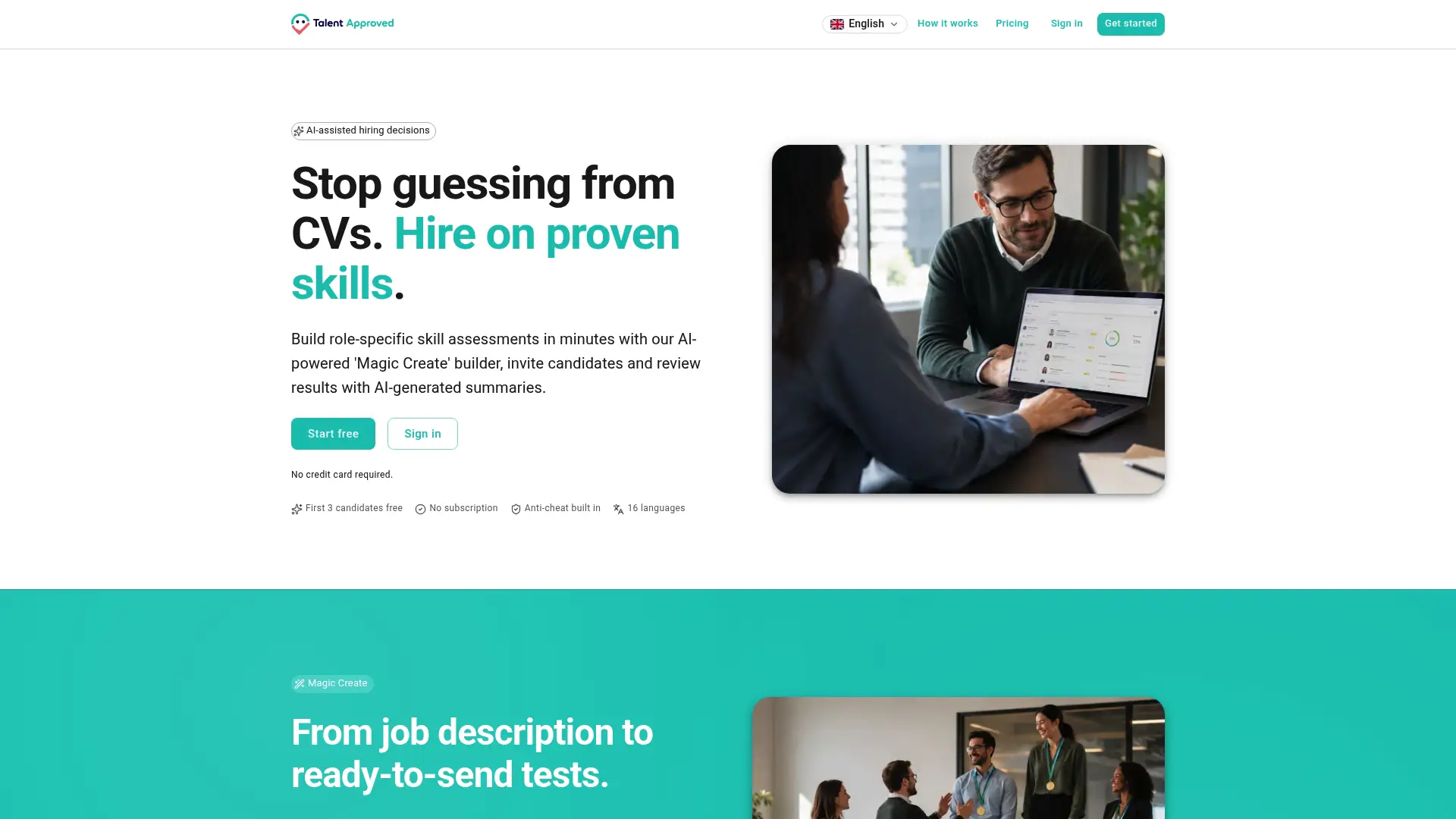
Every assessment run through the platform generates a versioned record: scoring rubrics, session replays, anti-cheat monitoring logs, and AI-generated candidate summaries that give you an audit trail if the EEOC or a rejected applicant ever asks questions. That’s the kind of documentation this article just walked through, built into the workflow instead of bolted on afterward. If you’re standing up a new testing program or auditing an existing one, start building a role-specific assessment and see how the job-analysis-to-test pipeline works for your open roles.
Sources
- 29 C.F.R. Part 1607 - Uniform Guidelines on Employee Selection Procedures
- Employment Tests and Selection Procedures | U.S. Equal Employment Opportunity Commission
- Pre-Employment Inquiries and Medical Questions & Examinations | U.S. Equal Employment Opportunity Commission
- 29 C.F.R. § 1607.4 - Information on impact (CFR excerpt)
- Select issues: Assessing adverse impact in software, algorithms, and AI used in employment selection procedures | EEOC (PDF)
FAQ
What is the EEOC 80% rule?
The four-fifths rule compares selection rates across demographic groups; if any group’s rate falls below 80% of the highest group’s rate, the EEOC treats that as initial evidence of adverse impact requiring further review.
What are the different types of employment tests EEOC regulates?
Common categories include cognitive ability, personality, skills or work-sample, physical fitness, medical, drug, background and credit checks, structured interviews, algorithmic screening tools, situational judgment, integrity, and language proficiency tests.
What should employers report through EEO-1 filings related to testing?
EEO-1 reporting captures workforce demographic data by job category, which employers should reconcile against their own testing and selection-rate records to spot adverse impact before regulators do.
What are the core EEOC guidelines employers must follow?
Tests must be job-related and consistent with business necessity when they cause adverse impact, validated using an accepted UGESP strategy, and supported by documentation available for inspection.
Can Talent Approved help employers meet EEOC testing guidelines?
Talent Approved supports compliance efforts by generating role-specific assessments tied to job descriptions and maintaining versioned records, scoring rubrics, and audit trails, though employers remain responsible for their own validation and adverse-impact analysis.