
How to Transition to CV-Free Hiring Step by Step

Yes, you can replace CV-based screening with a lawful, skills-based hiring process in a 16–20+ week rollout. Start this quarter by auditing your job descriptions, building a skills taxonomy, and picking 2–3 pilot roles, ideally high-turnover or hard-to-fill positions where a faster, fairer screen will show measurable ROI quickly. BCG’s research on skills-based hiring confirms that shifting from credential-focused hiring to skills and potential widens the talent pool and improves long-term retention.
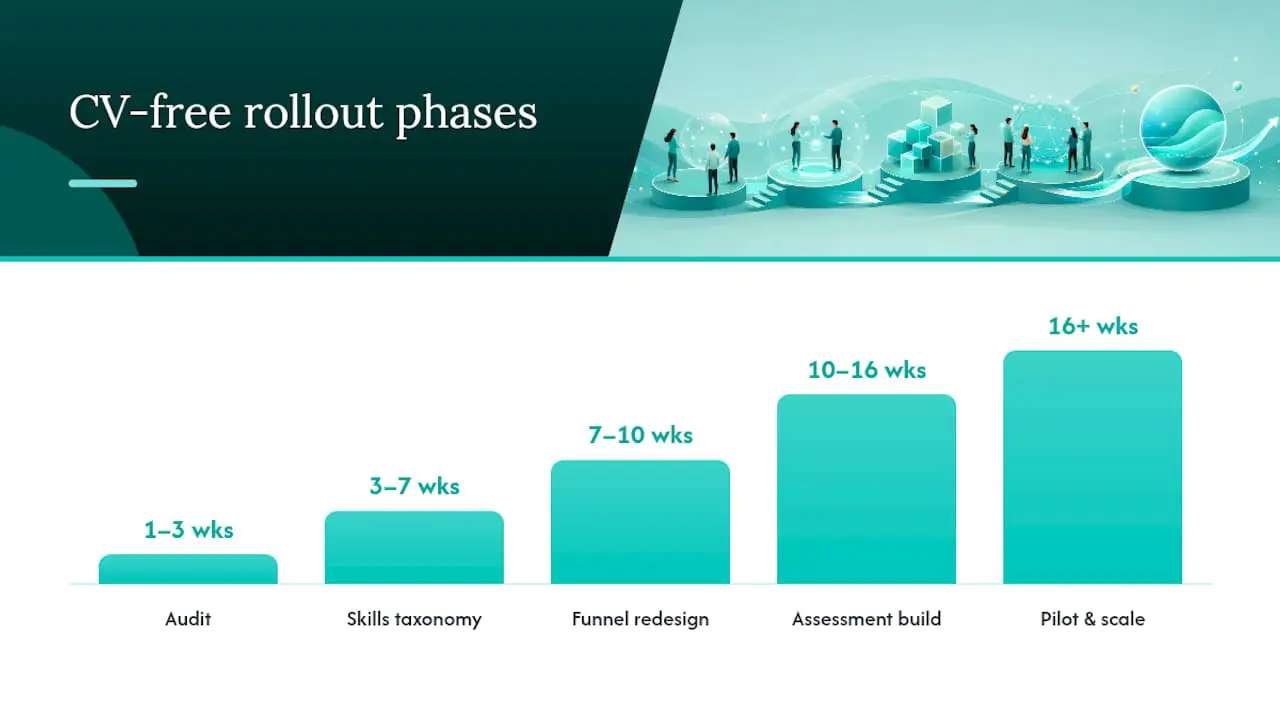
The five-phase arc looks like this: Weeks 1–3 audit existing JDs and flag degree/pedigree filters. Weeks 3–7 build a skills taxonomy. Weeks 7–10 redesign the screening funnel. Weeks 10–16 deploy role-specific assessments. Weeks 16+ run your pilot, measure, and scale.
Quick-start action: Before week 2 ends, pull three job descriptions and highlight every requirement that cannot be directly tested. Those are your first targets for removal.
Key Takeaways
A lawful CV-free hiring transition requires a phased 16–20+ week rollout, a validated skills taxonomy, EEOC-compliant assessments, and a pilot on 2–3 roles before scaling.
| Point | Details |
|---|---|
| Start with a pilot | Choose 2–3 high-turnover or hard-to-fill roles to prove ROI before a wider rollout. |
| Build the taxonomy first | Map 3–5 testable skills per role with proficiency levels before redesigning any screening step. |
| Legal compliance is non-optional | Document job-relatedness, run the 4/5ths adverse-impact test monthly, and require vendor validation studies. |
| Measure at three frequencies | Track funnel metrics weekly, adverse-impact monthly, and quality-of-hire quarterly. |
| Talent Approved accelerates the build | Magic Create, anti-cheat, and AI summaries compress the assessment-build and review phases at $5 per completed candidate. |
Table of Contents
- How to transition to CV-free hiring step by step: the full 16–20+ week plan
- How do you design role-specific assessments that actually predict performance?
- What are the EEOC and Title VII requirements for CV-free hiring?
- How do you get hiring managers to actually use skills-based decisions?
- Which KPIs tell you whether your CV-free process is working?
- Your pilot checklist and sample communications for launch day
- Why does the 16–20+ week timeline work? The evidence behind it
- What the real implementation pitfalls look like
- Talent Approved makes your pilot faster and more defensible
- Sources
- FAQ
How to transition to CV-free hiring step by step: the full 16–20+ week plan
A phased rollout keeps the process manageable and gives you defensible data at each gate. Treegarden’s phase-level roadmap recommends mapping 3–5 testable skills per role before touching the screening funnel, which prevents scope creep later.
| Phase | Weeks | Goal | Key Deliverable |
|---|---|---|---|
| Audit | 1–3 | Identify credential filters and skill gaps | JD audit report; list of untestable requirements |
| Skills taxonomy | 3–7 | Define testable skills per role family | Skills library with proficiency levels (novice to expert) |
| Funnel redesign | 7–10 | Remove CV gate; replace with skills screen | Updated application flow; recruiter brief |
| Assessment build | 10–16 | Create role-specific tests | Validated assessments with rubrics and passing thresholds |
| Pilot and scale | 16+ | Run pilot on 2–3 roles; measure and expand | Pilot report; go/no-go decision memo |
Owner assignments matter. HR owns the audit and taxonomy. Legal reviews every assessment for job-relatedness before launch. Hiring managers co-author rubrics and calibrate scoring in weeks 12–14. IT or your vendor handles ATS integration by week 9. Salary frames this as: build skill-based profiles, identify gaps, rewrite JDs, deploy assessments, and track outcomes, which maps cleanly to the phases above.
Go/no-go gates: At week 10, confirm legal sign-off and at least one validated rubric before building assessments. At week 16, confirm candidate drop-off is below your baseline before scaling.
How do you design role-specific assessments that actually predict performance?
Multi-measure assessments outperform single-format screens. Combine at least two of these formats per role:
- Work sample: Candidates complete a realistic task (a code snippet, a written brief, a data analysis). Highest predictive validity for technical roles.
- Simulation or microtask: A condensed version of a real job scenario. Works well for customer-facing and operations roles.
- Structured interview with behavioral anchors: Scored against a 1–5 rubric tied to specific job duties, not general impressions.
- Credentials review: Verify claimed certifications or licenses only when the credential is legally required for the role.
Build your rubric by mapping each skill to proficiency levels and writing one concrete example behavior per level. A shared 1–5 scale reduces scorer drift and increases inter-rater reliability across panels. Set passing thresholds before you see any results, not after, to avoid post-hoc rationalization.
Example task templates:
- Technical role (software engineer): “Fix this bug in the provided code snippet within 30 minutes. Explain your reasoning in 3–5 sentences.” Score on correctness, code quality, and communication clarity.
- Nontechnical role (customer success): “A client emails you upset about a billing error. Write a response that resolves the issue and retains the relationship.” Score on tone, accuracy, and resolution quality.
The EEOC’s employer testing guide recommends combining tests, work samples, and structured scoring to reduce selection errors. When selecting a platform, your feature checklist should include: AI test generation from a job description, anti-cheat with screen and webcam monitoring, session replay, multilingual support, AI-generated candidate summaries, and reviewer workflow tools.
Pro Tip: Keep total assessment time under 45 minutes for most roles. Longer tests increase drop-off without proportionally improving signal quality. For part-time or high-volume roles, 20–30 minutes is the practical ceiling.
What are the EEOC and Title VII requirements for CV-free hiring?
Under Title VII and EEOC guidelines, every selection procedure must be job-related and consistent with business necessity. If an assessment produces adverse (disparate) impact on a protected group, you must justify its use and confirm no viable, less-discriminatory alternative exists. The Uniform Guidelines on Employee Selection Procedures (UGESP) provide the validation framework.
The legal standard is job-relatedness, not novelty. Any assessment, AI-powered or otherwise, must link directly to the duties of the specific role. Vendors must supply validation studies that document that linkage before you deploy.
Practical compliance checklist:
- Document the job analysis that ties each test to specific duties.
- Run adverse-impact analysis using the 4/5ths (80%) rule after each hiring cycle. If a protected group’s selection rate falls below 80% of the highest-selected group’s rate, investigate.
- For small samples (under 30 per group), use Fisher’s Exact Test rather than the 4/5ths rule alone.
- Require vendors to provide technical manuals, bias audit results, and data-handling clauses before signing.
- Obtain candidate consent for any behavioral or biometric data collection.
- Schedule revalidation every 12–18 months or when the role changes materially.
Fisher Phillips identifies six mitigation steps for AI assessments: validation, bias audits, vendor transparency, candidate disclosure, HR training, and ongoing monitoring. Build all six into your vendor contract and your internal SOPs before launch.
Accessibility matters legally and practically. Offer alternative formats (extended time, screen-reader-compatible interfaces) and document every accommodation request and response.
How do you get hiring managers to actually use skills-based decisions?
Stakeholder alignment is where most transitions stall. Map your stakeholders early: CHRO (executive sponsor), legal (compliance sign-off), hiring managers (rubric co-authors), recruiting ops (process owners), and your DEI lead (diversity metrics and bias audits).

Manager training should include three elements. First, a mock scoring session where managers score the same candidate responses independently, then compare results and discuss gaps. Second, a calibration session before each new role launches to align on what “3 out of 5” actually looks like for that role’s rubric. Third, a scorecard review after the first 10 candidates to catch drift early.
Panel composition is a practical lever most teams overlook. Panels that include members from different educational backgrounds are less likely to penalize candidates who lack traditional credentials. Rotate panel members across hiring cycles to prevent group-think from calcifying.
The longer-term culture work is harder. BCG emphasizes that skills-based hiring must be persistent: promotions and internal mobility should use the same skill frameworks as external hiring. If you hire on skills but promote on tenure and pedigree, you create a two-tier system that undermines the entire program.
Which KPIs tell you whether your CV-free process is working?
Track metrics at three frequencies. Weekly: time-to-hire, interview-to-offer rate, offer-accept rate, and candidate drop-off by stage. Monthly: adverse-impact ratios by protected group and assessment completion rates. Quarterly: quality-of-hire (6-month and 12-month performance ratings) and assessment reliability scores.

| Metric | Frequency | Decision threshold |
|---|---|---|
| Time-to-hire | Weekly | Flag if >10% above pre-pilot baseline |
| Adverse-impact ratio | Monthly | Investigate if any group falls below 80% selection rate |
| Candidate drop-off | Weekly | Pause assessment if >25% abandon before completion |
| Quality-of-hire (6-month) | Quarterly | Revalidate assessment if correlation with performance drops |
| Assessment reliability | Quarterly | Revalidate if inter-rater reliability is low |
When adverse impact appears, your first response is analysis, not removal. Check whether the test is measuring a skill genuinely required for the role. If it is, document that finding. If it is not, revise or replace the assessment before the next cycle.
Your pilot checklist and sample communications for launch day
A clean pilot launch requires these steps completed before you post a single role:
- Select 2–3 roles with high turnover or long time-to-fill.
- Build and QA the assessment (test it yourself and with one recruiter).
- Brief the recruiting team with a written script explaining the CV-free process.
- Get legal sign-off on the assessment and the candidate-facing language.
- Set up your analytics dashboard to capture funnel and diversity metrics from day one.
Sample candidate email:
“Thank you for your interest in [Role] at [Company]. We evaluate all candidates through a short skills assessment rather than a CV review. The assessment takes approximately [X] minutes and focuses on [Skill 1] and [Skill 2]. If you need an accommodation, reply to this email before starting. Your results will be reviewed within [X] business days.”
CV-free job description snippet:
“We hire based on what you can do, not where you went to school. This role requires [Skill A], [Skill B], and [Skill C]. No degree requirement. All candidates complete a short, paid skills assessment as the first step.”
Skills-based job ads tend to list more explicit, transferable soft skills than traditional postings. When rewriting JDs, choosing the right skills to test is the decision that shapes everything downstream.
Pro Tip: Send a brief “what to expect” email 24 hours before the assessment link expires. Completion rates improve noticeably when candidates know the deadline and the time commitment upfront.
Why does the 16–20+ week timeline work? The evidence behind it
The week ranges are realistic because each phase has a genuine dependency on the one before it. You cannot build a valid assessment without a skills taxonomy. You cannot redesign the funnel without legal sign-off on the assessment format. Rushing any phase compresses the validation work that makes the process legally defensible.
The multi-measure approach is not just best practice; it is the standard the EEOC’s testing guide recommends. Combining work samples, structured interviews, and scored simulations increases predictive validity compared to any single measure. The Treegarden roadmap confirms that week-based deliverables and a phased approach are the practical model practitioners use, not a theoretical ideal.
Talent Approved’s Magic Create feature shortens the assessment-build phase materially. Paste a job description, and the platform generates a role-specific assessment in minutes. Anti-cheat tools with screen and webcam monitoring, session replays, and AI-generated candidate summaries handle the review workflow without adding headcount.
What the real implementation pitfalls look like
The most consistent mistake HR leaders make is trying to convert the entire organization at once. A company-wide rollout without a validated pilot is a high-risk bet. The skills taxonomy is incomplete, the rubrics are untested, and hiring managers have not been calibrated. The result is inconsistent scoring and, often, a quiet retreat to CV screening within two quarters.
They document the before-and-after numbers, time-to-hire and 6-month retention, and use that data to earn budget and buy-in for the next wave. The pilot is not a test of the concept; it is the proof you need to scale.
Talent Approved makes your pilot faster and more defensible
Running a CV-free pilot without the right platform means building assessments in spreadsheets, chasing candidates for results, and manually reviewing dozens of responses. Talent Approved removes that friction at every step.
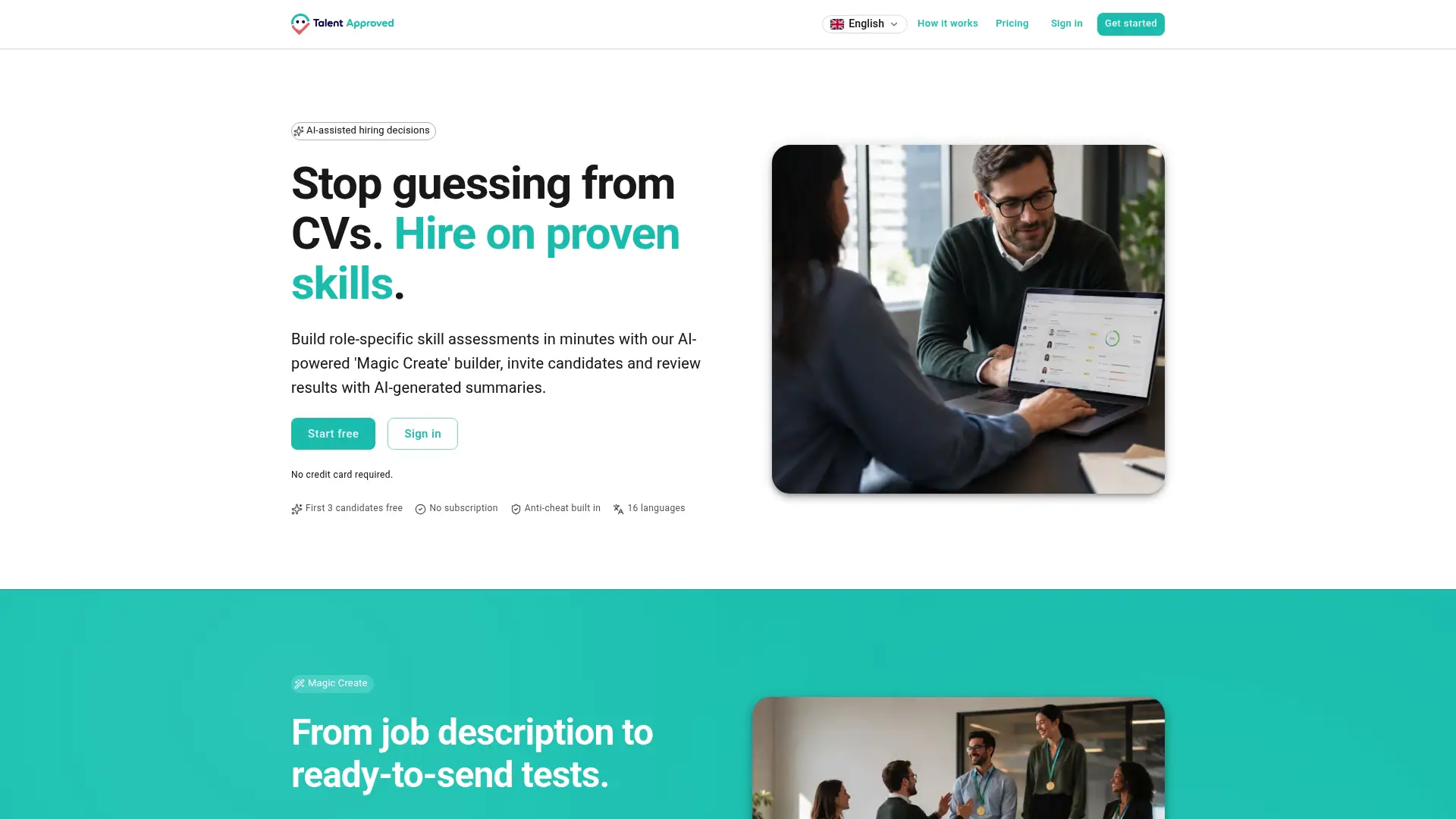
Magic Create generates a role-specific assessment from your job description in minutes, not days. Anti-cheat tools with screen and webcam monitoring and session replay give you confidence in result integrity. AI-generated summaries rank candidates and surface key findings so your team spends time on decisions, not data entry. There is no subscription: you pay $5 per completed candidate assessment, which means your pilot costs exactly as much as the number of candidates who finish it. Pick your pilot role, paste your JD into Magic Create, and run your first assessment today.
Sources
The following primary sources informed the legal, assessment design, and implementation guidance in this article:
- Employment Tests and Selection Procedures | U.S. Equal Employment Opportunity Commission
- Thinking About Gamified AI Hiring Assessments? 6 Legal Risks and 6 Mitigation Steps to Consider | Fisher Phillips LLP
- Bcg
- Salary
- Skills-Based Hiring: How to Implement It Step by Step | Treegarden Blog
This article is general information, not a substitute for advice from a qualified lawyer. Consult a qualified legal professional about your own circumstances before acting on anything here.
FAQ
How long does a CV-free hiring transition realistically take?
A full transition takes 16–20+ weeks when phased correctly: audit (weeks 1–3), skills taxonomy (weeks 3–7), funnel redesign (weeks 7–10), assessment build (weeks 10–16), and pilot launch with measurement from week 16 onward.
Is CV-free hiring legal under U.S. employment law?
Yes, provided every assessment is job-related, consistent with business necessity, and validated under EEOC and UGESP standards. Employers must monitor for adverse impact and document their validation choices.
What is the 4/5ths rule in skills-based hiring?
The 4/5ths (80%) rule states that if a protected group’s selection rate falls below 80% of the highest-selected group’s rate, adverse impact is indicated and the employer must investigate and justify the assessment.
How does Talent Approved support a CV-free pilot?
Talent Approved’s Magic Create feature generates role-specific assessments from a job description in minutes. Anti-cheat monitoring, session replays, and AI candidate summaries handle result integrity and review, with no subscription required at $5 per completed assessment.
How many skills should a CV-free job description include?
Map 3–5 directly testable skills per role. Skills-based job ads tend to list more explicit, transferable skills than traditional postings, but keeping the list focused on what you can actually assess prevents scope creep in your rubric design.