
What Is a Talent Acquisition Strategy? A 2026 Guide

A talent acquisition strategy is a written, multi-year plan that guides how an organization identifies, attracts, evaluates, and hires the talent it needs to meet business goals. Unlike reactive recruiting, which fills seats as they open, a mature talent acquisition strategy operates as a 12 to 36-month operating plan linking hiring directly to revenue, product, and capability targets. The distinction matters: 77% of talent leaders now align their talent acquisition strategies with total business value creation rather than cost reduction alone. That shift signals a fundamental change in how high-performing organizations think about hiring.
What is a talent acquisition strategy built on?
A talent acquisition strategy rests on seven interconnected pillars. Effective strategies integrate workforce planning, employer brand, sourcing, candidate experience, assessment, technology, and analytics as a single operating system, not a collection of separate programs. Each pillar requires an owner, a set of KPIs, and a review cadence to function well.
Here is what each pillar covers in practice:
- Workforce planning: Forecast hiring demand based on business growth, attrition, and capability gaps. This connects headcount decisions to revenue and product plans, not just backfill requests.
- Employer value proposition (EVP): Define what makes your organization worth joining. A clear EVP shapes job postings, recruiter conversations, and candidate outreach.
- Multi-channel sourcing: Use a mix of job boards, employee referrals, talent communities, and direct outreach. Track cost-per-source to allocate budget where it produces the best candidates.
- Candidate experience: Design every touchpoint from first contact through onboarding. Candidates who have a poor experience share it widely, which damages your employer brand.
- Assessment and selection: Use structured interviews, scorecards, and skills-based tests to evaluate candidates consistently. Standardized methods reduce bias and improve defensibility.
- Technology stack: Integrate your applicant tracking system, assessment tools, and analytics dashboards so data flows without manual effort.
- Analytics and continuous improvement: Track outcomes at each stage and use the data to refine your process quarterly.
Pro Tip: Document your strategy as a written plan, not a shared understanding. A written TA strategy survives leadership changes and prevents institutional knowledge from becoming folklore that disappears when key people leave.
How does a mature talent acquisition strategy differ from traditional recruitment?

Traditional recruitment is transactional. A vacancy opens, a recruiter posts a job, screens applicants, and fills the role. The process restarts the next time a seat empties. This reactive model treats hiring as a fire drill rather than a strategic investment, and the financial consequences are real.
Organizations that operate tactically pay what practitioners call an “enterprise tax.” Strategic TA reduces cost-per-hire by 25–40% compared to tactical approaches over a three to five year horizon. That gap compounds. A company making 200 hires per year at a $5,000 cost-per-hire premium pays $1 million more annually than a competitor with a mature TA function.
A mature talent acquisition strategy differs from traditional recruitment in three specific ways:
- Continuity: A TA strategy runs continuously, building talent pipelines and employer brand even when no roles are open. Recruitment starts only when a vacancy exists.
- Alignment: TA strategy connects hiring plans to business objectives, product roadmaps, and revenue targets. Recruitment responds to headcount requests without that context.
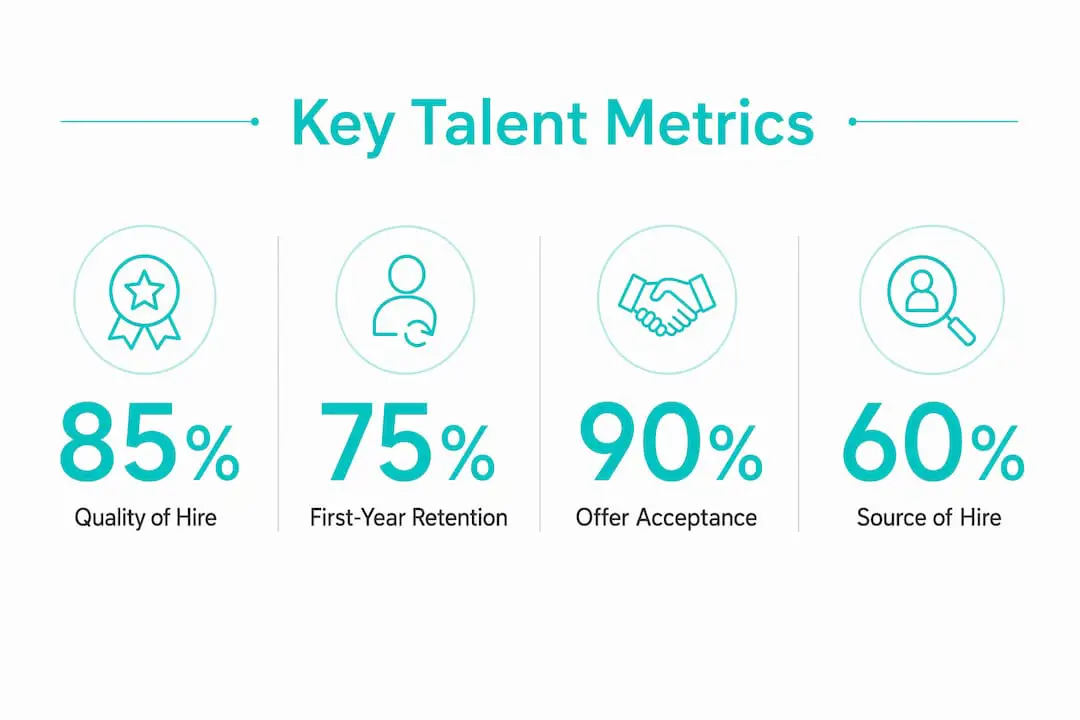
- Measurement: TA strategy tracks quality of hire, first-year retention, and source effectiveness. Recruitment typically measures time-to-fill and cost-per-hire alone.
The shift from reactive to proactive is not cosmetic. It changes who owns hiring decisions, how recruiters spend their time, and what success looks like at the end of each quarter.
How to develop a talent acquisition strategy that actually works
Building a talent acquisition plan requires structure and sequence. Skipping steps early creates expensive rework later.
-
Set your hiring forecast. Start with the business plan. How many people does the organization need to hire in the next 12 months? Which roles are critical to revenue? Which skills are hardest to source? Answering these questions before opening any requisitions prevents the scramble that drives up costs.
-
Define talent profiles and success criteria. Before sourcing begins, write a clear profile for each role: required skills, experience level, performance indicators for the first 90 days, and deal-breaker criteria. Vague job descriptions attract mismatched applicants and waste everyone’s time.
-
Build structured screening and interview processes. Structured interviews and standardized evaluation improve hiring consistency and defensibility, especially in high-volume environments. Use scorecards so every interviewer evaluates the same criteria in the same way.
-
Align recruiters and hiring managers before sourcing starts. Hiring manager alignment is the single most common failure point in talent acquisition. When recruiters and managers disagree on what “good” looks like, the process stalls, candidates drop out, and the wrong people get hired.
-
Select and integrate your technology. Choose tools that support your process without creating extra manual steps. Your applicant tracking system, assessment platform, and analytics tools should share data automatically.
-
Track the right KPIs from day one. Quality of hire, offer acceptance rate, first-year retention, and source of hire tell you whether your strategy is working. Time-to-fill tells you only how fast you moved, not whether you moved in the right direction.
Pro Tip: Run a skills-based hiring process alongside structured interviews. Candidates who demonstrate skills in a test environment give hiring managers concrete evidence to evaluate, which shortens decision cycles and reduces second-guessing.
What role does technology play in modern talent acquisition strategies?
Technology does not replace a talent acquisition strategy. It amplifies one. The most effective teams use technology to improve signal quality in the early hiring funnel, not simply to process more applicants faster.
High-performing teams shift from volume-based recruiting to signal-driven hiring, focusing on identifying qualified candidates earlier rather than increasing the total number of applications. This approach produces faster decisions, less bias, and more defensible outcomes. The practical implication is that a well-designed skills assessment at the top of the funnel outperforms a high-volume job board campaign that floods recruiters with unqualified applicants.
Key technology applications in a mature TA strategy include:
- AI-powered skills assessments: Evaluate candidates on role-relevant tasks before the interview stage. This surfaces qualified candidates who might not have impressive CVs and filters out those who look good on paper but cannot perform the work.
- Structured evaluation platforms: Standardize how interviewers score candidates so that data from different interviewers is comparable and defensible.
- Analytics dashboards: Track funnel conversion rates, source quality, and time-in-stage to identify where candidates drop out and why.
- Automated candidate communication: Keep candidates informed at each stage without adding recruiter workload. Silence is one of the top reasons candidates withdraw.
AI should support role-relevant signal detection within structured processes, with humans retaining accountability for final decisions. Over-reliance on AI without human review creates legal exposure and misses context that algorithms cannot capture.
How can organizations measure talent acquisition strategy success?
Measurement is what separates a strategy from a wish list. KPIs such as quality of hire, retention, offer acceptance, and source of hire provide real insight into whether a TA strategy is working. Time-to-fill alone tells you nothing about whether the person hired will succeed.
The most useful metrics feed back into planning. If first-year retention is low for a specific role, the talent profile or assessment process needs revision. If offer acceptance rates drop, the EVP or compensation structure may be misaligned with the market. Each metric points to a specific lever.
Pro Tip: Review your quality of hire metrics quarterly, not annually. Annual reviews surface problems too late to correct them before they compound.
Assign ownership for each pillar and its associated metrics. A TA strategy without clear ownership defaults to whoever has the most urgent open requisition, which is the definition of reactive recruiting. Establish a quarterly review cadence where pillar owners present results, identify gaps, and propose adjustments. This cadence is what turns a written strategy into a living operating system.
Without a documented TA strategy, organizations consistently incur higher costs and produce worse hiring outcomes. Documentation is not bureaucracy. It is the mechanism that makes continuous improvement possible.
Key Takeaways
A talent acquisition strategy is a written, multi-year operating plan that connects hiring to business goals and consistently outperforms reactive recruitment on cost, quality, and retention.
| Point | Details |
|---|---|
| Strategy vs. recruitment | TA strategy is proactive and continuous; recruitment is reactive and vacancy-driven. |
| Seven-pillar framework | Effective strategies integrate workforce planning, EVP, sourcing, candidate experience, assessment, technology, and analytics. |
| Financial impact | Strategic TA reduces cost-per-hire by 25–40% compared to tactical approaches over three to five years. |
| Measurement matters | Track quality of hire, first-year retention, and source of hire, not just time-to-fill. |
| Documentation is non-negotiable | A written strategy survives leadership changes and enables continuous improvement cycles. |
Why most TA strategies fail before they start
The most common failure I see is organizations treating talent acquisition strategy as a project rather than an operating system. A team spends weeks building a plan, presents it to leadership, and then files it away. Six months later, recruiters are back to filling requisitions one at a time with no connection to business goals.
The second failure is confusing technology adoption with strategy. Buying an AI assessment tool or a new applicant tracking system is not a strategy. It is a tool purchase. The strategy is the documented plan that defines which roles to hire for, what good looks like, how candidates are evaluated, and how results are measured. Technology supports that plan. It does not replace it.
The organizations that build durable TA functions share one habit: they treat the written strategy as a living document with a named owner and a quarterly review. They update it when business priorities shift, when sourcing channels stop performing, or when retention data reveals a hiring quality problem. That discipline is what separates a mature TA function from a well-intentioned but ultimately reactive recruiting team.
Invest in your people’s ability to execute the strategy, not just in the tools they use. A recruiter who understands workforce planning and can connect a hiring decision to a revenue target is worth more than any platform subscription.
— Jimmie
How Talent Approved supports your talent acquisition strategy
Structured assessment is one of the hardest pillars to execute consistently at scale. Talent Approved gives HR teams and recruiters an AI-powered platform to build role-specific skills tests in minutes using the Magic Create feature. Simply input a job description or a list of required skills, and the platform generates a tailored assessment ready to send to candidates.
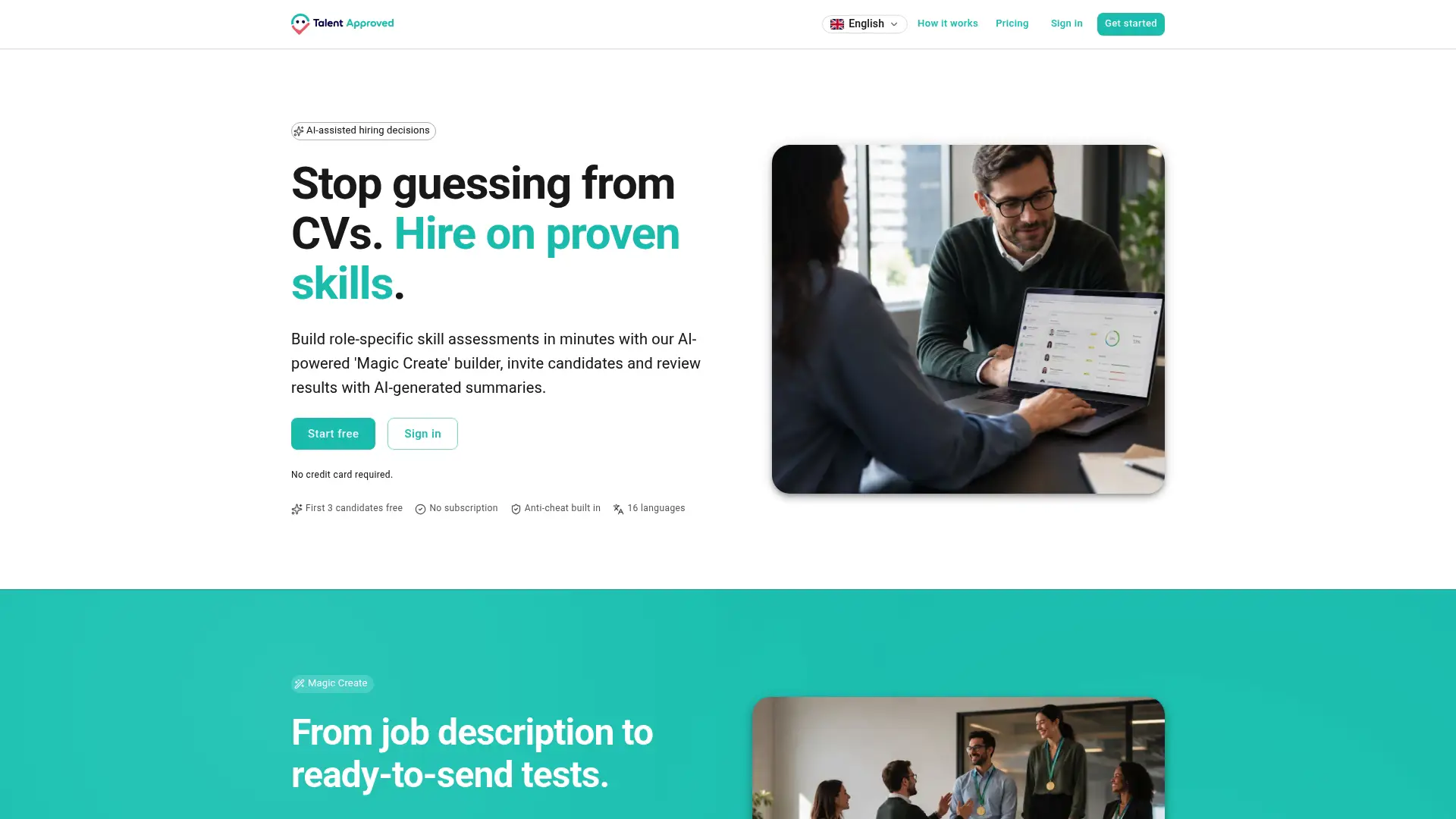
Built-in anti-cheat proctoring and AI-generated candidate summaries mean your team spends less time reviewing raw responses and more time making confident hiring decisions. The platform supports the assessment pillar of your TA strategy by delivering consistent, bias-reducing signal at the top of the funnel. Explore how Talent Approved works and see how structured skills testing fits into your hiring process.
FAQ
What is a talent acquisition strategy in simple terms?
A talent acquisition strategy is a written plan that defines how an organization will attract, evaluate, and hire the talent it needs to meet its business goals over the next one to three years.
How does talent acquisition differ from recruitment?
Recruitment fills open vacancies reactively. Talent acquisition operates continuously, building pipelines and employer brand even when no roles are open, and connects hiring decisions to long-term business objectives.
What are the most important KPIs for a talent acquisition strategy?
Quality of hire, first-year retention, offer acceptance rate, and source of hire are the most informative metrics. Time-to-fill is useful but insufficient on its own.
How long does it take to build a mature talent acquisition strategy?
A documented strategy can be drafted in four to six weeks, but reaching operational maturity, where all seven pillars have owners, KPIs, and review cadences, typically takes one to two years of consistent execution.
Why do organizations without a TA strategy pay more per hire?
Organizations without a documented strategy default to reactive recruiting, which inflates cost-per-hire by 25–40% compared to those with mature, proactive talent acquisition frameworks built over three to five years.