
The Role of Hiring Manager Alignment in Effective Hiring

Hiring manager alignment is defined as the shared, structured understanding between recruiters and hiring managers about role requirements, evaluation criteria, and decision ownership throughout the hiring process. This goes far beyond a quick kickoff meeting. Teams with high alignment exceed business goals 79% of the time, compared to just 36% for low-alignment teams. That gap is not a coincidence. It reflects whether your hiring process runs on shared infrastructure or on assumptions. The role of hiring manager alignment determines whether your team selects the right candidates consistently or repeats costly mistakes. Misaligned hiring decisions can cost up to 30% of an employee’s first-year salary, making alignment a financial priority, not just an HR preference.
What is the role of hiring manager alignment in the hiring process?
Hiring manager alignment is the operational backbone of effective hiring team collaboration. Without it, recruiters and hiring managers pull in different directions, evaluate candidates against different standards, and make decisions based on different information. The result is a slower pipeline, higher bias risk, and candidates who accept offers but leave within the first year.
The standard industry term for this concept is “recruiter-hiring manager alignment,” and it covers three distinct layers. The first is role clarity: both parties agree on what the job actually requires, not just what the job description says. The second is evaluation alignment: both parties use the same criteria to assess candidates. The third is decision ownership: both parties know who makes which call and when.
Defined decision ownership reduces friction and speeds hiring by removing the ambiguity that causes delays. When a hiring manager waits for a recruiter to make a call that is actually the hiring manager’s responsibility, the pipeline stalls. When a recruiter overrides a hiring manager’s instinct without data to back it up, trust erodes. Alignment prevents both failure modes.
What are the hiring manager’s responsibilities in achieving alignment?
Clear accountability is the foundation of effective hiring strategy alignment. Each role in the hiring team carries distinct responsibilities, and blurring those lines creates the operational friction that slows hiring down.
Hiring manager responsibilities:
- Define the role’s success criteria, not just its tasks
- Establish what “good” looks like for this specific position and team context
- Make the final selection decision with full context from the recruiter
- Participate in structured intake meetings and scorecard reviews
- Provide timely, evidence-based feedback after each interview stage
Recruiter responsibilities:
- Orchestrate the hiring process from intake to offer
- Own sourcing strategy, candidate experience, and pipeline management
- Translate hiring manager requirements into screening criteria
- Deliver structured candidate summaries that support informed decisions
HR business partner responsibilities:
- Confirm compliance with employment law and internal policy
- Manage escalation protocols when recruiter and hiring manager disagree
- Audit the process for bias risk and documentation gaps
Hiring managers must own the definition of “good” and make selection decisions. Recruiters manage processes but should not make hiring decisions without full context from the hiring manager. This boundary is not about hierarchy. It is about placing decisions with the person who has the most relevant context.
Pro Tip: Document each person’s decision rights in a one-page RACI chart before the intake meeting. Shared visibility on who is responsible, accountable, consulted, and informed prevents the most common alignment breakdowns before they start.

How do shared artifacts sustain alignment throughout hiring?
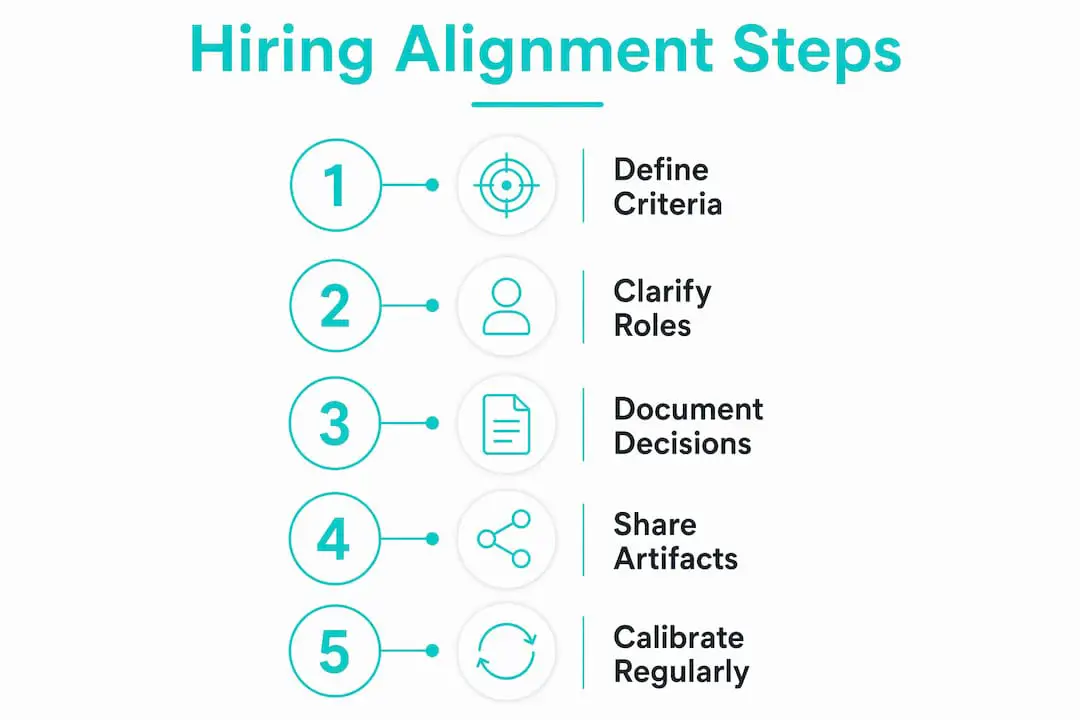
The most common mistake in hiring alignment is treating it as a one-time agreement reached in a kickoff meeting. True alignment requires shared artifacts that are continuously updated and used across every stage of the hiring process. Meetings fade from memory. Documents do not.
The difference between agreement and alignment comes down to infrastructure. Agreement is what you reach in a conversation. Alignment is what persists when that conversation’s participants change roles, go on leave, or leave the company entirely.
| Approach | What it looks like | What breaks it |
|---|---|---|
| Agreement only | Verbal kickoff, shared expectations in memory | Personnel change, time, competing priorities |
| Alignment infrastructure | Shared intake brief, live scorecard, linked panel invites | Rarely breaks; survives team changes |
| Ad hoc feedback | Email threads, verbal debrief | Lost context, inconsistent criteria |
| Structured evidence | Scored rubrics with written rationale | Auditable, bias-resistant, transferable |
Shared intake briefs capture the role’s must-haves, nice-to-haves, and disqualifying factors in one document that both the recruiter and hiring manager sign off on. Candidate scorecards with written evidence replace gut-feel assessments with documented reasoning. Linked panel invites connect interviewers to the same scorecard, so every evaluator uses the same criteria.
Teams that use structured, explainable, shared data report 3.8 times higher relationship quality and better candidate close rates. That improvement comes from trust. When a hiring manager can see exactly why a recruiter advanced a candidate, and when a recruiter can see exactly why a hiring manager passed, both parties make better decisions faster.
Pro Tip: Build your alignment artifacts in a shared system, not in email. A scorecard that lives in a recruiter’s inbox is not shared infrastructure. It is a private document that disappears the moment that recruiter leaves.
What are the biggest obstacles to hiring alignment and how do you fix them?
58% of hiring teams experience operational friction with their recruiter or hiring manager counterpart, even though 90% rate the relationship as good or excellent. This gap reveals the core problem: alignment issues are often invisible until they cause a real breakdown. The relationship feels fine. The process does not work.
The four most common obstacles and their fixes:
-
Mismatched incentives. Recruiters are often measured on speed and volume. Hiring managers are measured on team performance. These metrics pull in opposite directions. Fix this by agreeing on a shared success metric, such as quality of hire at 90 days, before the search begins.
-
Informational gaps. Recruiters and hiring managers often look at different candidate data. The recruiter sees the full application and sourcing context. The hiring manager sees a resume and interview notes. Fix this by standardizing the candidate summary format so both parties review the same structured information.
-
Conflict without a resolution path. When a recruiter and hiring manager disagree on a candidate, the pipeline stalls. Evidence-based scorecards and a defined escalation system within 24 hours prevent bottlenecks and maintain hiring momentum. The HR business partner serves as the escalation point when the two parties cannot resolve the disagreement directly.
-
Undefined decision boundaries. When neither party knows who makes the final call, both parties either defer or override each other. Fix this by documenting decision rights explicitly: the recruiter decides who advances to the hiring manager, and the hiring manager decides who receives an offer.
Pro Tip: Schedule a 15-minute structured calibration review after every two or three candidate rejections. If the hiring manager is consistently passing on candidates the recruiter advances, the intake criteria need updating, not the candidates.
Why does mission alignment matter for hiring manager collaboration?
Mission and values alignment is the layer of hiring alignment that most teams skip. Role alignment tells you whether a candidate can do the job. Values alignment tells you whether they will stay and contribute at full capacity. Both matter and the hiring manager is responsible for embedding both into the evaluation process.
Employees with mission alignment are 5.6 times more engaged and have burnout rates of 13% compared to 38% for those without it. That difference shows up in retention, team cohesion, and the quality of work produced over time.
The shift from culture fit to behavioral alignment is a practical one. Culture fit is subjective and prone to bias. Behavioral alignment is observable and documentable. You can assess behavioral alignment through values-based interviewing, which asks candidates to describe specific past situations that reveal how they act under pressure, in conflict, and when priorities shift.
Key practices for embedding values alignment into hiring manager collaboration:
- Add two to three behavioral interview questions tied to company values to every scorecard
- Require written evidence, not just a score, for each values-based criterion
- Debrief on values fit separately from skills fit to prevent one from overriding the other
- Use candidate motivation assessment techniques to surface whether a candidate’s goals align with the role’s actual growth path
Hiring managers who treat values alignment as a checkbox create teams that perform adequately in stable conditions but fracture under stress. Hiring managers who treat it as a structured evaluation criterion build teams that hold together when conditions change.
Key Takeaways
Hiring manager alignment is the single most reliable predictor of whether a hiring team consistently selects the right candidates and achieves its business goals.
| Point | Details |
|---|---|
| Alignment drives business results | Teams with high alignment exceed business goals 79% of the time versus 36% for low-alignment teams. |
| Define decision ownership clearly | Hiring managers own the final selection decision; recruiters own process and pipeline management. |
| Build shared artifacts, not just agreements | Intake briefs, scorecards, and linked panel invites sustain alignment when personnel or priorities change. |
| Address hidden friction early | 58% of teams experience operational friction despite rating their relationships as good or excellent. |
| Values alignment improves retention | Mission-aligned employees are 5.6 times more engaged and have significantly lower burnout rates. |
Alignment is infrastructure, not a kickoff meeting
I have watched well-intentioned hiring teams run thorough kickoff meetings, shake hands on the criteria, and then diverge completely by the second round of interviews. The hiring manager starts favoring candidates who remind them of past high performers. The recruiter keeps advancing candidates who match the written job description. Neither party is wrong. They are just working from different mental models of the same role.
The fix is not more meetings. The fix is making the shared mental model visible and permanent. When I see a team struggling with alignment, the first question I ask is: “Can you show me your scorecard?” If the answer is “we have one somewhere” or “the recruiter has it,” the problem is already clear. Alignment lives in shared systems, not in individual memories.
The recruiter-hiring manager relationship works best when each party respects the other’s domain. Recruiters are pattern recognizers. They see hundreds of candidates and can spot signals that a hiring manager, who interviews a handful of people per quarter, will miss. Hiring managers are decision owners. They know what the team needs, what the role actually demands day to day, and what kind of person will thrive in that specific context. When both parties operate from shared data and respect those distinct accountabilities, the hiring process becomes genuinely collaborative rather than a series of handoffs and second-guessing.
Quick escalation protocols matter more than most teams realize. A disagreement that sits unresolved for a week does not just delay one hire. It damages the relationship and makes the next disagreement harder to resolve. Build the escalation path before you need it, and use it without hesitation when you do.
— Jimmie
How Talent Approved supports hiring team alignment
Alignment depends on shared, structured candidate data. Without it, recruiters and hiring managers evaluate candidates through different lenses and reach different conclusions. Talent Approved gives both parties the same evidence-backed view of every candidate.
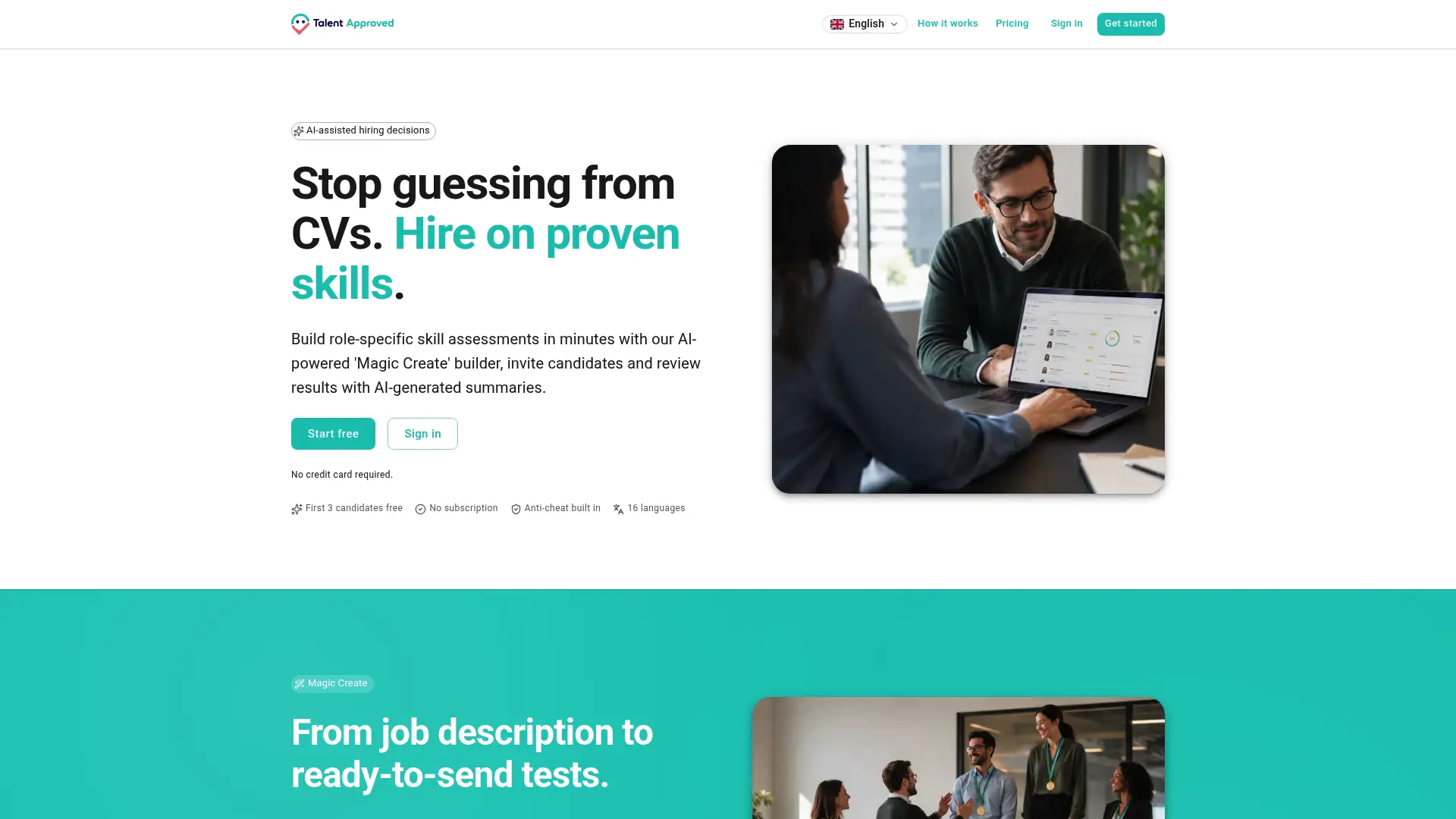
Talent Approved’s AI-powered skill assessments generate structured candidate summaries that both recruiters and hiring managers can review before interviews. The Magic Create feature builds role-specific assessments in minutes from a job description, so your scorecard criteria are grounded in actual role requirements from day one. Built-in anti-cheat mechanisms and AI-generated summaries reduce the administrative burden on both sides, freeing up time for the calibration conversations that matter. If you want to see how it works in practice, the how it works page walks through the full assessment process. Improving your quality of hire metrics starts with giving your hiring team a shared source of truth.
FAQ
What is hiring manager alignment?
Hiring manager alignment is the shared, structured understanding between recruiters and hiring managers about role requirements, evaluation criteria, and decision ownership. It functions as continuous infrastructure, not a one-time agreement.
Why does hiring alignment affect business performance?
Teams with high hiring alignment exceed business goals 79% of the time, compared to 36% for low-alignment teams. The gap reflects whether hiring decisions are made from shared data or from separate assumptions.
What causes operational friction between recruiters and hiring managers?
Mismatched incentives, informational gaps, and undefined decision boundaries are the three primary causes. Structured scorecards and a defined escalation path within 24 hours resolve most conflicts before they stall the pipeline.
How do shared scorecards improve hiring team collaboration?
Shared scorecards give both recruiters and hiring managers the same evaluation criteria and documented evidence for each candidate. Teams using structured, explainable shared data report 3.8 times higher relationship quality and better candidate close rates.
What is the difference between culture fit and behavioral alignment?
Culture fit is subjective and prone to bias. Behavioral alignment is observable and documented through values-based interviewing, which asks candidates to describe specific past situations that reveal how they act under real conditions.