
The Role of Data in Hiring Decisions: An HR Playbook

Data connects candidate signals to predicted job outcomes. When HR teams use it well, they fill roles faster, select stronger performers, and build a defensible record that holds up under EEOC scrutiny. When they skip it, they rely on gut instinct that is hard to validate and harder to improve. The research backs this up: a multi-sector study of 423 HR professionals found that AI-assisted hiring reduced time-to-hire significantly, though bias mitigation gains were modest without additional safeguards. That gap between speed and fairness is exactly where governance and structured assessments, like those Talent Approved provides, do their most important work.
What you can do in the next 30–90 days:
- Measure: Pull your current time-to-hire, cost-per-hire, and first-year retention data from your ATS or HRIS.
- Pilot: Choose one role or team and introduce a structured skill assessment with a defined scoring rubric.
- Audit: Run an adverse impact check on your shortlist data and document your selection criteria before you scale.
Table of Contents
- What does data-driven hiring actually mean for HR teams?
- What types of hiring data should you collect?
- How do you collect and prepare reliable hiring data?
- What measurable outcomes does data-driven hiring deliver?
- Which hiring metrics should you track, and how do you read them?
- How do you implement data-driven hiring step by step?
- What are the bias risks and legal safeguards you need to know?
- Which tool categories support data-driven hiring?
- How structured skill assessments changed one hiring workflow
- Key Takeaways
- The part most HR teams skip
- Talent Approved makes structured assessments fast to build and easy to audit
- Useful sources and further reading
- FAQ
What does data-driven hiring actually mean for HR teams?
Data-driven hiring means using structured, measurable signals to make and document every selection decision, from sourcing through offer. It is not the same as automating your process or buying an AI tool. The distinction matters.
AIHR defines data-driven recruitment as using recruiting metrics to track success, eliminate guesswork, and build legally defensible processes. That definition covers four stages: sourcing (where candidates come from), assessment (how skills and fit are measured), selection (how shortlists are built), and workforce planning (how hiring connects to business capacity). Each stage generates data you can act on.
Do:
- Measure skill outcomes with validated assessments and structured interview rubrics.
- Document selection criteria before screening begins, not after.
- Use data to identify process bottlenecks and justify resource allocation.
- Maintain consent records and audit trails at every stage.
Don’t:
- Equate automation with fairness. Speed gains do not automatically reduce bias.
- Treat your ATS data as complete. Missing fields and inconsistent schemas distort every metric downstream.
- Retrain models on outcomes from a biased prior process without correcting the source data first.
The EEOC requires employers to demonstrate that selection procedures are job-related and consistent with business necessity. Data-driven hiring, done correctly, gives you that evidence. Done carelessly, it just scales your existing blind spots faster.
What types of hiring data should you collect?
HR teams have access to more data than most use systematically. The practical taxonomy below covers the primary types, with a concrete example of how each informs a decision.
- Application metadata: Timestamps, source channel, drop-off points. Use it to identify where candidates abandon your funnel and which channels produce completed applications.
- Assessment scores: Skill tests, work samples, and cognitive ability scores. Work-sample and structured assessments predict job performance more reliably than resume screening or unstructured interviews. Use a score threshold to build your shortlist.
- Interview rubric scores: Structured ratings from hiring managers on defined competencies. Reduces interviewer-to-interviewer variance and gives you a comparable record across candidates.
- ATS/CRM sourcing data: Source-of-hire tags, pipeline stage durations, and channel conversion rates. Use it to shift budget toward channels that produce hires, not just applicants.
- HRIS and performance outcomes: First-year performance ratings, 90-day productivity markers, and retention data. These are the downstream signals that validate whether your selection criteria actually predict success.
- Candidate experience surveys: Post-process feedback on clarity, fairness, and communication. Flags deterrence issues before they affect your funnel.
- External labor-market benchmarks: Salary ranges, role availability, and competitor hiring velocity from sources like the Bureau of Labor Statistics or LinkedIn Talent Insights.
| Data Type | Typical Fields / Sources | Common Pitfalls |
|---|---|---|
| Application metadata | Source tag, timestamp, stage, drop-off point (ATS) | Incomplete source tagging; multi-touch attribution gaps |
| Assessment scores | Skill test results, work-sample ratings (assessment platform) | Proxy bias if test content correlates with demographics |
| Interview rubric scores | Competency ratings, notes (structured scorecard) | Inconsistent rubric use across interviewers |
| Sourcing data | Channel, cost, conversion rate (ATS/CRM) | Conflating applicant volume with hire quality |
| Performance outcomes | 90-day review, first-year rating, retention (HRIS) | Lag time; manager rating bias in downstream data |
| Candidate surveys | NPS, fairness rating, communication score | Low response rates skew results |
| Labor-market benchmarks | Salary bands, availability index (BLS, LinkedIn) | Stale data if not refreshed quarterly |
How do you collect and prepare reliable hiring data?
Reliable analysis starts with clean, consistently structured data. Most HR teams have the right tools already; the gap is usually in how those tools are connected and how data is stored.
Tool categories to use:
- ATS (Greenhouse, Lever, Workday Recruiting): the primary source for pipeline, source, and stage data.
- Assessment platforms (Talent Approved and similar): generate structured, exportable scores tied to specific roles.
- HRIS (Workday, BambooHR, SAP SuccessFactors): the source of truth for post-hire performance and retention.
- Sourcing analytics (LinkedIn Talent Insights, built-in ATS dashboards): channel conversion and cost data.
- Candidate experience surveys (Culture Amp, Typeform): post-process feedback tied to candidate IDs.
Data-hygiene checklist:
- Assign unique candidate IDs that persist across systems.
- Standardize field names and value formats before any cross-system export.
- De-duplicate records when candidates apply to multiple roles.
- Timestamp every stage transition so you can calculate accurate time-to-hire and time-to-fill.
- Store consent records alongside candidate data, not in a separate file.
- Version your data exports so audits can reproduce any historical analysis.
For integration, prioritize tools that offer API connections or structured CSV exports with consistent schemas. Practical recruitment dashboards built from these exports let you track source effectiveness, cost-per-hire, and channel conversion in one place. Audit trails, meaning timestamped logs of who accessed or changed a record, are not optional if you want a defensible process.
Pro Tip: Create a lightweight data dictionary for your recruitment dataset. Define every field name, its allowed values, and the system it comes from. Version it alongside your data exports. This single document cuts onboarding time for new analysts and makes every audit reproducible.

What measurable outcomes does data-driven hiring deliver?
The business case for using data in hiring decisions is concrete. Each benefit below maps directly to a metric your leadership team can verify.
- Higher quality of hire: Structured assessments and validated scoring rubrics select candidates whose skills match role requirements. Pair this with 90-day performance data and you can calculate the correlation between your selection signals and on-the-job output. For enterprise recruiting KPIs, quality-of-hire is the metric that connects TA to business outcomes.
- Faster time-to-hire: The F1000Research study found a statistically significant reduction in time-to-hire when AI-assisted tools were introduced (β = 0.61, p < 0.001). Faster screening cycles reduce the risk of losing candidates to competing offers.
- Lower cost-per-hire: Source-of-hire analysis lets you reallocate budget from high-volume, low-conversion channels to those that consistently produce hires. That shift compounds over time.
- DEI insights: Selection ratio data broken down by demographic group reveals where your funnel narrows disproportionately. Without this data, you cannot identify or fix the problem.
- Workforce planning accuracy: Historical hiring velocity and attrition data let you forecast headcount needs before a gap becomes urgent, rather than reacting to it.
- Stakeholder alignment: A shared dashboard of agreed KPIs gives hiring managers and HR leadership a common language. SHRM guidance recommends pairing speed metrics with quality measures like time-to-productivity and first-year success to avoid overemphasizing speed at the expense of fit.
Which hiring metrics should you track, and how do you read them?
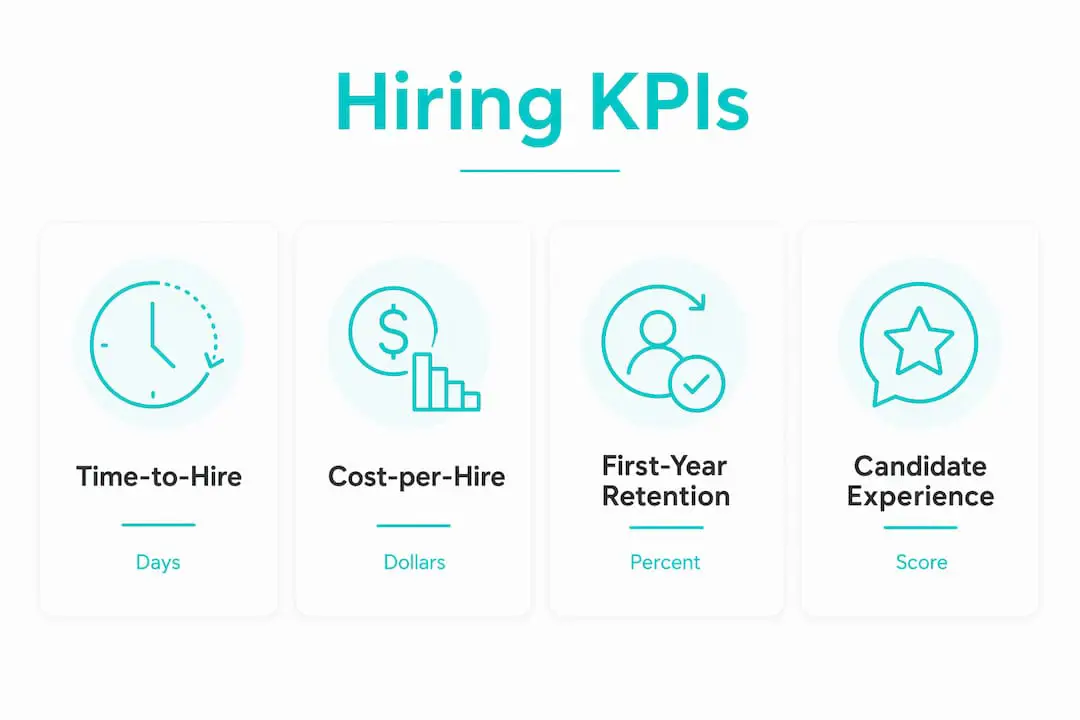
Tracking the right metrics matters less than interpreting them correctly. The table below covers the core KPIs, with a one-line interpretation tip and the most common misuse for each.
| Metric | Definition | Interpretation Tip | Common Misuse |
|---|---|---|---|
| Time-to-hire | Days from application to accepted offer | Segment by role level; executive roles skew averages | Optimizing speed without tracking quality-of-hire |
| Time-to-fill | Days from job opening to accepted offer | Includes sourcing lag; useful for workforce planning | Conflating with time-to-hire (different start points) |
| Cost-per-hire | Total recruiting spend ÷ number of hires | Include agency fees, tool costs, and recruiter time | Excluding internal costs understates the true figure |
| Quality-of-hire | Composite of performance, retention, and ramp time | Requires post-hire data; set a 90-day review cadence | Using manager satisfaction alone as a proxy |
| Selection ratio | Hires ÷ applicants per stage | Run by demographic group to detect adverse impact | Ignoring stage-level ratios; only tracking final ratio |
| Source-of-hire | Channel that produced each hire | Pair with quality-of-hire to assess channel value | Optimizing for volume rather than downstream performance |
| Candidate drop-off | Percentage who abandon at each funnel stage | Spikes at assessment or asynchronous interview stages signal user experience friction | Ignoring drop-off data until pipeline volume falls |
| Recruiter-to-hire ratio | Hires per recruiter per quarter | Benchmarks capacity and flags overload before it affects quality | Using it to cut headcount without examining role complexity |
Pro Tip: Triangulate metrics rather than reading them in isolation. A channel with a low cost-per-hire but a high first-year attrition rate is not a good channel. Connect your sourcing data to your HRIS performance data at least quarterly to validate which sources actually produce lasting hires.
For a deeper breakdown of recruiter efficiency metrics, including how to set benchmarks by role type and team size, the Talent Approved resource library covers the full KPI stack.
How do you implement data-driven hiring step by step?
A phased approach reduces risk and gives you real evidence before you commit to a full rollout. Here is a sequenced playbook.
- Define success metrics first. Before you touch any tool, decide what “a good hire” means for the role you are piloting. Write down the 90-day and first-year indicators you will use to validate your selection model.
- Map your data sources. Audit which systems hold which data, whether fields are consistently populated, and where the gaps are. Fix schema inconsistencies before you start collecting.
- Run a small pilot. Choose one role family or one team. Keep the sample large enough to be meaningful (aim for at least 30 hires over the pilot period) and set a fixed duration of 60–90 days.
- Collect the right data during the pilot. Track source-of-hire, assessment scores, interview rubric scores, time-to-hire, and candidate drop-off rates. Capture hiring manager feedback at the 30- and 90-day marks.
- Evaluate outcomes against your defined metrics. Did your selection signals predict the performance indicators you set in step one? Where did the model fail?
- Iterate before scaling. Adjust your scoring rubrics, drop underperforming channels, and fix any drop-off spikes. Document every change.
- Scale with governance. Roll out to additional roles with a defined review cadence, a named data owner, and a bias audit scheduled at least annually.
Questions to ask any vendor before you buy:
- Can we export raw scores in a structured format?
- How does your scoring model work, and can you explain a specific decision?
- Do you provide audit logs of who accessed or changed candidate records?
- What bias-detection features are built in, and how are they tested?
Red flags to watch for:
- No raw data export; you can only see aggregate dashboards.
- Opaque scoring with no explanation of how a candidate ranked.
- No audit logs or consent-management features.
- Vendor cannot demonstrate validity evidence for their assessments.
What are the bias risks and legal safeguards you need to know?
Data can reveal bias or amplify it. The outcome depends entirely on how you govern the process. A PLOS One analysis of algorithmic bias in HR systems found that models trained on historically biased outcome data reproduce and compound those biases at scale, particularly when proxy features (zip code, school name, employment gaps) correlate with protected characteristics.

The F1000Research study reinforces this: AI tools produced modest bias mitigation (β = 0.21, p < 0.05) and no significant improvement in candidate trust without additional safeguards. Speed gains are real; fairness gains require deliberate design.
Practical pitfalls to avoid:
- Biased training data: If your historical hires skew toward one demographic, a model trained on those outcomes will replicate that skew.
- Feedback loops: Retraining a model on outcomes from a biased prior process compounds the original error. Correct the source data before retraining.
- Candidate deterrence: A field experiment with 3,000 applicants found that asynchronous audio and video interviews caused over a 50% decrease in application continuation, with disproportionate effects on women. Candidate experience design is a fairness issue, not just a UX issue.
- Proxy discrimination: Features that seem neutral (commute distance, degree institution) can function as proxies for race or socioeconomic status.
U.S.-focused legal and compliance steps:
- Document your selection criteria and the job-relatedness rationale for every assessment before screening begins.
- Run adverse impact analyses (four-fifths rule) on your selection ratios by race, sex, and other protected classes, as EEOC guidance requires.
- Maintain consent records for every candidate whose data you process.
- Apply data minimization: collect only what you need for the specific hiring decision.
- Keep audit trails that show which criteria were applied and when.
Pro Tip: Schedule a fairness audit at the end of every pilot and annually thereafter. Run a proxy-feature scan to check whether any input variable correlates with a protected characteristic at a rate that could indicate disparate impact. Document the results and your remediation steps.
Which tool categories support data-driven hiring?
No single platform covers the full data-driven hiring stack. You will typically combine tools from several categories. Here is what each category does and what to look for when evaluating options.
Applicant Tracking Systems (ATS): The pipeline backbone. Look for consistent source tagging, stage-level conversion tracking, exportable data in structured formats, and API connections to your HRIS and assessment tools.
Assessment platforms: Generate structured, role-specific scores from skill tests and work samples. Selection criteria: validated assessments with published reliability data, raw score exports, explainable results, anti-cheat features, and bias-detection capabilities. Talent Approved’s AI-powered assessment platform covers all of these, including AI-generated summaries that make score review faster without removing human judgment.
Video and asynchronous interview platforms: Useful for screening at scale, but carry candidate-experience risk. Require clear candidate communication about the format, opt-out alternatives, and structured scoring rubrics to keep results comparable.
HRIS and performance systems: The source of post-hire validation data. Integration between your ATS and HRIS is what makes quality-of-hire measurement possible. Without it, you are guessing.
Analytics and BI tools: Tableau, Power BI, and Looker can visualize your recruiting funnel when fed clean, consistently structured data. The tool is not the bottleneck; the data quality is.
Sourcing and CRM tools: Track candidate engagement before application. Useful for measuring pipeline health and time-to-engage by channel.
Architecture advice: Store assessment scores in a vendor-agnostic format outside the assessment platform itself. This protects your data if you switch vendors and makes cross-tool analysis straightforward. Prefer open export formats (CSV, JSON) over proprietary dashboards for any data you will use in audits.
For guidance on psychometric testing and how structured assessments fit into a broader tooling strategy, the Talent Approved article library covers the selection criteria in detail.
How structured skill assessments changed one hiring workflow
A mid-size technology services team was screening software engineers primarily through resume review and a single unstructured phone screen. Hiring managers reported inconsistent shortlists and a first-year attrition rate that suggested selection signals were weak.
The intervention was straightforward: replace the unstructured screen with a role-specific skill assessment built around the actual technical tasks in the job description. Scoring was blind, meaning reviewers saw scores before they saw resumes. Interview rubrics were standardized across all hiring managers for the role.
Replication steps:
- Write the assessment around tasks the role performs in the first 90 days, not generic knowledge questions.
- Run blind scoring: evaluate assessment results before reviewing application materials.
- Map each assessment dimension to a 30/60/90-day success indicator so you can validate the signal post-hire.
- Collect hiring manager ratings at 30 and 90 days and compare them to assessment scores to calculate predictive validity.
What to measure in your post-pilot validation:
- Conversion rate from assessment to offer, segmented by source channel.
- First-year performance ratings correlated with assessment scores.
- 12-month retention rate for the pilot cohort versus the prior-year baseline.
- Adverse impact ratios across demographic groups at the assessment stage.
Talent Approved’s Magic Create feature builds role-specific assessments from a job description in minutes. The platform’s AI-generated result summaries let hiring managers review candidate performance quickly, while exportable score data feeds directly into your audit and validation workflow. Hiring accuracy improves when selection signals are structured, documented, and tied to post-hire outcomes.
Key Takeaways
Data-driven hiring requires structured measurement, governed tooling, and human oversight at every stage to convert efficiency gains into fair, defensible hiring decisions.
| Point | Details |
|---|---|
| Define metrics before you screen | Set your quality-of-hire indicators before the pilot starts, not after results come in. |
| Bias requires active governance | The F1000Research study found only modest bias mitigation (β = 0.21) without deliberate safeguards; speed gains do not fix fairness gaps. |
| Async assessments affect your funnel | A field experiment found asynchronous interviews caused over a 50% drop in application continuation; design candidate experience carefully. |
| Triangulate, don’t optimize one metric | Pair time-to-hire with first-year retention and source-of-hire quality to avoid trading speed for fit. |
| Talent Approved for structured assessments | Talent Approved’s Magic Create builds role-specific skill tests from job descriptions, with exportable scores and AI summaries for auditable, bias-aware hiring. |
The part most HR teams skip
The conversation around data-driven hiring tends to focus on tools and dashboards. What gets less attention is the change-management work that determines whether any of it sticks.
Hiring managers are the most important variable in the system. You can build a perfect assessment rubric and a clean data pipeline, and it will still fail if hiring managers treat scores as a formality and make decisions on instinct afterward. The fix is not more training decks. It is short, role-specific calibration sessions where managers see the correlation between past assessment scores and actual 90-day performance for their own team. That evidence, specific to their context, changes behavior faster than any policy document.
Stakeholder buy-in follows the same logic. When HR presents a dashboard of abstract KPIs, leadership nods and moves on. When HR presents a specific finding, such as “our top-performing channel last quarter had a 40% lower first-year attrition rate than our highest-volume channel,” the conversation shifts to resource allocation. Data earns credibility when it answers a question the business is already asking.
The governance rituals matter too. Monthly metric reviews with a named data owner, a standing adverse impact check at the end of every pilot, and a documented change log for any scoring adjustment. These are not bureaucratic overhead. They are what separates a defensible process from a liability.
Talent Approved makes structured assessments fast to build and easy to audit
Structured skill assessments are one of the highest-leverage actions you can take to improve hiring quality, and Talent Approved is built to make them practical for HR teams without a large technical team behind them.
Magic Create generates a role-specific assessment from a job description in minutes. Every test includes built-in anti-cheat mechanisms, so scores reflect genuine candidate ability. AI-generated summaries give hiring managers a clear picture of each candidate’s performance without requiring them to review raw data manually. And every result is exportable, giving you the structured score data you need for post-pilot validation, adverse impact analysis, and audit trails.
- Fast setup: Build a tailored assessment from a job description in under 10 minutes.
- Structured scoring: Consistent rubrics reduce interviewer variance and produce comparable candidate records.
- Exportable results: Download scores in structured formats for integration with your HRIS or BI tool.
- AI summaries: Review candidate performance quickly without sacrificing depth or oversight.
Ready to run your first structured pilot? Create your first skill test and see how fast you can move from job description to a scored, auditable shortlist.
Useful sources and further reading
These are the primary sources behind this article’s claims, plus practical guides for deeper work.
-
Transformations in Talent Acquisition: Measuring AI’s Impact — F1000Research survey of 423 HR professionals quantifying AI’s effect on time-to-hire, candidate experience, bias mitigation, and trust. Use this to build your internal business case and set realistic expectations for what AI tools will and won’t fix.
-
Data-Driven Recruitment: The Benefits and 5 Best Practices — AIHR’s practitioner guide covering data sources, metric selection, and common pitfalls. Useful for teams building their first recruiting dashboard or standardizing their ATS data structure.
-
SHRM: Data-Driven Recruiting Proves Business Impact — SHRM guidance on pairing speed metrics with quality-of-hire measures. Recommended reading before any KPI presentation to senior leadership.
-
Algorithmic Bias in HR Recruitment Systems — PLOS One analysis of how algorithmic systems reproduce historical bias, including the ML-BAMS framework for modular bias detection. Essential for teams planning to retrain or build custom scoring models.
-
A Brave New World of Hiring: Field Experiment on Asynchronous Interviews — Natural field experiment with 3,000 applicants documenting the candidate-experience effects of async interviews and AI assessments. Read this before deploying any asynchronous screening step.
-
Talent Approved: How It Works — Platform overview covering assessment creation, anti-cheat features, AI summaries, and result exports. The practical next step if you are ready to pilot structured skill assessments.
Pro Tip: When presenting any of these findings to leadership, pair the efficiency data (time-to-hire reductions) with the governance data (bias mitigation limitations). Presenting only the efficiency gains sets expectations that the evidence does not support and creates credibility risk when the limitations surface later.
FAQ
How can data improve the quality of hiring decisions?
Data replaces subjective impressions with structured, comparable signals. Structured assessments and validated scoring rubrics predict job performance more reliably than resume review or unstructured interviews, and post-hire performance data lets you validate and refine your selection criteria over time.
What is the role of data in HR decision-making?
Data gives HR teams evidence to identify process bottlenecks, justify resource allocation, and build legally defensible selection processes. The goal is not to automate decisions but to make them traceable, consistent, and improvable.
What is the 70/30 rule in hiring?
The 70/30 rule is an informal practitioner guideline suggesting that about 70% of a hiring decision should rest on measurable, structured signals (assessment scores, rubric ratings, verified credentials) with around 30% on qualitative judgment (cultural fit, communication style, contextual factors). Use it as a framing device for calibration conversations with hiring managers, not as a fixed formula.
Why is data important for reducing bias in recruitment?
Without data, bias operates invisibly. Selection ratio analysis broken down by demographic group is the primary tool for detecting adverse impact under EEOC guidance. However, data alone does not eliminate bias: a PLOS One study found that models trained on historically biased outcomes reproduce those biases at scale, which is why audit trails, proxy-feature scans, and human oversight are required alongside any data-driven process.