
How Hiring Accuracy Is Measured: A Guide for HR Teams

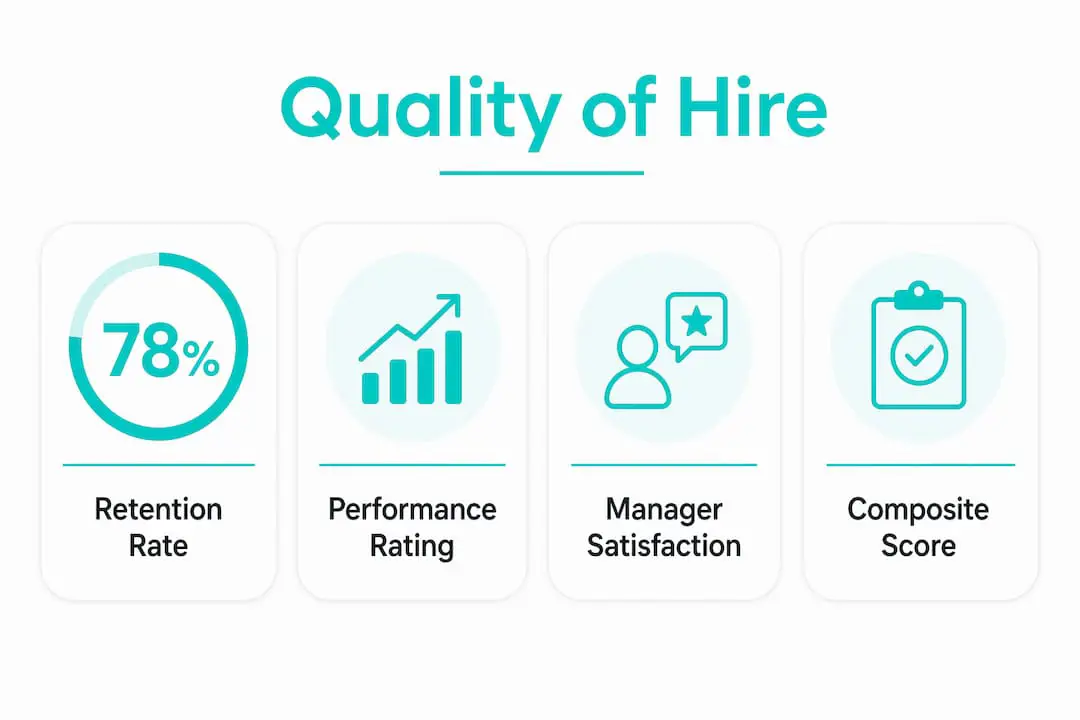
Hiring accuracy is the objective measurement of how well recruitment decisions predict employee success, using validated performance and retention data collected after a hire starts. The industry standard for tracking this is the Quality of Hire composite metric, which combines four equally weighted components: 12-month retention rate (target 78%), performance rating (target 3.5/5), hiring manager satisfaction (target 3.8/5), and time to productivity (target 4.2 months). These four components normalize to a 0–100 scale, giving HR teams a single, comparable score across roles and departments. Understanding how hiring accuracy is measured at this level connects recruitment decisions directly to business outcomes, including revenue growth.
What are the key metrics used to measure hiring accuracy?
The Quality of Hire Index is the most widely accepted framework for measuring recruitment effectiveness. Each component captures a different dimension of post-hire success, and no single metric tells the full story on its own.
The four core components
- Retention rate: Measured at 12 months post-hire. A target of 78% signals that the role fit and onboarding were strong enough to keep the employee engaged past the initial adjustment period.
- Performance rating: Collected from manager reviews at 90 days and again at 6 months. A target of 3.5 out of 5 reflects solid, sustained contribution rather than a honeymoon-period spike.
- Hiring manager satisfaction: Surveyed at 30 and 90 days. A target of 3.8 out of 5 captures whether the hire met the manager’s expectations for skills and team fit.
- Time to productivity: The average target is 4.2 months. Shorter ramp-up times indicate that the candidate’s skills matched the role requirements from day one.
Each component is scored on a normalized 0–100 scale before averaging into the composite. The European average composite score sits at approximately 72 out of 100, which serves as a useful external benchmark for teams building their first baseline.
| Metric | Target benchmark | When to collect |
|---|---|---|
| Retention rate | 78% at 12 months | 12 months post-hire |
| Performance rating | 3.5 / 5 | 90 days and 6 months |
| Manager satisfaction | 3.8 / 5 | 30 days and 90 days |
| Time to productivity | 4.2 months | Ongoing until full output |

The composite score matters because it prevents any one data point from distorting the picture. A hire who performs well at 90 days but leaves at month eight scores poorly on retention, which the composite captures accurately.
How do organizations collect and validate data for hiring accuracy?
Multi-source data collection is the foundation of reliable hiring accuracy measurement. Pulling from a single system, such as your HRIS alone, produces an incomplete picture because different stakeholders own different parts of the data.
The most effective approach integrates four sources:
- HRIS data for retention and tenure records
- Performance management systems for structured review scores
- Manager surveys for satisfaction and ramp-up assessments
- Employee engagement tools for early signals of disengagement or cultural misfit
Siloed data is the most common obstacle. When HR owns retention data but managers own performance scores, the two sets rarely sync automatically. Assigning a dedicated data owner for each metric, and scheduling quarterly reconciliation reviews, closes that gap.
Longitudinal tracking produces far more valid data than short-term snapshots. High-quality hires are measured not just by short-term performance but also by longer-term retention and achievement, including promotions and peer recognition. A hire who earns a promotion at 18 months represents a different level of success than one who simply stays.
Calibration sessions are one of the most underused validation tools available. Calibration sessions can reduce interview rating variance by up to 25%, aligning interviewer expectations and improving score reliability. Monthly meetings where interviewers review scored examples together normalize behavioral anchors and reduce the personal bias that skews individual ratings.
Pro Tip: Before adopting any AI recruitment platform, request role-specific accuracy benchmarks from the vendor, not platform-wide averages. Generic platform stats often conflate basic keyword filtering with advanced AI capabilities, which inflates expectations and leads to poor hires.
What are the common challenges when measuring hiring accuracy?
Measurement obstacles are predictable, and knowing them in advance lets you design around them.
-
Overreliance on a single metric. Using retention rate alone ignores performance quality. Using performance scores alone ignores whether the hire stays long enough to deliver value. Relying on a single indicator oversimplifies hiring accuracy, and the Society for Industrial and Organizational Psychology strongly recommends multi-metric approaches that integrate feedback, retention, performance, and cultural fit.
-
Biased manager ratings. Managers who hired a candidate are often reluctant to rate them poorly, especially in the first 90 days. Structured rating scales with defined behavioral anchors reduce this effect significantly.
-
Misinterpreting correlational data. A high Quality of Hire score in one department does not prove that the hiring process caused the result. External factors like team leadership, compensation, and market conditions all influence retention and performance. Always examine context before drawing causal conclusions.
-
Inconsistent cultural fit measurement. Cultural fit is real and consequential, but it resists easy quantification. Without a defined competency framework, different managers score it differently, making it useless as a comparative metric. Standardized behavioral interview questions tied to specific values produce more consistent data.
-
Vendor marketing claims versus verified benchmarks. Many AI recruitment platforms lack independently verified, role-specific accuracy benchmarks. Organizations that accept platform-wide statistics at face value often discover that performance in their specific job categories falls well below the advertised average.
-
Low measurement consistency across organizations. Less than one-quarter of organizations consistently measure Quality of Hire in detail, even though consistent measurement correlates with lower turnover and stronger performance. The gap between knowing measurement matters and actually doing it remains wide.
What practical strategies improve the accuracy of hiring measurement?
The most reliable hiring accuracy improvement strategies combine structured processes with technology that produces verifiable data.
Build a multi-metric framework from the start. Define which four or five metrics your organization will track before the first hire is made under the new system. Retroactively adding metrics creates gaps in your baseline data that make trend analysis unreliable.
Run interviewer calibration sessions monthly. Calibration reduces variance in how different interviewers score the same competency. Bring three or four scored interview examples to each session, discuss where scores diverged, and agree on the behavioral anchor for each rating level. This practice directly improves the reliability of your hiring scores over time.
Use AI-assisted screening with validated accuracy data. AI-powered screening increases interview success rates to 53% versus 29% for manual screening. That 24-percentage-point gain reflects a real improvement in candidate quality reaching the interview stage. Talent Approved’s AI skill assessments generate role-specific, structured test results that feed directly into your composite scoring framework.
- Conduct post-hire assessments at 30, 90, and 180 days to capture performance trends early.
- Map each assessment to the competencies defined in the original job description.
- Track candidate source channels alongside Quality of Hire scores to identify which sourcing methods produce the strongest hires.
Pro Tip: Correlate your candidate source data with Quality of Hire scores quarterly. If referrals consistently score 15 points higher than job board hires, that data justifies shifting your sourcing budget. Use psychometric testing insights to add a validated behavioral layer to your scoring framework.
How does hiring accuracy measurement impact talent acquisition success?
Hiring accuracy measurement is not an administrative exercise. It is a direct driver of business performance.
A one-point increase in a standardized Quality of Hire Index correlates with approximately 0.14% higher revenue growth for Fortune 500 companies. That figure means that improving your composite score from 72 to 82 over two years produces a measurable revenue effect, not just a better-looking HR dashboard.
Accurate hiring data also guides where to invest in retention. When your measurement system shows that hires from a specific source channel score consistently low on manager satisfaction at 90 days, you can intervene with targeted onboarding support before those hires become turnover statistics. That kind of early signal is only possible when you collect data at multiple time points rather than relying on annual reviews.
Cultural fit and engagement data, when measured consistently, reveal patterns that performance scores alone miss. A hire who scores 4.2 out of 5 on performance but disengages from team activities by month six is signaling a cultural misalignment that your measurement system should catch. Integrating early performance feedback with engagement and retention data gives you that visibility.
Continuous measurement turns hiring from a one-time decision into a feedback loop. Each Quality of Hire score you collect makes the next hiring decision more accurate, because you are building an evidence base about what predicts success in your specific roles, teams, and culture.
Reducing turnover costs is the most immediate financial benefit. When your measurement system identifies which hiring practices produce the strongest retention, you can replicate those practices at scale. The result is fewer replacement hires, lower recruiting spend, and more stable team productivity.
Key Takeaways
Hiring accuracy is most reliably measured through a composite Quality of Hire framework that integrates retention, performance, manager satisfaction, and time to productivity into a single normalized score.
| Point | Details |
|---|---|
| Use a composite metric | Combine retention, performance, manager satisfaction, and ramp-up time into one normalized 0–100 score. |
| Collect data from multiple sources | Integrate HRIS, performance systems, manager surveys, and engagement tools to avoid blind spots. |
| Run calibration sessions | Monthly calibration reduces interview rating variance by up to 25%, improving score reliability. |
| Measure consistently over time | Less than one-quarter of organizations track Quality of Hire consistently, yet consistency predicts lower turnover. |
| Link scores to business outcomes | A one-point Quality of Hire gain correlates with measurable revenue growth for large organizations. |
Why most hiring measurement programs stall before they deliver results
Most HR teams I have worked with understand the theory of Quality of Hire measurement. They know the metrics, they have seen the benchmarks, and they genuinely want to build a data-driven hiring process. What stops them is not knowledge. It is organizational readiness.
The hardest part of measuring hiring accuracy is not choosing the right metrics. It is getting managers to submit satisfaction surveys on time, getting IT to connect the HRIS to the performance system, and getting leadership to treat a 72 composite score as a starting point rather than a failure. Without that organizational alignment, even the best measurement framework produces data that nobody acts on.
My honest observation is that teams who succeed with hiring accuracy measurement treat it as a continuous improvement tool, not a report card. They set a baseline, run calibration sessions, collect early post-hire data, and adjust their process every quarter. They also use technology that generates structured, role-specific data from the first candidate interaction, which is exactly what tools like Talent Approved’s candidate ranking and AI scoring are built to do. The measurement program that works is the one that starts simple, stays consistent, and builds complexity only after the basics are running reliably.
— Jimmie
Talent Approved and the path to more accurate hiring data
Measuring hiring accuracy requires structured, role-specific data from the moment a candidate enters your process. Talent Approved’s AI-powered platform generates that data automatically.

The Magic Create feature builds a tailored skill assessment from a job description in minutes. Every candidate completes the same structured test, which means your Quality of Hire baseline starts with objective, comparable scores rather than subjective interview impressions. Built-in anti-cheat mechanisms protect data integrity, and AI-generated summaries let you review assessment results quickly without sacrificing depth. You can create your first skill test and start collecting validated candidate data today.
FAQ
What is the standard formula for measuring Quality of Hire?
Quality of Hire is calculated as a composite of four equally weighted metrics: 12-month retention rate, performance rating, hiring manager satisfaction, and time to productivity, each normalized to a 0–100 scale and averaged into a single score.
How often should organizations collect hiring accuracy data?
Collect manager satisfaction and early performance data at 30, 90, and 180 days post-hire, then track retention and longer-term performance at 12 months to build a complete Quality of Hire picture.
What is a good Quality of Hire benchmark score?
The European average composite Quality of Hire score is approximately 72 out of 100. Organizations scoring above this benchmark consistently show stronger retention and performance outcomes.
How does AI screening improve hiring accuracy?
AI-powered screening increases interview success rates to 53% compared to 29% for manual screening, which means more qualified candidates reach the interview stage and your Quality of Hire scores improve at the source.
Why do most organizations fail to measure hiring accuracy consistently?
Less than one-quarter of organizations measure Quality of Hire in detail on a consistent basis. The primary barriers are siloed data systems, lack of stakeholder alignment, and no defined process for collecting post-hire feedback at regular intervals.