Personal Growth Development: An HR Playbook for Skills Programs

Run a role-aligned skills assessment cycle every quarter, tied to a documented skills framework, and feed the results straight into your HCM system. That single habit is what separates HR teams who can prove their impact from teams still guessing at development budgets.
Here’s what to do this week:
- Pick a pilot group of 5 to 10 employees or candidates in one role family.
- Draft a success profile with 8 to 12 role-specific skills, borrowing structure from models like the AIHR T-shaped HR Assessment or a Korn Ferry-style success profile.
- Choose a simple 3 or 4-point scoring scale before you run a single test, and set up scoring in a platform such as Talent Approved so results land in one place from day one.
Table of Contents
- Why Personal Growth Development Programs Matter to the Business
- What Core Components Does a Skills Program Need?
- How Do You Design and Run a Skills Assessment Program?
- What Should You Measure to Prove ROI?
- How Do You Turn Results Into Development That Sticks?
- How Do You Keep Assessment Data Fair and Legally Sound?
- What Should You Look for in Assessment Tooling?
- An HR Practitioner’s Take on Running This at Scale
- What Should You Prioritize as a Skills Program Grows?
- Where to Learn More About Skills Assessment Frameworks
- Run Your Next Assessment Cycle Without the Manual Setup
- Sources
- FAQ
Why Personal Growth Development Programs Matter to the Business
Skills programs stop being an HR nicety once you connect them to numbers leadership already tracks. Korn Ferry finds that a significant majority of CHROs prioritize skills development as a top strategic lever, yet most admit they lack a clear process for building those skills at scale. That gap is where a structured assessment cadence pays off.
Regular validated assessments do three things an annual review never will:
- They give you a hiring accuracy baseline you can defend to a hiring manager.
- They surface internal mobility candidates before you post an external req.
- They turn “we think engineering has a gap” into a specific, ranked list of who needs what.
Ad hoc assessment, by contrast, tends to produce inconsistent scores across managers, no historical trend line, and development budgets spent on whoever asked loudest. Structured personal growth development data replaces that guesswork with a record you can audit.
What Core Components Does a Skills Program Need?
Every durable program rests on the same handful of building blocks, no matter the company size.
- A skills framework: the taxonomy of skills tied to roles and business priorities. Quality check: can a manager point to which framework skill a project actually required?
- Success profiles: the target proficiency level for each skill by role or level, a practice Korn Ferry treats as central to connecting assessment data to workforce planning.
- A rating scale: usually 3 to 4 points, simple enough that two raters land on the same score independently.
- Governance: an owner, a review cadence, and documented validity checks.
- HCM/ATS/LMS integration: so scores flow into records that already drive pay, promotion, and training decisions.
Assessment type should match the decision you’re making. Self-assessments surface awareness gaps; manager ratings add accountability; 360 feedback catches blind spots invisible to a single rater; work samples and simulations measure what someone can actually do, which matters most for hiring. Whichever mix you pick, insist on anti-cheat safeguards and a documented reliability check. A score nobody trusts is worse than no score at all.
How Do You Design and Run a Skills Assessment Program?
Treat this as four connected phases, not one big rollout.
1. Design. Set one business goal per assessment cycle, such as reducing time-to-fill for engineering roles or closing a leadership succession gap. Training Central recommends capping the skill list at 8 to 12 per role. Build a success profile for each skill and lock in a 3 or 4-point rating scale before you touch a spreadsheet. If you’re deciding which skills actually deserve a slot, a structured selection process keeps the list from ballooning to 30 items nobody scores consistently.
2. Run. Pilot with 5 to 10 people first. Tell them plainly why the assessment exists and what happens with their score. A four-week pilot timeline works for most teams: week one for setup and communication, weeks two and three for testing, week four for review. Train every rater on the same rubric before scoring starts. This is also where you calibrate managers so one rater’s “3” means the same thing as another’s “3.”

3. Analyze. Aggregate scores by team and role, then triangulate against performance reviews and hiring outcomes. FirstHR notes that when more than 40% of a group falls below proficiency on a skill, that’s usually a systemic training problem, not five individual performance issues. Below that threshold, treat it as individual remediation instead of a group workshop.
4. Act. Assign an owner to every gap you find, whether that’s the employee’s manager or an L&D lead. Write SMART goals tied directly to the measured gap, not a generic “improve communication” line. Set a reassessment window (30, 90, or 180 days depending on severity) and calendar it now, because gaps you don’t reassess tend to quietly disappear from the record.
What Should You Measure to Prove ROI?
A skills program earns its budget when you can show the numbers behind it, not just the activity.
| KPI | How to calculate or approximate it |
|---|---|
| Skill proficiency trend | Average rating per skill per quarter, tracked over 2 to 4 cycles |
| Development velocity | Time from identified gap to reassessment showing improvement |
| Reassessment delta | Score change (before vs. after) for employees on a development plan |
| Time-to-hire | Days from job posting to accepted offer for assessed vs. non-assessed roles |
| Internal promotion rate | Share of open roles filled internally, tracked before and after program launch |
Employee skills assessment programs improve hiring accuracy and personalize onboarding precisely because the data supports triangulation with these business metrics rather than sitting in isolation.
Visualize results as cohort trend lines, not single snapshots. A heatmap by team and skill catches where three underperforming scores cluster in one department, which is a different intervention than one low score scattered across five teams. Keep reporting to a single quarterly page: one business metric (time-to-hire or retention), the skill scores that moved it, and what you did about the gap.
How Do You Turn Results Into Development That Sticks?
A score without an assigned response just becomes a line item nobody revisits. AIHR’s guidance on embedding development plans into annual HR rhythm works because it forces a decision at the moment the gap is found, not three months later.
A sample SMART goal: “Increase data analysis proficiency from a 2 to a 3 on the team rubric within 90 days by completing a defined course and applying it to one live reporting project, with manager sign-off at the 90-day checkpoint.”
Match the response to gap severity:
- Small gap, high urgency: coaching or a short applied stretch assignment.
- Moderate gap: a structured foundational course plus one on-the-job application.
- Large or systemic gap: formal training program with checkpoints at 30, 90, and 180 days.
Reassess at each checkpoint using the same rating scale you started with, so movement is comparable across cycles.
How Do You Keep Assessment Data Fair and Legally Sound?
Trustworthy scores need three things: validated question design, rater calibration, and a minimum sample size before you draw group-level conclusions from thin data. Skip any one of them and the numbers stop meaning anything.
On fairness, favor anonymized scoring where the format allows it, use anti-cheat controls for remote or timed assessments, and validate your rubric against EEO-aware criteria so no protected class is disadvantaged by question design or scoring pattern. Keep a written record of who can access individual scores and for how long.
Pro Tip: Run a short calibration session before every assessment cycle where raters score the same sample candidate independently, then compare notes. Disagreements bigger than one point on your scale usually mean the rubric needs a clearer definition, not stricter raters.
What Should You Look for in Assessment Tooling?
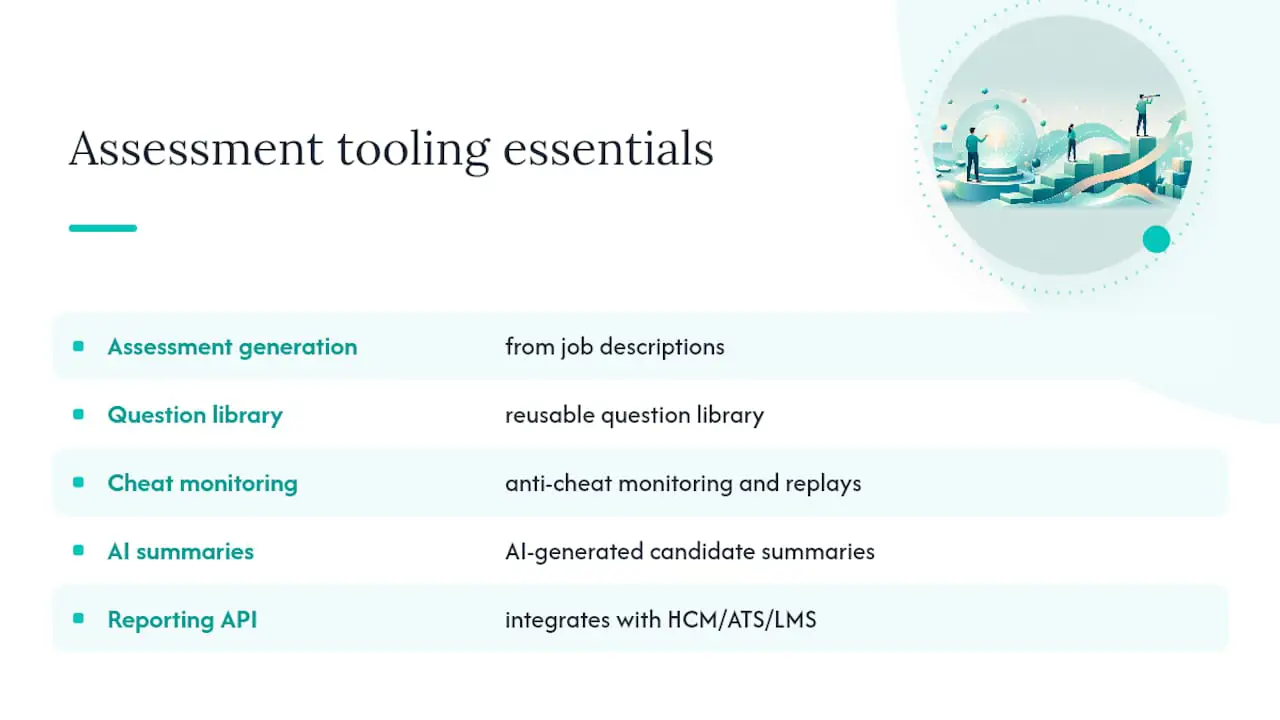
Whatever platform you choose, the feature checklist stays the same: assessment generation from job descriptions, a reusable question library, anti-cheat monitoring, session replays for disputed scores, AI-generated candidate summaries, and clean integration with your HCM, ATS, or LMS through a reporting API.
Operationally, templates and role-based permissions matter more than most teams expect once you scale past a single pilot. Assign clear assessor roles early, and if you’re paying per completed candidate rather than a flat subscription, model that cost against your expected hiring volume before committing.
Talent Approved’s Magic Create feature builds a role-specific assessment directly from a job description or skills list within minutes, which shortens the design phase from days to a single sitting. Built-in anti-cheat monitoring, session replays, and AI-generated summaries cover most of the checklist above without extra integration work.
For teams standardizing scoring across raters, a look at how technical assessment formats map to different skill types helps decide where a work sample beats a self-report questionnaire.
An HR Practitioner’s Take on Running This at Scale
The biggest failure mode isn’t bad questions, it’s scope creep. Teams add skills to a profile until nobody can score consistently. The shortcut that actually saves time: cap the list at 10 skills, calibrate raters before round one, and resist the urge to measure everything at once.
What Should You Prioritize as a Skills Program Grows?
The strongest personal growth development programs work because they pair a fixed skills framework with a repeatable assessment cadence and route every gap to an owner and a deadline.
| Point | Details |
|---|---|
| Set one cadence | Run role-aligned assessments quarterly or annually, tied to your skills framework and HCM data. |
| Cap the skill list | Limit each success profile to 8 to 12 skills so raters can stay consistent across candidates. |
| Calibrate before scoring | Train raters on the same rubric first to prevent score inflation and manager bias. |
| Link scores to a business metric | Report skill trends against one KPI, like time-to-hire or internal promotion rate. |
| Automate the operational load | Talent Approved’s Magic Create and anti-cheat tools handle assessment generation, monitoring, and summaries so HR teams can focus on acting on results. |
Where to Learn More About Skills Assessment Frameworks
- Korn Ferry: framework design and HCM integration guidance.
- AIHR: the T-shaped assessment model and development-plan cadence.
- Relias: retention evidence tied to pre-hire and onboarding assessments.
- FirstHR: scaled-down methods for smaller HR teams.
- Talent Approved: an operational platform for teams ready to pilot an assessment program.
Run Your Next Assessment Cycle Without the Manual Setup
Building a role-specific assessment from scratch, wrangling rater calibration sheets, and chasing candidates through a webcam-monitored test all eat the hours a lean HR team doesn’t have. Talent Approved cuts that setup time to minutes: paste in a job description or skill list, and Magic Create generates a structured, role-specific assessment ready to send.
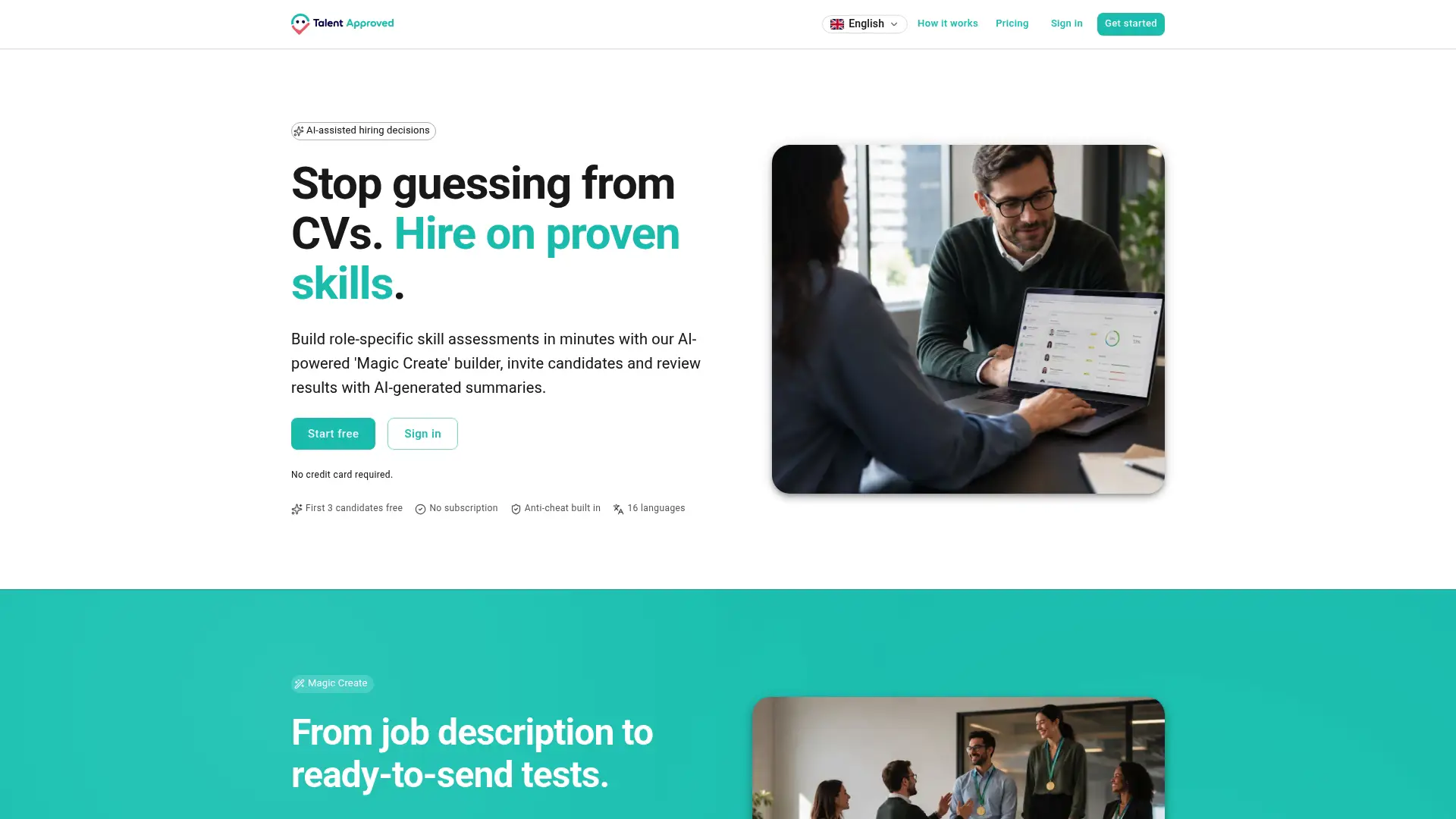
Every completed assessment comes with anti-cheat monitoring, a session replay if you need to review a score, and an AI-generated summary so you’re not reading forty transcripts to compare candidates. Pricing runs per completed candidate, so a small pilot group costs you exactly what it should, nothing more. If you’re ready to test the design principles from this playbook on a real role, start building your first assessment on Talent Approved and have results back before your next standup.
Sources
- How To Build An Effective Skills Assessment Framework
- HR Skills Assessment: 7 Ways to Identify Skills Gaps - AIHR
- Skills Assessment: Definition and Complete Guide | FirstHR | FirstHR
- How To Conduct A Skills Assessment: Step-By-Step Guide – Training Central
FAQ
What Is an HR Skills Assessment Program?
It’s a structured, recurring process that measures employee or candidate proficiency against role-specific success profiles, then feeds the results into hiring, development, and workforce planning decisions.
How Often Should Companies Run Skills Assessments?
Most frameworks recommend a quarterly quick review paired with a comprehensive annual update, which keeps the skills taxonomy current without overwhelming managers with constant testing.
What’s the Difference Between a Self-Assessment and a 360 Review?
A self-assessment reflects the employee’s own view of their proficiency, while a 360 review adds perspectives from managers, peers, and sometimes direct reports to catch blind spots a single rater would miss.
How Many Skills Should a Success Profile Include?
Cap each role’s success profile at 8 to 12 skills so raters can score consistently and the assessment stays short enough for candidates and employees to complete without fatigue.
Can Talent Approved Handle Both Hiring and Development Assessments?
Yes. Its Magic Create feature builds role-specific assessments for hiring from a job description, and the same reusable question libraries and scoring data support internal development tracking over time.