
45–90 Minute Measurement First Data Analyst Assessment for HR Teams

The best data analyst assessment tests several job tasks pulled straight from the role’s actual responsibilities, scored on a transparent rubric, and delivered as a timeboxed take-home or short live lab. Pilot it internally before it touches a real candidate. That model produces faster, fairer, and more predictive hiring than resume screens or trivia-based quizzes ever will. Platforms like Talent Approved exist specifically to build and score this kind of assessment without the manual overhead.
TL;DR:
- Conduct assessments with a clear focus on actual data tasks such as cleaning data, writing SQL queries, and explaining findings to ensure practical job readiness.
- Time tasks appropriately, with simple data cleaning in 30 to 45 minutes and more complex SQL problems taking up to 60 minutes, adjusting based on candidate seniority.
- Use multi-axis rubrics covering correctness, approach, interpretation, communication, and reproducibility to reliably rank candidates and set fair thresholds.
- Incorporate randomized data, clear instructions, and anti-cheat tools for higher-stakes assessments to prevent cheating without harming candidate experience.
- Regularly track completion, pass, and time-to-hire metrics to calibrate assessments, emphasizing small, focused tasks that predict actual on-the-job performance.
Table of Contents
- What Is a Data Analyst Assessment, and What Should It Measure?
- How Do You Map a Job Description Into Testable Tasks?
- Which Assessment Format Fits a Data Analyst Role?
- How Should You Score and Rank Candidates Fairly?
- How Do You Prevent Cheating Without Hurting the Candidate Experience?
- How Do You Know If Your Assessment Is Actually Working?
- What I’ve Learned Watching These Pilots Succeed or Fail
- Build Your Assessment Without Starting From a Blank Page
- Further Reading on Building and Scaling Assessments
- FAQ
What Is a Data Analyst Assessment, and What Should It Measure?
A data analyst assessment is a structured test that measures whether a candidate can actually do the job: clean messy data, write working SQL, interpret results, and explain findings to someone who doesn’t touch spreadsheets for a living. That’s different from a data analysis skills test built for job seekers to practice on their own time. This is a tool HR teams and hiring managers build and control, tied to a specific job description and scored against a rubric your team defines.
The mistake most hiring teams make is testing knowledge instead of tasks. A candidate who can define “median absolute deviation” from memory might still choke when handed a spreadsheet full of duplicate rows and inconsistent date formats. The fix starts with mapping the role itself, not the resume.
How Do You Map a Job Description Into Testable Tasks?
Start by pulling several core, observable tasks directly from the job description. This job-task analysis is the foundation of the entire assessment, and skipping it is the single biggest reason assessments fail to predict performance. Building test items straight from the job description consistently improves how well an assessment forecasts on-the-job results, according to enterprise hiring guides that track this connection.
For a typical data analyst role, that task list usually looks like:
- Cleaning a dataset with missing values, duplicates, or inconsistent formatting
- Writing SQL joins across two or three related tables
- Defining a metric clearly enough that two people would calculate it the same way
- Building a chart or short narrative that explains a finding to a non-technical stakeholder
- Spotting an error or outlier in someone else’s analysis
Seniority changes the bar, not the task list. An entry-level candidate might get a single clean table and 45 minutes. A senior analyst candidate gets three messy, loosely related tables, ambiguous requirements, and 90 minutes, because part of what you’re testing is how they handle ambiguity.
Before this assessment ever meets a real candidate, run it with two or three current employees on your own analytics team. Their scores become your benchmark, and their feedback tells you whether the task takes 45 minutes or secretly takes two hours.
Pro Tip: If your own analysts can’t finish the task in the time you’ve allotted, no candidate will either. Adjust the clock before you adjust your expectations of candidates.
Which Assessment Format Fits a Data Analyst Role?
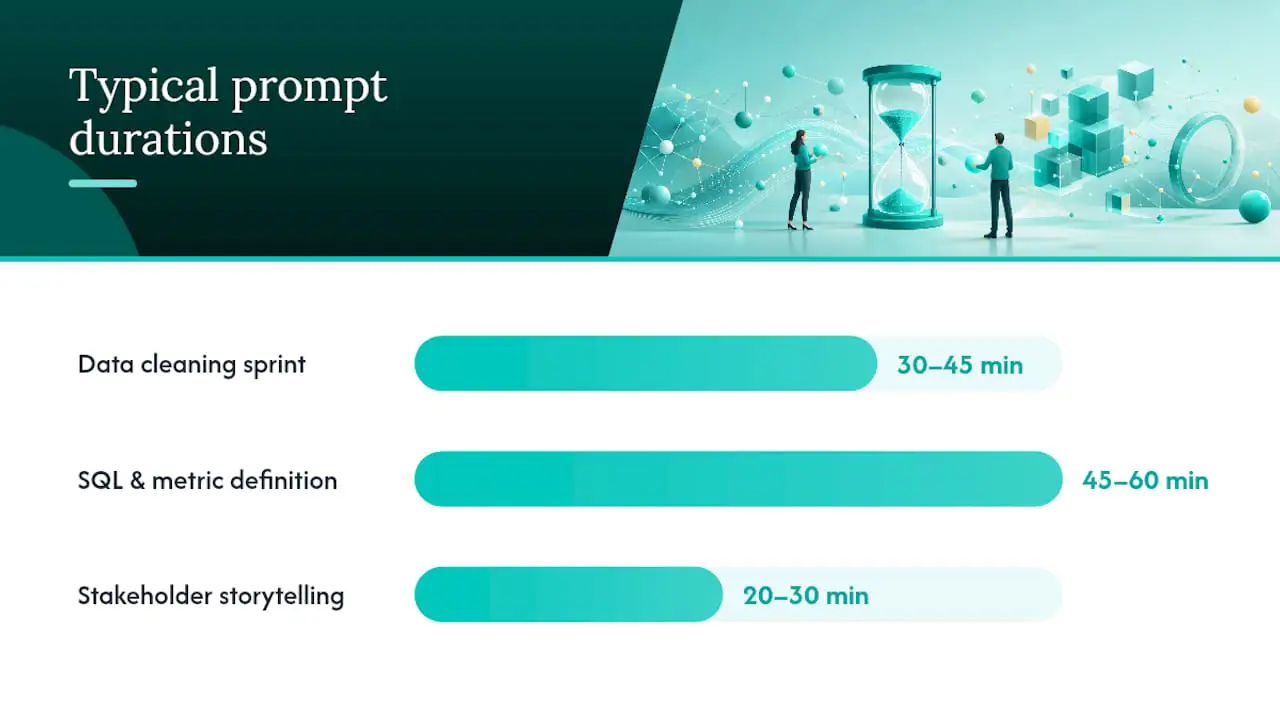
Format decides how much signal you get and how much friction the candidate feels. A short live screen is fast and hard to fake, but it only surfaces surface-level fluency. A timed take-home shows real problem-solving under low pressure, but it’s more vulnerable to outside help. A hands-on lab with a sandboxed dataset sits in the middle: realistic, harder to game, and still respectful of a candidate’s time. Format choice consistently trades fidelity against candidate burden and cheating risk, and shorter, more relevant tasks tend to produce cleaner completion data than long, generic ones.
Three prompts that work well for most data analyst hires:
- Data cleaning sprint (30 to 45 minutes). Give a raw CSV with duplicate rows, inconsistent date formats, and a handful of null values. Ask the candidate to produce a clean dataset plus a short list of what they fixed and why.
- SQL and metric definition (45 to 60 minutes). Provide two related tables and ask for a query answering a specific business question, plus a written definition of the metric they calculated.
- Stakeholder storytelling (20 to 30 minutes, live or recorded). Hand over a finished chart or summary table and ask the candidate to explain it to a hypothetical marketing director in under three minutes.
Seed the take-home data with a few realistic quirks, like a currency field mixed with text, so the task feels like an actual Tuesday at the office rather than a puzzle.
How Should You Score and Rank Candidates Fairly?
Score every submission against a weighted rubric with four or five axes, not a single pass or fail toggle. Multi-axis rubrics produce more reliable ranking than single-score grading because they force reviewers to separate “got the right number” from “got there the right way.”
A solid rubric for a data analyst assessment usually covers:
- Correctness — did the output match the expected result, and how close was it if not?
- Approach — did the candidate choose a sound method, or did they get lucky?
- Interpretation — did they draw the right conclusion from their own output?
- Communication — could a non-analyst understand their explanation?
- Reproducibility — could another analyst rerun their steps and get the same answer?
Weight correctness and approach heaviest for junior roles, and shift weight toward interpretation and communication as seniority rises. Set your “advance to interview” threshold at your pilot benchmark score, not an arbitrary round number.
AI-generated summaries can speed up review by flagging strong and weak submissions before a human reads them line by line, but they work best as a second opinion. A reviewer who never opens the actual work is grading the summary, not the candidate. Assessment analytics that track completion and pass distribution help you check whether your rubric weighting is actually separating strong candidates from weak ones over time.
How Do You Prevent Cheating Without Hurting the Candidate Experience?
Anti-cheat controls should match the stakes of the role, not maximize suspicion. A junior screen might only need randomized dataset seeds. A final-round assessment for a senior analyst role might warrant session replay or browser lockdown. Randomizing the data each candidate receives cuts down on answer-sharing without changing what you’re actually grading.
Whichever controls you choose, pair them with clear instructions: state the time limit, name the tools and libraries that are fair game, and say plainly whether search engines are allowed. Vague rules cause more legitimate failures than actual cheating does, and shorter, clearly scoped tests tend to produce better completion rates than open-ended ones.
Automation removes the manual grind:
- Trigger assessment invites automatically once a candidate reaches a set ATS stage
- Route completed assessments into a reviewer queue instead of an inbox
- Push scores back into the ATS through a webhook so nobody re-types results
Pro Tip: Test your own invite flow as a candidate would see it before launch. Broken links and confusing instructions kill completion rates faster than any tricky SQL question.
How Do You Know If Your Assessment Is Actually Working?
Track four numbers from day one: completion rate, pass rate, time-to-hire, and interviewer-hours saved. A pass rate that never moves, no matter who applies, suggests your rubric threshold is miscalibrated rather than your candidate pool being unusually strong or weak.
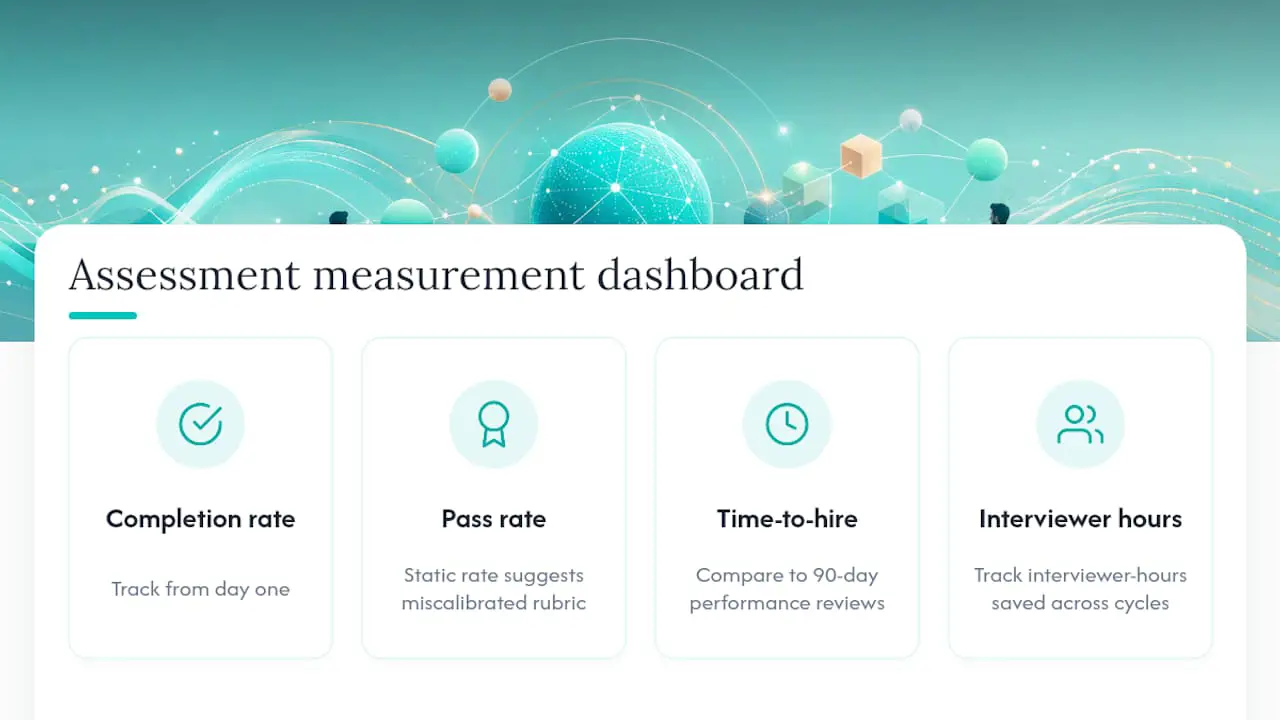
Run your pilot against a small group first, then compare early assessment scores to actual 90-day performance reviews once those hires are on the job. That correlation, even from a handful of hires, tells you more than any theoretical scoring model. Tracking completion, pass distribution, and time-on-task over multiple cycles also lets you catch score drift or bias before it quietly skews who gets hired.
What I’ve Learned Watching These Pilots Succeed or Fail
The pilots that fail almost always share one root cause: the task list was too broad, or nobody benchmarked it against a real employee before it touched a candidate. Teams get excited and try to test six competencies in one assessment, and the result is a bloated task that exhausts candidates without sharpening the signal. Three focused tasks scored well beat six shallow ones every time.
The second lesson is blunter. Trivia questions about statistical terminology feel rigorous but predict almost nothing about whether someone can clean a real dataset under a deadline. Task alignment to actual job outcomes is the entire game. Used honestly, AI-generated summaries and anti-cheat tooling don’t replace a reviewer’s judgment. They just clear away the noise so that judgment gets spent on the submissions that actually deserve a close read.
— Jimmie
Build Your Assessment Without Starting From a Blank Page
Talent Approved turns the workflow above into something you can launch the same afternoon you read this. Feed a job description or a skill list into Magic Create, and it generates a tailored, role-specific assessment in minutes instead of the days it usually takes to write tasks, rubrics, and instructions from scratch.
Every assessment runs with built-in anti-cheat controls, including screen and webcam monitoring and session replay, so you’re not choosing between candidate trust and result integrity. AI-generated summaries give reviewers a fast first read on every submission, and candidate rankings turn rubric scores into a shortlist without a spreadsheet in sight. Because the pricing runs pay-as-you-go with no subscription commitment, you can test the model on your next open req by visiting the platform for current details. Visit the Talent Approved platform to build your first assessment from an existing job description and see how quickly a pilot comes together.
Further Reading on Building and Scaling Assessments
- How assessments drive candidate ranking explains how rubric scores translate into a usable shortlist.
- Technical assessment formats for HR teams breaks down format trade-offs in more detail.
- Marketing analytics dashboard examples offer templates worth adapting into stakeholder-storytelling prompts.
FAQ
How Long Should a Data Analyst Assessment Take?
Most effective assessments run 45 to 90 minutes total, split across 2 to 3 tasks. Longer tests usually hurt completion rates more than they improve signal.
What Skills Should a Data Analyst Skills Test Actually Cover?
Focus on data cleaning, SQL joins, metric definition, and stakeholder communication. Statistics knowledge matters, but only when tied to a task the candidate has to actually complete.
Should You Use a Live Lab or a Take-Home Test?
Take-homes work well for early screening because they’re low pressure and easier to scale, while live labs or short live screens suit final rounds where you want to watch someone think in real time.
How Do You Stop Candidates From Cheating on a Take-Home?
Randomize the dataset each candidate receives, set clear time limits, and use session replay or browser monitoring for higher-stakes final rounds. Tools like Talent Approved build these controls directly into the assessment.
What’s a Good Pass Rate for a Data Analyst Assessment?
There’s no universal number, but a rate that never shifts across very different applicant pools usually means your rubric threshold needs recalibration, not that your hiring pool is unusually consistent.