
How Assessments Drive Candidate Ranking in 2026

Candidate assessments are the backbone of any defensible ranking process. When recruiters rely on structured evaluations rather than resume impressions, they generate standardized, comparable data that makes ranking both faster and fairer. The role of assessments in candidate ranking comes down to one core shift: replacing subjective judgment with evidence tied directly to job requirements.
Here is what well-designed assessments deliver in a ranking workflow:
- Objective scores that compare candidates on the same criteria, regardless of who reviewed them
- Standardized data that feeds weighted scoring models inside applicant tracking systems
- Audit trails that document why each candidate advanced or was declined
- Bias reduction by grounding decisions in performance signals rather than background or presentation
What candidate assessments are and why they matter in recruitment
Candidate assessments are structured tools used to measure a job applicant’s skills, knowledge, personality traits, cognitive ability, or behavioral tendencies. They range from short skills tests and situational judgment questionnaires to full work simulations and structured interview rating forms. What unites them is that each produces a score or rating tied to defined criteria, not a hiring manager’s gut feeling.
The importance of candidate assessments becomes clearest when applicant volumes are high. Reviewing hundreds of resumes introduces inconsistency; a recruiter’s attention and standards shift across a long queue. Assessments apply the same standard to every candidate, which protects both the quality of the decision and the organization’s legal standing.
Compliance is a real driver here. US federal hiring, for example, uses multi-hurdle assessment frameworks that screen broadly at first and then apply intensive evaluations to a smaller shortlist. This staged approach keeps the process defensible and focuses resources where they matter most. Private-sector teams that adopt similar structures gain the same protection.
Pro Tip: Before selecting any assessment tool, confirm it has documented criterion validity, meaning its scores actually predict on-the-job performance. The SHRM Foundation identifies criterion and content validity as the most critical factors when choosing selection tools.
Key recruitment benefits delivered by candidate assessments
Integrating assessments into your hiring workflow produces measurable gains across quality, speed, fairness, and candidate experience. The following benefits are consistently supported by US industry research and industrial-organizational psychology.
-
Improved quality of hire. Skills assessments are linked to a 78% improvement in quality of hire and cut time-to-hire by over 50%, from 60 to 25 days, according to recent US industry reports. Objective skill validation at the screening stage means fewer mismatches reach the offer stage.
-
Reduced unconscious bias. Structured assessments paired with interview pipelines reduce bias by focusing on job-relevant performance signals rather than subjective impressions. This improves diversity outcomes and makes the process fairer for all applicants.
-
Faster, cheaper hiring. Weighted candidate scoring systems reduce panel debates by aligning evaluators around shared criteria before interviews begin. Fewer rounds of deliberation means lower cost per hire.
-
Better employer branding. Candidates who experience a fair, job-relevant assessment process report higher satisfaction and are more likely to recommend the employer to others, even when they do not receive an offer. Candidate experience is now a direct factor in talent attraction.
-
Defensible, auditable decisions. Every score tied to a specific candidate response creates a record that HR teams can review, audit, and defend. Unanchored scorecards, by contrast, are difficult to justify if a hiring decision is challenged.
Common types of candidate assessments and how each aids ranking
Different assessment formats contribute different kinds of data to a ranking model. Choosing the right combination depends on the role, the hiring stage, and the validity evidence behind each tool.
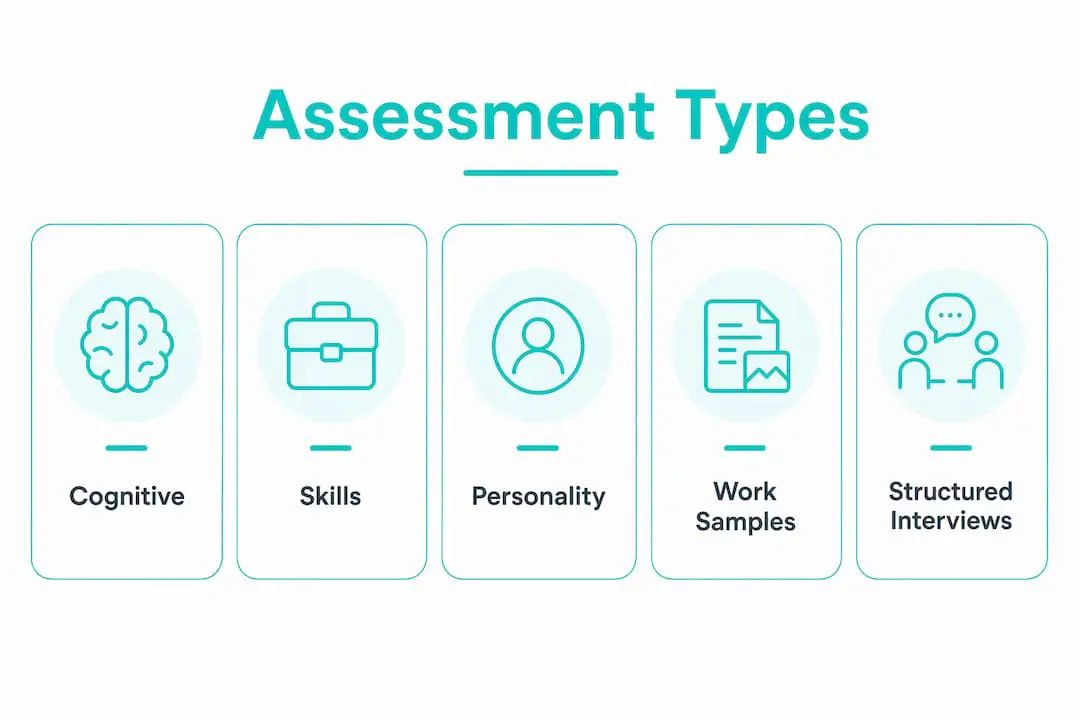
| Assessment type | What it measures | Best use in ranking |
|---|---|---|
| Cognitive ability tests | Reasoning, problem-solving, learning speed | Strong predictor of performance; useful for early screening |
| Personality assessments | Behavioral tendencies, work style, cultural fit | Adds context to skills data; best combined with other measures |
| Skills tests | Technical or functional competencies | Direct match to job requirements; high content validity |
| Work samples / simulations | Actual task performance | Highest face validity; candidates perceive them as fair |
| Structured interviews | Behavioral and situational responses | Standardized scoring reduces inter-rater variability |
Cognitive ability tests tend to carry the strongest predictive validity across job types, but they can produce subgroup differences that affect diversity outcomes. Work samples and job simulations address this by grounding evaluation in realistic tasks, which candidates also perceive as more relevant. Personality assessments add value when combined with other measures rather than used alone; the AESC notes that no single tool provides a complete picture of a candidate.

Multi-hurdle pipelines combine these formats deliberately. A typical structure might use a skills test to screen the full applicant pool, a work sample for the shortlist, and a structured interview with behaviorally anchored rating scales for final candidates. Each stage adds a layer of evidence, and the combined score across stages produces a ranking that reflects the whole person rather than a single data point.
Best practices for effective implementation of assessments in ranking workflows
Getting the most from candidate assessments requires more than selecting a valid tool. How you design, administer, and score assessments determines whether the ranking output is reliable and defensible.
- Anchor every rating to specific evidence. Unanchored scorecards are subjective and undermine auditability. Each rating should reference a concrete candidate response, not a general impression.
- Calibrate raters before evaluation sessions. Calibration sessions typically run about an hour and align evaluators on how to interpret rating scales consistently. They pay for themselves by reducing the variability that leads to poor hires.
- Use behaviorally anchored rating scales (BARS). BARS attach specific behavioral examples to each score level, which reduces the gap between how different reviewers interpret the same performance.
- Weight criteria to reflect actual job priorities. A scoring model that treats every criterion equally distorts rankings when some skills matter far more than others for a given role.
- Communicate clearly with candidates. Tell applicants what the assessment covers, how long it takes, and when they will hear back. Transparency reduces drop-off and improves the perception of fairness.
- Treat assessments as decision support, not decision makers. Assessment data informs human judgment; it does not replace it. Final decisions should integrate scores with interview findings and reference checks.
- Build an audit trail from the start. Linking every rating to a specific response and a calibration consensus is critical for defensible hiring decisions and continuous process improvement.
Pro Tip: Train hiring managers on assessment interpretation before the process begins. Scores mean different things in different applicant pools. A candidate who ranks in the top 20% of a highly competitive batch may outperform someone who scored higher in a weaker pool. Talent Approved’s guide on training hiring managers walks through this distinction in practical terms.
Research insights and US market data on assessment impact
The evidence for structured assessments in hiring is substantial and consistent across decades of industrial-organizational psychology research.
Skills assessments are linked to a 78% improvement in quality of hire and reduce time-to-hire by over 50%, from 60 to 25 days, with 79% of US employers identifying skills assessments as a top hiring criterion. These figures reflect a broader shift in how US organizations approach talent decisions, moving away from credential-based screening toward demonstrated capability.
The distinction between scores and rankings matters practically. Rankings are relative comparisons within a specific applicant pool, while scores are absolute measures. Mixing these without normalization can lead to mis-hiring, particularly when comparing candidates from different sourcing channels or time periods.
AI-enabled tools that capture interview conversations and link them directly to rating scales improve scoring accuracy and reduce subjective variability. This is especially relevant for high-volume hiring, where manual calibration across dozens of interviewers becomes impractical.
| Research finding | Impact |
|---|---|
| Skills assessments paired with structured interviews | significant improvement in quality of hire |
| Time-to-hire reduction with assessment-led screening | substantial reduction in time-to-hire |
| Employers ranking skills assessments as top criterion | a large proportion of US employers |
| Calibration sessions before evaluation | Reduces inter-rater variability; typically last about an hour per session |
Validity remains the non-negotiable standard. The SHRM Foundation identifies criterion validity and content validity as the most important factors when selecting assessment tools, because a test that does not predict job performance adds noise rather than signal to the ranking process.
Assessments also structure decisions around evidence rather than intuition, which increases panel confidence and makes the hiring rationale easier to document and defend. For organizations subject to EEOC scrutiny or internal equity audits, this documentation is not optional.
How organizations use assessments in practice
Large US employers in sectors like financial services and technology have moved to skills-first hiring models that place assessments at the center of the pipeline. A common pattern: an automated skills test screens the full applicant pool, a short work sample filters the top performers, and a structured panel interview with BARS scoring produces the final ranking. Each stage reduces the candidate pool while adding richer data.

For roles where technical skills are measurable, this approach produces rankings that correlate strongly with post-hire performance. Teams using structured candidate evaluation criteria report fewer regretted hires and shorter ramp times for new employees.
Smaller organizations benefit from the same logic at lower volume. A single well-designed skills test, scored consistently, gives a 10-person hiring team the same ranking confidence that a large enterprise achieves with a full multi-hurdle pipeline. The key is consistency: every candidate completes the same assessment under the same conditions.
Psychometric assessments are increasingly used at the executive level as well. The AESC reports that most executive search firms now supplement structured interviews with psychometric tools to provide a more complete picture of leadership candidates. These tools are introduced at the shortlist stage and inform final interviews and reference checks, not as the sole basis for selection but as one structured data source among several.
Managing large applicant pools with structured assessments is a challenge that industry practitioners address through phased screening, where early-stage assessments are short and low-friction, and later-stage assessments are more intensive and role-specific.
How to measure the impact of assessments on your hiring outcomes
Measuring the return on assessment investment requires tracking metrics before and after implementation, then connecting assessment data to post-hire outcomes.
Quality of hire is the primary metric. Define it before you start: a composite of performance review scores, manager satisfaction ratings, and retention at 12 months gives a reliable picture. Compare this composite for cohorts hired with assessments versus those hired without them.
Time-to-hire and cost-per-hire are easier to track and show faster results. If assessments screen out unqualified candidates early, the number of interviews per hire drops, and so does the time from application to offer. The quality of hire metrics guide from Talent Approved covers how to build this measurement framework in practical terms.
Predictive validity is the most rigorous measure. Correlate assessment scores with performance ratings at 6 and 12 months. A strong correlation confirms the assessment is measuring what matters. A weak correlation is a signal to revisit the assessment design or the scoring criteria.
Candidate drop-off rate tracks how many applicants abandon the assessment before completing it. High drop-off often signals that the assessment is too long, poorly explained, or perceived as irrelevant. Monitoring this metric protects both the quality of the applicant pool and the employer’s reputation.
Adverse impact analysis checks whether the assessment produces statistically significant score differences across demographic groups. US employers subject to EEOC guidelines should run this analysis regularly and document the results. If adverse impact appears, the assessment’s job-relatedness and business necessity must be demonstrable.
Reviewing assessment results with AI can surface patterns across large candidate pools that manual review would miss, making it easier to spot both high-potential candidates and potential fairness issues before they affect hiring decisions.
Talent Approved’s AI-powered platform lets you create a skill test from a job description in minutes, with built-in anti-cheat mechanisms and AI-generated candidate summaries that make ranking straightforward. The Magic Create feature removes the setup barrier that keeps many teams from using assessments consistently.
See how Talent Approved works and start ranking candidates on proven skills rather than polished resumes.
Key Takeaways
Structured candidate assessments are the most reliable method for producing fair, defensible, and accurate candidate rankings in modern recruitment.
| Point | Details |
|---|---|
| Assessments replace guesswork | Standardized scores give every candidate the same evaluation criteria, removing subjective impressions from rankings. |
| Quality of hire improves measurably | Skills assessments are linked to a 78% improvement in quality of hire and cut time-to-hire by over 50%, from 60 to 25 days. |
| Scores and rankings are distinct | Rankings are relative to the applicant pool; treating absolute scores as rankings without normalization can cause mis-hires. |
| Calibration is non-negotiable | Rater calibration sessions, typically about one hour, reduce inter-rater variability and protect the defensibility of hiring decisions. |
| Measure what matters post-hire | Correlating assessment scores with 6- and 12-month performance ratings confirms whether the assessment predicts job success. |
FAQ
What is the role of assessments in candidate ranking?
Assessments generate standardized, objective scores tied to job-relevant criteria, giving recruiters comparable data across all applicants. This shifts ranking from subjective impressions to structured, evidence-based decisions.
What are the main types of candidate assessments used in hiring?
The five most common types are cognitive ability tests, personality assessments, skills tests, work samples or simulations, and structured interviews with behaviorally anchored rating scales. Most effective pipelines combine at least two of these formats.
What is the difference between a candidate score and a candidate ranking?
A score is an absolute measure of performance on a specific assessment. A ranking is a relative comparison within a particular applicant pool. Treating scores as rankings without normalization can lead to poor hiring decisions, especially when comparing candidates from different sourcing channels.
What are red flags in a candidate’s assessment results?
Inconsistencies between self-reported skills and test performance, unusually fast completion times that suggest guessing, and significant gaps between structured interview ratings and skills test scores all warrant closer review before advancing a candidate.
How do you measure whether assessments are improving hiring outcomes?
Track quality of hire as a composite of performance scores and retention at 12 months, then compare cohorts hired with and without assessments. Correlating assessment scores with post-hire performance ratings at 6 and 12 months provides the most direct evidence of predictive validity.