
25–35 Minute Customer Service Skills Test for HR Teams With Rubrics & AI

The strongest customer service skills test combines a situational judgment test (SJT) with a short written work sample, scored on a weighted rubric with behavioral anchors and delivered with timing, randomization, and anti-cheat controls. That combination, run in 25 to 35 minutes, gives HR teams a defensible signal about how a candidate will actually handle a customer, not just how they describe handling one.
TL;DR:
- A customer service skills test should last 25 to 35 minutes, combining situational judgment questions with short written samples, tailored to the role.
- Tests must measure real job competencies like troubleshooting, communication, and policy judgment, not just memorized knowledge or multiple-choice quizzes.
- Use outcome-driven design by defining key performance goals before creating the test and pairing scenario-based SJTs with written prompts accordingly.
- Implement a weighted rubric with behavioral anchors across dimensions such as empathy, clarity, ownership, troubleshooting, and policy judgment for consistent scoring.
- Remote test integrity relies on anti-cheat controls like timed sections, question randomization, and webcam monitoring, with regular item bank rotation every quarter.
Table of Contents
- What Should a Customer Service Skills Test Actually Measure?
- How to Design an Outcome-Aligned Customer Service Test
- Ready-to-Use Exercise Types and Blueprints
- Building a Weighted Rubric With Behavioral Anchors
- Practical Anti-Cheat and Proctoring Controls for Remote Delivery
- Where the Test Fits in the Hiring Workflow
- What HR Teams Get Wrong When They Adopt This
- Build and Deploy This Test in Minutes, Not Weeks
- Sources
- FAQ
What Should a Customer Service Skills Test Actually Measure?
A customer service assessment earns its place in a hiring workflow only when it measures the things that separate a strong rep from a mediocre one on day 30, not day one. That means testing troubleshooting, written and verbal communication, empathy, reading comprehension, and policy judgment together, since a candidate can ace one and fail badly at another.
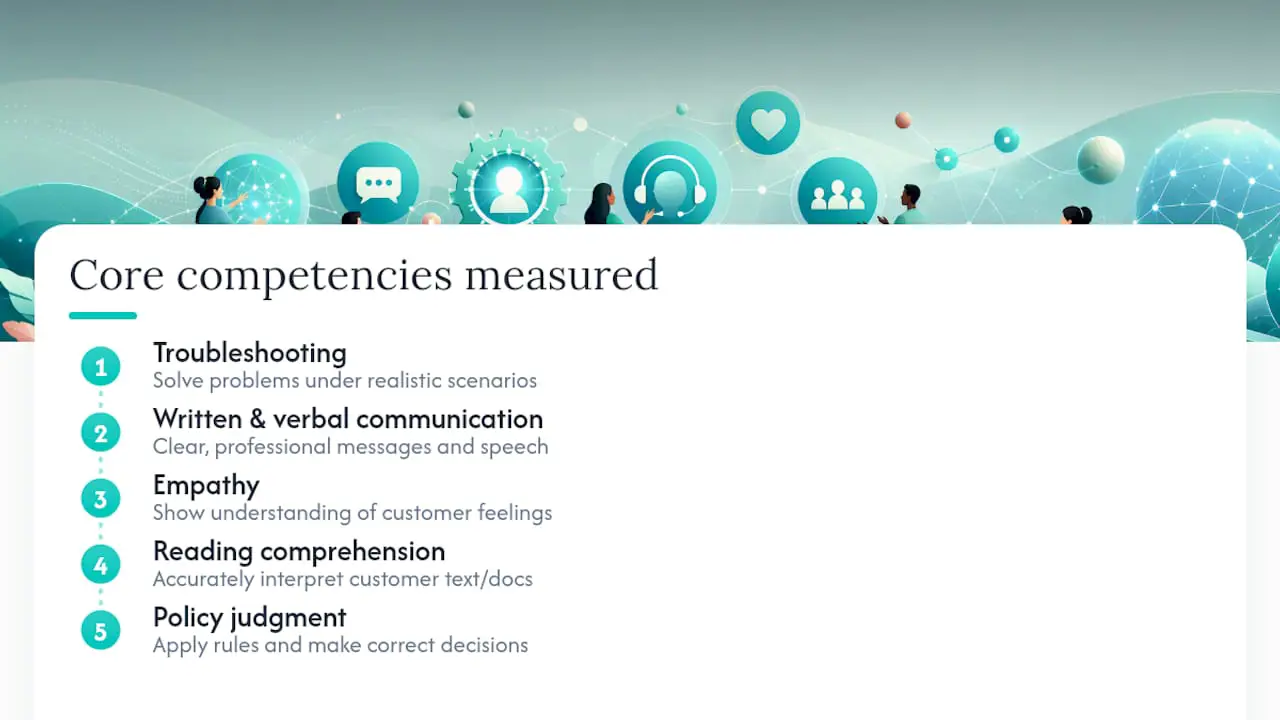
Situational judgment tests, scenario prompts, and short written or verbal tasks are the most effective way to surface troubleshooting, decision-making, communication, and comprehension in a single sitting, according to Workable’s guidance on assessing customer service representatives. Job postings themselves tell you what matters most: Indeed’s analysis of customer service job listings shows communication, computer skills, empathy, and organization show up most often, with bilingual ability weighted heavily for teams serving multilingual customers.
Why job knowledge quizzes fall short
A multiple-choice quiz on refund policy tells you whether someone memorized a page. It tells you nothing about whether they can stay calm while a customer yells about a shipping delay, or whether they’ll invent a policy exception that costs your company money. That’s the gap SJTs and work samples close: they force a candidate to act, not recite.
How to Design an Outcome-Aligned Customer Service Test
Start with a number, not a question bank. Pick one measurable hiring outcome, such as 90-day time-to-productivity or a target CSAT lift, before writing a single item. The Talent Approved job task analysis framework treats this outcome-first sequence as the difference between a test that predicts performance and one that just feels thorough.
From there, the design process runs in four steps:
- Run a job task analysis (JTA): interview your top-performing reps about what they actually do in a shift, then map each recurring task to a testable competency.
- Choose your format mix: pair scenario-based SJTs with short written prompts so you capture both decision-making and written output quality.
- Set the length: aim for 25 to 35 minutes total, structured as 12 to 18 SJT items plus two written prompts, a ratio the Truffle assessment framework has found holds up across support teams of varying seniority.
- Build in fairness checks: offer extended time as an accommodation, avoid idioms or regional slang in scenario writing, and screen items for content that assumes a specific cultural background.
If your team serves customers primarily through chat and email, weight written samples higher. If judgment calls on the phone matter more, weight the SJT higher. That single adjustment, borrowed from a structured job-specific screening approach, keeps the test aligned to the actual job rather than a generic template.
Ready-to-Use Exercise Types and Blueprints
You don’t need to write test items from scratch. Three formats cover almost every competency HR teams care about, and each one has a simple, repeatable structure.
- Situational judgment items. Present a short scenario (a customer threatening to cancel, an angry escalation, a policy edge case), then offer three or four response choices ranked from best to worst. Add one optional short-answer field asking the candidate to justify their pick. That rationale field does double duty: it gives you richer scoring evidence and makes memorized answers harder to fake.
- Written work samples. Two prompts cover most roles well: draft a refund denial email to a frustrated customer, and respond to an escalated live chat where the customer is already threatening to leave a bad review. Score both on tone, clarity, accuracy, and whether the candidate actually solves the problem instead of just apologizing.
- Role-play or video response. Give a brief setup (an angry customer voicemail, a confusing support ticket), then a two to three-minute window to record a response. Score for tone control, active listening cues, and whether the candidate confirms the issue before offering a fix.
Rotate your item bank on a schedule, not just when you suspect leaks. Swapping in fresh scenarios each quarter, alongside the short open-response fields mentioned above, is one of the more reliable ways to catch memorized answers before they undercut your results.
Pro Tip: Keep one written prompt tied to a scenario your top performers have actually handled in the last quarter. Real friction points make better test items than hypothetical ones.
Building a Weighted Rubric With Behavioral Anchors
A test is only as good as its scoring. Grading customer service responses on gut feeling is how two reviewers land on wildly different scores for the same answer, which is why practitioners increasingly favor weighted rubrics with explicit behavioral anchors over simple pass/fail grading.
Use a 0 to 4 or 1 to 5 scale, and write out what each point actually looks like. A “2” for empathy might read: “acknowledges the customer’s frustration but moves to policy language too quickly.” A “4” might read: “names the emotion, validates it briefly, then pivots to a concrete next step.” Five dimensions cover most support roles well:
- Empathy: does the response acknowledge the customer’s emotional state before problem-solving?
- Clarity: is the language direct, jargon-free, and easy to act on?
- Troubleshooting: does the candidate correctly diagnose the root issue?
- Policy judgment: does the response respect company policy without sounding robotic?
- Ownership: does the candidate take responsibility for a resolution rather than deflecting?
Run calibration sessions before your first real hiring round: have two or three reviewers score the same five responses independently, then compare. Simple 1 to 5 scorecards across dimensions like empathy and escalation judgment make this calibration far faster than free-text notes, and any score gap wider than one point on the same response should trigger a rubric review, not a shrug.
Practical Anti-Cheat and Proctoring Controls for Remote Delivery
Remote delivery only works if you can trust the score. The baseline controls that protect test integrity without turning the experience into an interrogation:
- Timed sections that prevent candidates from researching answers mid-test.
- Randomized question order so two candidates in the same room can’t compare screens.
- Disabled tab switching during active sections.
- Session recording or monitored proctoring for higher-stakes roles.
Configurable anti-cheat settings matter because a one-size-fits-all lockdown feels excessive for an entry-level support role but appropriate for a senior escalations position. Whatever you enable, disclose webcam or recording use upfront and offer accommodation paths for candidates who need them; a closer look at lockdown browser trade-offs is worth reading before you flip every switch by default.
Rotate your item bank quarterly, and keep a handful of short open-response items in the mix. AI-based review tools can flag unusual response timing or copy-paste patterns automatically, cutting the manual review work that used to fall entirely on a recruiter’s afternoon.
Where the Test Fits in the Hiring Workflow
An assessment score only matters if it changes what happens next. Build your workflow around a clear sequence and clear thresholds:
- Resume screen filters for baseline qualifications.
- Skills assessment (SJT plus written samples) runs before any interview, saving interviewer time on candidates who won’t pass anyway.
- Structured interview follows, targeting whatever rubric dimension scored weakest. A candidate who scored low on policy judgment gets a follow-up question built around a real policy edge case.
- Reference check confirms what the assessment already suggested.
Set three score bands: auto-pass for top scorers, manual review for the middle range, and auto-reject below a floor you set from pilot data. Then close the loop. Track hired candidates’ assessment scores against real 90-day performance metrics, and adjust your thresholds every quarter based on what the data actually shows.
What HR Teams Get Wrong When They Adopt This
Most teams overbuild their first test, thirty items and vague scoring instructions, then wonder why reviewers disagree constantly. Start with one outcome, pilot on a single role, and calibrate fast. AI-generated summaries and anti-cheat guardrails don’t replace judgment; they cut the busywork so your reviewers spend time on the decisions that actually need a human.
— Jimmie
Build and Deploy This Test in Minutes, Not Weeks
Writing 15 SJT items and two written prompts from a blank page takes most HR teams days they don’t have. Talent Approved’s Magic Create feature builds a tailored assessment directly from a job description or a short list of target skills, generating scenario-based items and written prompts aligned to the competencies you already identified in your job task analysis.
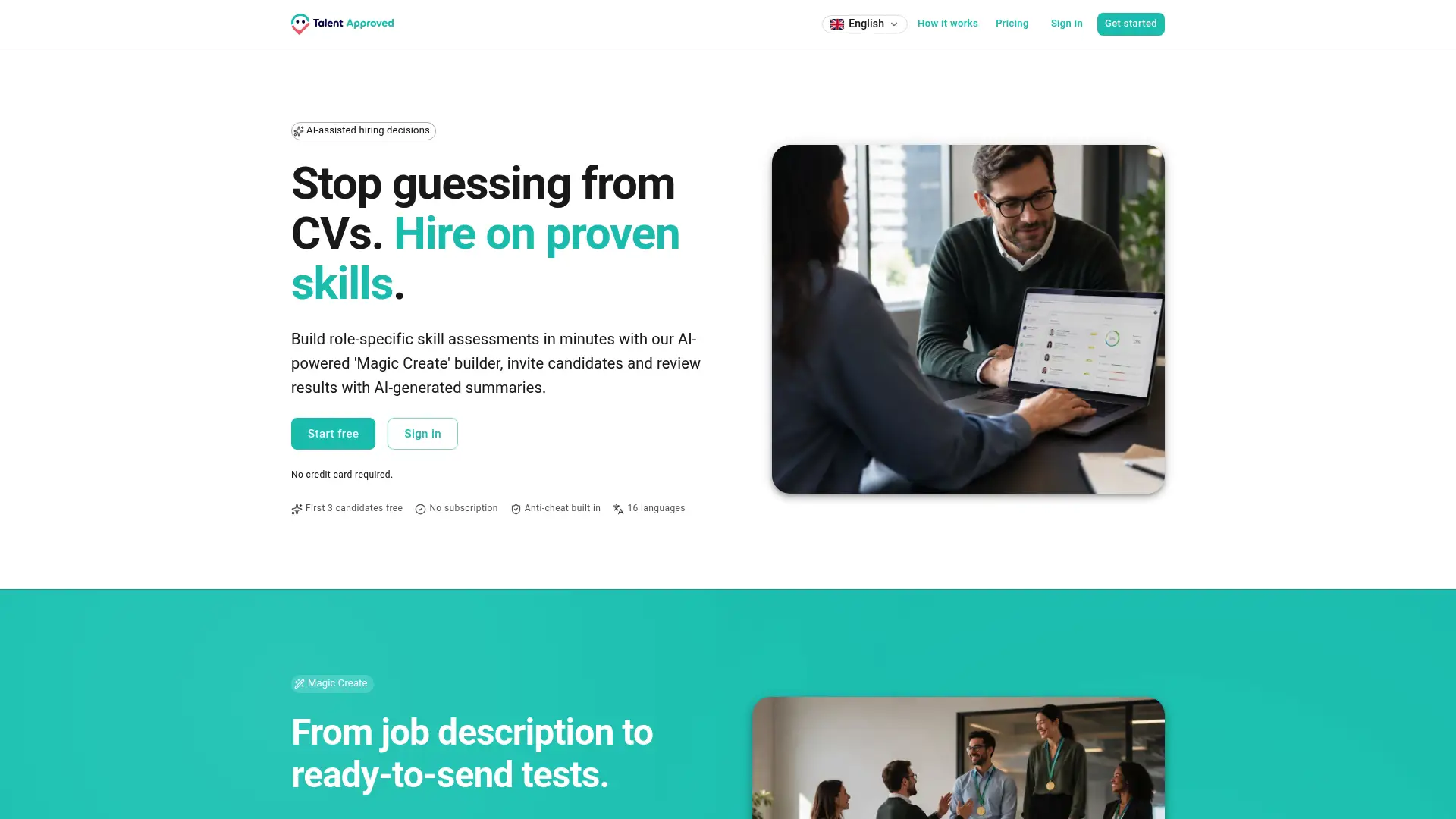
The platform’s built-in anti-cheat controls, including screen and webcam monitoring, session replays, and randomized question order, handle the integrity work this article just walked through, so you’re not configuring proctoring settings from scratch. AI-generated candidate summaries and rankings mean your reviewers open a shortlist instead of a spreadsheet of raw scores. Talent Approved runs on a pay-as-you-go model with a fee per completed candidate assessment, no subscription required, which makes piloting a single role low-risk. Visit the Talent Approved platform to build your first assessment from a job description you already have on file.
Sources
For deeper templates, the Truffle customer service assessment kit offers ready-made rubrics. The job task analysis framework covers outcome alignment in more depth, and Indeed’s skills breakdown is useful for competency mapping. Teams comparing AI-graded screening tools may also want to review Iteration’s hiring suite.
- How to assess customer service representatives | Workable
- Technical Assessment Design Framework: Align Hiring to Business Outcomes
- What Is a Customer Service Assessment Test | How to Conduct It - ProProfs
FAQ
How Long Should a Customer Service Skills Test Take?
Most effective tests run 25 to 35 minutes, structured as 12 to 18 situational judgment items plus two written work samples.
What’s the Difference Between an SJT and a Role-Play Exercise?
An SJT presents a written scenario with multiple-choice responses, while a role-play exercise asks the candidate to record or deliver a live response, which better captures tone and real-time composure.
How Do You Score a Customer Service Skills Test Fairly?
Use a weighted rubric with behavioral anchors at each point on the scale, calibrate scoring across reviewers before launch, and flag any two-reviewer score gap wider than one point for review.
Can AI Help Reduce Bias in Customer Service Assessments?
AI-generated summaries and structured, role-specific test items reduce reliance on subjective interviewer impressions by keeping every candidate’s evaluation tied to the same scenarios and scoring criteria, which platforms like Talent Approved build directly from the job description.
What Anti-Cheat Controls Matter Most for Remote Testing?
Timed sections, randomized question order, disabled tab switching, and session recording form the core guardrails for protecting test integrity during remote delivery.