
Build Assessment Scoring Rubrics Educators Can Pilot and Scale with AI

Assessment scoring rubrics are structured tools that turn subjective grading into a consistent, defensible process. Every functional rubric has four parts: a task description, the criteria you’re measuring, performance levels that mark quality bands, and descriptors explaining what each level actually looks like. This guide walks through building one, piloting it against real student work, and running the reliability checks that keep multiple graders on the same page.
TL;DR:
- Reliable scoring requires limiting criteria to the most impactful aspects, typically three to six, to prevent confusion and maintain consistency.
- Norming sessions help calibrate graders by scoring sample work independently and discussing discrepancies to clarify descriptor interpretation.
- Starting with measurable, observable descriptors and pilot testing a rubric on real student work ensures grading accuracy and fairness.
- Using a single-point rubric or a meta-rubric reduces scope creep and simplifies training for consistent application across large assessment volumes.
- AI-powered assessment tools can replicate rubric criteria consistently at scale, minimizing human drift and speeding up the evaluation process.
Table of Contents
- What Are Scoring Rubrics? The Four Parts You Need
- How to Create a Scoring Rubric Step by Step
- Rubric Templates You Can Adapt Today
- Grading Individual Students vs. Assessing Program Outcomes
- Norming and Reliability: Keeping Multiple Graders Consistent
- Best Practices That Keep Rubrics Useful
- Where Talent Approved Fits Into Rubric-Based Assessment
- What I’ve Learned Balancing Rubric Detail Against Grading Time
- Scale Your Rubric Practice with Talent Approved
- Where to Go Deeper on Rubric Design
- Sources
- FAQ
What Are Scoring Rubrics? The Four Parts You Need
A scoring rubric is only as useful as its structure. Skip one of the four core parts and grading drifts back into guesswork, which is the exact problem rubrics exist to solve.
Analytic rubrics score each criterion on its own scale, then combine the results. If you’re grading a lab report on hypothesis clarity, methodology, and data analysis separately, you’re using an analytic model. It takes longer to apply but tells the student precisely where they lost points, which makes it the standard choice for complex, developmental tasks.
Holistic rubrics collapse everything into a single overall score based on a general impression of quality. They’re fast, which is why large-enrollment courses and timed writing assessments lean on them, but they give students less to act on when they want to improve.
Single-point rubrics describe only the “proficient” level in one column, leaving space on either side for the grader to write specific notes on where the work exceeded or fell short. They cut prep time and, according to guidance from NC State’s teaching resources, tend to produce more individualized feedback than a fully populated grid because graders write in their own words instead of picking a canned phrase.
Choosing among the three comes down to purpose:
- Use analytic rubrics for portfolios, capstones, and any task with multiple distinct skill dimensions.
- Use holistic rubrics for high-volume grading where speed matters more than diagnostic detail.
- Use single-point rubrics when you want fast setup and rich, individualized comments.
- Start from a meta-rubric like an AAC&U VALUE rubric when you need a vetted, cross-institutional starting point, then narrow it into task-specific criteria for specialized work like a music jury or lab practicum.
How to Create a Scoring Rubric Step by Step
Building a rubric that actually holds up under use follows a specific order. Skip a step and you’ll find out during grading, when it’s expensive to fix.
- Start with the learning outcome. Write a one-sentence task description tied to what students should demonstrate, not just what they should submit.
- Choose 3 to 6 criteria. More than that and graders start skimming; fewer and you’re not really measuring the outcome. Each criterion should map to something you actually taught.
- Set 3 to 5 performance levels. Utah Tech’s assessment office recommends staying in that range for clarity and usability; more levels than that and raters can’t reliably tell them apart.
- Write observable descriptors. “Demonstrates strong argumentation” is vague. “Supports each claim with at least two pieces of textual evidence” is observable. Cornell’s Center for Teaching Innovation specifically warns against words like “interesting” or “creative” because two graders will interpret them differently every time.
- Decide on weighting. If methodology matters more than formatting, say so numerically. A simple aggregation might weight four criteria at 30/30/25/15 percent rather than splitting the total evenly.
- Pilot on real student work and revise. Cornell’s guidance points to testing a draft against actual submissions before finalizing it, and practitioners who do this regularly find that scoring three to ten sample papers is usually enough to expose where a descriptor fails to discriminate between two adjacent levels.
Pro Tip: Grade a stack of five papers with your draft rubric before you touch a single real grade. If you can’t consistently tell why a paper landed in “proficient” instead of “developing,” the descriptor is the problem, not the student’s work.
Rubric Templates You Can Adapt Today
Templates save time, but only if you adjust the language to your discipline instead of copying it wholesale.
A compact analytic rubric for a short essay might score Thesis Clarity, Evidence Use, and Organization across four levels: Exemplary, Proficient, Developing, and Beginning. Weight each criterion equally at first, then adjust once you see where students actually struggle. A total score of 12/12 becomes meaningful once the descriptors under each level are specific enough that a colleague scoring blind would land on the same number.
A holistic rubric works well for a timed in-class response. Instead of separate criteria, write four or five paragraph-length benchmark descriptions, one per score band, and match the student’s work to the closest overall description. Some programs speed this up further with a “stack” method: sort ungraded papers into rough piles first, then assign numbers within each pile.
A single-point template lists your criteria down the left with only the “meets expectations” column filled in. Leave the “below” and “above” columns blank for handwritten notes:
- Criteria column: name the skill (thesis, evidence, mechanics).
- Meets expectations column: one clear sentence describing solid work.
- Concerns / strengths columns: blank space for targeted comments.
Adapting any of these across disciplines mostly means swapping vocabulary. A lab practicum rubric replaces “thesis clarity” with “hypothesis formulation,” while a presentation rubric adds a criterion for vocal delivery that a written-essay rubric would never need.
Grading Individual Students vs. Assessing Program Outcomes
A rubric score means something different depending on who’s reading it. When you’re grading, the number belongs to one student and drives feedback on their specific work. When you’re doing outcomes assessment, that same rubric data gets aggregated across a whole class or program, and the individual disappears into a pattern.
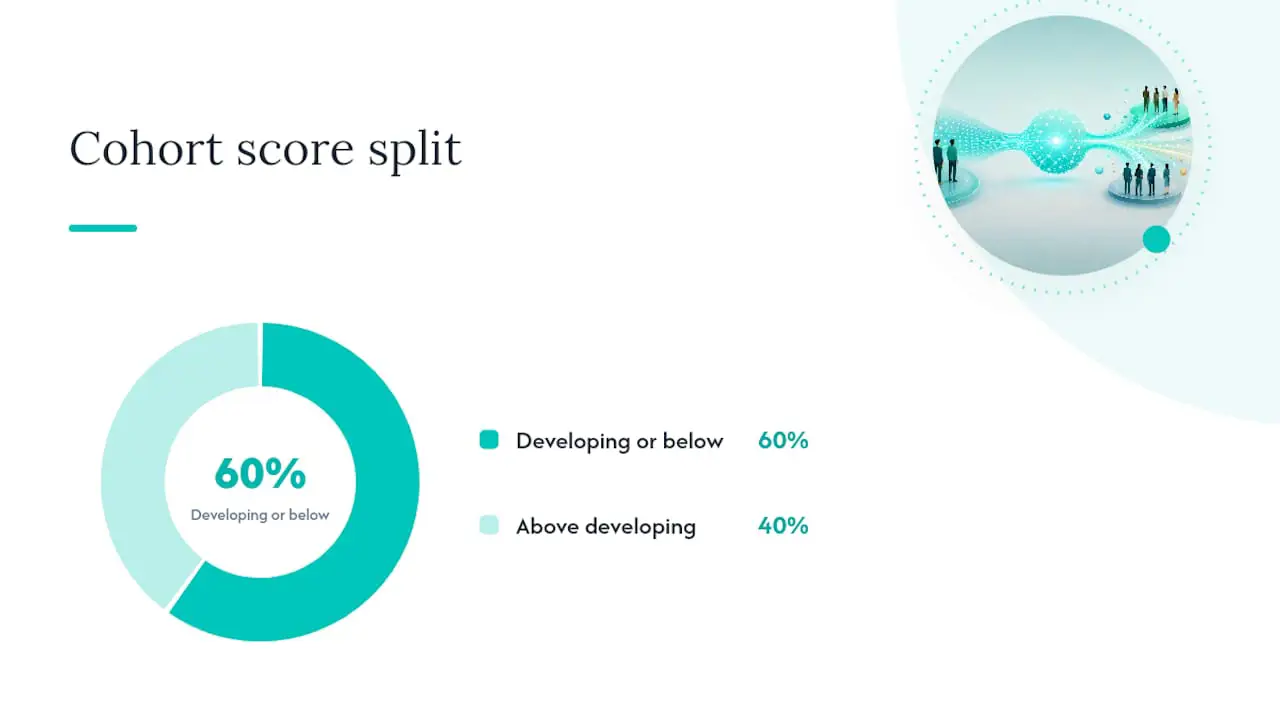
Cornell’s assessment guidance draws this distinction directly: instructional feedback calls for analytic, criterion-by-criterion detail, while program-level decisions call for aggregated trends across many students. If 60 percent of a graduating cohort scores “developing” or below on a data-analysis criterion, that’s not feedback for one student. It’s a signal the curriculum needs a change.
Practical reporting steps:
- Calculate a mean and a distribution per criterion, not just an overall average.
- Flag criteria where scores cluster at the low end. That’s your curriculum weak spot.
- Document your piloting and norming process alongside the results. Accreditation reviewers want to see that the rubric itself was validated, not just that scores exist.
Norming and Reliability: Keeping Multiple Graders Consistent
A rubric is only as reliable as the humans applying it. Two graders can read the same descriptor and land on different scores unless they’ve calibrated first.
A norming session follows a clear pattern, according to guidance from UC Berkeley’s GSI Teaching & Resource Center: gather a handful of shared student samples, have every grader score them independently without discussion, then compare results as a group. Wherever scores diverge, the conversation exposes exactly which descriptor was ambiguous. That reconciliation step catches problems faster than simply rewriting descriptors in isolation and hoping they read more clearly the second time.

Two descriptor problems show up constantly: overlapping language between adjacent levels (“good” evidence versus “strong” evidence, without a measurable difference) and vague qualifiers that mean different things to different readers. The fix is usually quantifiable language: number of sources cited, specific errors per page, a countable feature rather than an adjective.
Pro Tip: If two trained graders score the same paper more than one full level apart on your scale, don’t blame the grader. Rewrite the descriptor separating those two levels first.
Best Practices That Keep Rubrics Useful
The single biggest failure mode in rubric design is scope creep. A rubric with twelve criteria doesn’t grade more precisely; it just takes longer and invites inconsistency, because no grader can hold twelve distinct standards in mind at once while also reading for content.
- Limit criteria to the handful that actually matter for the outcome you’re measuring.
- Use parallel descriptor structure across levels so “proficient” and “developing” differ by degree, not by an entirely different sentence structure.
- Hand students the rubric before the assignment is due, not after grading starts. It functions as a roadmap, not a scorecard revealed after the fact.
- Build in peer or self-assessment using the same rubric language so students internalize the criteria rather than just receiving a verdict.
- Keep the whole rubric to one page when possible. If it doesn’t fit, the criteria list is probably too long.
One coherent but limited signal from assessment offices: starting with a single-point or meta-rubric format and only adding complexity when piloting proves it’s needed helps prevent what practitioners call rubric creep, where a clean tool slowly accumulates criteria nobody actually uses.
Where Talent Approved Fits Into Rubric-Based Assessment
Everything above scales fine for a single classroom. It gets harder across a hiring team scoring dozens of candidates against the same criteria. Talent Approved’s Magic Create feature builds role-specific assessments from a job description or skill list, mapping questions to criteria the way a well-built rubric maps criteria to learning outcomes. AI-generated summaries score responses against those criteria consistently, while session replay and anti-cheat monitoring protect the validity of remote testing the same way in-person norming protects grading consistency. Related reading on candidate evaluation criteria covers the hiring-side application in more depth.
What I’ve Learned Balancing Rubric Detail Against Grading Time
The rubrics that actually get used aren’t the most thorough ones. They’re the ones a grader can apply in under two minutes per submission without losing diagnostic value, which usually means cutting criteria you’re tempted to keep.
Three things to do this week: draft one rubric for your next assignment using three to six criteria, pilot it against three real samples before it goes live, and if you grade alongside anyone else, run a fifteen-minute norming session on two shared papers.
— Jimmie
Scale Your Rubric Practice with Talent Approved
Building one great rubric is manageable. Applying it consistently across fifty candidate submissions with zero drift between reviewers is where most manual processes break down. Talent Approved is built for exactly that gap: instead of hand-scoring every response against your criteria, Magic Create turns a role description into a structured, rubric-aligned assessment in minutes, and AI-generated summaries apply your scoring logic the same way every time, whether it’s candidate three or candidate three hundred.

Anti-cheat monitoring and session replay mean you can trust the scores you’re aggregating, the same validity concern that drives norming sessions in a classroom. If you want to see how criteria-based scoring translates from an academic rubric into a hiring workflow, the T-shaped skills assessment guide walks through adapting rubric language for professional skill profiles. Start by exploring the Talent Approved platform and build your first assessment from a role description you already have on hand.
Where to Go Deeper on Rubric Design
For hands-on template libraries, Utah Tech’s assessment office and NC State’s teaching resources both offer downloadable examples across formats. Cornell’s Center for Teaching Innovation covers the creation process in detail, while Northern Illinois University’s Center for Innovative Teaching and Learning is useful for discipline-specific adaptation. For accreditation-ready criteria, the AAC&U VALUE rubrics remain the standard reference point.
Sources
- Creating a Scoring Rubric | Academic Assessment (Utah Tech University)
- Rubrics, scoring & grading — Assessment Handbook (University of Michigan engineering)
- Using rubrics — Center for Teaching Innovation (Cornell University)
- Rubrics for Assessment — Center for Innovative Teaching and Learning (Northern Illinois University)
- Rubric best practices, examples, and templates (NCSU teaching resources)
FAQ
How do I create a scoring rubric for an assessment?
Align the rubric to a specific learning outcome, choose 3 to 6 criteria, set 3 to 5 performance levels, write observable descriptors for each level, then pilot it against real student work before finalizing.
What are scoring rubrics?
Scoring rubrics are structured evaluation tools that break a task into named criteria and describe what quality looks like at each performance level, replacing subjective grading with consistent standards.
What is an assessment rubric?
An assessment rubric is the same tool applied to measure learning outcomes across a class or program, often aggregated to spot patterns rather than scored purely for individual feedback.
What are the four basic parts of a scoring rubric?
The four parts are the task description, the evaluative criteria, the performance levels, and the descriptors explaining what each level of performance looks like.
Can AI tools help apply rubrics consistently across many evaluations?
Yes. Platforms like Talent Approved use AI-generated scoring summaries to apply the same criteria consistently across large volumes of responses, which mirrors what norming accomplishes for human graders.