
How to Tailor Assessments for Niche Industry Roles

Build a role-specific assessment by mapping the hire’s first six months of operational outcomes to one or two realistic work samples and a short situational judgment test (SJT). That combination predicts on-the-job performance far better than a resume screen or a generic aptitude test.
Every effective tailored assessment includes these elements:
- Defined outcomes: 3–5 impact statements describing what the hire must accomplish by month six (e.g., “deliver the first client audit,” “close X-type deals,” “ship feature Y”)
- 1–2 work samples: realistic tasks drawn directly from those outcomes, time-boxed to keep total candidate time at 30–60 minutes
- A scoring rubric: anchored at three levels (below expectations / meets / exceeds) with weighted dimensions
- Anti-cheat controls: screen recording or webcam monitoring to protect result integrity
To get a draft assessment ready in minutes, paste your job description into an AI test generator like Talent Approved’s Magic Create and refine from there.
Table of Contents
- Why role-specific assessments outperform generic tests for niche industry roles
- How do you define first-6-month outcomes and turn them into testable tasks?
- Which assessment types work best for which outcomes?
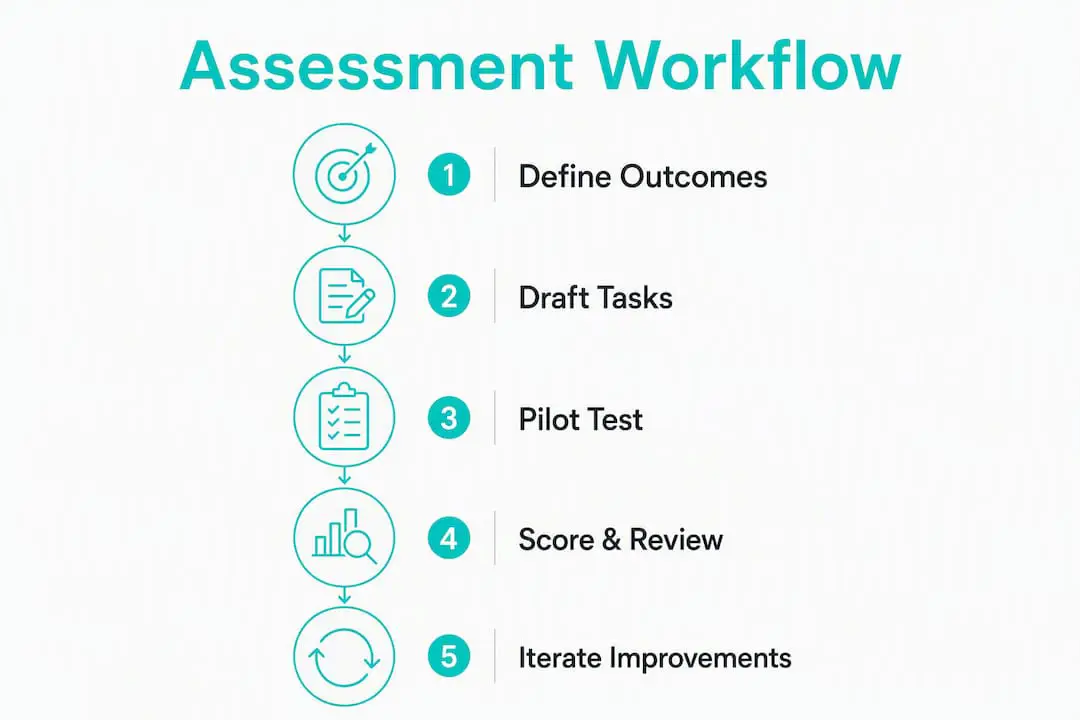
- Step-by-step workflow: build a tailored assessment from a job description
- Designing assessments for fairness, predictive validity, and U.S. hiring compliance
- How do scoring rubrics and AI summaries produce consistent decisions?
- How do you pilot, measure, and improve your assessments over time?
- How Talent Approved accelerates tailored, role-specific assessments
- Key Takeaways
- What most hiring teams get wrong about niche role assessments
- Talent Approved builds your niche role assessment in minutes
- Authoritative sources and further reading
- FAQ
Why role-specific assessments outperform generic tests for niche industry roles
Generic cognitive or personality tests measure broad traits. They tell you a candidate is analytical; they do not tell you whether that candidate can debug a production API under a tight deadline or handle a client escalation in a regulated industry. Custom skills assessments that mirror real work predict job performance more reliably than resumes or education credentials alone.
“Design assessments by defining what a new hire must accomplish in their first six months, then map tests to those operational outcomes. This simplifies test design and improves predictive validity.” — HireZapp
The payoff is concrete. When assessment tasks mirror actual job conditions, hiring managers gain confidence in their shortlists, ramp time shortens, and mis-hire risk drops. For niche roles in consulting, aerospace, or specialized engineering, where a bad hire is expensive and replacements are scarce, that predictive lift matters more than it does in high-volume commodity hiring.
Pro Tip: Keep your assessment tasks as close to real work conditions as possible. A content strategist who writes a brief under realistic constraints tells you far more than one who scores well on a verbal reasoning test.
How do you define first-6-month outcomes and turn them into testable tasks?
HireZapp’s framework centers outcome mapping as the primary design principle: define what success looks like at month six, then work backward to the tasks that predict it.
- Schedule a hiring manager intake. Ask: “What does this person need to have accomplished by month six for you to consider the hire a success?” Capture 3–5 specific impact statements.
- Write outcome statements in measurable terms. “Deliver first client audit with no material errors” beats “understand audit process.”
- Translate each outcome into a testable task. A client audit outcome becomes a sample data set with errors to find and a written summary to produce. A sales outcome becomes a role-play email responding to a prospect objection.
- Add scoring cues to each task. Note what a strong response includes: specific terminology, correct methodology, appropriate tone.
- Time-box every task. Most tasks should take 10–20 minutes each so the full assessment stays within 30–60 minutes.
- Run an internal pilot with current top performers before sending it to candidates. Their responses calibrate your rubric anchors.
For specialized advisory roles, consulting firms often find that a short written deliverable (a one-page recommendation memo, for example) surfaces judgment and communication skills that no multiple-choice test can replicate. Planning and practice consulting contexts illustrate exactly this: the work product tells the story.
Which assessment types work best for which outcomes?

| Outcome type | Recommended item | Candidate time | Key trade-off |
|---|---|---|---|
| Customer-facing communication | Role-play or support-ticket simulation | 10–20 min | High signal; harder to score at scale |
| Technical / analytical | Work sample or timed coding task | 20–30 min | Objective scoring; may need SME review |
| Judgment under ambiguity | Situational judgment test (SJT) | 10–20 min | Fast to administer; less role-specific |
| Portfolio / creative | Portfolio review with structured rubric | Async | Rich evidence; reviewer time intensive |
| Process / compliance | Micro-task or scenario walkthrough | 10–20 min | Easy to standardize; limited depth |
A few practical notes on format choice:
- Work samples are the gold standard for predictive validity but require more design effort and SME review time.
- SJTs scale well and reduce drop-off because candidates find them less intimidating than open-ended tasks.
- Timed coding exercises work for engineering roles but should reflect actual stack and complexity, not whiteboard puzzles.
- Role-plays (written or recorded) are underused in non-sales roles; they surface communication quality that resumes never show.
Keep total candidate time at 30–60 minutes for early-stage screening. Longer assessments increase drop-off without proportionally improving signal quality.
Step-by-step workflow: build a tailored assessment from a job description
AI tools can standardize job descriptions into precise skills frameworks quickly, which makes the JD your best starting point.
- Extract outcome statements from the JD and hiring manager intake. Highlight every verb phrase that describes a deliverable (“manage client relationships,” “produce monthly reports,” “own the onboarding process”).
- Select 1–2 item types from the matrix above that match your top two outcomes.
- Write realistic prompts. For a content role: “You have 20 minutes to write a 200-word brief for a blog post targeting mid-market CFOs on cash flow forecasting.” For a support role: “A client emails you upset that their order shipped to the wrong address. Write your response.”
- Build a three-level scoring rubric for each task: below expectations, meets expectations, exceeds expectations. List 2–3 observable criteria per level.
- Set anti-cheat options. Enable screen recording and webcam monitoring for high-stakes roles.
- Pilot internally. Send to 3–5 current employees in the same role. Calibrate rubric anchors based on their responses.
- Launch to 10–30 candidates and collect completion rate and candidate feedback before scaling.
Total time from JD to pilot-ready assessment: roughly one to two weeks when you use an AI generator for the first draft.
Designing assessments for fairness, predictive validity, and U.S. hiring compliance
Job-relevance plus standardized scoring equals a defensible assessment. Every task must connect directly to a documented job requirement, and every candidate must receive the same instructions, time limits, and scoring criteria.
A minimum compliance checklist for U.S. hiring:
- Job analysis on file: document the link between each task and a specific job duty
- Uniform administration: same prompt, same time limit, same rubric for every candidate
- Adverse impact monitoring: track pass rates by protected class; investigate gaps above 4/5ths rule thresholds
- Validation plan: correlate assessment scores with 3–6 month performance reviews after your first cohort of hires
- Audit trail: retain rubrics, scores, and reviewer notes for each candidate
Pro Tip: Store rubric versions with timestamps. If your assessment changes after a legal challenge, you need to show which version a specific candidate received.
Track these validity metrics after each hiring cohort: completion rate, differential pass rates by demographic group, and correlation between assessment score and first-performance review. A correlation above 0.3 is a meaningful signal that the assessment is doing its job.
How do scoring rubrics and AI summaries produce consistent decisions?
Raw responses need structure before they become hiring decisions. A compact scoring template looks like this:
- Dimensions: technical accuracy, communication clarity, judgment / problem-solving approach
- Weights: assign higher weight to the dimension most critical for the role (e.g., technical accuracy at 50% for an engineering role)
- Anchors: for each dimension, write one sentence describing a below / meets / exceeds response
The reviewer workflow that reduces evaluator variance:
- Blind first pass: reviewers score without seeing other reviewers’ marks or candidate names
- SME calibration: a subject-matter expert reviews borderline scores and flags inconsistencies
- Reconciled score: where two reviewers diverge by more than one level, a third reviewer adjudicates
- Hiring manager view: the final reconciled score and AI summary go to the hiring manager for the interview decision
AI-generated summaries surface key evidence from each response and flag where a candidate scored high or low on specific dimensions. This reduces the time a hiring manager spends reading raw responses and keeps the rationale auditable. For niche engineering and specialist roles, SME-calibrated rubrics and human-in-the-loop review remain non-negotiable for trustable decisions.
How do you pilot, measure, and improve your assessments over time?
Pilot checklist before full deployment:
- Select 10–30 candidates from an active or recent pipeline.
- Collect completion rate and time-to-complete data.
- Gather candidate feedback (a 2-question NPS survey works).
- After 60–90 days, map assessment scores to first-performance review ratings.
| KPI | Target | Action if off-target |
|---|---|---|
| Completion rate | — | Shorten tasks or clarify instructions |
| Time-to-complete | 30–60 min | Trim or split tasks |
| Candidate NPS | >30 | Improve prompt clarity and UX |
| Inter-rater reliability | — | Run calibration session with reviewers |
| Score-to-performance correlation | >0.3 | Revise item types or rubric anchors |
Iterate on a quarterly cadence. Retire any item where fewer than 60% of strong hires scored above the midpoint. Add new items when the role’s responsibilities shift. Piloting with current top performers before each revision cycle keeps rubric anchors calibrated to real performance standards.
How Talent Approved accelerates tailored, role-specific assessments
Talent Approved is built for exactly this workflow. Key features mapped to each stage:
- Anti-cheat screen recording and webcam monitoring: session replays give you an audit trail for high-stakes or regulated roles; see how proctoring works
- Candidate ranking: — scores are normalized and ranked automatically, so your shortlist is ready without manual sorting
A typical Talent Approved workflow: upload the JD to Magic Create, review and adjust the draft tasks, set anti-cheat options, send to candidates, and review AI summaries to build your shortlist. The platform’s pay-as-you-go model ($5 per completed candidate) means no subscription commitment while you pilot. For teams managing assessment templates at scale, the reusable library reduces build time on every subsequent role.
Key Takeaways
Outcome-mapped, role-specific assessments predict hire quality better than resumes or generic tests, and AI tools now make them fast to build and easy to govern.
| Point | Details |
|---|---|
| Start with six-month outcomes | Define 3–5 impact statements before choosing any assessment format. |
| Keep it to 30–60 minutes | Early-stage assessments longer than 60 minutes increase candidate drop-off without improving signal. |
| Use a three-level rubric | Anchored scoring (below / meets / exceeds) with weighted dimensions reduces evaluator variance. |
| Pilot before scaling | Run 10–30 candidates, then correlate scores to 3–6 month performance before full deployment. |
| Talent Approved speeds the build | Magic Create drafts a role-specific assessment from a job description in minutes, with anti-cheat and AI summaries included. |
What most hiring teams get wrong about niche role assessments
The conventional wisdom says niche roles are too specialized for standardized assessments. That is exactly backward. Generic tests fail niche roles not because the roles are too complex to assess, but because the tests are not designed around what the role actually produces.
The teams that get this right do one thing differently: they start with the output, not the input. They do not ask “what skills does this person need?” They ask “what will this person have built, closed, or delivered by month six?” That shift changes everything about how the assessment is designed, what tasks it includes, and how reviewers score it.
AI tools have removed the last real barrier, which was time. Building a custom assessment used to take days of SME interviews and item-writing workshops. Now a hiring manager can paste a JD, review a draft in minutes, and run a pilot within a week. The teams still relying on resume screens and gut-feel interviews for specialist roles are not being careful. They are just slower.
Talent Approved builds your niche role assessment in minutes
HR teams hiring for specialized roles spend days designing assessments that candidates complete in under an hour. Talent Approved closes that gap. Paste your job description into Magic Create, get a draft assessment with role-specific tasks and scoring criteria, and send it to candidates the same day. Anti-cheat screen recording and AI-generated summaries are built in, so your audit trail and shortlist are ready without extra tools or manual review steps.
No subscription required. At $5 per completed candidate, you can run a full pilot on a niche role for less than the cost of a single bad phone screen. Create your first assessment at talentapproved.com.
Authoritative sources and further reading
- How AI Can Help You Find Niche Talent & Close Skills Gaps — Beamery on using AI to standardize JDs and build skills frameworks
FAQ
What makes an assessment valid for a niche industry role?
A valid assessment maps directly to documented job duties and uses standardized scoring so every candidate is evaluated on the same criteria. Correlate scores with 3–6 month performance reviews after your first hiring cohort to confirm predictive power.
How long should a role-specific assessment take?
Keep early-stage assessments to 30–60 minutes. Longer tests increase candidate drop-off without meaningfully improving the quality of the signal you collect.
How do you tailor assessments for niche industry roles quickly?
Paste the job description into an AI test generator like Talent Approved’s Magic Create to get a draft with role-specific tasks and scoring criteria in minutes, then refine with a hiring manager before piloting.
What U.S. compliance rules apply to candidate assessments?
Assessments must be job-related, uniformly administered, and documented with a scoring rubric. Monitor pass rates by protected class against the 4/5ths rule and retain all rubrics and scores as part of your audit trail.
How many candidates do you need to pilot a new assessment?
Run your pilot with 10–30 candidates, collect completion rate and candidate feedback, then map scores to 3–6 month performance reviews before scaling the assessment to your full pipeline.