
How to Calculate Assessment Pass Marks the Right Way

An assessment pass mark, also called a cut score, is the minimum number of points a test taker needs to be classified as passing. The formula is simple: minimum passing marks = total marks × (passing percentage ÷ 100).
Here’s the quick version. If a test is worth 100 points and the passing percentage is 60%, you need 60 marks to pass. That’s the entire calculation for a straightforward, single-section test.
Real assessment pass marks get more complicated once you factor in:
- Weighted sections that count differently toward the final score
- Rounding rules for scores that land on a fraction
- Standard-setting methods used to justify why the threshold sits where it does
- Measurement error near the cut score that affects who gets classified as a pass or fail
The rest of this guide walks through each of those, with worked examples you can adapt to your own numbers.
Key Takeaways
A defensible assessment pass mark comes from a documented method, not a guessed percentage, and the formula for computing raw marks needed is always total marks times passing percentage divided by 100.
| Point | Details |
|---|---|
| Use the core formula | Minimum passing marks equal total marks multiplied by the passing percentage, divided by 100. |
| Know your context | 60% is a common U.S. undergraduate baseline, while licensure exams often require 70% to 75%, set through formal standard-setting. |
| Choose a defensible method | Modified Angoff, contrasting groups, borderline group, and Hofstee each suit different stakes and item types. |
| Treat the cut score zone carefully | Scores within one standard error of measurement of the cut deserve review, not an automatic pass or fail. |
| Document every decision | Panel composition, method choice, and impact data protect the pass mark if it’s ever challenged. |
| Test consistently against your cut | Talent Approved’s Magic Create and session data help build role-specific assessments and audit scores near the threshold. |
Table of Contents
- Calculating Passing Grades: Formula, Presets, and Rounding
- What Counts as a Passing Grade Across Different Settings
- Standard-Setting Methods: How Professional Pass Marks Get Built
- Building a Defensible Pass-Mark Process
- Scores Near the Cut: What Standard Error of Measurement Means for You
- Worked Examples You Can Reuse
- How Talent Approved Supports Documented Pass-Mark Decisions
- Why Documentation Matters More Than the Number Itself
- Set Pass Marks You Can Actually Defend
- Sources
- FAQ
Calculating Passing Grades: Formula, Presets, and Rounding
The math stays the same no matter the total marks involved. Multiply the total by the passing percentage, expressed as a decimal.
- Test out of 100 at 60%: 100 × 0.60 = 60 marks needed.
- Test out of 80 at 70%: 80 × 0.70 = 56 marks needed.
- Weighted final worth 40% of a course grade: if the course needs an overall 65% and other components already contribute 30 points out of a possible 60, the final exam needs to supply at least 35 of its 40 available points to close the gap.
Rounding matters more than people assume. Most institutions round up to the nearest whole mark when a calculation lands on a fraction (59.4 becomes 60), since rounding down would technically lower the stated threshold.
A passing score calculator can run these conversions instantly, but knowing the underlying formula means you’re never dependent on one.
What Counts as a Passing Grade Across Different Settings
A score around 60% usually corresponds to a ‘D’ grade in the standard U.S. grade band, and this level is frequently treated as the minimum passing threshold in undergraduate courses. But “passing the class” and “meeting program requirements” aren’t always the same thing.
Statistic Callout: A D-level score around 60% often earns course credit, yet many degree programs, majors, or professional tracks require a C (70%) or higher in prerequisite courses before you can advance.
Outside the classroom, the threshold logic shifts entirely:
- Licensure and certification exams frequently sit at 70% to 75%, and the number is rarely arbitrary. It’s typically built through formal standard-setting rather than picked as a round figure.
- Employers and software vendors set bespoke pass marks per role, based on what “competent enough to start the job” actually looks like for that position.
- Some certifications use criterion-referenced standards that ignore how everyone else scored and focus purely on whether an individual met a fixed bar.
Standard-Setting Methods: How Professional Pass Marks Get Built
High-stakes tests don’t pick a passing percentage out of thin air. They use documented standard-setting methods, and understanding them explains why a licensure exam might pass at 68% while a similar-looking test passes at 75%.
The modified Angoff method is the most widely used test-centered approach. A panel of subject-matter experts reviews each item and estimates the probability that a “minimally competent” candidate would answer it correctly. Sum those probabilities across all items, and you get the recommended cut score. Panels typically run several rounds, adjusting estimates after seeing real performance data.
Other approaches work from the examinee side instead of the item side:
- Contrasting groups compares score distributions of examinees already classified as competent versus not-yet-competent, then finds where the two distributions cross.
- Borderline group method asks judges to identify examinees who are right at the edge of competence, then uses their actual scores to anchor the cut.
- Hofstee is a compromise method that sets acceptable minimum and maximum failure rates upfront, which keeps a cut score from drifting to an unreasonable extreme.
- Bookmark method fits tests built on item response theory, where items are ordered by difficulty and panelists place a “bookmark” at the point a minimally competent candidate would likely fail.
Pro Tip: If your assessment has real consequences for candidates, pair one test-centered method (like Angoff) with one examinee-centered method (like contrasting groups). Agreement between the two is some of the strongest evidence you can produce that your cut score is defensible.
None of these methods “discover” a true pass mark. They construct one, through expert judgment supported by data. That distinction is worth sitting with before you finalize any threshold that affects real people’s outcomes.
Building a Defensible Pass-Mark Process
Before running a formal standard-setting exercise, work through a short decision checklist: How high are the stakes? What item formats are involved (multiple choice, performance tasks, simulations)? Is there a psychometric model behind the scoring? How many qualified panelists can you recruit, and is your candidate sample large enough to generate meaningful impact data?
Once you know the shape of the problem, the operational steps look roughly like this, similar to how a comprehensive Sales Call Scorecard operationalizes scoring and rubrics for performance assessments:
- Define performance levels in plain language. What does “minimally competent” actually mean for this role or subject?
- Recruit and train panelists who understand the content and the population being tested.
- Run the chosen method (Angoff, contrasting groups, Hofstee, or a combination) and collect independent judgments.
- Generate impact data showing what pass rate the proposed cut score would produce against real or historical scores.
- Document every decision: who sat on the panel, what method was used, and why.
Smaller organizations often skip formal psychometric support and default to a preset percentage instead, which is fine for low-stakes internal quizzes. For anything tied to hiring, licensure, or certification, budget real time. A checklist for evaluation criteria can help structure the performance-level definitions before you bring in a panel.
Scores Near the Cut: What Standard Error of Measurement Means for You
No test measures perfectly, and the standard error of measurement (SEM) quantifies that imprecision. A candidate who scores one point below the cut isn’t necessarily less competent than one who scores one point above it. The SEM tells you how much a retest score would plausibly bounce around, even with no real change in ability.
- A borderline zone, often the cut score plus or minus one SEM, flags scores that deserve a second look rather than an automatic pass or fail.
- Options inside that zone include manual review of the response pattern, targeted remediation followed by a retest, or a supervised retake under fresh conditions.
Statistic Callout: Because score distributions for competent and not-yet-competent groups always overlap to some degree, every cut score misclassifies somebody. The goal of good standard-setting isn’t zero errors. It’s minimizing them and being transparent about the trade-off.
Every organization has to choose which error it fears more: passing someone who shouldn’t have passed, or failing someone who deserved to pass. Document that choice. If a regulator or a rejected candidate ever asks why the line sits where it does, “we decided as a policy matter, based on this evidence” is a far stronger answer than silence.
Worked Examples You Can Reuse
- Standard percentage test: Total marks = 100, passing percentage = 60%. Calculation: 100 × 0.60 = 60 marks needed to pass.
- Different total, higher threshold: Total marks = 80, passing percentage = 70%. Calculation: 80 × 0.70 = 56 marks. If the raw score works out to 55.6, round up to 56, since rounding down effectively lowers the published standard.
- Weighted course grade: Say coursework and midterms already contribute 45 points out of a possible 60 (75% on that portion), and the final exam is worth 40% of the total grade. To reach an overall 70%, the final exam needs to supply enough points to bring the combined score to 70 out of 100, which usually means solving for the exact points needed on that specific exam using its own point scale rather than assuming a flat 70% on the final alone.
How Talent Approved Supports Documented Pass-Mark Decisions
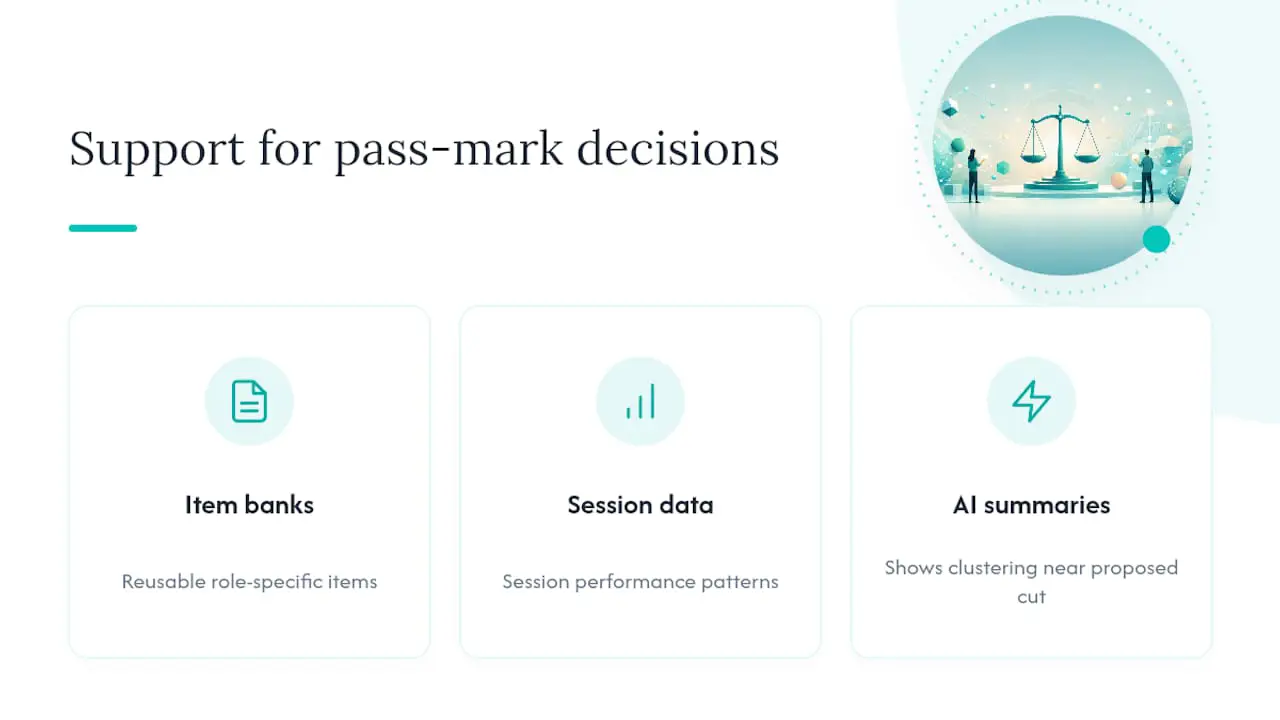
Running a defensible standard-setting process by hand means tracking panelist judgments, item data, and impact analysis across spreadsheets. Talent Approved’s workflows keep that trail in one place: reusable item banks for building role-specific assessments, session data for reviewing performance patterns, and AI-generated summaries that surface where candidates cluster around a proposed cut. See how to design job-specific screening tests for a starting framework.
Why Documentation Matters More Than the Number Itself
The percentage you land on matters less than most people assume. What actually protects an organization when a pass mark gets challenged is the paper trail behind it: who judged it, what method was used, and what evidence backed the final call. Pick a method that fits your stakes, write down why you chose it, and revisit the data once real candidates start taking the test.
— Jimmie
Set Pass Marks You Can Actually Defend
Building a fair cut score is only half the job. You also need a way to test candidates consistently against it, without spending days building item banks by hand. Talent Approved’s Magic Create tool turns a job description or a list of required skills into a structured, role-specific assessment in minutes, so the performance-level definitions behind your pass mark actually get tested the way you intended.

Built-in anti-cheat monitoring and session replays give you the procedural evidence a defensible standard-setting process depends on: a record of how each candidate actually performed, not just a final score. Pair that with AI-generated summaries and candidate rankings, and reviewing scores near your cut becomes a five-minute task instead of a manual audit. Since Talent Approved runs on a pay-as-you-go model with a flat $5 fee per completed assessment, there’s no subscription commitment to test it against your own role requirements. Start building an assessment and see how your proposed pass mark performs against real candidate data.
Sources
- Standard-setting literature: modified Angoff method (PMC article)
- What is a passing grade in college? | University of the People (blog)
- Standard setting — methods and validity (Cogn-IQ encyclopedia)
FAQ
What Is an Assessment Score?
An assessment score is the raw or scaled number a test taker earns, which gets compared against a predetermined pass mark to classify the result as passing or failing.
How Do You Interpret Assessment Results Near the Cut Score?
Scores within one standard error of measurement of the cut score fall into a borderline zone, where organizations often apply manual review, remediation, or a supervised retake rather than an automatic classification.
What Is Considered a Passing Exam Score?
There’s no universal number.