HR Playbook for AI vs Human Grading: 30–90 Day Pilot + 4 TEVV Steps

AI grading works well for structured, role-specific skill tests: it scores faster than a person and lands close to the same average marks. It should not run alone on high-stakes or ambiguous decisions. Frameworks from SIOP and NIST’s TEVV testing approach exist for a reason, and platforms like Talent Approved are built around pairing AI scoring with human review, not replacing it outright.
TL;DR:
- AI grading is most reliable for structured assessments like coding tests and standardized knowledge quizzes, where clear right or wrong answers exist.
- A hybrid model with AI in initial screening and human review for nuanced or ambiguous tasks offers the best balance of speed and accuracy.
- Both AI and human graders show inconsistencies in scoring identical submissions, emphasizing the need for validation and ongoing monitoring.
- Bias risks include measurement bias and predictive bias, which can be mitigated through thorough testing, transparency, and inclusive rubric design.
- Running small pilot programs and comparing assessment scores with actual job performance helps ensure AI tools are predictive and fair in hiring.
Table of Contents
- How AI Grading and Human Grading Work in Hiring
- Strengths and Limits: Accuracy, Speed, Consistency, and Bias
- Validation, Testing, and Governance HR Teams Must Run
- Implementation Checklist: Decision Rules and Metrics
- Impact of AI Grading on Feedback Quality for Candidates
- From Paper Tests to AI Scoring: A Short History
- Ethical Considerations Specific to AI vs Human Grading
- Why AI Grading Results Are Harder to Interpret
- AI Grading Across Different Roles and Skill Types
- A Pragmatic Path to Human and AI Grading Working Together
- Ready to Pilot AI-Assisted Grading? Start Here
- Sources
- FAQ
How AI Grading and Human Grading Work in Hiring
AI grading tools score candidate work against a rubric built from training labels, structured criteria, or a job description fed into the system. Some AI assessment platforms provide features that build role-specific assessments and scoring structures from job descriptions in minutes, then generate summaries of each candidate’s performance so recruiters can review results without reading every submission line by line. The advantage is throughput: a system like this can grade hundreds of code samples or written responses in the time a single subject-matter expert reviews a handful.
Human grading works differently. A subject-matter expert applies a rubric using judgment, context, and experience, which is valuable for nuance but expensive to scale. Two things slow it down every time: cost per candidate and inter-rater variability, meaning two qualified reviewers can score the same answer differently depending on mood, fatigue, or interpretation of the rubric.
Most employers land on a hybrid model rather than picking one side. Common patterns include:
- AI-first with human spot-checks: AI grades every submission, and a recruiter reviews a sample or any borderline scores.
- Human-first for complex tasks: open-ended or judgment-heavy prompts go straight to a person, while structured tasks (coding tests, math problems, multiple-choice logic) go to AI.
- Mechanical synthesis: human evaluators and algorithmic scores are blended into one combined output, a method shown to preserve predictive accuracy while improving buy-in from hiring managers who want a human check on the process.
Strengths and Limits: Accuracy, Speed, Consistency, and Bias
A peer-reviewed comparison of AI grading against human experts in IT recruitment found no significant difference in average scores between the two. AI graded far faster, but the study also found something less flattering for both sides: neither was fully consistent. The AI produced varying scores when asked to regrade the same submission, and human reviewers showed the same inter-rater unreliability that has been documented in hiring research for decades.
Where each approach tends to win:
- AI wins on raw speed and consistency across large candidate pools when the task is structured (code tests, standardized problem sets).
- Humans win on context: recognizing an unconventional but valid answer, applying accommodations, or catching a candidate who solved the problem a different but equally correct way.
- Neither wins outright on repeatability. Both AI and human graders can produce different scores for the same work on a second pass.
Consistency check: the same study that found AI matched human average scores also found both AI and human grading showed measurable inconsistency on repeat evaluation of identical submissions, which is why a single grading pass from either source is a risky basis for a final hiring decision.
Bias deserves its own breakdown, because “biased” gets used loosely. SIOP separates it into two distinct, testable concepts: measurement bias, where a test performs differently for different groups despite equal underlying skill, and predictive bias, where a test score predicts job performance differently across groups. Treating these as one vague problem is how employers miss real risk. A common failure mode is target leakage, where a model trains on a proxy variable that correlates with a protected characteristic rather than the skill itself. Missing accommodations for candidates with disabilities is another: an AI rubric built without ADA considerations in mind can penalize a legitimate alternative approach that a human reviewer would recognize instantly.
Validation, Testing, and Governance HR Teams Must Run
Deploying an AI grading tool without a testing plan is how employers end up defending a lawsuit instead of a hiring decision. NIST’s TEVV-Athlon approach gives a practical structure for this, built around four stages:
- Define goals. Decide exactly what the grading tool needs to measure and what “good performance” looks like for the role.
- Construct validation. Confirm the test actually measures the skill it claims to, not a loosely related proxy.
- User and field testing. Run the tool against real candidate submissions, including red-teaming attempts to find where it breaks or scores unfairly.
- Synthesize results. Combine everything into a documented judgment on whether the tool is ready for live use.
An audit checklist worth running before launch and on a recurring cadence afterward should include construct and practical validity checks, adverse impact testing across demographic groups, documentation of label sources and rubric design, adequate sample sizes before drawing conclusions, and a fixed monitoring schedule rather than a one-time review. Talent Approved’s built-in adverse impact testing guidance walks through how to run this kind of check without a statistics background.
The most overlooked step is feedback integration: connecting pre-hire scores to what actually happens after the hire. Comparing assessment scores against retention and performance data turns a screening test into a genuinely predictive instrument, rather than a filter you hope is working.
Pro Tip: Run your first validation cycle on a role you already hire for often. You’ll have enough historical performance data to check whether the assessment score actually predicted anything, instead of guessing.
Implementation Checklist: Decision Rules and Metrics
Not every test belongs in the same bucket. A workable decision rule looks like this:
- Use AI-only or AI-first grading for structured coding tests, standardized problem sets, and high-volume initial screening.
- Require human review for ambiguous free-text responses, portfolio evaluation, and any final-stage decision that affects an offer.
- Default to hybrid scoring whenever the role is high-stakes but the test format is still structured enough for AI to handle a first pass.
Once the rules are set, track them with real metrics instead of gut feel:
- Inter-rater agreement — Cohen’s kappa for two-rater comparisons, or Fleiss’ kappa when more raters are involved, applied to both AI-versus-human and human-versus-human comparisons.
- Subgroup score distributions — regularly broken out by demographic category to catch measurement bias early.
- Predictive validity correlations — how well pre-hire scores actually track post-hire performance.
- Processing time and error rate — how long grading takes and how often outputs need manual correction.
Operational controls matter as much as the metrics themselves: give candidates notice where state law requires it, build an escalation path for outlier scores, document every audit for compliance review, and set a fixed retraining trigger rather than waiting for a complaint to force the issue. Talent Approved’s instant assessment scoring is built with this kind of transparent, auditable rubric in mind.
Impact of AI Grading on Feedback Quality for Candidates
Faster grading changes what candidates experience, not just what recruiters see. A candidate who finishes a skill test and gets a result in hours instead of two weeks stays engaged with your process instead of accepting a competing offer. AI-generated summaries can give recruiters a readable breakdown of strengths and gaps per candidate almost immediately after submission, which shortens the gap between assessment and next steps.
Feedback quality is a separate question from feedback speed, though, and it is where AI still has real limits. A generated summary can flag that a candidate’s code failed certain test cases or that a written response missed key criteria from the rubric. It struggles to explain the “why” with the same texture a skilled human reviewer brings, especially for creative or judgment-heavy tasks where the right answer isn’t singular.
The practical fix most hybrid workflows land on is layered feedback: AI generates the first-pass summary immediately, and a recruiter or hiring manager adds context before it reaches a candidate or hiring committee. This keeps the speed advantage of automated grading without losing the interpretive nuance a person adds. It also protects against a subtler risk: candidates trusting an AI summary as more authoritative than it actually is, simply because it arrived fast and looks tidy.
From Paper Tests to AI Scoring: A Short History
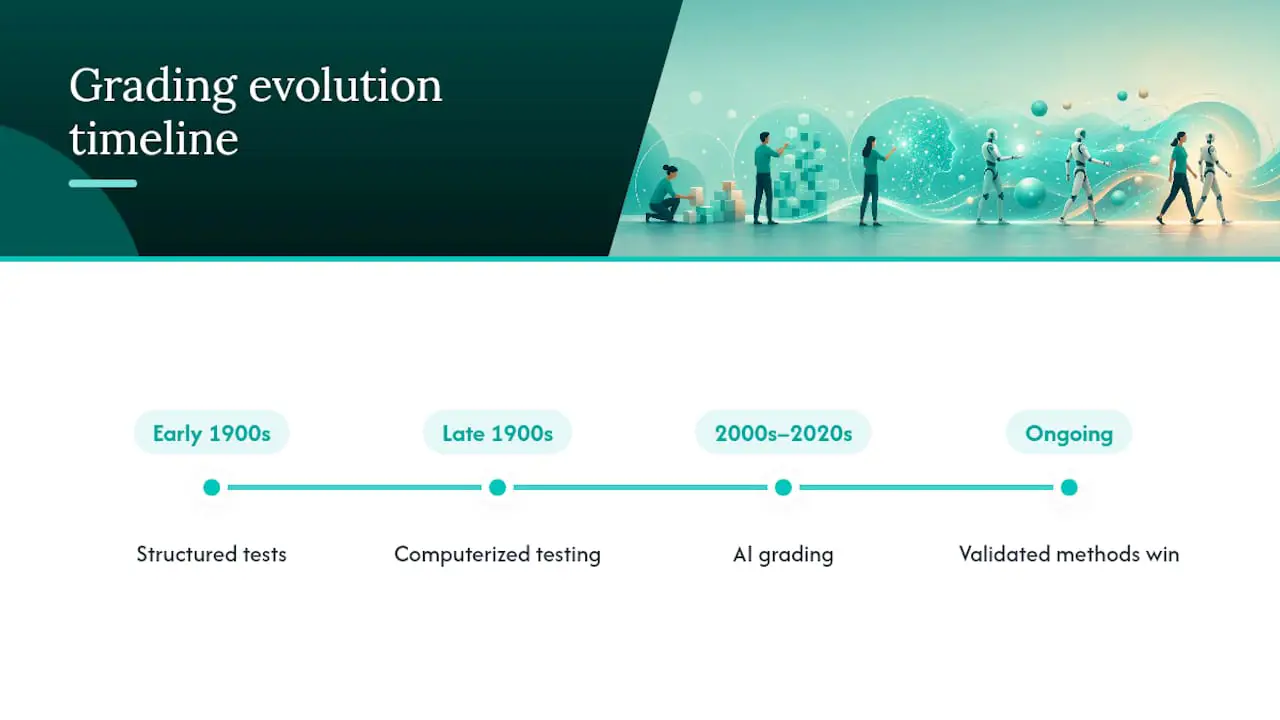
Grading candidates didn’t start with software. Structured hiring assessment traces back to early 20th-century personnel psychology, when employers first tried standardizing tests to reduce reliance on gut instinct and personal referrals. Decades of research since then consistently show that structured, job-relevant methods, work samples and structured interviews especially, produce the strongest link to actual job performance, far outperforming unstructured interviews or resume screening alone.
The next big shift came with computerized testing in the late 20th century, which let employers standardize scoring and reduce some inter-rater inconsistency for multiple-choice and numeric assessments. But open-ended tasks, writing samples, code review, scenario responses, still needed a human to read and judge them, which kept grading slow and expensive at scale.
AI grading is the next step in that same trajectory, not a break from it. What changed is the ability to apply a consistent rubric to unstructured responses (written answers, code, even video) at a speed no human panel can match. The research on combining selection methods that predates modern AI by decades still holds the underlying lesson: validated, job-relevant tests beat informal judgment, whether the grader is a person or a model. AI didn’t invent that principle. It just made applying it at scale finally practical.
Ethical Considerations Specific to AI vs Human Grading
The ethical questions around AI grading aren’t really about whether a machine “understands” fairness. They’re about whether the humans deploying it built enough accountability into the process. Three issues come up repeatedly.
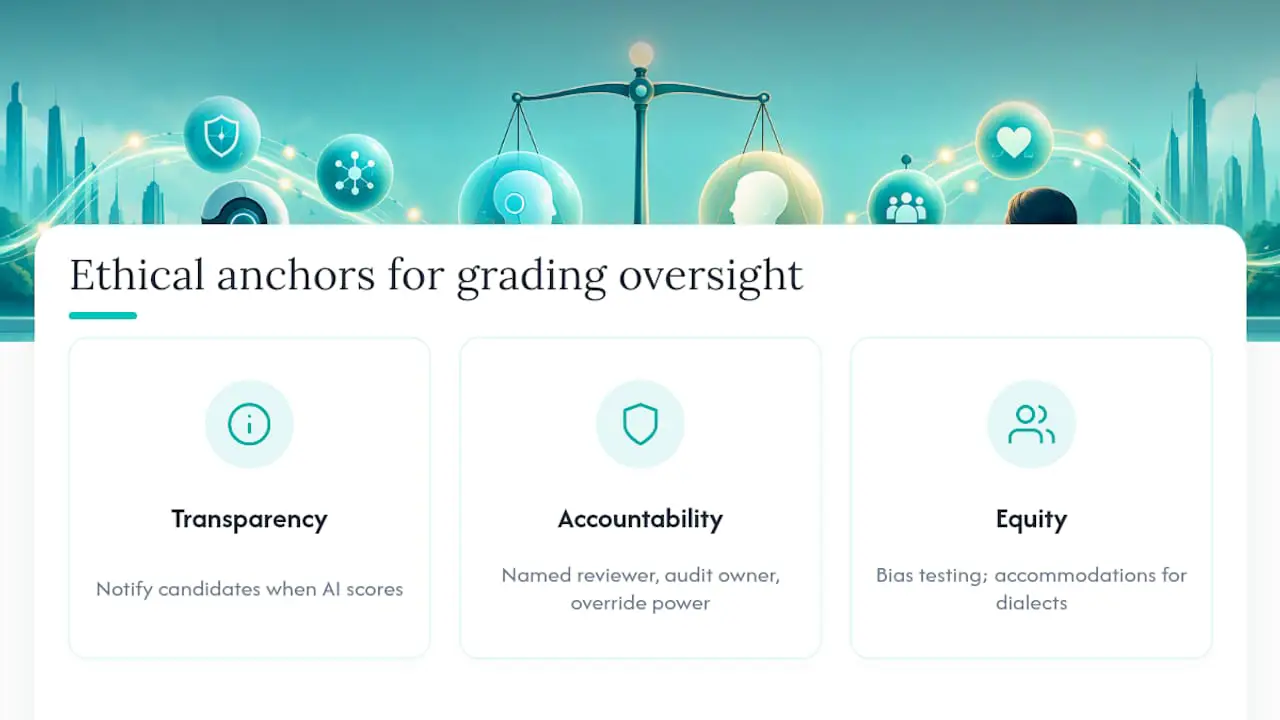
Transparency. Candidates deserve to know when AI is involved in scoring their work, and a growing number of state laws require exactly that kind of notice. Employers who bury this in fine print are creating legal exposure, not just an ethics problem.
Accountability for errors. When a human grader makes a mistake, there’s a person to escalate to. When an AI system misgrades a response, the accountability chain needs to be just as clear: who reviews outliers, who owns the audit, and who has authority to override a score.
Equity across candidates. A grading system trained without attention to accommodations, dialect variation in written responses, or non-traditional problem-solving approaches can quietly disadvantage qualified candidates without anyone noticing until an adverse impact audit catches it. Human graders carry their own version of this risk through unconscious bias, which is exactly why SIOP treats bias testing as a technical requirement for either grading method, not a one-time ethical checkbox.
None of this argues against using AI. It argues for treating grading, of either kind, as a system that needs oversight, not a tool you deploy and forget.
Why AI Grading Results Are Harder to Interpret
A human grader can usually explain a score in a sentence: “the candidate’s solution worked but used an inefficient approach.” An AI-generated score is often harder to unpack, especially when the underlying model weighs dozens of signals a recruiter never sees directly.
This creates a specific interpretation problem: a score without a clear rationale is difficult to defend if a candidate challenges it or a regulator asks how a decision was made. It’s also harder to know whether a low score reflects a genuine skill gap or a quirk in how the candidate phrased an answer.
The practical answer isn’t to distrust every AI score. It’s to demand explainability as a baseline feature, not an afterthought. A useful AI-generated summary should show which specific criteria a candidate met or missed, not just a single composite number. That level of detail lets a recruiter cross-check the AI’s reasoning the same way they’d sanity-check a human reviewer’s notes, and it turns an opaque score into something a hiring manager can actually stand behind in a final decision.
AI Grading Across Different Roles and Skill Types
AI grading isn’t one tool applied uniformly. How well it works shifts depending on what’s being tested.
Technical and coding assessments are where AI grading performs most reliably. Test cases either pass or fail, execution time is measurable, and code quality metrics can be scored against clear criteria, which is exactly the structured environment the IT recruitment study measured when it found AI matching human average scores at much faster speed.
Structured knowledge tests, compliance quizzes, aptitude tests, situational judgment tests with defined correct answers, are nearly as strong a fit, since the scoring logic barely differs from a well-built multiple-choice exam.
Written response and communication tasks sit in the middle. AI can flag grammar, structure, and whether a response addressed the prompt, but judging tone, persuasiveness, or creative problem-solving still benefits from a human second look.
Sales, customer service, and interpersonal role tasks lean human-heavy for now. These roles depend on reading emotional cues and adapting mid-conversation, territory where a rubric struggles to capture what actually predicts success on the job.
Talent Approved’s role-specific test design guidance is built around matching the assessment format to the skill being tested, which is the real lever for deciding how much weight to put on AI scoring for any given role.
A Pragmatic Path to Human and AI Grading Working Together
Skip the all-or-nothing debate. Run a pilot on one role, blend AI scores with human judgment through mechanical synthesis rather than picking one, and audit a small sample before scaling to anything high-stakes. Platform features that support this, structured rubric generation, anti-cheat monitoring, AI-generated summaries, exist to make the human review step faster, not to replace it. Track post-hire performance against pre-hire scores and adjust the rubric when the data tells you to, not before.
— Jimmie
Ready to Pilot AI-Assisted Grading? Start Here
Talent Approved is built for exactly the hybrid model this article recommends: AI does the heavy lifting on scoring, and you keep the final call. Magic Create turns a job description into a role-specific assessment in minutes, built-in anti-cheat monitoring (screen and webcam checks, session replays) protects the integrity of what you’re scoring, and AI-generated summaries give you a readable breakdown per candidate instead of a raw number. Pricing runs on a pay-as-you-go model at $5 per completed candidate assessment, with no subscription required.
If you’re ready to test this properly, run a 30 to 90 day pilot: pick one role, generate the assessment with Magic Create, score every submission with both the AI summary and a human reviewer in parallel, run an adverse impact check across the results, and compare pilot hires against performance data once they’re on the job. Check the pricing page to scope your pilot before you commit to a full rollout.
Sources
Before rolling out AI grading at scale, review SIOP’s validation guidance, NIST’s TEVV-Athlon framework, and the IT recruitment study comparing AI and human grading. For evolving legal obligations, K&L Gates’ summary of shifting federal guidance is worth a read.
- ChatGPT vs human expertise in the context of IT recruitment
- Considerations and Recommendations for the Validation and Use of AI-Based Assessments for Employee Selection (SIOP)
- NIST ARIA 0.1 pilot report
- The validity and utility of selection methods in personnel psychology
FAQ
Can AI Replace Human Graders Entirely?
No. Research comparing AI and human grading in IT recruitment found similar average accuracy but faster AI speed, while both showed inconsistency on repeat scoring. Human review still matters for ambiguous tasks and final-stage decisions.
Is AI Grading Legally Defensible for Hiring Decisions?
It can be, if you validate the tool and document the process. SIOP recommends formal psychometric validation, and several states now require candidate notice or consent when AI is used in scoring.
How Much Does Talent Approved Cost?
Talent Approved charges $5 per completed candidate assessment on a pay-as-you-go basis, with no subscription required.
What’s the Difference Between Measurement Bias and Predictive Bias?
Measurement bias means a test scores differently across groups despite equal underlying skill. Predictive bias means the score predicts job performance differently by group. SIOP treats these as separate, testable issues, not one general fairness problem.
Which Skill Tests Are Safest to Grade With AI Alone?
Structured, objectively scored tests, coding challenges, standardized knowledge quizzes, and situational judgment tests with defined correct answers, are the safest fit for AI-only grading. Open-ended written responses and interpersonal role assessments still benefit from human review.