
Talent Approved $5 Pilot: Candidate Benchmarking Scores for HR

Candidate benchmarking scores are standardized ways to compare applicants against a role-specific target instead of gut feeling. They come in two frames: norm-referenced, which ranks a candidate against a peer group, and criterion-referenced, which checks whether someone hit a defined skill standard. Before you act on any score, confirm the benchmark is documented and the comparison group actually fits your role.
TL;DR:
- Norm-referenced scores compare candidates against a peer group, while criterion-referenced scores measure if a candidate meets fixed skill standards; choosing the right frame depends on the role.
- Building a reliable benchmark requires clear role competency mapping, selecting an appropriate norm group, ensuring a sample size of over 100, and regularly re-norming every 12 to 24 months.
- Scores must be interpreted within the context of the test difficulty, role type, and chosen benchmark frame, as a 75th percentile on one assessment may differ significantly from a 75% accuracy score.
- Comparing candidate scores to inappropriate norms, using outdated data, or ignoring the full candidate profile reduces benchmarking accuracy and risks poor hiring decisions.
- Using assessment platforms that automatically convert job descriptions into role-specific tests and provide live scoring helps streamline benchmarking and reduces manual workload.
Table of Contents
- What Do Candidate Benchmarking Scores Actually Measure?
- How Do You Build a Job Benchmark From Scratch?
- What Counts as a Good Benchmark Score in Hiring?
- What Pitfalls Undermine Benchmarking Accuracy?
- How Do Assessment Platforms Put Benchmarking Into Practice?
- Where Should HR Teams Actually Start With Benchmarking?
- Put Benchmarking to Work With Talent Approved
- Sources
- FAQ
What Do Candidate Benchmarking Scores Actually Measure?
Norm-referenced scores answer one question: how does this candidate rank against a comparison group? Criterion-referenced scores answer a different one: did this candidate meet a defined skill standard, regardless of how anyone else performed. The Michigan Assessment Consortium frames these as separate tools built for separate jobs, and mixing them up is where a lot of hiring mistakes start.
Assessment platforms report results in a handful of formats:
- Percentile: where a candidate lands among 100 hypothetical peers (85th percentile beats 85% of the comparison group).
- Percent-correct: raw accuracy on the test content, unrelated to how anyone else did.
- Stanine: a nine-band score (1 to 9) that groups percentiles into rougher categories.
- Comparative score: a live ranking against the current applicant pool rather than a historical norm.
Here’s where it gets confusing: a candidate who scores 70% correct on a hard coding assessment might land in the 90th percentile, because the test was tough for everyone. A 70% on an easy test might land someone in the 40th percentile. Treating those two “70s” the same is a common, avoidable error. Percentiles can also mislead on their own, without a mastery threshold attached for context, according to Educational Psychology Interactive.
How Do You Build a Job Benchmark From Scratch?
A benchmark is only as good as the role analysis behind it. Rushing this step is the number one reason benchmarking programs get abandoned within a year.
- Map the role to competencies. Break the job into 4 to 6 measurable skills or task outcomes, not vague traits like “team player.”
- Pick your reference frame. Screening for a minimum bar favors criterion-referenced thresholds; selecting top talent for a competitive role favors norm-referenced ranking.
- Choose a representative norm group. National norms work for generalist roles; a narrower, industry-specific or special-group norm works better for specialized cohorts like engineers, where general population comparisons can flatten meaningful differences, as University of Delaware’s testing guidance notes.
- Check sample size. A norm group under 100 candidates produces shaky percentiles. Aim higher, and re-norm every 12 to 24 months as your applicant pool shifts.
- Document thresholds and ownership. Write down who owns the benchmark and when it gets revisited.
Pro Tip: Start with the job description, not the test catalog. Assessments built backward from an existing test tend to measure what’s convenient, not what the role actually needs.
What Counts as a Good Benchmark Score in Hiring?
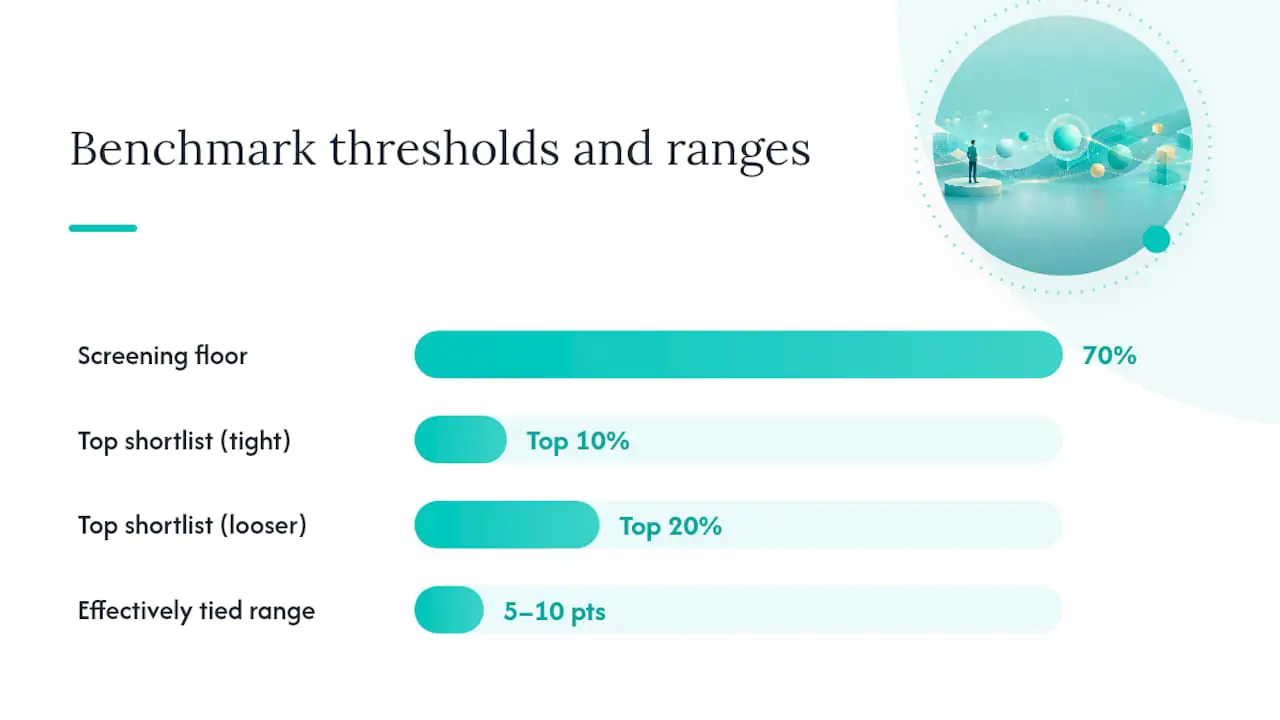
There’s no universal “good” score. A good score is one that matches the reference frame you chose and the risk level of the role. A 75th percentile on a norm-referenced sales assessment means something different from 75% correct on a criterion-referenced compliance test, and treating both as an equivalent pass mark is a mistake.
Some practical guardrails:
- For screening at volume, set a criterion-referenced floor (e.g., 70% on core job tasks) to filter out clear mismatches before human review.
- For competitive, low-volume roles, use norm-referenced percentile bands (top 10% or top 20%) to shortlist finalists.
- Treat scores within 5 to 10 percentile points of each other as effectively tied, not ranked.
- Never let a single score override strong signal from work samples or structured interviews.
Watch for scenarios where the highest scorer isn’t the best hire; a candidate who aces a technical assessment but bombs collaboration signals in an interview is a real pattern, not an edge case. Benchmark scores narrow the field. They don’t replace judgment.
What Pitfalls Undermine Benchmarking Accuracy?
The most common failure is norm-group mismatch. Comparing a specialist candidate pool against general population norms flattens the very differences you’re trying to detect, and special-group norms exist specifically to fix that, per University of Delaware’s guidance. A second failure is letting norms go stale. Test technical manuals often specify a re-norming cadence for exactly this reason, since applicant pools and skill baselines shift over time.
Run these checks before you trust a benchmark:
- Item review: have a subject-matter expert confirm test items still reflect real job tasks.
- Differential item functioning (DIF) checks: flag questions that unfairly disadvantage specific demographic groups.
- Stratified performance review: compare pass rates across groups to catch adverse impact early.
- Pilot and correlate: run a small pilot and check whether scores actually predict early job performance.
A representative, adequately sized, and properly stratified norm group is a prerequisite for trustworthy rankings, not an optional refinement, according to University of Delaware’s School Psychology resources. Skipping that step is how otherwise well-designed assessments produce misleading rankings. Correlating scores against on-the-job performance within the first few months remains one of the fastest, most concrete ways to catch a bad threshold before it costs you a bad hire, based on validation research published in PMC.
How Do Assessment Platforms Put Benchmarking Into Practice?
Turning this checklist into a daily habit is where most HR teams stall. This is the part where the framework needs to become a workflow.
Talent Approved’s Magic Create feature builds a role-specific assessment directly from a job description or skill list, which shortcuts the competency-mapping step most teams struggle with. From there:
- Choose a comparative reporting mode to rank candidates against the current applicant pool, or a criterion mode to check for mastery against a fixed threshold, depending on whether you’re screening at volume or selecting top talent.
- Built-in anti-cheat monitoring (screen and webcam tracking) protects the integrity of the score itself.
- Session replays let a hiring manager verify a borderline score before making a call.
- AI-generated summaries and candidate rankings turn raw scores into something a non-technical hiring manager can act on quickly.
As more candidates complete a role’s assessment, the comparative score naturally stabilizes into a more reliable, self-refreshing norm group.
Where Should HR Teams Actually Start With Benchmarking?
The fastest win sits in high-volume screening, not executive hiring. Roles that get 50 or more applications for one opening are where a criterion threshold saves the most reviewer hours with the least risk.
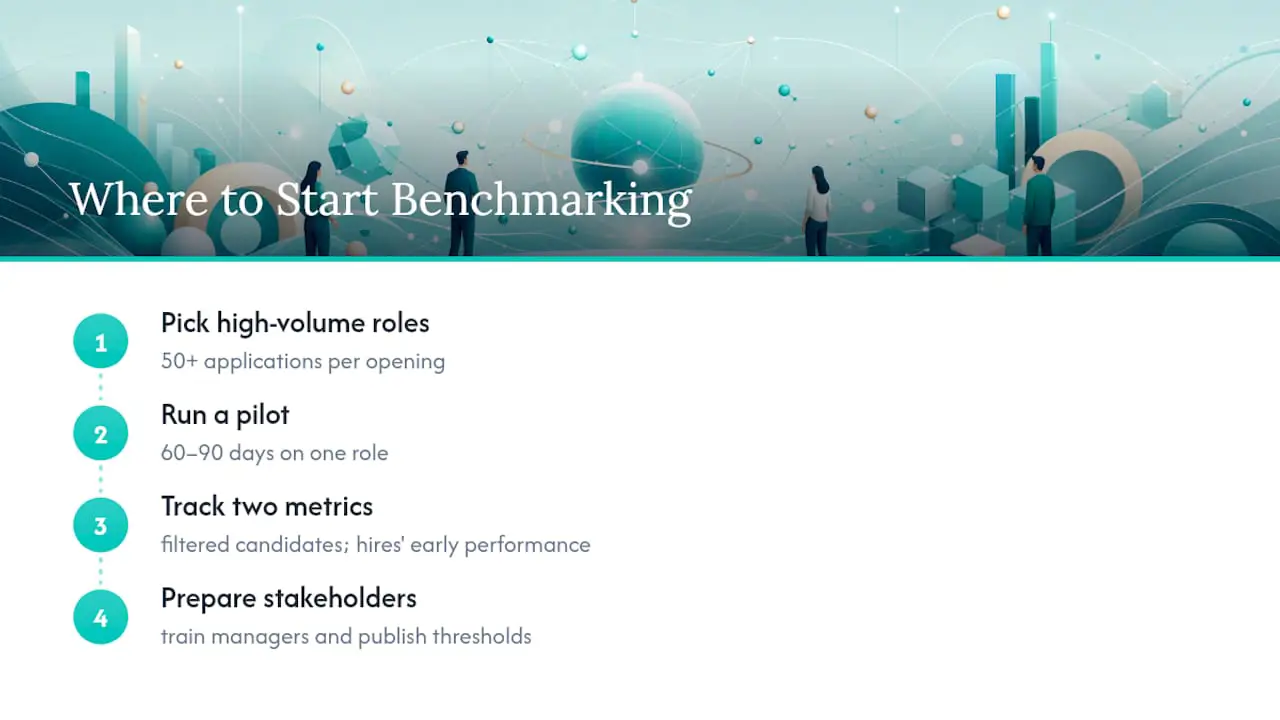
Run a pilot on one role for 60 to 90 days before rolling anything out company-wide. Track two numbers: how many candidates the threshold filtered out, and whether the hires who passed performed as expected in their first few months. That second number matters more than people expect.
Train hiring managers on what the score frame means before you show them a single number, and publish your thresholds internally. A benchmark nobody understands gets ignored the first time it produces an inconvenient result.
— Jimmie
Put Benchmarking to Work With Talent Approved
Talent Approved gives HR teams a faster path to a documented benchmark than building one from scratch. Instead of spending weeks mapping competencies and drafting test items, Magic Create turns a job description into a structured, role-specific assessment in minutes, so the competency-mapping step from this guide happens automatically rather than manually.

The platform supports both reporting frames covered above: comparative scoring for competitive roles and criterion thresholds for high-volume screening, so you’re not locked into one interpretation style. Anti-cheat monitoring, session replays, and AI-generated summaries handle the validation and review work that normally eats a recruiter’s afternoon. There’s no subscription commitment. You pay $5 per completed candidate assessment, which makes it practical to pilot a benchmark on a single role before expanding it further. If you’re ready to test this against a live req, start building your first assessment on the Talent Approved platform today.
Sources
For deeper technical grounding, the Michigan Assessment Consortium’s norm and criterion guidance and Educational Psychology Interactive’s breakdown both cover score reporting in more depth than a hiring-focused guide can. For industry-specific benchmarking outside HR, these sales performance benchmarks show how the same logic applies to revenue teams.
- University of Delaware: School Psychology resources
- Michigan Assessment Consortium: Criterion- and norm-referenced score reporting
- PMC article on assessment validation and best practices
- Educational Psychology Interactive: Criterion- vs. Norm-Referenced Tests
FAQ
What Is a Good Score on a Benchmark Test?
There’s no fixed universal cutoff. A good score depends on whether you’re using a norm-referenced frame (top percentile bands, like the top 10% to 20%) or a criterion-referenced frame (a fixed mastery threshold, often 70% or higher on core tasks).
What Is the 80/20 Rule in Recruiting?
In most hiring contexts, this refers to the idea that a small share of sourcing channels or candidate signals drives most of your quality hires, so teams should focus effort on the highest-yield inputs rather than spreading attention evenly across every channel.
What Are the Strongest Qualities to Look for in a Candidate?
Definitions vary by role, but assessment data consistently points to demonstrated task competency, problem-solving under realistic constraints, and communication clarity as signals that predict performance better than credentials alone.
How Often Should You Re-Norm a Candidate Benchmark?
Most testing guidance recommends re-norming every 12 to 24 months, or sooner if your applicant pool or role requirements shift significantly.
Can Benchmarking Scores Replace Interviews Entirely?
No. Benchmark scores narrow the applicant pool and reduce reviewer workload, but they should be combined with structured interviews or work samples before a final hiring decision, since a top scorer isn’t always the best fit for the team.