
Applicant Ranking Systems: A Fair Hiring Guide for HR

An applicant ranking system automatically orders job candidates by a role-specific score so recruiters see the best matches first, not just the most recent applications. The core idea is straightforward: convert multiple evaluation signals into a single, comparable number, then sort. The U.S. Office of Personnel Management draws a useful distinction here: rating checks whether a candidate meets minimum qualifications, while ranking compares qualified candidates based on job-specific factors to determine who is best suited.
For HR teams, the immediate recommendation is to build ranking on assessment-driven signals, document every scoring rule, and keep a human reviewer in the final decision loop. Agencies like OPM and compliance bodies like the EEOC set the guardrails; platforms like Talent Approved supply the assessment infrastructure that makes those guardrails practical to follow.
- Use objective, role-specific assessments as the primary ranking input.
- Document scoring weights before a campaign opens, not after.
- Assign a human reviewer to every rank band before offers go out.
Key Takeaways
An applicant ranking system orders candidates by a composite role-fit score, and the most defensible, predictive systems build that score from structured assessment data rather than resume keywords alone.
| Point | Details |
|---|---|
| Definition and purpose | Ranking systems order qualified candidates by role-fit score so recruiters shortlist faster and more consistently. |
| Assessment-driven signals | Weighting skills assessment scores at 40% or more improves both predictive accuracy and diversity of hire. |
| U.S. compliance anchors | OPM’s 2025 Rule of Many and EEOC Uniform Guidelines require documented, auditable, numerically scored ranking. |
| KPIs to monitor | Track time-to-interview, hire conversion rate by rank band, and 90-day performance correlation to validate your rubric. |
| Talent Approved | Generates role-specific assessments from job descriptions, applies anti-cheat monitoring, and produces AI summaries that feed a 0–100 composite rank. |
Table of Contents
- What types of applicant ranking systems exist?
- How does an applicant ranking system work?
- What signals go into a candidate’s ranking score?
- What are the business benefits, and which KPIs should you track?
- What are the limits, bias risks, and U.S. compliance considerations?
- How do you implement ranking responsibly in your hiring workflow?
- A practical example: Talent Approved assessments feeding a ranking workflow
- The case for assessment-first ranking, not algorithm-first
- Talent Approved makes assessment-driven ranking practical
- Sources
- FAQ
What types of applicant ranking systems exist?
Not every ranking system in recruitment works the same way. The right approach depends on hiring volume, role complexity, and your compliance environment.
- Manual ranking involves a hiring panel scoring resumes or interview notes against a shared rubric. It works for low-volume, specialist roles where nuanced judgment matters, but it scales poorly and introduces panel-level inconsistency.
- ATS / rule-based scoring uses keyword matches and boolean filters to assign points. Fast and cheap to deploy, but it rewards resume formatting over actual ability and can quietly penalize non-traditional career paths.
- Assessment-driven ranking feeds structured test scores, work samples, or situational judgment results into a composite score. This approach produces the most defensible, skills-based rank lists and pairs well with EEOC-aligned validation.
- AI/ML ranking applies a trained model to predict candidate fit from multiple inputs simultaneously. Powerful for high-volume roles, but it requires explainability documentation and regular adverse impact testing to stay compliant.
A 2026 EACL demo paper shows one direction AI ranking is heading: an LLM-driven, interpretable framework that uses listwise tournament comparisons aggregated with a Plackett–Luce model to produce auditable, stable rank orders. That kind of explainability is exactly what regulated hiring environments need.
How does an applicant ranking system work?
The data flow follows a consistent pattern regardless of the system type: inputs feed a scoring engine, the engine produces a ranked list, and that list triggers downstream workflows.
Primary inputs typically include the job description, resume or application data, assessment results, years of relevant experience, certifications, and metadata like location or availability. The richer and more role-specific the inputs, the more predictive the final score.
Scoring methods vary by sophistication. Weighted rubrics assign fixed point values to each criterion. Normalized test scores convert raw assessment results to a common scale. Composite 0–100 scales blend multiple signals into a single number recruiters can sort and filter. Model probabilities, used in AI/ML systems, estimate the likelihood of a candidate succeeding in the role.
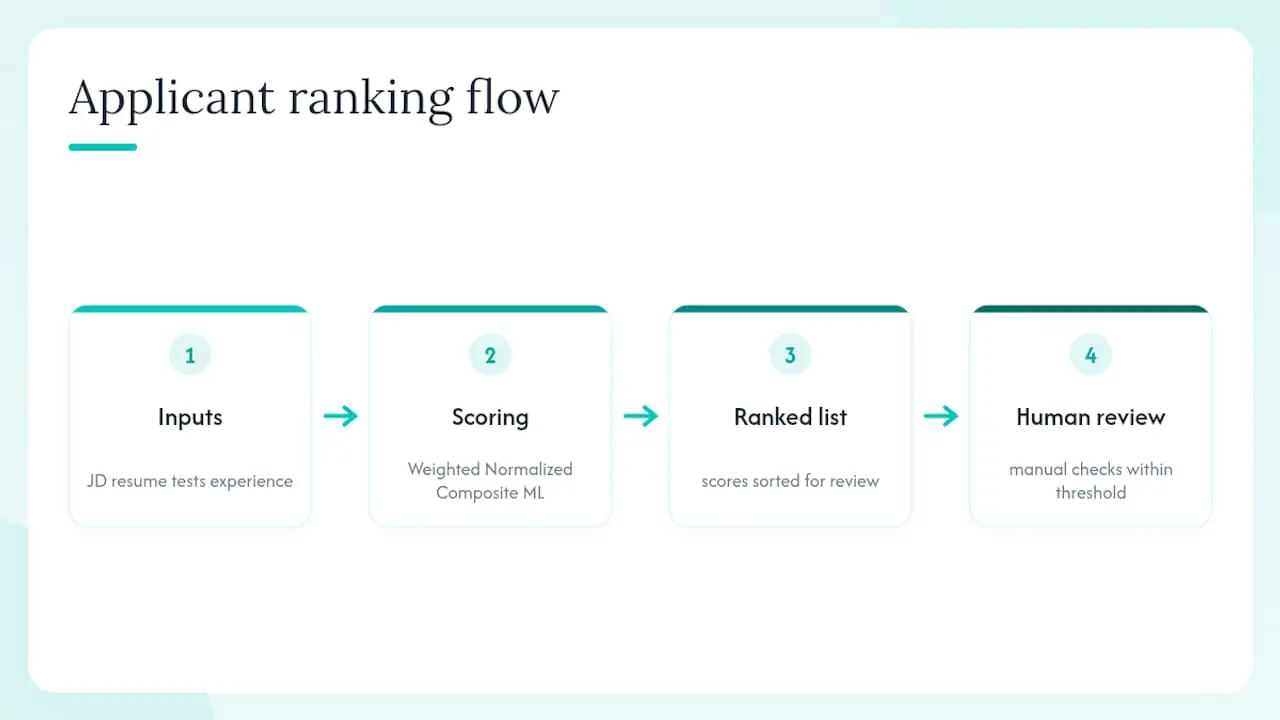
Integration points matter for adoption. A ranking system that connects to your ATS, assessment platform, and interview scheduling tool creates a single workflow instead of three separate ones. OPM’s hiring process guidance estimates a 15-day HR evaluation window for federal roles; well-integrated ranking tools can compress that significantly for private-sector teams.
Human-in-the-loop checkpoints should be designed before deployment. Set a review threshold (for example, all candidates within 5 points of the cut-off score get a manual review), define override rules, and maintain an audit trail of every score change.
Pro Tip: Version and freeze your scoring rules at the start of each campaign. If you adjust weights mid-search, you lose the ability to compare candidates fairly and you create an audit liability.
What signals go into a candidate’s ranking score?
The signals you choose determine who rises to the top. Common inputs across applicant evaluation processes include:
- Skills match against the job description
- Assessment or test score (normalized to a 0–100 scale)
- Years of directly relevant experience
- Scope of responsibility in prior roles
- Measurable achievements (revenue managed, team size, certifications held)
- Cultural-fit indicators from structured interview or survey responses
- Source quality (employee referral typically predicts higher retention than a generic job board)
How you weight those signals changes the shortlist. An illustrative composite scoring breakdown might look like this:
That trade-off tends to improve diversity of hire because it reduces the advantage held by candidates with access to prestigious employers. Shifting weight toward experience, on the other hand, favors depth but can narrow the pool. Neither choice is universally right; the right weights come from a job analysis tied to actual performance data. Guidance on choosing which skills to test can help you build a rubric grounded in role requirements rather than assumptions.
What are the business benefits, and which KPIs should you track?
Ranking systems in recruitment pay off in two categories: operational speed and hire quality.
Operational benefits show up quickly. Time-to-shortlist drops when recruiters no longer read every application sequentially. Time-to-hire compresses when interview scheduling triggers from a rank band rather than from a recruiter’s inbox.
Quality benefits take longer to measure but matter more. When assessments feed the ranking, hire-to-performance correlation improves because the score predicts job behavior rather than interview polish. Early turnover tends to fall when candidates are selected on demonstrated skills rather than resume keywords.
KPIs to track:
- Time-to-interview (days from application to first interview)
- Percentage of ranked candidates who reach the interview stage
- Hire conversion rate by rank band (do top-ranked candidates actually get hired and perform well?)
- Assessment pass rate by role and source channel
- Candidate satisfaction or NPS score post-assessment
- Hiring manager satisfaction with the shortlist quality
Tying rank band to 90-day performance reviews closes the feedback loop. If your top-ranked candidates consistently outperform mid-ranked hires, the weights are working. If not, the rubric needs recalibration.
What are the limits, bias risks, and U.S. compliance considerations?
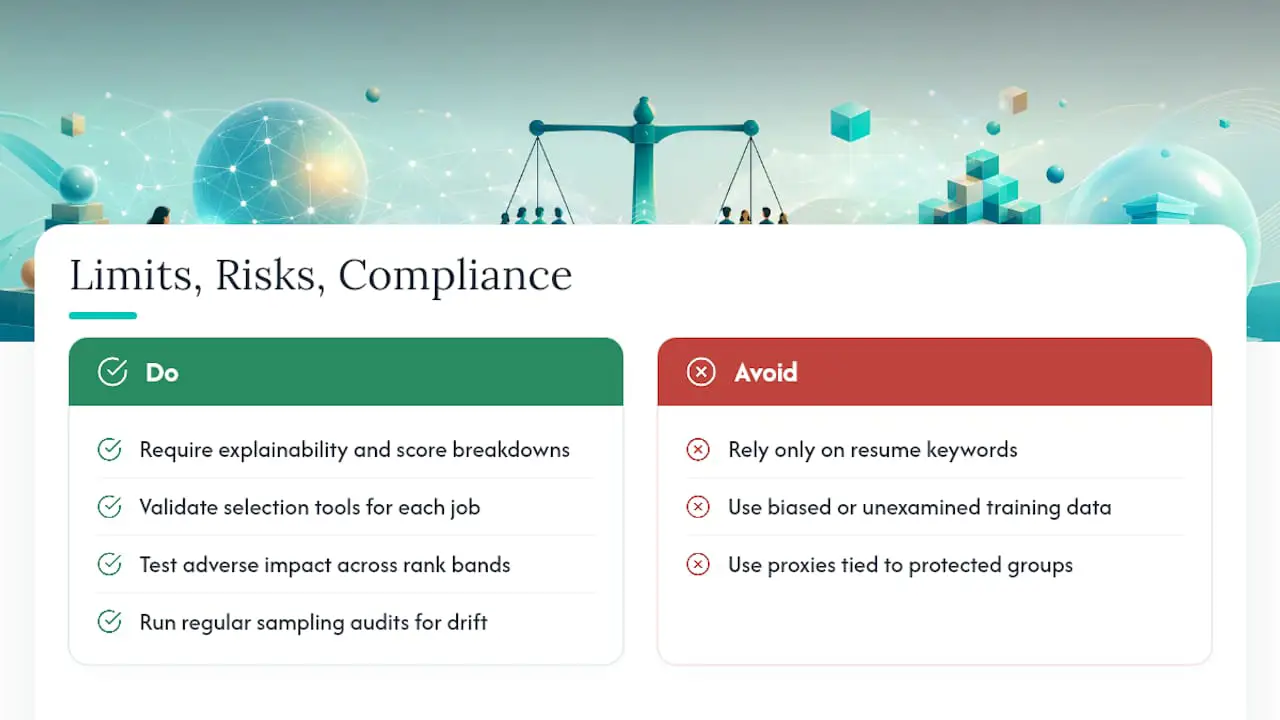
Ranking systems can fail quietly. The most common failure modes are biased training data, proxy variables that correlate with protected characteristics, and over-reliance on resume keywords that favor certain educational backgrounds.
Explainability is the first line of defense. A ranking system that cannot tell a recruiter why a candidate scored 72 instead of 68 is a liability, not an asset. Dimension-level score breakdowns and plain-language summaries for top-ranked candidates make audits possible and help hiring managers trust the output.
U.S. legal context adds specific requirements. The EEOC’s Uniform Guidelines on Employee Selection Procedures require that selection tools be validated for the jobs they are used for and that adverse impact be tested across protected groups. Federal hiring carries additional rules: OPM’s September 2025 memorandum introduced the “Rule of Many,” replacing the older “Rule of Three” and establishing numerical scoring with rank-order selection for federal competitive and excepted service hiring. Veterans’ preference augmentation applies to those scores.
Compliance pivot: The Rule of Many FAQ describes four methods agencies may use to set how many top-ranked candidates to refer: a cut-off score, a set number, a percentage of top-ranked candidates, or a business-necessity cut-off. Private-sector HR teams should study these methods as a governance model even when federal rules do not apply directly.
Operational mitigations include validation studies before deployment, adverse impact testing at each rank band, and regular sampling audits to catch drift over time.
How do you implement ranking responsibly in your hiring workflow?
A phased rollout reduces risk and builds internal confidence. Follow this checklist:
- Define role-specific success criteria. Map the job description to a rubric, then assign weights to each criterion based on a job analysis.
- Start with assessment-driven signals. Pilot on one role before applying the system across the organization. Assessment-driven ranking guidance can help you structure the pilot.
- Establish governance. Name a scoring owner, set an audit cadence (quarterly at minimum), define human review thresholds, and document override rules.
- Communicate with candidates. Tell applicants that an assessment is part of the process, obtain consent where required, and provide an appeal path for candidates who believe their score was incorrect.
- Test for adverse impact before the first hire and after every 50 hires in the pilot.
- Review and recalibrate. Compare rank band to 90-day performance data and adjust weights when the correlation weakens.
Pro Tip: Freeze and version your scoring rubric for each campaign. This lets you run A/B comparisons between rubric versions and respond to audit requests with a complete record of how scores were calculated.
A practical example: Talent Approved assessments feeding a ranking workflow
Here is how a skills-assessment-driven ranking workflow runs end to end using Talent Approved.
- Generate the assessment. A recruiter inputs the job description into Talent Approved’s Magic Create feature, which produces a role-specific question set in minutes. No test-writing from scratch.
- Candidate completes the assessment. The candidate works through a timed test with screen and webcam monitoring active. Session replays are available if a score looks anomalous.
- Score and summarize. The platform produces a normalized score and an AI-generated summary that highlights the candidate’s strongest and weakest evidence areas, giving recruiters a plain-language explanation of the number.
- Build the composite rank. The assessment score (weighted at 40% in the example rubric above) combines with experience and credential inputs to yield a 0–100 composite rank. Recruiters review the ranked list and schedule interviews from the top band.
Either approach gives you a defensible, data-grounded starting point.*
The case for assessment-first ranking, not algorithm-first
The conventional advice on applicant ranking tends to focus on the algorithm: which model, which ATS, which scoring formula. That framing gets the priority order backwards.
The algorithm is only as good as the inputs it receives. A sophisticated AI ranking model fed resume keywords and job titles will reproduce the same biases that manual screening produces, just faster and at greater scale. The real leverage point is the quality of the assessment data entering the system. Structured, role-specific skills tests produce signals that are both more predictive of job performance and more defensible under EEOC scrutiny than resume-derived features.
OPM’s shift to the Rule of Many in September 2025 reflects this logic at the federal level: numerical, skills-based scoring with documented rank-order selection is now the standard for federal hiring. Private-sector HR teams that build assessment-driven ranking now are ahead of where compliance expectations are heading, not just catching up.
The explainability requirement is equally underrated. A ranking system that produces a score without a reason is one adverse hiring decision away from a legal challenge. Dimension-level breakdowns, AI-generated summaries, and versioned scoring rules are not bureaucratic overhead. They are the evidence base that lets you defend every shortlist.
Talent Approved makes assessment-driven ranking practical
Ranking on skills rather than resumes is the right approach. The barrier is usually time: building assessments, monitoring for cheating, and summarizing results across dozens of candidates takes hours most recruiting teams do not have.
Talent Approved removes that barrier. The AI test generator builds a role-specific assessment from a job description in minutes. Anti-cheat monitoring runs automatically. AI-generated summaries give every recruiter a plain-language read of each candidate’s performance before the ranked list is reviewed. There is no subscription required; you pay $5 per completed candidate, so the cost scales with your actual hiring volume.
See how the candidate ranking and AI scoring features work, and run your first assessment today.
Sources
This article is general information, not a substitute for advice from a qualified lawyer. Consult a qualified legal professional about your own circumstances before acting on anything here.
FAQ
What is an applicant ranking system?
An applicant ranking system scores and orders job candidates by role-fit so recruiters see the best-qualified applicants first. It converts multiple evaluation signals (assessments, experience, credentials) into a single comparable number.
How does applicant ranking differ from applicant rating?
USAJOBS explains that rating checks whether a candidate meets minimum qualifications, while ranking compares qualified candidates against job-specific factors to determine who is best suited for the role.
What is the Rule of Many in federal hiring?
OPM’s September 2025 memorandum replaced the Rule of Three with the Rule of Many, requiring numerical scoring and rank-order selection for federal competitive and excepted service hiring, with veterans’ preference augmenting those scores.
What is an example of a ranking system in hiring?
The National Resident Matching Program uses a formal rank-order list system for medical residency placements as a high-stakes analog.
What is the 70/30 rule in hiring?
It is not a regulatory standard, and the exact split should be calibrated to each role’s job analysis rather than applied as a universal formula.