
Rapid Hiring Framework for Startups: Skills-First Sprint Guide

A rapid hiring framework is a timeboxed hiring sprint with a built-in decision architecture that lets startups fill critical roles in 2–6 weeks without sacrificing quality. The core idea, supported by research from Deliberate Directions, is that speed comes from removing handoffs and distributing authority, not from skipping evidence. SHRM’s skills-first hiring toolkit and the BEAM framework provide the compliance and fairness guardrails that keep a fast process legally sound. Platforms like Talent Approved let you generate role-specific skill assessments in minutes, so screening stays merit-based even when the calendar is compressed.
Key Takeaways
A rapid hiring framework delivers vetted, role-ready talent in 2–6 weeks by combining a timeboxed sprint structure with skills-first assessment and SHRM-aligned compliance guardrails.
| Point | Details |
|---|---|
| Define criteria first | Lock in skills crosswalk and 30/60/90 benchmarks before sourcing begins. |
| Four-phase structure | Prepare, distribute authority, integrate, and quality-control every sprint. |
| Skills-first assessment | Use structured rubrics and async tests at every stage to keep hiring merit-based. |
| Track five core metrics | Monitor time-to-offer, time-to-fill, offer-acceptance rate, quality-of-hire, and 90-day retention. |
| Talent Approved | Generates role-specific assessments from job descriptions at $5 per completed candidate. |
Table of Contents
- What a rapid hiring framework is and when to run one
- The four phases every rapid hiring framework needs
- How to embed skills-first hiring inside the sprint
- Legal compliance and inclusive-hiring guardrails
- Key metrics and a sample sprint timeline
- Tools and templates to run a hiring sprint
- Step-by-step checklist to launch your first sprint
- What actually breaks in speed hiring
- Talent Approved makes skills-first sprints faster to run
- Sources
- FAQ
What a rapid hiring framework is and when to run one
The sprint metaphor is precise: you set a fixed window, parallelize pipeline stages, and push decisions to the people closest to the work. Instead of sequential rounds that stall on one interviewer’s schedule, a hiring sprint runs sourcing, screening, and interview panels simultaneously, collapsing weeks of handoff delays into days. The startup-speed hiring cycle model describes this as “compressed signal density” — gathering more evidence per unit of time, not less.
Run a hiring sprint when any of these triggers appear:
- A funding event (Seed, Series A/B) that requires headcount to deploy capital
- A hard product deadline that needs a specific skill set on the team now
- Sudden attrition in a revenue-critical function
- An enterprise deal that contractually requires specific roles to be filled
- Unexpected scaling needs after a viral launch or partnership
The tradeoff is real. Speed reduces time-to-offer and keeps top candidates from accepting competing offers. The risk is cultural drift and mis-hires if you accelerate without first locking in performance criteria and cultural standards. The startup hiring playbook from Workable notes that your first 20 hires set the cultural and operational baseline for everything that follows, which makes pre-sprint preparation non-negotiable.
The four phases every rapid hiring framework needs
A four-phase framework built on clarity, distributed authority, integration pipelines, and quality controls outperforms any approach that simply shortens the number of interview rounds.
Phase 1: Prepare hiring infrastructure. Define the role’s must-have skills, performance outcomes for 30/60/90 days, and cultural criteria before you post a single job description. Without this, speed produces random hires.
Phase 2: Distribute hiring authority. Train hiring managers to make final calls within their domain. Founders who stay in every decision loop become the bottleneck. Assign clear owners and decision checkpoints.
Phase 3: Build integration and onboarding pipelines. Prepare onboarding materials, buddy assignments, and 30-day ramp plans before the offer goes out. Candidates who accept and then wait two weeks for a laptop become early attrition statistics.
Phase 4: Implement quality-control feedback loops. Run 30/60/90-day check-ins, collect hiring manager accuracy scores, and refine scorecards after each sprint. This is what turns a one-time sprint into a repeatable system.
| Task | Owner | Decision Checkpoint |
|---|---|---|
| Define role skills and outcomes | Founder / CTO | Approved before JD is published |
| Source and screen candidates | Recruiter / HR | Pass/fail at skills screen |
| Conduct structured interviews | Hiring manager | Score against rubric before debrief |
| Extend offer | Founder / HR | Signed off by budget owner |
| Run 30/60/90 check-ins | Hiring manager | Flagged to HR if below benchmark |
30/60/90 benchmarks to set before the sprint: At 30 days, the hire should complete onboarding and deliver one defined output. At 60 days, they should operate independently on core tasks. At 90 days, they should contribute measurably to team goals.
Pro Tip: Before you accelerate velocity, write down your performance and cultural criteria in a shared doc and get sign-off from every interviewer. Skipping this step is the single most common cause of “random hiring” in fast-growing startups.
How to embed skills-first hiring inside the sprint
SHRM’s skills-first approach centers on aligning every hiring step to job-related skills through structured selection methods, skills-based job descriptions, and consistent scoring. Here is how to apply that inside a compressed sprint:
- Build a skills crosswalk. List every task in the role, map each task to the skill it requires, and rank skills by frequency and impact. Use the SHRM Foundation’s Skills-First Toolkit for a ready-made crosswalk template.
- Rewrite the job description. Replace credential bullets (“5+ years experience”) with skill-and-outcome statements (“Can build and maintain a CI/CD pipeline that deploys to production daily”).
- Decide what to test at each stage. Async screen: one short task proving the top-ranked skill. Take-home: a role-specific scenario testing two to three skills. Deep-dive interview: live problem-solving on the highest-stakes skill. Short trial-on-contract: real work, paid, to de-risk the final decision.
- Design a structured interview rubric. Each question maps to one skill. Interviewers score evidence on a 1–4 scale and note red flags before the debrief. This keeps scoring consistent whether you have one interviewer or five.
Your rubric fields should include: Skill being assessed, Question asked, Evidence provided by candidate, Score (1–4), and Red flags observed. Knowing how to choose the right skills to test at each stage prevents over-testing early and under-testing late.
Talent Approved’s Magic Create feature generates role-specific assessments directly from a job description, and its anti-cheat screen recording keeps async tests credible at scale.

Legal compliance and inclusive-hiring guardrails
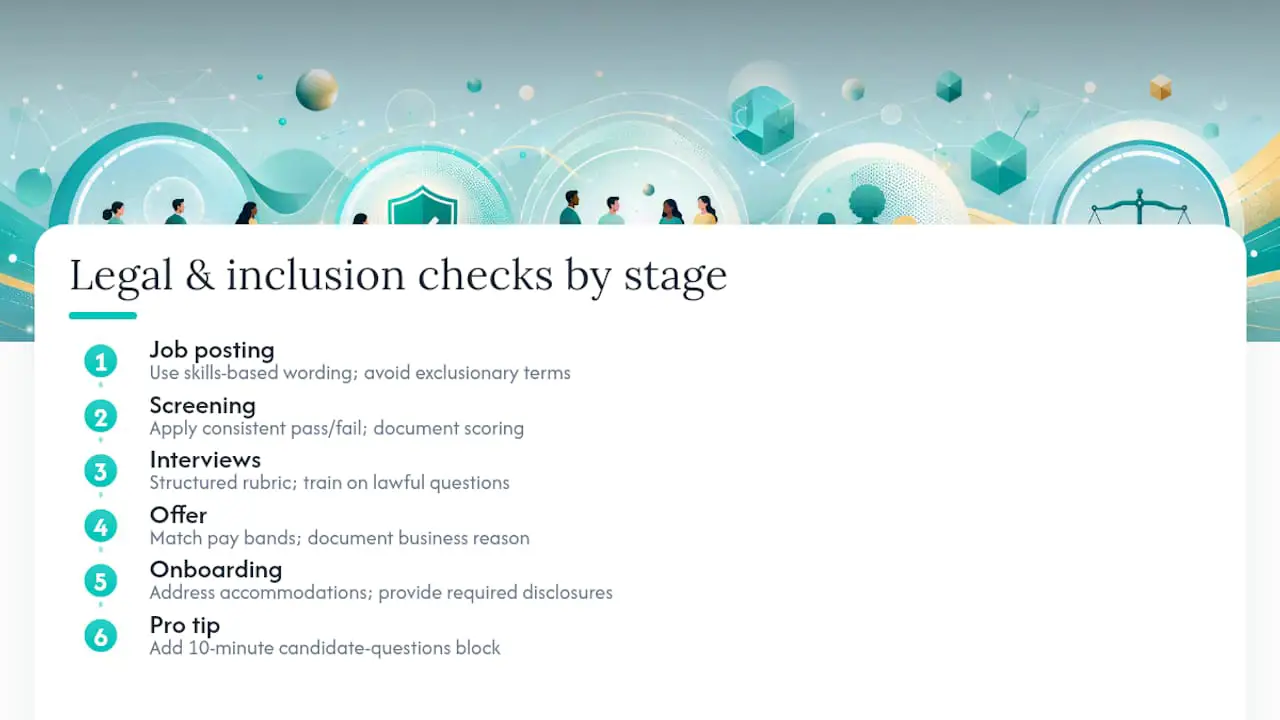
Speed is not a legal defense. SHRM’s BEAM framework recommends embedding legally compliant, merit-based inclusion checks at every stage of the hiring lifecycle, from job posting through onboarding. For startups, this means building the checklist into the sprint template itself, not treating it as a post-process audit.
At job posting: Use skills-based language. Avoid degree requirements unless the role legally mandates them. Review wording for gendered or exclusionary phrasing.
At screening: Apply consistent pass/fail criteria to every candidate. Document your scoring rationale. Use blind resume review or skills-first filters in your ATS where possible.
At interviews: Use the same structured rubric for every candidate in the same role. Train interviewers on what constitutes a legally permissible question. Avoid questions about family status, national origin, or age.
At offer: Verify that compensation is consistent with your internal pay bands. Document the business reason for the offer amount.
At onboarding: Confirm accommodation requests are addressed before day one. Provide required disclosures under applicable state law.
State-specific rules on background checks, salary history bans, and pay transparency vary significantly across the US. Consult employment counsel before your first sprint if you are hiring in California, New York, or Colorado, where requirements differ materially from federal baselines.
Pro Tip: When compressing interview windows, schedule a brief 10-minute “candidate questions” block at the end of every interview. It signals respect, surfaces accommodation needs early, and keeps your process defensible under equal-opportunity standards.
Key metrics and a sample sprint timeline
Tracking the right numbers tells you whether to accelerate, pause, or redesign the sprint mid-cycle. Fast candidate evaluation workflows depend on live metric visibility, not post-sprint retrospectives.
Core metrics to track:
- Time-to-offer: Days from job posting to signed offer letter. Target for a rapid sprint: a time period generally shorter than typical hiring processes.
- Time-to-fill: Days from posting to candidate’s first day. Target time-to-fill varies depending on role seniority and organizational context.
- Offer-acceptance rate: Accepted offers divided by total offers extended. A notably low offer-acceptance rate signals a compensation or candidate-experience problem.
- Short-term quality-of-hire: Hiring manager rating of the new hire at 30 and 90 days on a defined scale.
- 90-day retention: Percentage of sprint hires still employed at 90 days. Use this to improve quality-of-hire metrics sprint over sprint.
Sample 4-week sprint timeline:
- Week 1: Finalize role criteria, publish JD, activate sourcing channels, configure assessments.
- Week 2: Screen applicants, send async skill assessments, review results, advance top candidates.
- Week 3: Structured interviews, panel debrief, reference checks.
- Week 4: Extend offer, negotiate, countersign, trigger onboarding pipeline.
Tools and templates to run a hiring sprint
A minimal, effective sprint toolset covers four categories: pipeline management, skills assessment, scheduling, and offer execution.
Your ATS handles pipeline visibility and candidate communication. Greenhouse, Lever, and Workable all support quick-stage pipelines suited to sprint timelines. For async skills assessments, Talent Approved’s AI test generator builds role-specific tests from a job description in minutes, with anti-cheat screen recording and webcam monitoring built in. AI-generated candidate summaries cut reviewer time significantly by surfacing the highest-scoring candidates first. Calendar automation tools like Calendly eliminate the back-and-forth that kills sprint momentum. DocuSign or a comparable e-signature tool closes the offer loop without printing a single page.
Templates you need before the sprint starts: a job-skill crosswalk (role tasks mapped to skills), a structured interview rubric (skill, question, evidence, score, red flags), and an offer checklist (compensation, start date, equipment, onboarding contact). Building these once and reusing them across sprints is what converts a reactive hiring scramble into a repeatable process. The skills-based hiring process guide walks through converting traditional job descriptions into skills-first templates.
Step-by-step checklist to launch your first sprint
Use this sequence to prepare a sprint in one to four weeks before you need the hire in place.
- Define the role: write the skills crosswalk and 30/60/90 success benchmarks. Owner: Founder or CTO.
- Write the skills-based job description. Owner: HR or hiring manager.
- Train every interviewer on the structured rubric and legally permissible questions. Owner: HR.
- Configure your ATS pipeline stages to match the sprint phases. Owner: HR or recruiter.
- Build or generate the async skill assessment. Owner: HR using Talent Approved or equivalent.
- Activate sourcing: post the JD, notify your network, brief any external recruiters. Owner: Recruiter.
- Set up calendar automation for interview scheduling. Owner: Recruiter.
- Prepare the offer template and confirm compensation bands. Owner: Founder or HR.
- Build the onboarding pipeline (equipment, access, buddy, ramp plan) before the offer goes out. Owner: HR or ops.
- Schedule the sprint retrospective for the week after the hire’s start date. Owner: HR.
Sprint retrospective questions: What did we keep from the scorecard? Where did candidates drop off and why? Did the 30-day benchmark hold? What would we change in the next sprint?
For small teams where one person covers multiple roles, the founder typically owns steps 1, 2, and 8; a part-time recruiter or HR generalist covers 3–7 and 9–10.
What actually breaks in speed hiring
Speed hiring fails in predictable ways, and most of them trace back to the same root cause: teams compress the calendar without first compressing the ambiguity.
The most common failure mode is interviewer burnout. When a startup runs three roles simultaneously with the same two interviewers, panel fatigue sets in by Week 2. Scores drift, debrief conversations get shorter, and the last candidate in the queue gets a less rigorous review than the first. The fix is rotation: assign no interviewer to more than two active sprints at once, and cap individual interview loads at four per week.
Candidate experience is the second failure point. A compressed timeline that feels chaotic to the candidate signals organizational dysfunction. Clear communication at every stage, a named point of contact, and a realistic timeline shared upfront protect your employer brand even when the process is fast. Candidate experience best practices during rapid hiring cycles show that responsiveness matters more than speed: candidates tolerate a 3-week process if they hear from you every 48 hours.
The payoff of getting clarity and distributed authority right before the sprint is measurable. Teams that define performance criteria upfront and train interviewers before sourcing begins consistently report higher 90-day retention and fewer re-hires within the first year.
Talent Approved makes skills-first sprints faster to run
Running a hiring sprint without a dedicated assessment tool means building tests from scratch, chasing candidates for submissions, and reading unstructured responses under time pressure. Talent Approved removes that friction directly.
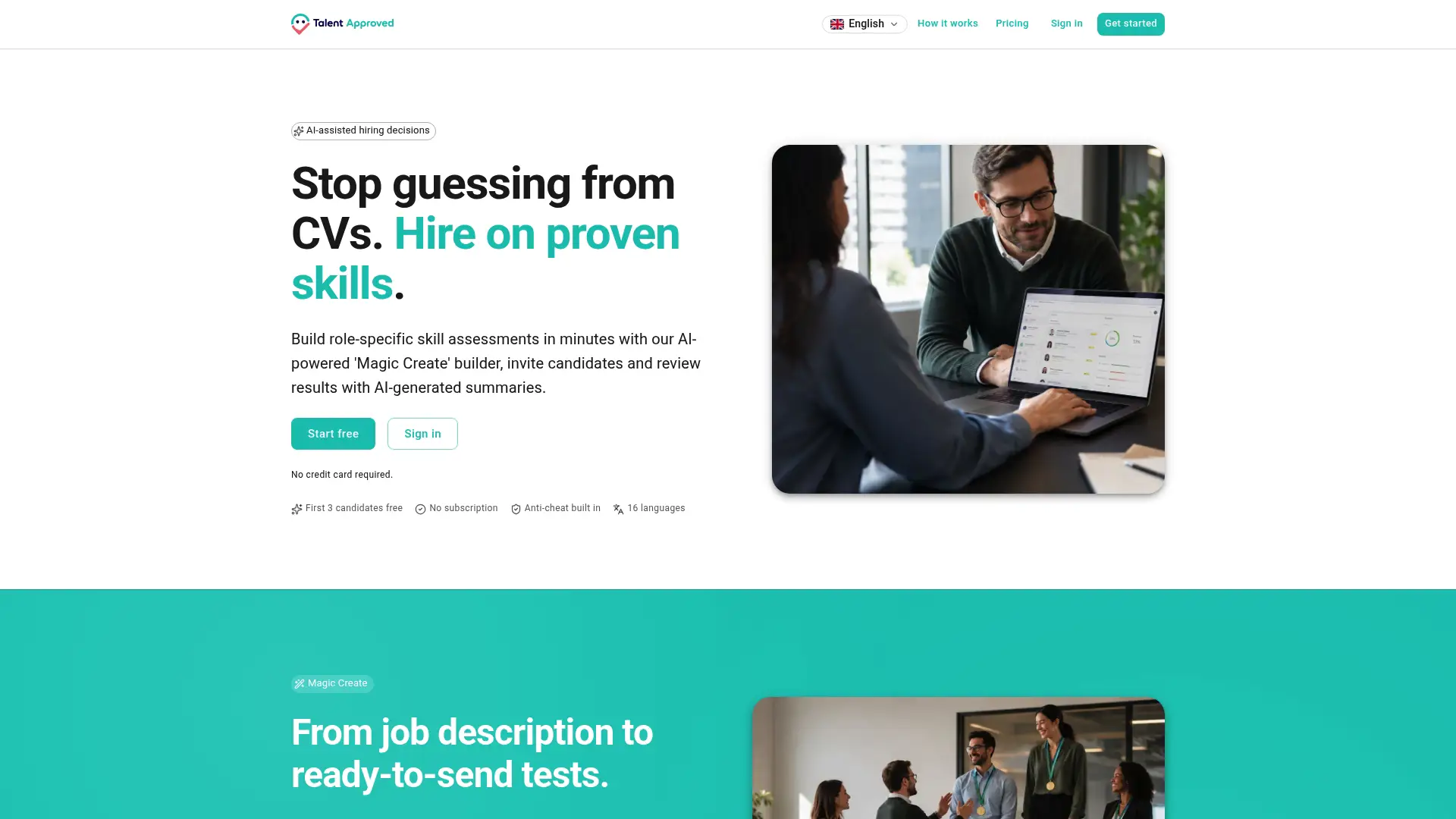
The platform’s Magic Create feature generates a role-specific skill assessment from your job description in minutes. Anti-cheat screen and webcam recording keeps async tests credible at scale, so you can send assessments to 30 candidates without worrying about result integrity. Candidate ranking and AI scoring surfaces your top performers automatically, cutting the time your team spends on manual review. There is no subscription required: you pay $5 per completed candidate assessment, which means a 20-candidate sprint costs $100 in assessment fees. Start your first sprint by creating a skill test from your job description today.
Sources
- Toolkit: Skills-First Hiring To Transform Talent Acquisition
- Rapid Growth Hiring Strategy: Scale Teams Fast & Smart
- Wild
- The startup hiring guide: your playbook for rapid growth (Workable)
This article is general information, not a substitute for advice from a qualified lawyer. Consult a qualified legal professional about your own circumstances before acting on anything here.
FAQ
What is a rapid hiring framework for startups?
A rapid hiring framework is a timeboxed hiring sprint that combines parallelized pipeline stages, distributed decision authority, and skills-first assessments to fill roles in 2–6 weeks. It balances speed with quality controls rather than simply shortening the number of interview rounds.
How does skills-first hiring fit into a rapid sprint?
Skills-first hiring replaces credential-based screening with structured assessments and rubric-scored interviews tied to specific job tasks, as recommended by SHRM’s skills-first toolkit. This keeps fast hiring merit-based and legally defensible.
What metrics should you track during a hiring sprint?
Track time-to-offer, time-to-fill, offer-acceptance rate, short-term quality-of-hire at 30 and 90 days, and 90-day retention.
How does Talent Approved support a rapid hiring sprint?
Talent Approved generates role-specific skill assessments from a job description in minutes, applies anti-cheat recording to async tests, and ranks candidates automatically so reviewers spend less time on manual scoring.
When should a startup pause a hiring sprint?
Diagnose the root cause before restarting.