
Job Benchmarks for Early-Stage Startups: HR Guide

Job benchmarks give early-stage teams a data-driven, role-specific target profile that sharpens hiring accuracy, speeds decisions, and produces defensible pay bands from day one. A complete benchmark covers five core fields: critical skills, key responsibilities, success indicators (KPIs), leveling criteria, and a compensation band. Tools like Talent Approved convert those fields into AI-driven assessments in minutes; methodology frameworks from TTI Success Insights and standards from SHRM give the process its credibility.
TL;DR
- What a benchmark contains: role mission, critical skills (technical + behavioral), % time allocation, decision authority, KPIs, leveling criteria, reference market/percentile, comp band (min/mid/max), and equity ownership range.
- Immediate next step: run a 2-hour SME workshop, finalize the benchmark fields, then export a job description into Talent Approved’s Magic Create to generate a live AI assessment the same day.
- Why now: job benchmarking is a strategic HR practice that compares roles to industry reference points to define skills, responsibilities, and market-competitive pay — and early-stage teams that skip it routinely overpay, underhire, or both.
Table of Contents
- Why does job benchmarking matter at the early stage?
- What core components does every job benchmark need?
- How do you build a benchmark in days, not weeks?
- How do you turn a benchmark into an AI-driven skill assessment?
- How should you set compensation and equity for early-stage hires?
- How do benchmarks support pay equity and compliance audits?
- What pitfalls should you watch for when benchmarking early-stage roles?
- Copyable job benchmark template and checklist
- Key Takeaways
- The part most early-stage teams skip
- Talent Approved turns your benchmark into a live assessment fast
- Useful sources and further reading
- FAQ
Why does job benchmarking matter at the early stage?
Three outcomes justify the investment immediately: faster hiring, stronger retention, and defensible pay decisions. Each is amplified in small startups where a single mis-hire can consume a significant portion of a team’s productive capacity for months.
Hiring speed. Without a benchmark, every new role restarts the debate about what “good” looks like. A documented benchmark aligns founders and hiring managers before the first resume arrives, cutting the back-and-forth that delays offers.
Retention. SME panels that collectively define the ideal candidate reduce early-tenure turnover by clarifying purpose, skills, and success indicators before the hire is made. When a new employee’s day-one reality matches what the benchmark described, they stay longer.
Defensible pay. Formal benchmarks provide the documented evidence needed for pay-equity analysis, compliance reviews, and audits. Without that paper trail, even well-intentioned offers are hard to defend.
What core components does every job benchmark need?
A benchmark is only as useful as the fields it contains. For AI-driven assessments, each field must map directly to a test item, scoring rule, or ranking criterion.

| Field | Example Entry | Maps To |
|---|---|---|
| Role mission/outcomes | “Own pipeline from 0 to $1M ARR in 12 months” | Scenario task in assessment |
| Critical technical skills | SQL, CRM management, outbound sequencing | Item bank selection |
| Critical behavioral skills | Adaptability, ownership mentality, cross-functional communication | Behavioral question set |
| % time allocation | 60% outbound, 25% reporting, 15% strategy | Weighting in scoring rubric |
| Decision authority | Can approve discounts up to 10% without sign-off | Situational judgment items |
| KPIs / success indicators | 20 qualified meetings/month by day 90 | Pass threshold configuration |
| Leveling criteria | Mid-level (L3): 3–5 years, no direct reports | Level filter in ranking |
| Comp band | Min $95K / Mid $110K / Max $125K | Offer rubric |
| Equity ownership range | 0.10–0.25% (seed stage) | Negotiation guardrail |
Behavioral and competency requirements — adaptability, ownership mentality, cross-functional versatility — are often more predictive of success in early-stage roles than CV signals alone. Build them into the benchmark explicitly, not as an afterthought.
How do you build a benchmark in days, not weeks?
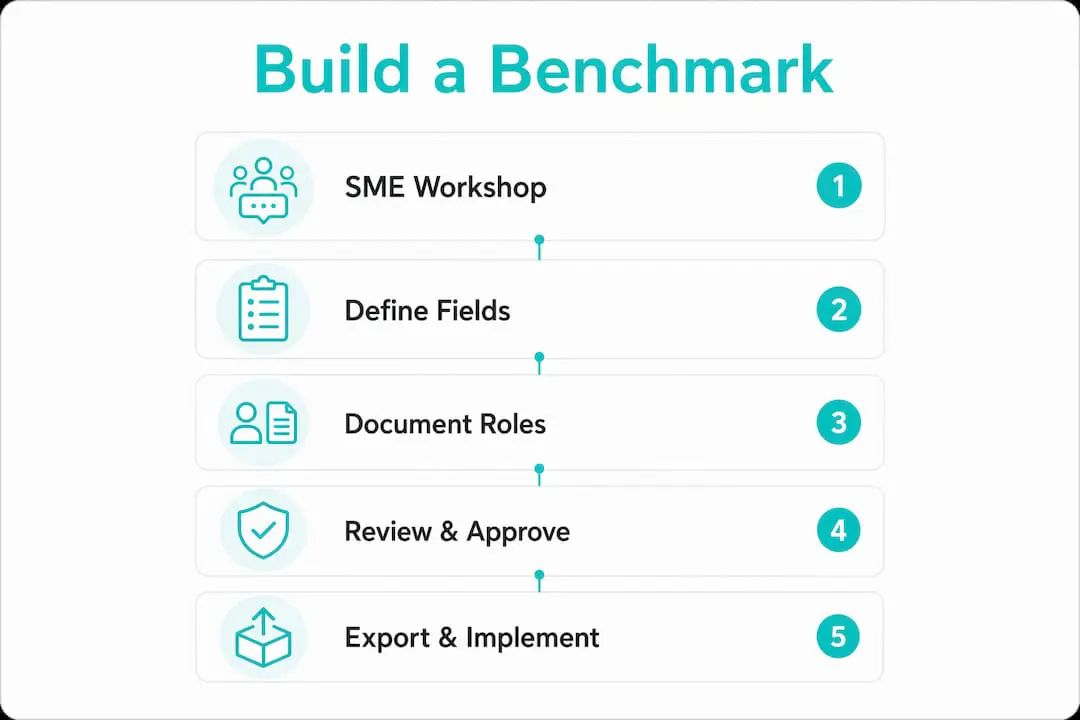
The recommended process runs in four steps: SME workshop → market triangulation → assessment mapping → validation. The whole cycle takes roughly three to four working days for a single role.
- SME workshop (2 hours) — Owner: founder + hiring manager. Gather two to four subject matter experts who know the role. Align on role mission, critical skills, KPIs, and leveling criteria. Document decisions in real time. Deliverable: draft benchmark fields.
- Market data triage (1 day) — Owner: HR. Pull comp data from at least two sources (see the Useful Sources section). Map the internal title to a survey job code — not just a title — before anchoring to a percentile. Deliverable: min/mid/max band and equity range.
- Assessment mapping (1 day) — Owner: HR + Talent Approved. Export the benchmark into an assessment builder. Map skills to item bank, KPIs to pass thresholds, and behavioral criteria to scenario tasks. Deliverable: live AI assessment ready for candidates.
- Validation (1–2 weeks) — Owner: hiring manager. Run the first hire through the assessment and a short trial project. Review scores against ramp performance at 30 days. Trim or adjust items that show low signal. Deliverable: validated benchmark version 1.0.
| Step | Owner | Deliverable | Acceptance Criteria |
|---|---|---|---|
| SME workshop | Founder / hiring manager | Draft benchmark fields | All 9 fields completed, SME sign-off |
| Market data triage | HR | Comp band + equity range | Two sources triangulated, percentile documented |
| Assessment mapping | HR + assessment platform | Live AI assessment | Items cover all critical skills; anti-cheat enabled |
| Validation | Hiring manager | Benchmark v1.0 | Score threshold correlates with 30-day ramp review |
How do you turn a benchmark into an AI-driven skill assessment?
Map each benchmark element to an assessment artifact, then configure scoring and controls before the first candidate sits the test.
The workflow runs like this: export your benchmark fields → select or seed a question library from your item bank → configure AI scoring rules and pass thresholds tied to your KPIs → enable anti-cheat and proctoring controls → pilot with one internal user → iterate on low-signal items.
A sample three-item assessment for a mid-level sales role might include: (1) a SQL data-pull scenario testing technical skill, (2) a written outbound sequence task testing communication, and (3) a situational judgment item testing decision authority under a discount scenario. Each item maps directly to a benchmark field, so the AI scoring engine has a clear rubric.
Pro Tip: Balance behavioral and technical items at roughly 40/60 for most early-stage roles. Pure technical tests miss the adaptability and ownership traits that predict success in fast-moving environments — and those traits are exactly what your benchmark’s behavioral fields should be capturing.
Controls matter for validity and auditability. Anti-cheat screen and webcam monitoring, session replays, and transparent AI-generated summaries give hiring managers confidence in the results and give auditors a documented record. Talent Approved’s platform includes all three natively, so you configure them once per benchmark and they apply to every candidate automatically.
For guidance on choosing the right skills to test, the mapping from benchmark field to test item is the critical decision point.
How should you set compensation and equity for early-stage hires?
Anchor to a reference market and percentile first, then translate that anchor into a min/mid/max band and an ownership range for equity.
- Choose a percentile. Targeting the P50 (market median) is the floor for retention; P75 is appropriate for critical or scarce roles. Salary benchmarking uses a chosen reference market and percentile with min/mid/max around a midpoint and an agreed review cadence.
- Account for stage. At seed, a mid-level engineer typically earns around $140K base; at Series A, that rises to roughly $155K, per startup salary benchmarks. Senior roles show a 30–40% spread across stages, so always specify funding stage when pulling market data.
- Adjust for geography. Remote companies using geographic tiers should note that San Francisco and New York City rates are significantly higher than the national average, meaning offers in such locations have higher purchasing power compared to many other regions.
- Set equity by ownership range, not dollar value. For early-stage hires, tie equity to ownership percentage ranges by role and stage rather than fixed dollar equivalents. Typical equity ranges vary by role and company stage, with higher-level roles receiving larger ownership percentages.
- Risk-adjust before combining. Early-stage equity often carries a high probability of being worth little or nothing. Never present equity face value as equivalent to cash compensation without stating that risk explicitly.
- Triangulate sources. Use at least two datasets. A compensation analysis guide can help you structure the triangulation process so your bands hold up under scrutiny.
How do benchmarks support pay equity and compliance audits?
Recorded benchmarks plus documented approval equal a defensible audit trail for every pay decision. An auditor reviewing your offer history will expect to see the benchmark itself, the market sources used, the SME sign-off, the offer rubric, and an exceptions log.
Minimal documentation to keep for each benchmark:
- The completed benchmark fields (all 9) with version date
- SME workshop notes and attendee sign-off
- Market data sources and the percentile chosen
- The offer rubric showing how the band was applied
- An exceptions log for any offer outside the band, with written approval
Export these as a package when an audit request arrives. The SME workshop notes and market-data citations are the two documents auditors most frequently ask for and most companies cannot produce quickly.
What pitfalls should you watch for when benchmarking early-stage roles?
The six most common mistakes are title inflation, stale benchmarks, overfitting to one hire, ignoring geography, conflating equity with cash, and skipping behavioral criteria. Each has a practical fix.
- Title inflation. Giving a role a senior title to attract candidates while paying mid-level rates creates retention risk the moment the hire realizes the mismatch. Fix: map every role to a survey job code and level (L3, L5), not a title.
- Stale benchmarks. A benchmark written at seed becomes misleading by Series A. Treat benchmarking as a living process with a semi-quarterly review or a review triggered by major business events.
- Overfitting to one hire. Writing a benchmark around the personality of the last person in the role narrows the candidate pool unnecessarily. Use role-level success criteria, not individual traits.
- Ignoring geography. Applying a national average to a San Francisco hire, or vice versa, produces bands that are either uncompetitive or unsustainable.
- Conflating equity with cash. Presenting a 0.20% grant as “worth $200K” at a $100M valuation ignores dilution and the 80–90% failure rate. State ownership percentage and risk separately.
- Skipping behavioral criteria. A benchmark with only technical skills misses the adaptability and ownership traits that predict early-stage success. Red flag: if your benchmark has no behavioral fields, revise it before the next hire.
Red-flag signals that a benchmark needs immediate revision: offer acceptance rate below 50%, first-90-day attrition above 20%, or more than two exceptions to the comp band in a single quarter.
Copyable job benchmark template and checklist
Fill every field, get SME sign-off, then export the completed template directly into your assessment builder to generate a live test.
| Field | Example Value | Owner | Validation Rule |
|---|---|---|---|
| Role mission | “Own pipeline from 0 to $1M ARR in 12 months” | Founder / hiring manager | Agreed by 2+ SMEs |
| Critical technical skills | SQL, CRM, outbound sequencing | Hiring manager | Maps to item bank |
| Critical behavioral skills | Adaptability, ownership, cross-functional comms | HR + SMEs | Behavioral items configured |
| % time allocation | 60% outbound / 25% reporting / 15% strategy | Hiring manager | Totals 100% |
| Decision authority | Approve discounts ≤10% independently | Founder | Documented in rubric |
| KPIs / success indicators | 20 qualified meetings/month by day 90 | Hiring manager | Pass threshold set |
| Leveling criteria | Mid (L3): 3–5 years, no direct reports | HR | Matches survey job code |
| Comp band | Min $95K / Mid $110K / Max $125K | HR | Two market sources cited |
| Equity ownership range | 0.10–0.25% (seed) | Founder | Stage-appropriate range |
Workshop checklist:
- [ ] Schedule 2-hour SME session with founder, hiring manager, and one domain expert
- [ ] Complete all 9 benchmark fields during the session
- [ ] Collect SME sign-off before leaving the room
- [ ] Pull comp data from two sources and document the percentile chosen
- [ ] Map the title to a survey job code
- [ ] Export benchmark to assessment builder and configure pass thresholds
- [ ] Enable anti-cheat and proctoring controls
- [ ] Set a review date (no more than 6 months out)
Key Takeaways
Job benchmarks for early-stage startups work because they convert role clarity into a documented, AI-ready target profile that speeds hiring, anchors pay bands, and creates an audit trail from day one.
| Point | Details |
|---|---|
| Run the SME workshop first | A 2-hour session with 2–4 subject matter experts produces all 9 benchmark fields and the sign-off needed to start hiring. |
| Map benchmark to assessment | Each benchmark field maps to a test artifact: skills to item bank, KPIs to pass thresholds, behavioral criteria to scenario tasks. |
| Anchor comp to a percentile | Use P50 as the retention floor; document the market sources and percentile so every offer is defensible in an audit. |
| Set equity by ownership range | Tie equity to ownership percentage by role and stage, never to a dollar-equivalent valuation. |
| Talent Approved | Converts a completed benchmark into a live AI assessment via Magic Create, with anti-cheat controls and AI-generated candidate summaries built in. |
The part most early-stage teams skip
Most early-stage HR guides treat job benchmarking as a compensation exercise. That framing undersells it. The real value at the early stage is alignment: when founders, hiring managers, and HR agree on what success looks like before a single resume arrives, the entire hiring process runs faster and produces better outcomes.
The behavioral fields are where this alignment pays off most. Adaptability and ownership mentality are harder to screen for than SQL proficiency, but they predict early-stage success more reliably. A benchmark that captures those traits gives an AI assessment engine something concrete to score against, rather than leaving evaluators to rely on gut feel during interviews.
The other underappreciated benefit is internal mobility. A benchmark written for a seed-stage mid-level role becomes the foundation for a career path when the company reaches Series A. Teams that document benchmarks from the start build that infrastructure without extra effort.
Talent Approved turns your benchmark into a live assessment fast
Once your benchmark fields are documented, Talent Approved converts them into a live AI-driven skill assessment in minutes using Magic Create. Paste in your job description or skill list, and the platform generates a role-specific test with no manual item writing required.
Key capabilities that map directly to your benchmark workflow:
- AI test generation from your job description via the AI test generator, so your assessment reflects the exact skills and KPIs your SME workshop defined.
- Anti-cheat screen and webcam monitoring plus session replay via built-in proctoring controls, giving you a documented record for every candidate session.
- AI-generated performance summaries and candidate ranking, so hiring managers review ranked results with clear scoring rationale rather than raw test data.
Talent Approved runs on a pay-as-you-go model at $5 per completed candidate, with no subscription required. Visit how Talent Approved works to build your first benchmark-driven assessment today.
Useful sources and further reading
Use these sources to triangulate compensation data and validate your benchmarking methodology:
- Bureau of Labor Statistics Occupational Employment and Wage Statistics (OEWS): Free, nationally representative wage data by occupation and geography. Use it as your baseline before layering startup-specific panels.
- Carta and Pave panels: Private startup equity and compensation databases with stage and role breakdowns. Useful for seed-to-Series B equity benchmarking.
- Salary Atlas compensation analysis guide: A curated list of salary research tools to help you triangulate market data and build defensible pay bands.
- SHRM compensation resources: Industry-standard guidance on job evaluation, pay equity, and documentation practices for U.S. employers.
- Talent Approved articles: Practical HR guides covering skills-based hiring, candidate evaluation, and assessment design for early-stage teams.
FAQ
What is the role of job benchmarks at the early stage?
Job benchmarks create a documented, role-specific target profile that aligns hiring decisions, anchors pay bands, and maps directly to AI-driven skill assessments. Early-stage teams benefit most because benchmarks replace ad hoc judgment with a repeatable, defensible process.
How often should early-stage startups update their benchmarks?
Benchmarking should be treated as a living process with a semi-quarterly review or a review triggered by major business events such as a new funding round or a significant change in role scope.
How do you convert a job benchmark into a skill assessment?
Map each benchmark field to an assessment artifact: critical skills to an item bank, KPIs to pass thresholds, and behavioral criteria to scenario tasks. Talent Approved’s Magic Create feature automates this mapping from a job description in minutes.
What comp data sources should early-stage startups use?
Triangulate at least two sources: a public dataset such as the BLS OEWS and a startup-specific panel such as Carta or Pave. Startup salary benchmarking benefits from combining public datasets, private surveys, and startup panels rather than relying on a single source.
Do job benchmarks help with pay equity compliance?
Yes. Documented benchmarks with SME sign-off, market sources, and an offer rubric create the audit trail that pay-equity reviews require. Keep an exceptions log for any offer outside the band, with written approval, to complete the record.