
3 Reliability Checks for Weighted Scoring Assessments in Hiring

A weighted scoring assessment ranks options by multiplying each score by a criterion weight, then summing the results: Total Score = Σ (Weight × Score). It gives you a transparent, defensible way to compare candidates or projects across multiple factors instead of guessing. Use it when the decision has real trade-offs and stakeholders need to see the reasoning, not just the outcome. Skip it for obvious calls where one option clearly wins.
TL;DR:
- Weights must be finalized and documented before scoring begins to prevent bias and manipulation during the evaluation process.
- Conduct sensitivity and closeness tests to verify that the ranking remains stable when adjusting weights or scores within reasonable ranges.
- Weighted scoring is most valuable when decisions involve significant trade-offs and require a transparent, justified rationale for the final choice.
- Avoid using weighted scoring for pass/fail criteria or situations with critical non-negotiable requirements that should be filtered out beforehand.
- Automated platforms can streamline building and applying weighted scores across multiple candidates, especially at scale or in high-volume hiring.
Table of Contents
- How Do You Build a Weighted Scoring Assessment?
- What Does a Weighted Scoring Matrix Look Like in Practice?
- What Are the Pros, Cons, and Traps of Weighted Scoring?
- How Do You Know If a Weighted Score Result Is Reliable?
- How Does Weighted Scoring Apply to Hiring Assessments?
- When Is Weighted Scoring Worth the Effort?
- Run Weighted Scoring Assessments Without the Spreadsheet Grind
- Where to Learn More About Weighted Scoring Methodology
- Sources
- FAQ
How Do You Build a Weighted Scoring Assessment?
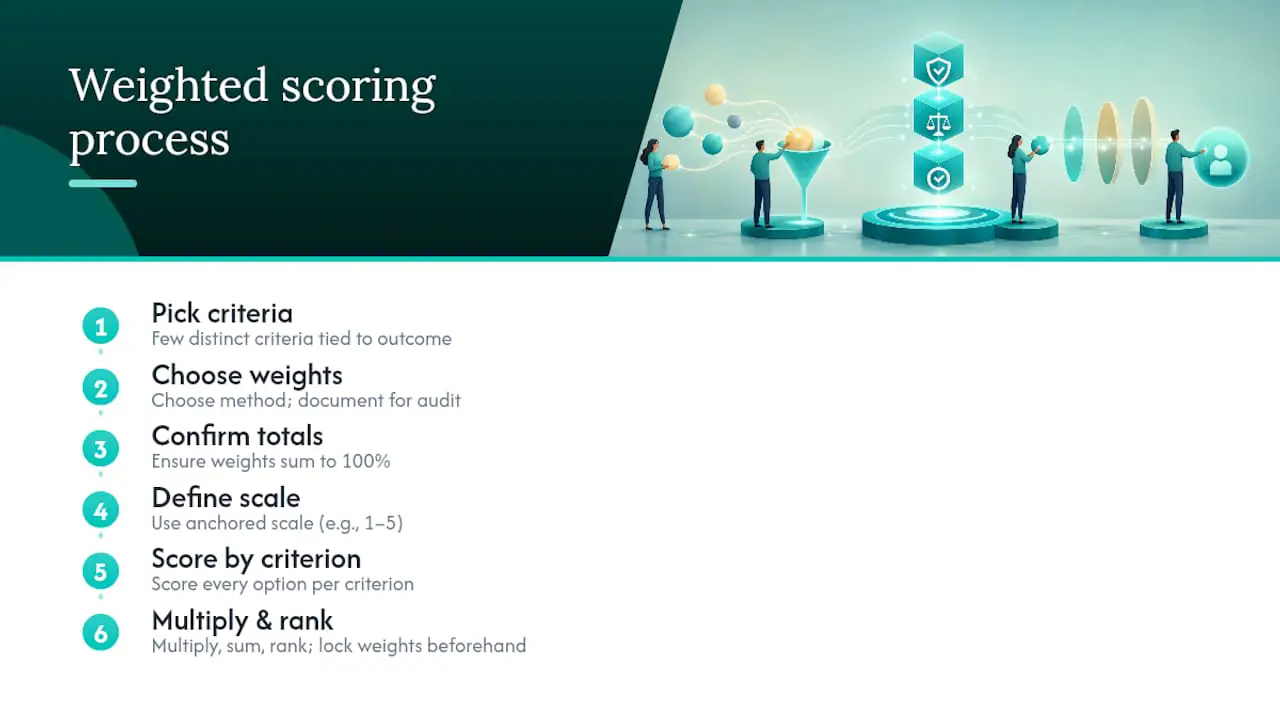
Building a working model comes down to five decisions made in a fixed order. Skip the order and the math falls apart, because scores drift once people know which criteria carry the most weight.
1. Pick a small number of criteria tied directly to the outcome. Too many criteria can cause overlap and double counting, while too few may resemble a gut check. Each criterion should measure something distinct: “communication skill” and “team fit” often overlap enough to double weight the same trait without anyone noticing.
2. Choose a method to determine weights and document the process. Common methods include distributing points across criteria, pairwise ranking, or swing weighting—which asks which criterion would most affect the outcome if it changed from worst to best case. Documenting the chosen method ensures an auditable record. That record is what makes the model auditable later.
3. Ensure weights sum correctly to the full total (e.g., 100%). Incorrect summations can distort scores quietly, invalidating comparisons.
4. Define a consistent scoring scale with clear descriptions. Using a scale (such as 1 to 5) with anchored meanings helps ensure different raters apply scores similarly.
5. Score all options on one criterion before moving to the next. This approach maintains calibration and reduces score drift during evaluation.
6. Multiply, sum, and rank. Multiply each raw score by its weight, add the weighted values across all criteria for each option, and rank by total. This is also the point where practitioners quietly nudge a weight to fix an outcome they don’t like. Lock weights before scoring starts, and the temptation mostly disappears because changing them after the fact is visibly obvious to anyone reviewing the step-by-step implementation process.
What Does a Weighted Scoring Matrix Look Like in Practice?
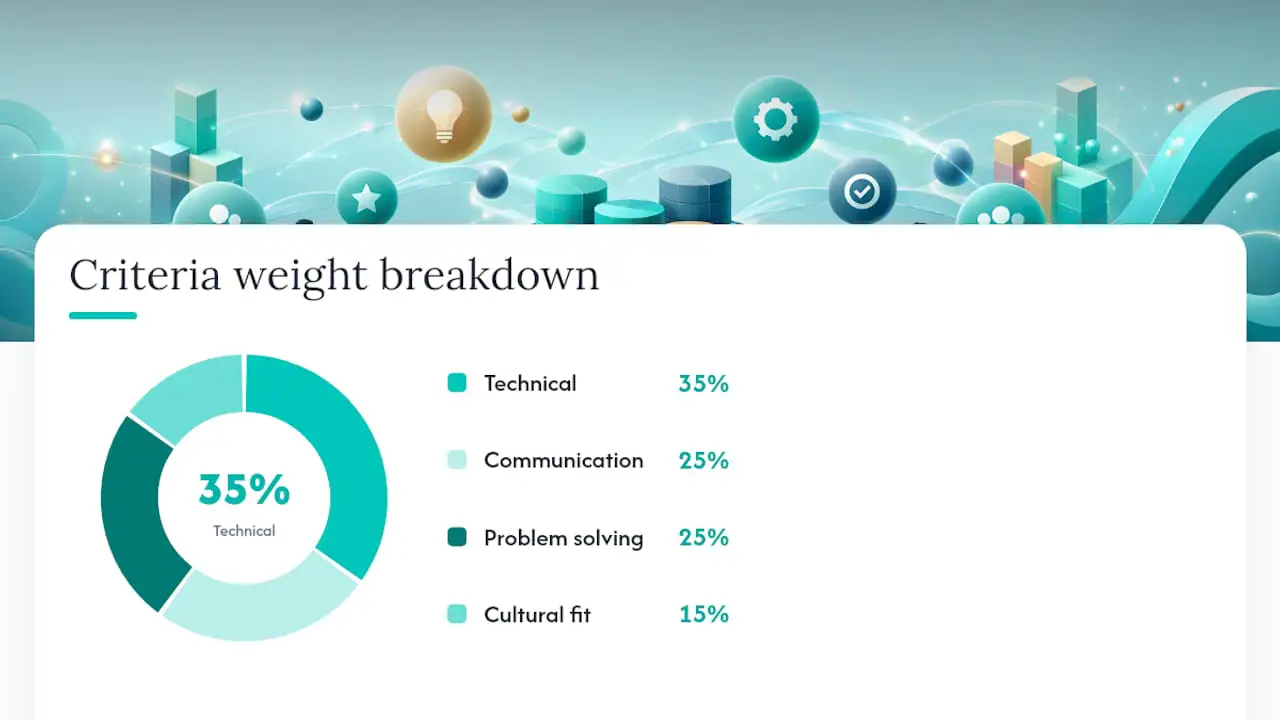
Numbers make this concrete faster than any explanation. Say a hiring team is choosing between four finalists for a senior support role, scored against four criteria: technical accuracy (35%), communication clarity (25%), problem-solving speed (25%), and cultural fit (15%). Weights sum to 100%, scores use a 1 to 5 scale.
Building this in a spreadsheet only takes three column groups:
- Raw scores per criterion (the 1 to 5 or 1 to 10 ratings before any math).
- Weighted values (raw score multiplied by that criterion’s decimal weight).
- Running totals and final rank (sum of weighted values per row, sorted descending).
Candidate A and Candidate B tie at 4.10, which is the case that matters most. When two totals land within a few percentage points of each other, treat the tie as a signal, not as noise. That’s a “closeness” result, and it means the ranking is not definitive on the numbers alone. The ASQ decision matrix guidance recommends resolving ties like this with a tiebreaker conversation focused on the specific criterion where the two options diverge most, in this case communication versus technical accuracy, rather than adjusting weights to force a winner.
What Are the Pros, Cons, and Traps of Weighted Scoring?
Weighted scoring earns its popularity because it makes reasoning visible. Every stakeholder can see exactly why Candidate A beat Candidate C, and that transparency holds up when someone challenges the decision later. It also forces alignment before the scoring even starts. Debating what the weights should be usually surfaces disagreements about priorities that would otherwise stay hidden until after a bad hire or a stalled project.
The same math that creates transparency also creates blind spots.
- Compensation effect: a candidate can bomb one critical criterion and still win on volume elsewhere, which is dangerous if that criterion should have been a hard requirement instead of a weighted one.
- False precision: multiplying a guess by a percentage still produces a guess, just with more decimal places.
- Weight manipulation: it’s tempting to tweak a weight after seeing scores to engineer a preferred winner.
- Anchoring bias: the first score entered on a panel often pulls every subsequent rater’s number toward it.
The compensation effect specifically means weighted scoring is the wrong tool for pass/fail requirements. If a criterion is a genuine dealbreaker, like a required certification or a security clearance, handle it as a knockout filter before scoring, not as one line in the weighted matrix.
Pro Tip: Finalize and record your weights in writing before anyone sees a single score. If you can’t explain why weights changed mid-process, don’t change them.
How Do You Know If a Weighted Score Result Is Reliable?
A ranking is only as trustworthy as it is stable. Run these three checks before you present results as final.
- Weight sensitivity test. Move your dominant weight up and down by 10 percentage points and redistribute the difference proportionally across the others. If the top-ranked option changes, the result depends more on your weighting opinion than on actual performance differences.
- Rating sensitivity test. Adjust any score you weren’t fully confident in by plus or minus one point. If that single-point shift flips the ranking, you’re looking at a fragile result built on a soft input.
- Closeness test. Check the percentage gap between your top two totals. A gap under 5% signals a non-definitive result that shouldn’t be treated as a clean win.
In the candidate matrix above, Candidate A and Candidate B tied exactly, which fails the closeness test outright. The recommended response isn’t to fiddle with weights until someone wins. It’s to gather more evidence on whichever criterion separates the two most, in this case communication, through a follow-up interview or a work sample, rather than trusting a coin-flip margin dressed up as math.
How Does Weighted Scoring Apply to Hiring Assessments?
Hiring teams face a specific version of this problem: do you weight entire competencies, or weight individual test items inside a competency? Both work, but they answer different questions. Competency-level weighting says “technical skill matters more than culture fit for this role.” Item-level weighting says “this specific coding question matters more than that one within the technical section.” Systems like USA Staffing’s weight-based rating method handle both, automatically recalculating response option values whenever a weight changes so the math stays internally consistent instead of drifting after a manual edit.
A few practices keep hiring-specific weighted scoring honest:
- Map every test item to a named competency before scoring starts, so raters know exactly what a given question is meant to measure.
- Write scoring anchors in plain language (“a 3 means the candidate solved the problem but needed a hint”) so two different reviewers land on similar numbers for the same answer.
- Keep the weight-elicitation record, rubric text, and reviewer notes together in one auditable file. If a rejected candidate ever challenges the decision, that record is your evidence.
- Lean on anti-cheat and session-review tools so a strong weighted score actually reflects the candidate’s own work.
A solid candidate evaluation criteria checklist helps here too, since most weighting disputes start with vague or overlapping criteria rather than bad math.
When Is Weighted Scoring Worth the Effort?
Weighted scoring earns its place when a decision has real trade-offs and someone will eventually ask “why did we choose this one?” It’s overkill for a binary hire/no-hire call where one candidate is obviously ahead, or for early-stage triage where a lighter framework like RICE, ICE, or a simple knockout filter gets you to a decision faster with less setup. Save the full weighted model for cases where the ranking needs to survive scrutiny from a hiring manager, a board, or a rejected applicant asking for a reason.
— Jimmie
Run Weighted Scoring Assessments Without the Spreadsheet Grind
Building the matrix above by hand works for one hiring decision. It falls apart at 50 candidates across a dozen open roles. Talent Approved turns the process this guide describes into something you can run in minutes instead of an afternoon: Some platforms take a job description or a skill list and generate a role-specific rubric with weighted criteria already structured, so you’re not starting from a blank spreadsheet every time.

Some platforms run sessions through anti-cheat monitoring, including screen and webcam checks, to help ensure a high weighted score reflects the candidate’s own work. AI-generated summaries can translate raw weighted totals into a plain-language rationale to provide hiring managers with clear explanations or audit trails. That combination matters most for high-volume hiring, where consistent competency weighting across hundreds of candidates is impossible to maintain by hand, and for any team that needs a defensible record of how a ranking was reached. If your evaluation criteria still need work before scoring starts, designing job-specific screening tests first will make the weights you assign later far more meaningful. Try Talent Approved to build your first weighted rubric today.
Where to Learn More About Weighted Scoring Methodology
For deeper reading beyond this guide, Product School’s implementation walkthrough covers the core formula and normalization rules. ASQ’s decision matrix resource offers alternative weight-assignment techniques like the Pugh matrix. For a critical look at the method’s limitations, SI Labs’ scoring model critique is the sharpest source on sensitivity analysis and the compensation effect. If you’re mapping criteria to real candidate signals, SparkCV’s CV tailoring checklist is a useful companion reference.
Sources
- Weighted Scoring Model: Step-by-Step Implementation Guide
- Scoring model guide and critique (SI Labs)
- Decision matrix resource (ASQ)
- Weight-based Rating Method (USA Staffing support document)
FAQ
What Is a Weighted Scoring Method?
It’s a decision-making technique that ranks options by multiplying each option’s score on a criterion by that criterion’s assigned weight, then summing the results across all criteria to get a total score.
How Do I Calculate a Weighted Score?
Multiply each raw score by its criterion’s decimal weight, then add the weighted values together: Total Score = Σ (Weight × Score), with weights normalized to sum to 100%.
How Do I Build a Weighted Scoring Model From Scratch?
Pick 3 to 6 relevant criteria, assign and lock weights before scoring, choose a consistent scale like 1 to 5, score every option criterion by criterion, then multiply and sum for a final rank. Platforms like Talent Approved can generate the rubric structure automatically from a job description.
What Does It Mean if Grades Are Weighted?
In an academic or assessment context, weighted grades mean certain sections or competencies count for more of the final score than others, similar to how a technical-skills section might carry more weight than a culture-fit question in a hiring assessment.
When Should I Avoid Weighted Scoring?
Skip it for obvious decisions with one clear winner, for pass/fail requirements better handled as knockout criteria, or when your input data is too uncertain to justify the false precision the math implies.